
Christoper Lloyd and Michael J. Fox discuss what kind of Chinese food they want in 1955, 1985, and 2015
92YTribeca
200 Hudson St. at Canal St.
Tuesday, December 25, $25-$30, 12:30
212-415-5500
www.92y.org/tribeca
“Okay. Time circuit’s on. Flux capacitor, fluxing. Engine running. All right.” Everything is ready for Doc Brown (Christopher Lloyd) and Marty McFly (Michael J. Fox) to get in that DeLorean, hit eighty-eight miles per hour, and head into either 1955 or 2015 in the first two Back the Future movies, both directed by Robert Zemeckis, who has also given us such other popular films as Romancing the Stone, Forrest Gump, Cast Away, and now Flight. Both flicks, which at one point were going to star Eric Stoltz as Marty and John Lithgow as Doc Brown, are being shown at 92YTribeca’s annual “Chinese and a Movie” Christmas Day party, with the first film screening at 1:00 and the sequel at 3:15. They will be accompanied by a Chinese food buffet beginning at 12:30 and lasting until it is all gone. So come celebrate Christmas with Fox, Lloyd, Crispin Glover as hapless George McFly, Copernicus the dog, Thomas F. Wilson as tough local boy Biff, Lea Thompson as hot MILF Lorraine, and 1.21 gigawatts of electricity that combine with Plutonium to help the protagonists blast off into another time.

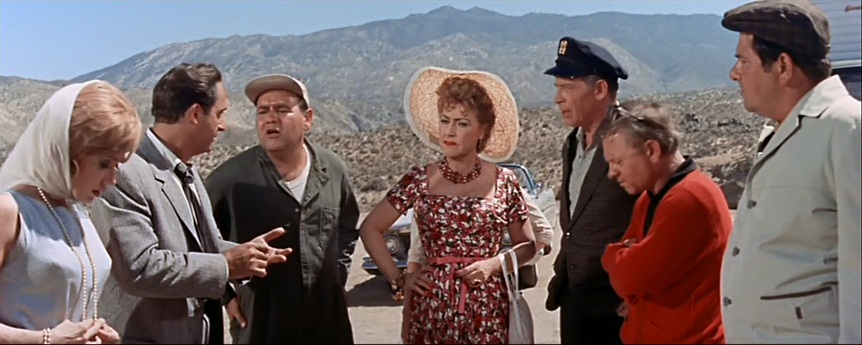
 They don’t come much crazier than the madcap 1963 comedy It’s a Mad Mad Mad Mad World. Producer-director Stanley Kramer takes a sharp turn with the wacky film, clearly needing a laugh following his rather serious string of issue pictures: The Defiant Ones, On the Beach, Inherit the Wind, and Judgment at Nuremberg. As he lays dying after a car crash, master thief Smiler Grogan (Jimmy Durante) tells a group of onlookers that there is $350,000 buried under a “big W” in Santa Rosita State Park. And off they go in search of the prize, willing to do just about anything and everything in order to get their greedy hands on the money. Hot on their trail is police captain T. G. Culpeper (Spencer Tracy), trying to solve one last case before he retires. It’s a Mad, Mad, Mad, Mad World lives up to its title, a mad, mad, mad, mad epic featuring the greatest all-star comedic cast ever assembled, including Sid Caesar, Edie Adams, Mickey Rooney, Buddy Hackett, an absolutely lunatic Jonathan Winters, Terry-Thomas, Phil Silvers, Dick Shawn, Peter Falk, Eddie “Rochester” Anderson, and Ethel Merman in addition to cameos by Jerry Lewis, Jack Benny, Joe E. Brown, Howard Da Silva, Andy Devine, Norman Fell, Selma Diamond, Leo Gorcey, Jim Backus, Marvin Kaplan, Stan Freberg, Arnold Stang, Jesse White, Carl Reiner, Don Knotts, Buster Keaton, and the Three Stooges. Basically, you can’t blink during the film’s 161 minutes or you’ll miss someone or some incredibly silly slapstick moment. And the ending is a laugh riot — literally. It’s a Mad, Mad, Mad, Mad World is screening December 22 and December 28 as part of the Film Society of Lincoln Center series “See It in 70MM!,” comprising fifteen films being shown in their original 70mm glory, beginning December 21 with Stanley Kubrick’s 2001: A Space Odyssey and continuing through January 1 with such other works as Ron Fricke’s Baraka, John Ford’s Cheyenne Autumn, Kenneth Branagh’s Hamlet, Basil Dearden’s Khartoum, Richard Brooks’s Lord Jim, and Jacques Tati’s Playtime.
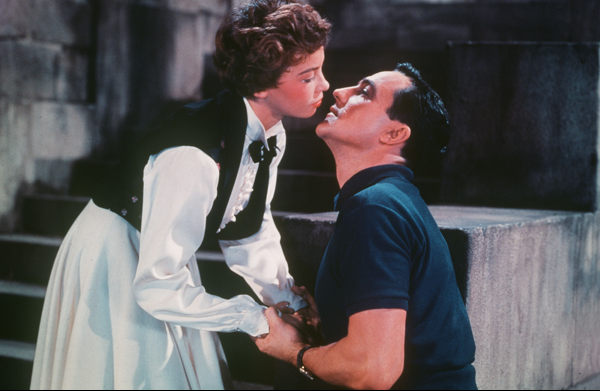
 To borrow a phrase from the Gershwins, Vincente Minnelli’s An American in Paris “’s wonderful, ’s marvelous.” In the 1951 MGM musical, which won six Academy Awards — including Best Picture, Best Color Cinematography, and Best Musical Score — it’s love at first sight for ex-pat artist Jerry Mulligan (a delightful Gene Kelly) upon seeing squirrely parfumerie girl Lise Bouvier (ballerina Leslie Caron, making her film debut after having been discovered by Kelly dancing with Les Ballets de Paris de Roland Petit). While Mulligan pursues Lise, he is pursued by wealthy socialite Milo Roberts (Nina Foch), who lures him in by buying one of his paintings and promising him a show. Complicating matters is French singer Henri Baurel (Georges Guétary), who has taken Lise under his wing. An American in Paris is a charmer from start to finish, with Kelly leading the way singing in the streets, tapping atop a piano, and romancing Caron on cheesy Hollywood sets doubling for the City of Lights.
 In such unique films as Rushmore, The Royal Tenenbaums, and The Darjeeling Limited, black-comedy master Wes Anderson has created a bizarre collection of characters who seem to live in their own alternate realities. In his latest, Moonrise Kingdom, Anderson has once again assembled an oddball assortment of men, women, and children in a terrifically clever and entertaining fairy tale all its own. Tired of being abused by his fellow Khaki Scouts and dismissed by his foster parents, twelve-year-old orphan Sam Shakusky (Jared Gilman) runs away from Camp Ivanhoe on the island of New Penzance, much to the chagrin of dedicated scout master Randy Ward (Edward Norton). Meanwhile, twelve-year-old loner Suzy Bishop (Kara Hayward) is fed up with her life as well, which she mostly spends listening to Benjamin Britten, reading fairy tales (fictitious stories made up by Anderson), watching the world through a pair of ever-present binoculars, and despising her parents (Bill Murray and Frances McDormand). Afraid of what might have happened to the children, the local police officer, Captain Sharp (Bruce Willis), gets involved, as does a stern woman from social services (Tilda Swinton) and, eventually, a very different kind of scout, Cousin Ben (Jason Schwartzman). The proceedings are overseen by a narrator (Bob Balaban) who ends up being more than just an omniscient presence. Moonrise Kingdom is an absolute gem of a film, an exciting, original tale about growing up told in a fabulously funny deadpan manner that combines slapstick humor with wildly ironic elements, filled with the endless wonders of childhood, although it is most definitely not for children. Newcomers Gilman and Hayward appear wise beyond their years in the lead roles, with outstanding support from an all-star cast, most prominently Norton as the by-the-book scout master on a mission. Written by Anderson with Roman Coppola and featuring a lovely score by Alexandre Desplat, Moonrise Kingdom is one of the best films of the year, by a director whose imagination never ceases to amaze. Moonrise Kingdom is screening December 22 at 8:00 as part of MoMA’s annual series “The Contenders,” consisting of exemplary films they believe will stand the test of time; upcoming entries include Tom Hooper’s Les Misérables, Sally Potter’s Ginger and Rosa, and Raoul Ruiz’s Night Across the Street.