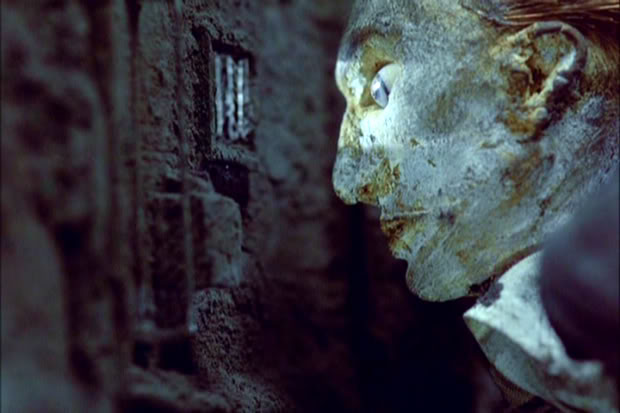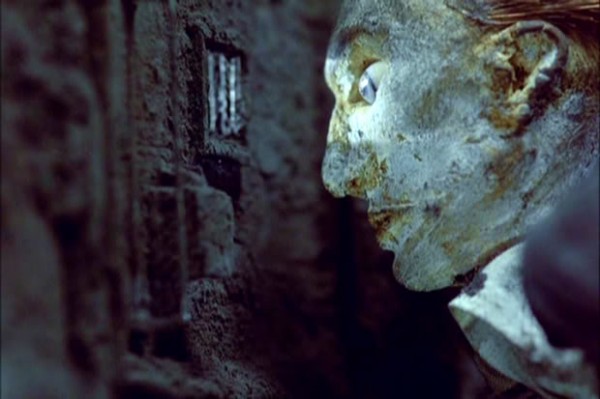
Career retrospective offers a dazzling look into the surreal world of the Brothers Quay (still from STREET OF CROCODILES, 1986)
Museum of Modern Art
11 West 53rd St. between Fifth & Sixth Aves.
Wednesday–Monday through January 7
Museum admission: $22.50 ($12 can be applied to the purchase of a film ticket within thirty days)
212-708-9400
www.moma.org
When MoMA Film associate curator Ron Magliozzi first approached twins Stephen and Timothy Quay about putting together a career retrospective at the Museum of Modern Art, the brothers weren’t sure why people would be interested in delving into their history and working process, but they opened their London studio to Magliozzi and helped design the appropriately strange and wonderful exhibit “On Deciphering the Pharmacist’s Prescription for Lip-Reading Puppets.” Similar in concept to the “Tim Burton” blockbuster a few years back, the Quay Brothers show is filled with paintings and drawings, film and video, early self-portraiture, photographs, collages, book and album covers, etchings, engravings, commercials, and other fascinating paraphernalia associated with their rather eclectic career, spread across several floors. Born in rural Pennsylvania in 1947 to a machinist father and homemaker mother, the Quays were heavily influenced by illustrator and naturalist Rudolf Freund, whom they met in the late 1960s; Polish poster art from the 1960s, which they saw in a 1967 exhibition at the Philadelphia College of Art; and avant-garde, experimental shorts by Jan Lenica and Walerian Borowczyk.
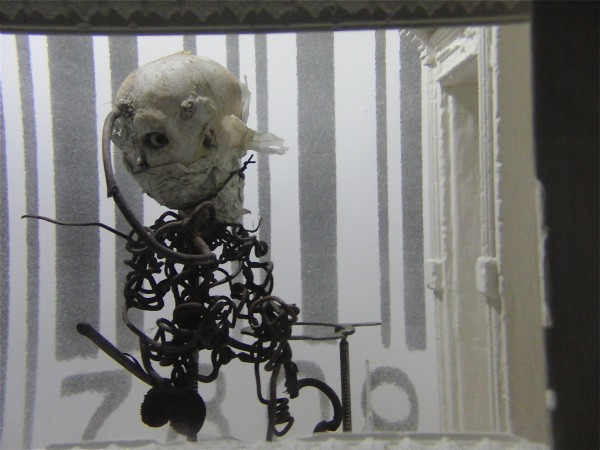
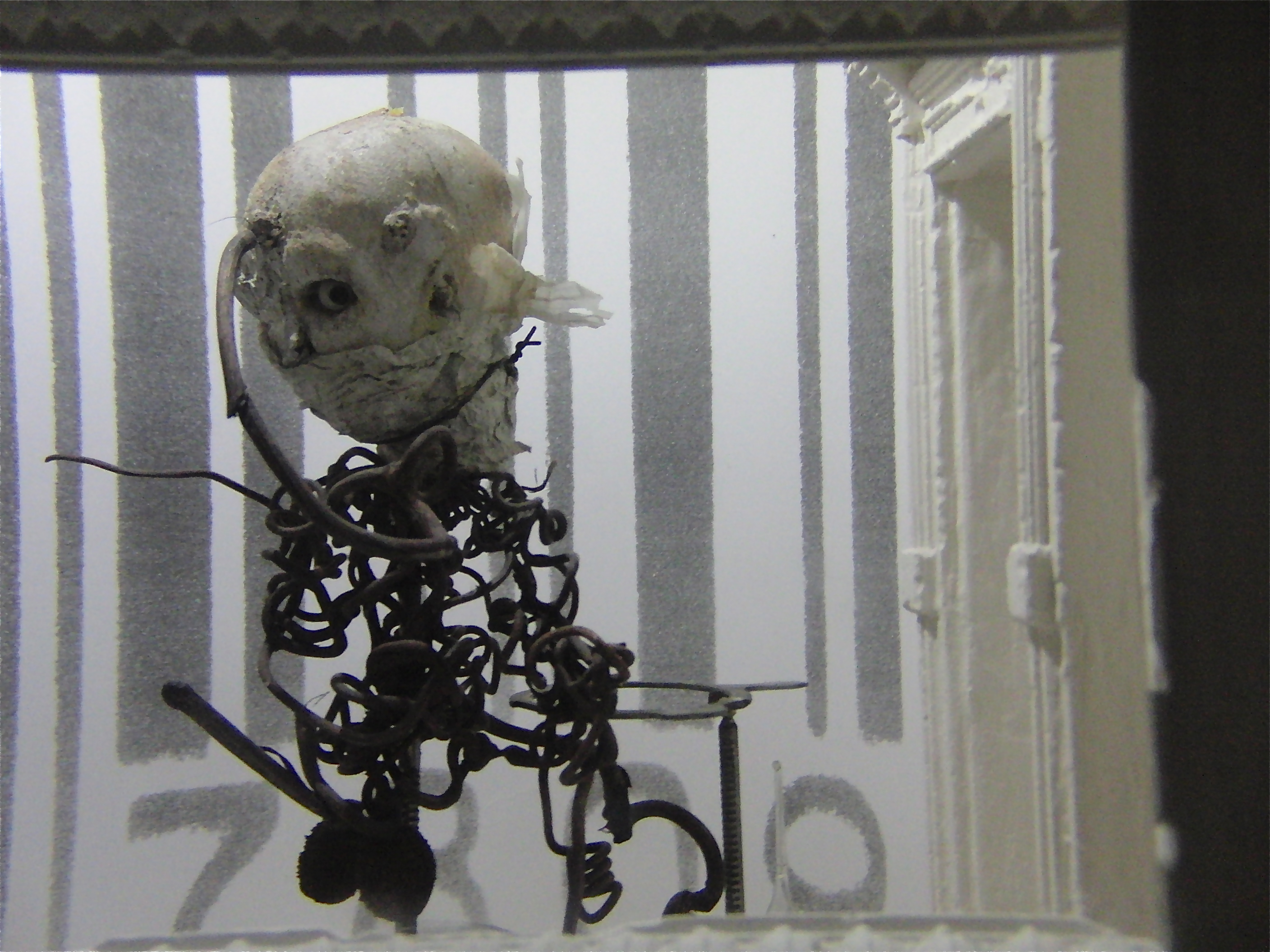
Quay Brothers, detail, “O Inevitable Fatum, Rehearsals for Extinct Anatomies, décor,” wood, fabric, glass, metal, 1987 (photo by twi-ny/mdr)
The MoMA show is set up like a labyrinth, with treats around every corner, from oil snowscapes done when the brothers were still in single digits to short films made when they were in school, from the creepy Black Drawings of the mid-1970s and stage designs for opera, theater, and dance by Béla Bartók, Eugene Ionesco, Molière, Sergei Prokofiev, Georges Feydeau, E. T. A. Hoffman, and others to their British television documentaries, made with longtime producer Keith Griffiths and including the absolutely insane documentary Igor, the Paris Years Chez Pleyel, in which paper cut-outs of Bolshevik poet Vladimir Mayakovsky, French writer and filmmaker Jean Cocteau, and Russian-born composer Igor Stravinsky hang out and do rather odd things in Paris. All of these works lend intrigue and insight to the primary sections of the exhibition, dedicated to the marvelous short films the Quays are renowned for, dark, dazzling stop-motion animations with puppets that relate mesmerizing tales set in a mysterious world of dreams and nightmares that delve into the subconscious. The Quay Brothers’ breakthrough came in 1986 with Street of Crocodiles, adapted from a Bruno Schulz short story, starring eyeless puppets with open heads and taking place in a Kinetoscope, featuring themes and elements that appear in many of their films, including machines, thread, scissors, repetitive movement, screws, bones, metal shavings, and aching, experimental music. Getting its own room, the film is followed by a two-minute outtake that has never been shown before. Among the many other classic Brothers Quay shorts on view in the galleries are In Absentia, The Cabinet of Jan Svankmajer, Rehearsals for Extinct Anatomies, The Sandman, and the dazzling color films This Unnameable Little Broom and The Comb (from the Museums of Sleep). Downstairs outside the Titus Theaters is “Dormitorium,” a terrific collection, previously seen at Parsons the New School for Design in 2009, of film décors, glass-enclosed sets from many of the above-mentioned films as well as many others. And on the first floor by the up escalator you can find “Coffin of a Servant’s Journey,” a short film inside a coffin that can be watched by only one person at a time.
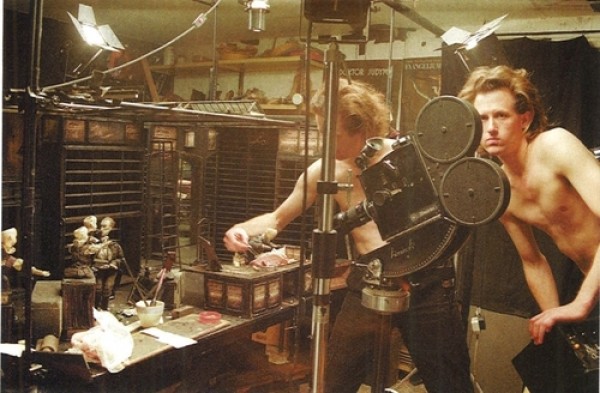
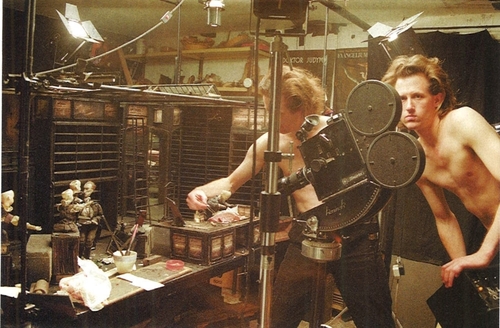
Quay Brothers, “Quay Brothers self-portrait,” photographic enlargement (Atelier Koninck QbfZ)
“On Deciphering the Pharmacist’s Prescription for Lip-Reading Puppets” is a magical trip inside the bizarre, surreal world of the Quay Brothers, an exhibition that was a long time coming and has been handled splendidly. It’s also an exhibition that requires a lot of time to be properly enjoyed, so don’t rush through it or you’ll miss so many of its myriad hidden treasures. And as far as the title itself goes, we’ll leave that to the Quays to describe themselves, as they do in the catalog in a faux interview with sixteenth-century composer Heinrich Holtzmüller: “In our mind it’s more of a teasing inducement for a journey. Not a grand journey but a tiny one . . . around the circumference of an apple. We’re no doubt gently abusing the anticipation that the prescriptive side is courting both a rational illegibility as well as an irrational legibility. Hopefully the intrigued will engage with the ambiguity. And besides, the prescription is only mildly inscrutable and one certainly won’t die from it, considering that thousands of people a year reportedly die from misread prescriptions.” You were expecting anything different?
(MoMA will be screening the Quay Brothers’ latest full-length film, Franz Kafka’s The Metamorphosis, on January 6-7 in Titus Theater 1, with a live musical score performed by Mikhail Rudy. Also on January 7, “The Essential Shorts, Part 2” will screen six shorts in the Education and Research Building, including Rehearsals for Extinct Anatomies, Nocturna Artificialia, Ex Voto, This Unnameable Little Broom: Epic of Gilgamesh, Maska, and Bartók Béla: Sonata for Solo Violin.)
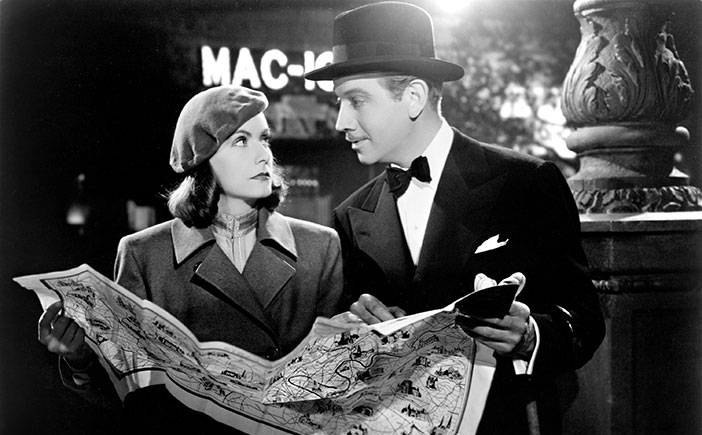
 Greta Garbo laughs — and says she doesn’t want to be alone — in Ernst Lubitsch’s classic pre-Cold War comedy Ninotchka, currently showing in a new 35mm print at Film Forum through January 3. In her next-to-last film, Garbo is sensational as Nina Ivanovna “Ninotchka” Yakushova, a Russian envoy sent to Paris to clean up a mess left by three comrade stooges, Iranov (Sig Ruman), Buljanov (Felix Bressart), and Kopalsky (Alexander Granach). The hapless trio from the Russian Trade Board had been sent to France to sell jewelry previously owned by the Grand Duchess Swana (Ina Claire) and now in the possession of the government following the 1917 Russian Revolution. But the duchess’s lover, Count Léon d’Algout (Melvyn Douglas), gets wind of the plan and attempts to break up the deal while also introducing the three men to the many decadent pleasures of a free, capitalist society. Then in waltzes the stern, by-the-book Ninotchka, who wants to set the Russian men straight, as well as Léon. “As basic material, you may not be bad,” she tells him atop the Eiffel Tower, “but you are the unfortunate product of a doomed culture.” At first, Ninotchka speaks robotically, spouting the company line, but she loosens up considerably once Léon shows her what communism has been depriving her of, yet it’s difficult for her to turn her back on the cause, leading to numerous hysterical conversations — the razor-sharp script was written by Charles Brackett, Walter Reisch, and Billy Wilder, based on a story by Melchior Lengyel — that serve as both a battle of the sexes and social commentary on the Russian and French ways of life. “I’ve heard of the arrogant male in capitalistic society. It is having a superior earning power that makes you that way,” Ninotchka tells Léon shortly after meeting him on a Paris street. “A Russian! I love Russians! Comrade, I’ve been fascinated by your Five-Year Plan for the last fifteen years,” Léon responds, to which Ninotchka tersely replies, “Your type will soon be extinct.” Nominated for four Academy Awards, including Best Picture, Best Actress, Best Original Story, and Best Screenplay, Ninotchka is one of the most delightful romantic comedies ever made, filled with little surprises every step of the way (including a serious cameo by Bela Lugosi), serving up a blueprint that has been followed by so many films for nearly three-quarters of a century ever since.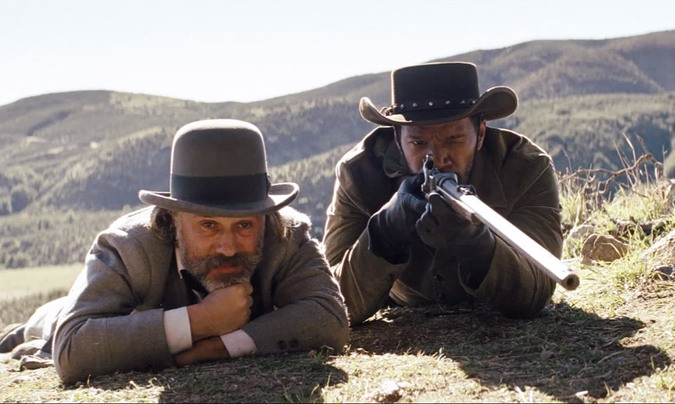
 Multigenre master Quentin Tarantino, who as writer-director has taken on the gangster film (Reservoir Dogs), pulp movies (Pulp Fiction), Blaxploitation (Jackie Brown), the martial arts (Kill Bill, Vols. I & II), grindhouse (Death Proof), and WWII (Inglourious Basterds) with nearly universally acclaimed results, has now turned his attention to the spaghetti Western, resulting in yet another awesome achievement. A Southern Western that in many ways is the black version of Inglourious Basterds, Django Unchained is set immediately before the Civil War, as bounty hunter and former dentist King Schultz (Oscar winner Christoph Waltz) obtains a slave named Django (Oscar and Grammy winner Jamie Foxx) in order to track down the wanted Brittle brothers (Cooper Huckabee, Doc Duhame, and M. C. Gainey) and collect a substantial reward. Schultz has promised Django his freedom and some cash in return for his assistance, but the two stick together as they go off in search of Django’s wife, Broomhilda Von Shaft (Kerry Washington), who was brutally taken away from him and now works on the Candyland plantation owned by the slick, smooth Calvin J. Candie (Leonardo DiCaprio) and run by an Uncle Tom slave known as Stephen (Samuel L. Jackson). As with most Tarantino films, things get a little violent by the end, an operatic barrage of blood and guts that would make Sam Peckinpah proud. Tarantino, who appeared in Takashi Miike’s 2007 Sukiyaki Western Django and plays a small part here as well, continues his reign as the King of the Revenge Film with Django Unchained, another movie that is, at its heart, another celebration of movies themselves. Tarantino masterfully toys with cinematic conventions, tongue often firmly in cheek, evoking a stream of Western classics, including The Wild Bunch, The Searchers, Blazing Saddles, and, of course, Sergio Corbucci’s 1966 Django — he even gives a small part to Franco Nero, who played the title role in the Corbucci flick. Tarantino also adds beautifully absurd humor, primarily in the form of a riotous scene with masked marauders, a perhaps overly liberal use of the N-word, a vast array of familiar faces rounding out the cast (Don Johnson, Dennis Christopher, Bruce Dern, Tom Wopat, James Russo, Jonah Hill, Robert Carradine, and James Remar inexplicably in two roles), and, as usual, a killer soundtrack, ranging from new music by Ennio Morricone, John Legend, and Anthony Hamilton to a spectacularly out-of-place song by the late Jim Croce. He even references German literature in the form of the famous myth of Siegfried and Brunhilde. Yes, the film is too long, too violent, and too filled with stereotypes, and the story comes together a little too easily, but heck, it’s still about as much fun as you’re gonna have at the movies this year.
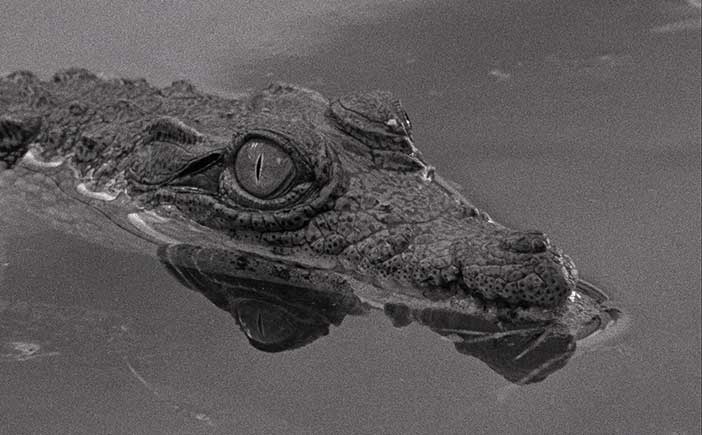
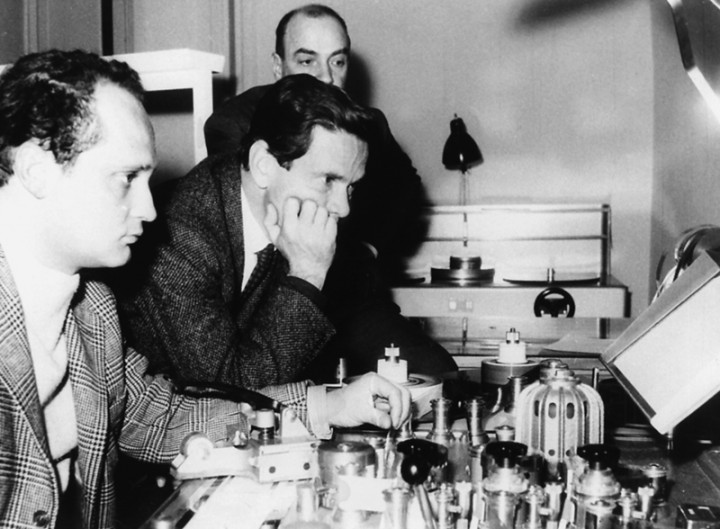
 In 1963, producer Gastone Ferranti asked Italian director Pier Paolo Pasolini to make a leftist political documentary about the postwar situation utilizing the producer’s large collection of Mondo Libero newsreel footage, answering the question “Why is our life dominated by discontent, by anguish, by the fear of war, by war?” Not thrilled with the result, he chopped Pasolini’s film in half and hired right-wing demagogue Giovanni Guareschi to create a conservative documentary providing an opposing viewpoint. La rabbia, or The Anger, opened in theaters in Italy and was quickly pulled from release, essentially disappearing until 2005, when a complete color negative was discovered and the two parts were restored and brought back together in a deluxe DVD package. La rabbia di Pasolini (The Anger of Pasolini), which is screening with the amazing La ricotta on December 26 at 4:30 as part of MoMA’s Pasolini career retrospective, is a curious examination of the state of the world. “My idea was to offer a Marxist denunciation of the society and events of the time,” Pasolini explained. Over the course of fifty-four minutes, he and editor Nino Baragli (with Giuseppe Bertolucci handling the recent reconstruction) create a cinematic collage of religion, communism, fascism, socialism, poverty, hunger, colonialism, race, and war through footage of the Hungary revolts of 1956, protests in Rome and Madrid, the war in Algeria, the coronation of Queen Elizabeth II, the rise of Patrice Lumumba in the Belgian Congo, and clips of such other international figures as Lenin, Stalin, Pope John XXIII, Sukarno, Nasser, de Gaulle, Eisenhower, Khrushchev, Yuri Gagarin, and even Marilyn Monroe as he poetically laments about life in the twentieth century. “People of color, it is in hope that man has no color,” one of his narrators says in the film. (The text is recited by actor Giorgio Bassani and painter Renato Guttuso; works by the latter are included in the documentary, along with pieces by Ben Shahn, Jean Fautrier, and George Grosz.) “Long live freedom,” the film repeats, but there’s not much promise for the future.