
HOW TO SURVIVE A PLAGUE provides a fascinating inside look at AIDS activists fighting the power
HOW TO SURVIVE A PLAGUE (David France, 2012)
Film Society of Lincoln Center
Elinor Bunin Munroe Film Center: Francesca Beale Theater
144 West 65th St. between Broadway & Amsterdam Ave.
Through Thursday, January 24
212-875-5601
www.filmlinc.com
www.surviveaplague.com
 Contemporary activists stand to learn a lot from the gripping documentary How to Survive a Plague. For his directorial debut, longtime journalist David France, one of the first reporters to cover the AIDS crisis that began in the early 1980s, scoured through more than seven hundred hours of mostly never-before-seen archival footage and home movies of protests, meetings, public actions, and other elements of the concerted effort to get politicians and the pharmaceutical industry to recognize the growing health epidemic and do something as the death toll quickly rose into the millions. Focusing on radical groups ACT UP and TAG (Treatment Action Group), France follows such activist leaders as Peter Staley, Mark Harrington, Larry Kramer, Bob Rafsky, and Dr. Iris Long as they attack the policies of President George H. W. Bush, famously heckle presidential candidate Bill Clinton, and battle to get drug companies to create affordable, effective AIDS medicine, all while continuing to bury loved ones in both public and private ceremonies. France includes new interviews with many key activists who reveal surprising details about the movement, providing a sort of fight-the-power primer about how to get things done. The film also shines a light on lesser-known heroes, several filled with anger and rage, others much calmer, who fought through tremendous adversity to make a difference and ultimately save millions of lives. How to Survive a Plague is screening at the Film Society of Lincoln Center through January 24, celebrating its Oscar nomination for Best Documentary Feature.

 Kirby Dick’s The Invisible War is one of the bravest, most explosive investigative documentaries you’re ever likely to see. Dick (This Film Is Not Yet Rated) busts open the military’s dirty little secret, revealing that episodes of horrific sexual abuse such as the Tailhook scandal are not an aberration but a prime example of a rape epidemic that seems to an accepted part of military culture. Dick speaks with many women and one man who share their incredible stories, describing in often graphic detail the sexual abuse they suffered, then faced further abuse when they reported what had happened. Their superiors, some of whom were the rapists themselves, either looked the other way, laughed off their allegations as no big deal, or threatened the victims’ careers. Dick includes remarkable Defense Department statistics — the government admits that approximately one out of every five female soldiers suffers sexual abuse and that there were nineteen thousand violent sex crimes in 2010 alone — even as such military officials as Dr. Kaye Whitley, Rear Admiral Anthony Kurta, and Brigadier General Mary Kay Hertog make absurd claims that they are satisfied with the way they are handling the alarming trend. The central figure in the film is Kori Cioca, a former member of the Coast Guard whose face was broken when she was raped by a superior and now keeps getting denied necessary medical services from the VA. Such courageous women as USAF Airman 1st Class Jessica Hinves, former Marine Officer Ariana Klay, USN veteran Trina McDonald, USMC Lieutenant Elle Helmer, USN Lieutenant Paula Coughlin, and even Special Agent Myla Haider of the Army Criminal Investigation Command also open up about the physical and psychological damage the abuse has left on their lives and careers. Inspired by Helen Benedict’s 2007 Salon.com article “The Private War of Women Soldiers,” Dick and producer Amy Ziering (The Memory Thief) have presented a searing indictment of an endemic military culture that has to come to an end, and fast. The Invisible War, which earned Dick and Ziering last year’s Nestor Almendros Award for courage in filmmaking at the Human Rights Watch Film Festival at Lincoln Center, is back at the Elinor Bunin Munroe Film Center for a brief run through January 24, celebrating its Oscar nomination for Best Documentary Feature.

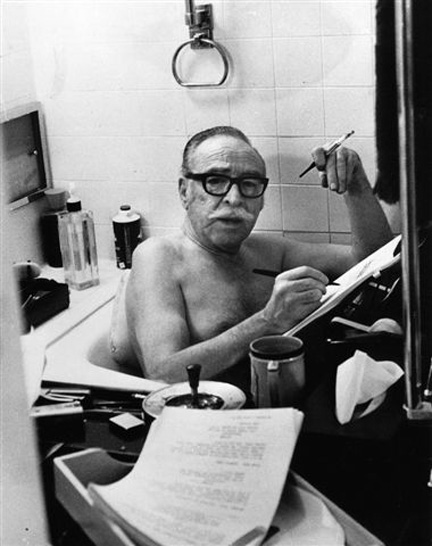
 In 2004-5, Christopher Trumbo’s play Trumbo: Red, White, and Blacklisted, based on the writings of his father, jailed Hollywood Ten screenwriter and novelist Dalton Trumbo (1905-76), toured the country, a staged reading directed by Peter Askin and starring such actors as Nathan Lane, Joe Mantegna, Bill Irwin, Brian Dennehy, and F. Murray Abraham in the title role. Christopher and Askin turned the show into a documentary film, with decidedly mixed results. Although Trumbo’s letters are works of art on their own, funny and incisive, biting and cynical, with a wry, dry sense of humor that summarizes the social and political climate of the cold war era, they lose much of their power when read overdramatically onscreen by Dennehy, Josh Lucas, Paul Giamatti, and others. The camera will linger on Michael Douglas or David Strathairn as they contemplate what they have just read, adding an unnecessary sense of seriousness and importance. It is almost impossible to concentrate on Trumbo’s words as you wonder why Joan Allen was selected, whether Liam Neeson should have tried an American accent, how long and white Donald Sutherland’s hair is, or how many sly gestures Lane will make as he relates a riotous treatise on onanism. Interviews with such friends and colleagues as Manny Azenberg, Kate Lardner, Kirk Douglas, and Trumbo’s children, Christopher and Mitzi, dig deeper into the kind of man Trumbo was, along with archival footage of Trumbo on talk shows, in home movies, and telling the House Un-American Committee to go to hell. Askin tries so hard to focus on the actual words of the Oscar-winning screenwriter behind such classics as Johnny Got His Gun, Roman Holiday, Spartacus, Exodus, and Papillon that he ends up obscuring the portrait as a whole. But oh, what words they are. Trumbo will be screening January 22 at the IFC Center as part of the Tuesday-night series “Stranger than Fiction,” with Askin on hand to participate in a Q&A. The series continues through February 26 with such other documentaries as Neil Barsky’s Koch, Amy Nicholson’s Zipper: Coney Island’s Last Wild Ride, and Terence Nance’s An Oversimplification of Her Beauty.
 In such unique films as Rushmore, The Royal Tenenbaums, and The Darjeeling Limited, black-comedy master Wes Anderson has created a bizarre collection of characters who seem to live in their own alternate realities. In his latest, Moonrise Kingdom, Anderson has once again assembled an oddball assortment of men, women, and children in a terrifically clever and entertaining fairy tale all its own. Tired of being abused by his fellow Khaki Scouts and dismissed by his foster parents, twelve-year-old orphan Sam Shakusky (Jared Gilman) runs away from Camp Ivanhoe on the island of New Penzance, much to the chagrin of dedicated scout master Randy Ward (Edward Norton). Meanwhile, twelve-year-old loner Suzy Bishop (Kara Hayward) is fed up with her life as well, which she mostly spends listening to Benjamin Britten, reading fairy tales (fictitious stories made up by Anderson), watching the world through a pair of ever-present binoculars, and despising her parents (Bill Murray and Frances McDormand). Afraid of what might have happened to the children, the local police officer, Captain Sharp (Bruce Willis), gets involved, as does a stern woman from social services (Tilda Swinton) and, eventually, a very different kind of scout, Cousin Ben (Jason Schwartzman). The proceedings are overseen by a narrator (Bob Balaban) who ends up being more than just an omniscient presence. Moonrise Kingdom is an absolute gem of a film, an exciting, original tale about growing up told in a fabulously funny deadpan manner that combines slapstick humor with wildly ironic elements, filled with the endless wonders of childhood, although it is most definitely not for children. Newcomers Gilman and Hayward appear wise beyond their years in the lead roles, with outstanding support from an all-star cast, most prominently Norton as the by-the-book scout master on a mission. Written by Anderson with Roman Coppola and featuring a lovely score by Alexandre Desplat, Moonrise Kingdom is one of the best films of 2012, by a director whose imagination never ceases to amaze, and the Museum of the Moving Image agrees, as Moonrise Kingdom is screening January 20 as part of the museum’s “Curators’ Choice: The Best of 2012” series, consisting of works selected by chief curator David Schwartz and assistant film curator Rachael Rakes; the series continues next month with David Cronenberg’s Cosmopolis and Hong Sang-soo’s In Another Country.