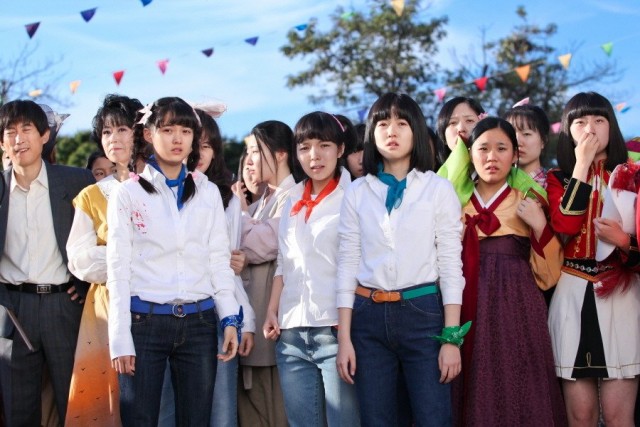
Kang Hyeong-cheol’s SUNNY goes back and forth between 1986 and 2011 as a group of friends reunites when one of them faces tragedy
KOREAN MOVIE NIGHT: SUNNY (Kang Hyeong-cheol, 2011)
Tribeca Cinemas
54 Varick St. at Laight St.
Tuesday, May 28, free, 7:00
212-759-9550
www.koreanculture.org
www.tribecacinemas.com
 A huge critical and popular hit in South Korea, Sunny is a delightful melodrama about a group of high school friends who attempt to reunite after twenty-five years when one of them becomes seriously ill. Taking its name from Bobby Hebb’s bright and cheery 1966 song (“Sunny, yesterday my life was filled with rain / Sunny, you smiled at me and really eased the pain”), the film opens with Im Na-mi (Yoo Ho-jeong) discovering that the leader of their old high school gang, Ha Chun-hwa (Jin Hee-kyung), has only two months to live. Na-mi, a housewife who is seeking more out of her boring, less-than-satisfying existence, decides to track down the rest of the members, none of whom, it turns out, is really happy with how their life turned out. Cowriter and director Kang Hyeong-cheol (Speedy Scandal) seamlessly weaves between 1986 and 2011 as the modern-day Na-mi looks back at her first days at school as a transfer student (played as a teenager by Shim Eun-kyung) befriended by the tough Chun-hwa (Kang Sora). Teaming up with the goofy Kim Jang-mi (Go Soo-hee as an adult, Kim Min-yeong as a teen), the older Na-mi tries to find Hwang Jin-hee (Hong Jin-hee / Park Jin-joo), Seo Geum-ok (Lee Yun-kyung / Nam Bo-ra), Ryu Bok-hee (Kim Sun-kyung / Kim Bo-mi), and Jung Su-ji (Yoon Jung / Min Hyo-rin), each of whom has their own personality and story both as teens and as grown-ups. Although it often gets silly, the film deals with such serious topics as bullying, terminal cancer, extramarital affairs, and slave labor as the young girls’ hopes and dreams seemingly remain just out of reach, anchored by the honest relationship among the characters, particularly between Na-mi and Chun-hwa, with standout performances by the adorable Shim and the compelling Kang, who won numerous awards for the role. Sunny is screening for free May 28 at Tribeca Cinemas as part of the Korean Movie Night series “Laughter and Love at the Box Office!,” which continues June 11 with Lee Yong-joo’s Architecture 101 and June 25 with Jo Sung-hee’s A Werewolf Boy.
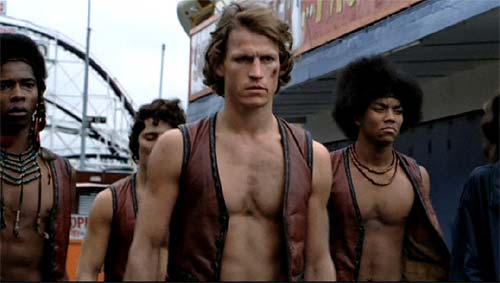
 At a huge gang meeting in the Bronx (actually shot in Riverside Park), the Warriors are wrongly accused of having killed Cyrus (Roger Hill), an outspoken leader trying to band all the warring factions together to form one huge force that can take over the New York City borough by borough. The Warriors then must make it back to their home turf, Coney Island, with every gang in New York lying in wait for them to pass through their territory. This iconic New York City gang movie is based on Sol Yurick’s novel, which in turn is loosely based on Xenophon’s Anabasis, which told of the ancient Greeks’ retreat from Persia. Michael Beck stars as Swan, who becomes the de-facto leader of the Warriors after Cleon (Dorsey Wright) gets taken down early. Battling Swan for control is Ajax (Sex and the City’s James Remar) and tough-talking Mercy (Too Close for Comfort’s Deborah Van Valkenburgh). Serving as a Greek chorus is Lynne (Law & Order) Thigpen as a radio DJ, and, yes, that young woman out too late in Central Park is eventual Oscar winner Mercedes Ruehl. Among the cartoony gangs of New York who try to stop the Warriors are the roller-skating Punks, the pathetic Orphans, the militaristic Gramercy Riffs, the all-girl Lizzies, the ragtag Rogues, and the inimitable Baseball Furies. Another main character is the New York City subway system itself. There’s nothing quite like The Warriors; be sure to come out and play at these Memorial Day weekend midnight screenings.

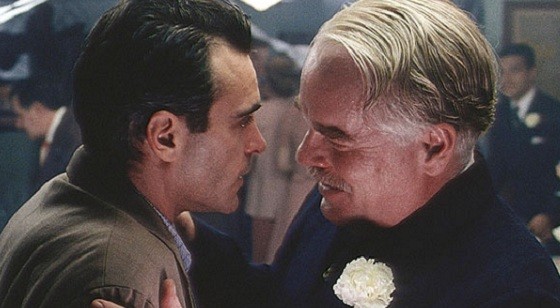
 One of America’s most daring and adventurous filmmakers, California native Paul Thomas Anderson, who has dazzled, amazed, challenged, and confused audiences with such previous gems as Boogie Nights, Magnolia, Punch-Drunk Love, and There Will Be Blood, has done it again with his latest, The Master. The film is built around the fascinating relationship between Freddie Quell (Joaquin Phoenix), a WWII vet struggling to fit into the real world after seeing so much violence and death overseas, and the Master (Philip Seymour Hoffman), the leader of a cultlike organization known as the Cause that believes in past-life regression and invasive questioning known as Processing to help people deal with personal trauma. The Master essentially adopts Quell, intrigued by his distorted outlook on life, making him a member of the family, which also includes his wife, Peggy (Amy Adams), his son, Val (Jesse Plemons), and his daughter, Elizabeth (Ambyr Childers). Inspired by the real-life tale of L. Ron Hubbard and Scientology — and incorporating war stories he was told by Jason Robards on the set of Magnolia, elements from the life of John Steinbeck, and discarded scenes from the script for There Will Be Blood — Anderson crafts a, dare we say, masterful cinematic experience built around a pair of extraordinary performances. Phoenix absolutely inhabits the role of Quell, staggering about with an awkward gait, with impossibly deep lines on his face and eyes that seem to be able to look through lead. Hoffman is his equal as the much cooler and calmer spiritual leader, until he is faced with sudden turmoil. The scenes in which the two men sit across from each other, going through a Processing session, are mesmerizing, the most powerful moments to be found onscreen last year. (Both Phoenix and Hoffman received Oscar nods, along with Adams.) But despite the title, the focus remains on Quell, a lost soul searching for somewhere to belong in a changing postwar America. Anderson’s first film in four years, The Master is a bold, audacious work that is as unsettling as it is exhilarating. The Master is screening May 24 at 7:00 and May 25 at 2:00 as part of the Museum of the Moving Image series “See It Big!,” which continues into June with such other great films as Akira Kurosawa’s Ran, Roberto Rossellini’s Journey to Italy, and Nicholas Ray’s Bigger Than Life.