First love and the past and the present come together in heartbreaking romance ARCHITECTURE 101
KOREAN MOVIE NIGHT: ARCHITECTURE 101 (GEONCHUKHAKGAERON) (Lee Yong-zoo, 2011)
Tribeca Cinemas
54 Varick St. at Laight St.
Tuesday, June 11, free, 7:00
212-759-9550
www.koreanculture.org
www.tribecacinemas.com
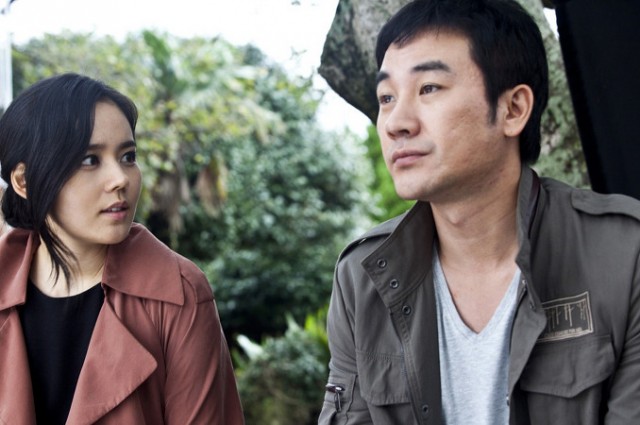
 The free Korean Movie Night series “Laughter and Love at the Box Office!” continues June 11 at Tribeca Cinemas with the bittersweet romantic tale Architecture 101. Former architect Lee Yong-zoo’s second feature film, following Possessed, examines the building of personal relationships as well as the construction of homes as a pair of grown-ups consider what might have been. When Seo-Yeon (Han Ga-in) enters the firm where Seung-Min (Uhm Tae-woong) works, the thirty-five-year-old architect appears initially not to know her, but it turns out that they explored the possibility of first love together fifteen years earlier at school. Lee cuts back and forth between the present, in which Seo-Yeon hires Seung-Min to rebuild a house for her, and the past, when Seung-Min (Lee Je-hoon) and Seo-Yeon (Bae Su-ji) are still figuring out what they want out of life and love, trying to understand the desire churning inside them. In the present, Seo-Yeon says she has been married for three years, and Seung-Min is secretly engaged to his assistant, Eun-Chae (Koh Joon-hee). Meanwhile, in the past, Seung-Min doesn’t know what to do about his feelings for Seo-Yeon, who seems to like one of his best friends, Jae-Wook (Yoo Yeon-seok). The past, present, and future meld into one over the musical theme of pop star Jeon Ram-whe’s sappy Korean ballad “Etude of Memory” as true love tantalizingly hangs just out of reach. Architecture 101 is a beautiful yet heartbreaking film with superb performances — Bae and Jo Jung-suk, who plays Nabddeuckyi, a confidant of the younger Seung-Min’s based on the director himself, both won Best New Actor awards for their portrayals — and a compelling narrative structure that builds to a powerfully emotional climax. “Laughter and Love at the Box Office!” concludes June 25 with Jo Sung-hee’s romantic fantasy hit A Werewolf Boy.

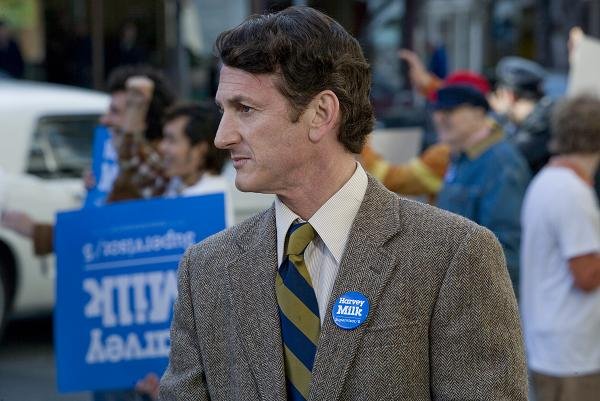
 Gus Van Sant’s Milk is a solid if surprisingly standard biopic focusing on the last eight years in the life of Harvey Milk, the gay activist and politician who was assassinated in 1978. Van Sant (Drugstore Cowboy, To Die For, Good Will Hunting) follows the eventual unofficial Mayor of Castro Street (Sean Penn) as he moves to San Francisco with his much younger partner, Scottie Smith (James Franco), and sets up a camera shop that soon becomes an important meeting ground for the local gay community, fighting for equal rights and supporting Milk as he continually campaigns for public office. The battle hits its high point in 1978 when Milk takes on John Briggs (Denis O’Hare) and the Briggs Initiative, also known as Proposition 6, which sought to take away existing employment rights from gays and lesbians in the California public school system, eerily reminiscent of the recent battle over Proposition 8 there. Although Milk was a rallying figure — his opening mantra was always “My name is Harvey Milk, and I am here to recruit you!” — the film never quite takes off the way it wants to, instead becoming too reverential and melodramatic. Penn, who won an Oscar for his portrayal, is good but subdued in the lead role; the best performance comes from Josh Brolin as Dan White, Milk’s main adversary among the SF supervisors. Milk is screening June 9 & 10 at MoMA as part of the series “Harris Savides: Visual Poet,” which pays tribute to the fashion photographer and cinematographer who died in October 2012 at the age of fifty-five; the festival includes a wide range of works on which he served as director of photography, including Noah Baumbach’s underrated Greenberg, Sofia Coppola’s Somewhere, Woody Allen’s Whatever Works, James Gray’s The Yards, David Fincher’s Zodiac, and John Turturro’s Illuminata, with Baumbach, Coppola, Fincher, and Turturro on hand to introduce various screenings.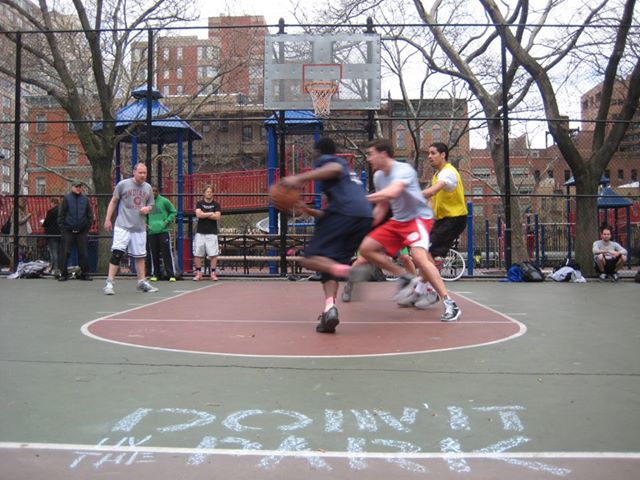
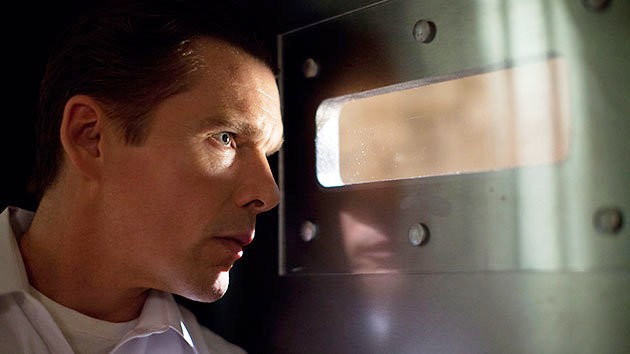
 Yes, the central plot is absurd and the plot twists are ridiculously stupid, but the home-invasion thriller The Purge still manages to keep things tense and exciting up to the very last minute. It’s 2022, and the New Founding Fathers have turned the night after the vernal equinox into twelve hours of murder and mayhem known as the Purge, when people can release their inner demons and get out all the rage that has built up inside them during the rest of the year, which is filled with peace and tranquillity. From 7:00 pm to 7:00 am, Americans are allowed to commit any crimes they want, without any consequences, which has been a boon for James Sandin (Ethan Hawke), who has done very well for himself and his family — wife Mary (Lena Headey, Cersei Lannister on Game of Thrones), teenage daughter Zoey (Adelaide Kane), and young tech wizard Charlie (Max Burkholder) — selling high-end security systems to his friends and neighbors who opt not to take part in the annual ritual, instead staying inside their well-protected expensive homes in their gated community and watching the events unfold on television. But things go terribly wrong when Zoe’s boyfriend, Henry (Tony Oller), sneaks into the house and Charlie decides to help out a troubled man running through the streets (Edwin Hodge as “Bloody Stranger”). The man is being chased by a group led by a crazy masked dude (Rhys Wakefield as “Polite Stranger”) who threatens to tear down the Sandins’ house and kill everyone inside if they don’t deliver the Bloody Stranger to them. Written and directed by James DeMonaco, The Purge works best when it doesn’t attempt to make any grand statements about racism, greed, justice, violence, and the haves and the have-nots, instead just concentrating on the intense action. It’s a combination of Michael Haneke’s Funny Games, Bryan Bertino’s The Strangers, David Fincher’s Panic Room, and the 2005 remake of Assault on Precinct 13 —which was written by DeMonaco and starred Hawke as well. (The two also teamed up on DeMonaco’s feature debut, 2009’s Little New York.) And while The Purge might lack the depth of each of those films, it tends to hang in there; every time it is about to descend into complete and utter inanity, it does something that rescues it from the abyss opening beneath it — and the audience.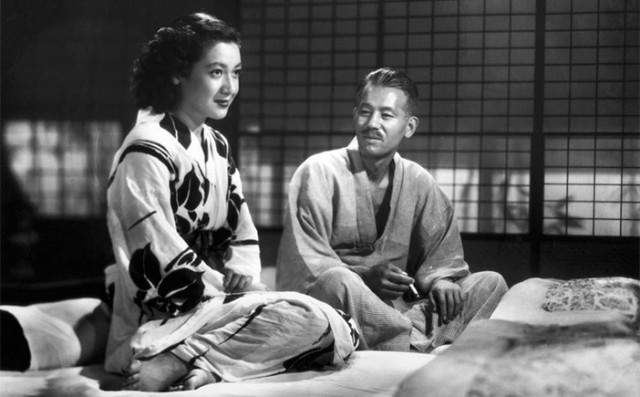
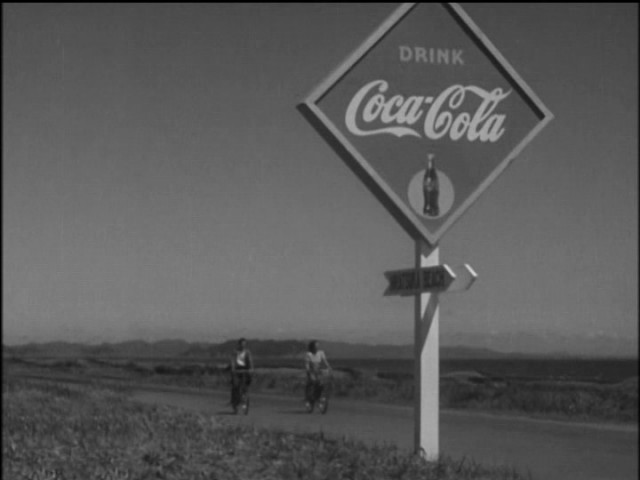
 It is rather appropriate that Film Forum’s three-week, thirty-plus-film “Ozu” series, held in honor of the fiftieth anniversary of director Yasujirō Ozu’s death, kicks off with Late Spring. Not only is it late spring right now in New York, but the work marked a late spring of sorts in the Japanese auteur’s career as he moved into a new, post-WWII phase of his long exploration of Japanese family life and the middle class. Based on Kazuo Hirotsu’s novel Father and Daughter, the black-and-white film, written by Ozu with longtime collaborator Kogo Noda, tells the story of twenty-seven-year-old Noriko (Setsuko Hara), who lives at home with her widower father, Shukichi Somiya (Chishu Ryu), a university professor who has carved out a very simple existence for himself. Her aunt, Masa (Haruko Sugimura), thinks Noriko should get married, but she prefers caring for her father, who she believes would be lost without her. But when Somiya starts dropping hints that he might remarry, like his friend and colleague Jo Onodera (Masao Mishima) did — a deed that Noriko finds unbecoming and “filthy” — Noriko has to take another look at her future. Late Spring is a masterpiece of simplicity and economy while also being a complex, multilayered tale whose every moment offers unlimited rewards. From the placement and minimal movement of the camera to the design of the set to the carefully choreographed acting, Ozu infuses the work with meaning, examining not only the on-screen relationship between father and daughter but the intimate relationship between the film and the viewer. Ozu, who never married, has a firm grasp on the state of the Japanese family as some of the characters try to hold on to old-fashioned culture and tradition while recovering from the war’s devastation and facing the modernism that is taking over.