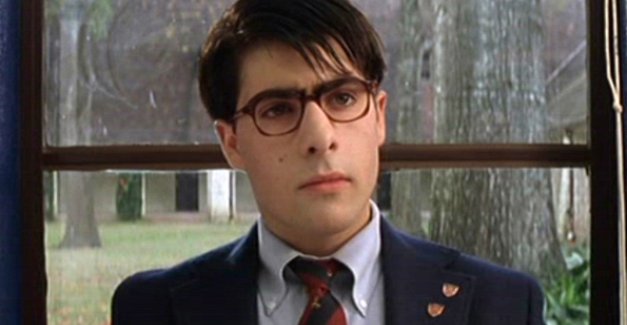
Jason Schwartzman is a different kind of teenager caught up in an adult world in Wes Anderson’s RUSHMORE
RUSHMORE (Wes Anderson, 1998)
Tompkins Square Park
Ave. A between Seventh & Tenth Sts.
Thursday, June 20, free, 6:00
718-777-6800
www.filmsintompkins.com
rushmoreacademy.com
 Wes Anderson’s Rushmore is a dazzlingly dark, sublime masterpiece. Anderson (The Royal Tenenbaums, Moonrise Kingdom) created one of the all-time-great quirky indie antiheroes in Max Fischer, played with relish by Jason Schwartzman. Max is a troubled genius at the private Rushmore Academy, where his eccentricities make him somewhat of an outcast. His best friend is wealthy iconoclast Herman Blume (Bill Murray in a career-redefining role), but their relationship turns sour when it becomes apparent that they both have their hearts set on beautiful teacher Rosemary Cross (Olivia Williams). A unique take on disaffected youth, Rushmore, which also features such Anderson regulars as Luke Wilson and Seymour Cassel and was cowritten by Owen Wilson, helped launch a new wave of American independent cinema with its offbeat narrative and eclectic soundtrack, which includes songs by Donovan, the Rolling Stones, Django Reinhardt, Cat Stevens, Yves Montand, and the Faces, along with original material by Devo’s Mark Mothersbaugh. Rushmore is screening June 20 as part of the free Films in Tompkins programming in Tompkins Square Park and will be preceded by a live performance by the all-women’s AfroBrazilian Samba Reggae drumming band BatalaNYC. The summer series continues into August with such other fab films as Reservoir Dogs (with Amour Obscur), Easy Rider (with Main Street Quintet), The Big Lebowski (with Jade Pinto and the Yeahtones), and O Brother, Where Art Thou?, which was rescheduled for August 22 after getting rained out on June 13.

 Award-winning Haitian filmmaker Raoul Peck’s Fatal Assistance begins by posting remarkable numbers onscreen: In the wake of the devastating earthquake that hit his native country on January 12, 2010, there were 230,000 deaths, 300,000 wounded, and 1.5 million people homeless, with some 4,000 NGOs coming to Haiti to make use of a promised $11 billion in relief over a five-year period. But as Peck reveals, there is significant controversy over where the money is and how it’s being spent as the troubled Haitian people are still seeking proper health care and a place to live. “The line between intrusion, support, and aid is very fine,” says Jean-Max Bellerive, the Haitian prime minister at the time of the disaster, explaining that too many of the donors want to cherry-pick how their money is used. Bill Vastine, senior “debris” adviser for the Interim Commission for the Reconstruction of Haiti (CIRH), which was co-chaired by Bellerive and President Bill Clinton, responds, “The international community said they were gonna grant so many billions of dollars to Haiti. That didn’t mean we were gonna send so many billions of dollars to a bank account and let the Haitian government do with it as they will.” Somewhere in the middle is CIRH senior housing adviser Priscilla Phelps, who seems to be the only person who recognizes why the relief effort has turned into a disaster all its own; by the end of the film, she is struggling to hold back tears. A self-described “political radical,” Peck doesn’t play it neutral in Fatal Assistance, instead adding mournful music by Alexei Aigui, somber English narration by a male voice (Peck narrates the French-language version), and a female voice-over reading melodramatic “Dear friend” letters that poetically trash what is happening in Haiti. “Every few decades, the rich promise everything to the poor,” the male voice-over says. “The dream of eradication of poverty, disease, death remains a perpetual fantasy.” Even though Peck (Lumumba, 2010 Human Rights Watch Film Festival centerpiece
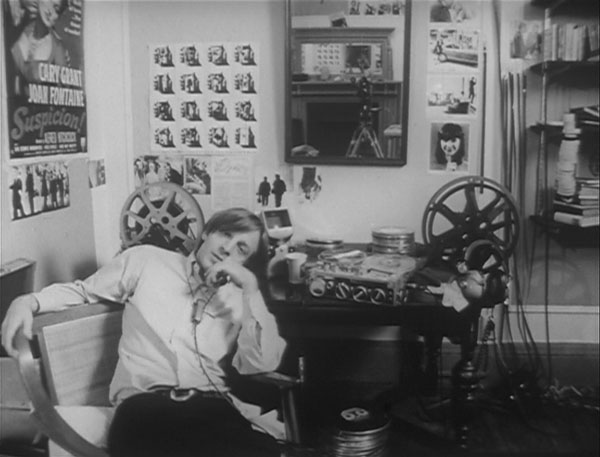
 New York City native Jim McBride’s directorial debut, the seminal David Holzman’s Diary, presages the YouTube Generation and reality shows in its depiction of a man obsessed with capturing virtually every moment of his life on camera. L. M. Kit Carson stars as David Holzman, a twenty-five-year-old unemployed schlemiel who goes everywhere with his 16mm camera, photographing the streets of his Upper West Side neighborhood, his model girlfriend, Penny (Eileen Dietz), and the woman in the apartment across the street. He also often turns the camera on himself as he discusses his life and moviemaking, directly and indirectly referencing Jean-Luc Godard, Alfred Hitchcock, Vincente Minnelli, Orson Welles, and Luchino Visconti. The black-and-white film is set up as if it’s a documentary, with choppy cuts and a barely audible soundtrack of a radio playing music and sharing the news of the day (July 1967). Holzman is happiest when he gets a new fish-eye lens and shows it off by carrying it through the streets above his head, offering a different perspective of the city. Like today’s world, McBride (The Big Easy, Great Balls of Fire!) brings up issues of voyeurism and privacy, because to Holzman, it’s as if nothing really exists unless it’s on film or television (or, now, the internet). Thus, it makes sense that David Holzman’s Diary is screening this week at Northside Film, on June 20 at 6:30 at UnionDocs. The four-day festival runs June 17-20 and includes some fifty films, from shorts in a DIY college competition to such full-length works as Franck Khalfoun’s Maniac with Elijah Wood, Aaron Schimberg’s Go Down Death, Jennie Livingston’s classic Paris Is Burning (with a live performance by House of Ladosha), Neil Jordan’s Byzantium, William Greaves’s 1968 Symbiopsychotaxiplasm Take One, and Nadia Szold’s Joy de V.