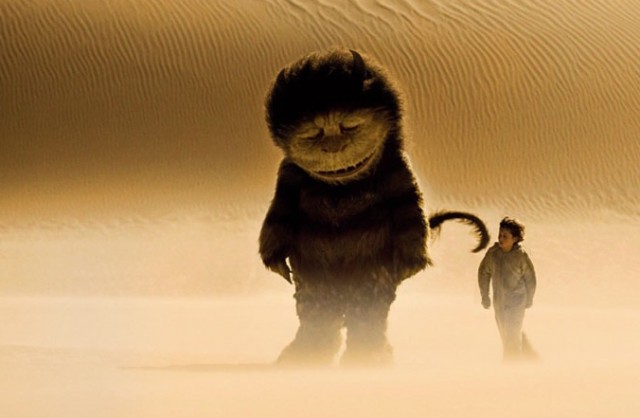
Carol (voiced by James Gandolfini) and Max (Max Records) discuss life in Spike Jonze’s inventive live-action version of WHERE THE WILD THINGS ARE
WHERE THE WILD THINGS ARE (Spike Jonze, 2009)
MoMA Film, Museum of Modern Art
11 West 53rd St. between Fifth & Sixth Aves.
Sunday, July 28, 2:30, and Sunday, August 11, 2:30
Tickets: $12, in person only, may be applied to museum admission within thirty days, same-day screenings free with museum admission, available at Film and Media Desk beginning at 9:30 am
212-708-9400
www.moma.org
www.wherethewildthingsare.warnerbros.com
 The endlessly inventive Spike Jonze (Being John Malkovich, Adaptation.) has done the seemingly impossible, expanding Maurice Sendak’s classic 1963 children’s book, Where the Wild Things Are, into a fun and fantastical feature-length film. Written by Jonze and Dave Eggers (A Heartbreaking Work of Staggering Genius), the movie uses the ten sentences of the book and Sendak’s magical characters and transforms them into a world of wonder. Acting out after his sister’s friends crush his igloo and his divorced mother (Catherine Keener) ignores him in favor of a new boyfriend (Mark Ruffalo), nine-year-old Max (Max Records) runs away and sails across the ocean, landing on a faraway island where seven giant monsters live. In search of a leader, they name Max king, but he gets more than he bargained for as the ruler of the cynical Judith (voiced by Catherine O’Hara), the dumpy Ira (Forest Whitaker), the independent KW (Lauren Ambrose), the mysterious Bull (Michael Berry Jr.), the sad sack Alexander (Paul Dano), the dependable Douglas (Chris Cooper), and, most importantly, the manic-depressive Carol (James Gandolfini).
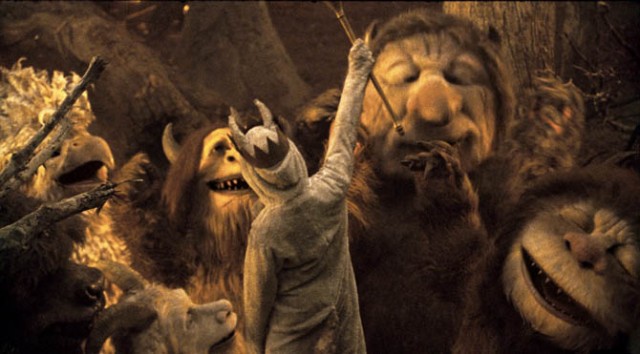
Max becomes king of the forest in cinematic adaptation of Maurice Sendak’s classic bedtime story
Each character represents a different part of Max, a developing emotion that he must learn to deal with as he grows up. He is immediately drawn to Carol, whom he first sees destroying the group’s small, makeshift homes, echoing Max’s feelings about his own family situation. Max’s relationship with Carol — himself in the midst of a breakup with KW — is the heart of the story, as Carol goes from one extreme to another, at one point bouncing around the forest with sheer glee, then snuggling up with everyone in a warming group sleep, and finally turning into a dangerous ogre. As Jonze has pointed out, Wild Things, which received the full blessing of Sendak, is not necessarily a movie for children but about childhood. It beautifully captures a child’s innate sense of adventure and imagination while also showing that choices come with consequences. Fans of the book will be amazed at how well Jonze depicts the Wild Things themselves, which come alive as if they just jumped right out of the pages of the book; actors (not the voice-over artists) are in the costumes, their faces digitally manipulated by CGI effects, but they feel as real as they did when your mother first read you the enchanting story while tucking you in your bed. Where the Wild Things Are is screening July 28 and August 11 as part of the MoMA series “A View from the Vaults: Warner Bros. Today,” which consists of thirty-one films from the last twenty years of movies coming out of the famed studio, including the Harry Potter, Dark Knight, and Lord of the Ring series as well as such wide-ranging fare as Zack Snyder’s Watchmen, Ted Braun’s Darfur Now, Jay Roach’s The Campaign, Christopher Nolan’s Inception, and George Clooney’s Good Night, and Good Luck.

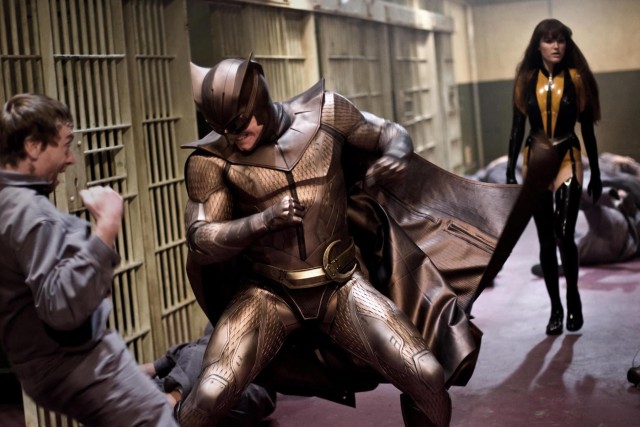
 After more than twenty years, it finally arrived. Zack (300) Snyder’s brilliant, near panel-by-panel re-creation of Alan Moore and Dave Gibbons’s genre-defining Watchmen doesn’t update the setting one bit. It’s still an alternate history, a dystopian 1980s with Richard Nixon in office, celebrating victory in Vietnam while trying to with the Cold War against the Russians. That era’s very real preoccupations might not quite match our own, but in this age of international terrorism, fear of violent death is still used as an effective political tool. Snyder’s bold move, to keep the ’80s setting intact, complete with hair, color, and style, is visually stunning, if oddly disconcerting; he also does an outstanding job going back to the ’50s and ’70s, following Gibbons’s beautiful design and Moore’s musical sensibility. (The soundtrack includes obvious songs by Dylan, Hendrix, Simon & Garfunkel, Leonard Cohen, and Wagner as well as a killer “Desolation Row” by My Chemical Romance over the closing credits.) Yet the genius lies in the universal nature of Moore’s story. Snyder maintains his atmosphere of dread, of people being tiny cogs caught in a machine manufacturing fear to control humanity, and it works. Because for many, that same system operates today, albeit with different faces, different bad guys, and different silhouettes and color schemes. Snyder’s refusal to update the superficial points out all the more strongly the essential power of Moore’s observations. The look is superb, with Gibbons’s characters walking right off the page and into three dimensions, breathing humans that fully embody their two-dimensional origins, often more fascinating out of costume than dressed for duty.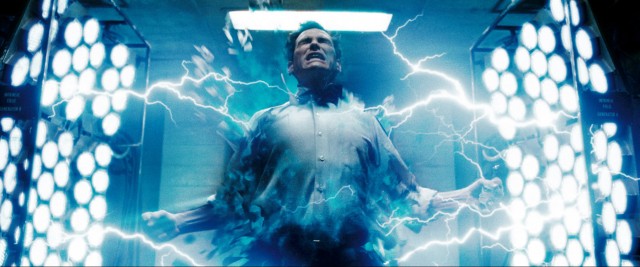
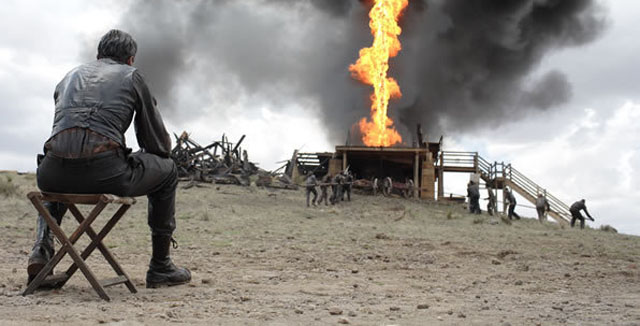
 Daniel Day-Lewis gives a spectacular, Oscar-winning performance as an independent oil man in Paul Thomas Anderson’s There Will Be Blood. Day-Lewis, in remarkable voice, absolutely embodies Daniel Plainview, a determined, desperate man digging for black gold in turn-of-the-century California. His first strike comes at a heavy price as he loses one of his men in a tragic accident, so he adopts the worker’s infant son, raising H.W. (Dillon Freasier) as his own. The growth of his company leads him to Little Boston, a small town that has oil just seeping out of its pores. But after not allowing Paul Sunday (Paul Dano), the charismatic preacher who runs the local Church of the Third Revelation, to say a prayer over the community’s first derrick, Plainview begins his descent into hell. Using Upton Sinclair’s 1927 novel Oil! as a starting point (and employing echoes of Orson Welles’s Citizen Kane and The Magnificent Ambersons in addition to the obvious reference, George Stevens’s classic 1956 oil flick Giant), writer-director Anderson (Boogie Nights, The Master) has created a thrilling epic about greed, power, and corruption as well as jealousy, murder, and, above all, family, where oil gushes out of the ground with fire and brimstone. Robert Elswit’s beautiful, Oscar-winning cinematography is so gritty and realistic, audiences will be reaching for their faces to wipe the oil and blood off. The piercing, classically based score, composed by Radiohead guitarist Jonny Greenwood, builds to a mind-blowing crescendo by the end of the film — a finale that is likely to be much talked about and widely criticized. Filmed in the same location — Marfa, Texas — where Giant was set, There Will Be Blood is an unforgettable journey into the dark heart of one man’s soul. The film is screening in a DCP projection July 27 at 5:30 and July 28 at 1:00 as part of the Museum of the Moving Image series “See It Big! The American Epic,” which continues July 28 at 4:30 with longtime Christian Science Monitor film critic Peter Rainer introducing Charles Laughton’s The Night of the Hunter, followed by a book signing of his new Rainer on Film: Thirty Years of Film Writing in a Turbulent and Transformative Era.