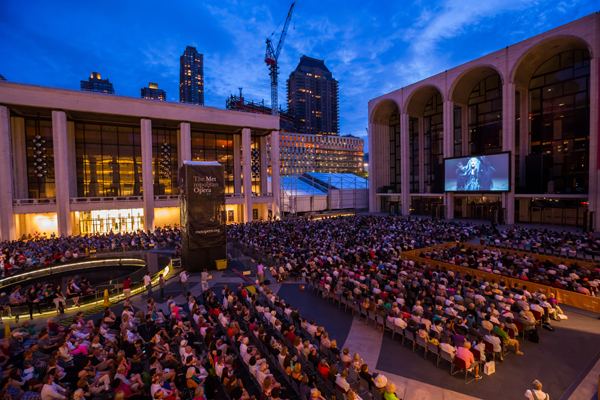
The Met will be screening recent productions of operas for free on Lincoln Center Plaza August 24 – September 2 (photo by Chris Lee)
Lincoln Center Plaza
Broadway at 64th St.
August 24 – September 2, free, 8:00
www.metoperafamily.org
Over the last several years, the Metropolitan Opera has been expanding its reach, presenting HD screenings of its productions, both live and previously recorded, on television and in movie theaters around the country, and more recently it has instituted the Free Summer HD Festival, holding free first-come, first-served screenings outside on Lincoln Center Plaza, by the fountain. This year’s series comprises ten operas recorded between 2008 and 2013, beginning August 24 with Willy Decker’s version of Verdi’s La Traviata, featuring Natalie Dessay, Matthew Polenzani, and Dimitri Hvorostovsky, conducted by Fabio Luisi. Mary Zimmerman’s staging of Donizetti’s Lucia di Lammermoor will be shown August 25, with Anna Netrebko, Piotr Beczala, Mariusz Kwiecien, and Ildar Abdrazakov, conducted by Marco Armiliato, followed August 26 by Robert Lepage’s take on Thomas Adès’s The Tempest, starring Audrey Luna, Isabel Leonard, Alan Oke, Alek Shrader, and Simon Keenlyside, conducted by Adès. The nightly festival continues with Renée Fleming in Verdi’s Otello, Jean-Pierre Ponnelle’s production of Mozart’s La Clemenza di Tito, James Levine conducting Berlioz’s La Damnation de Faust, the 2013 Met premiere production of David McVicar’s version of Donizetti’s Maria Stuarda, Netrebko in Massenet’s Manon, and the return to Sweden of Verdi’s Un Ballo in Maschera, then concluding September 2 with Luisi conducting Liudmyla Monastyrksa in Sonja Frisell’s staging of Verdi’s Aida.
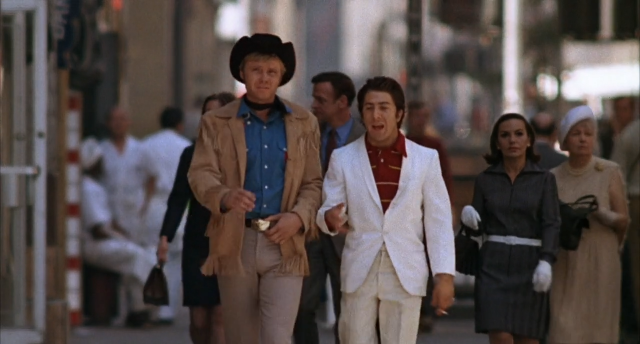
 Dustin Hoffman and Jon Voight star as the worst hustlers ever in John Schlesinger’s masterful Midnight Cowboy. The only X-rated film to win a Best Picture Oscar, Midnight Cowboy follows the exploits of Joe Buck, a friendly sort of chap who leaves his small Texas town, determined to make it as a male prostitute in Manhattan. Wearing his cowboy gear and clutching his beloved transistor radio, he trolls the streets with little success. Things take a turn when he meets up with Enrico Salvatore “Ratso” Rizzo (Hoffman), an ill, hobbled con man living in a condemned building. The two loners soon develop an unusual relationship as Buck is haunted by nightmares, shown in black-and-white, about his childhood and a tragic event that happened to him and his girlfriend, Crazy Annie (Jennifer Salt), while Rizzo dreams of a beautiful life, depicted in bright color, without sickness or limps on the beach in Miami. Adapted by Waldo Salt (Serpico, The Day of the Locust) from the novel by James Leo Herlihy, Midnight Cowboy is essentially a string of fascinating and revealing set pieces in which Buck encounters unusual characters as he tries desperately to succeed in the big city; along the way he beds an older, wealthy Park Ave. matron (Sylvia Miles), is asked to get down on his knees by a Bible thumper (John McGiver), gets propositioned in a movie theater by a nerdy college student (Bob Balaban), has a disagreement with a confused older man (Barnard Hughes), and attends a Warholian party (thrown by Viva and Gastone Rosilli and featuring Ultra Violet, Paul Jabara, International Velvet, Taylor Mead, and Paul Morrissey) where he hooks up with an adventurous socialite (Brenda Vaccaro). Photographed by first-time cinematographer Adam Holender (The Panic in Needle Park, Blue in the Face), the film captures the seedy, lurid environment that was Times Square in the late 1960s; when Buck looks out his hotel window, he sees the flashing neon, with a sign for Mutual of New York front and center, the letters “MONY” bouncing across his face with promise. The film is anchored by Harry Nilsson’s Grammy-winning version of “Everybody’s Talkin’,” along with John Barry’s memorable theme. Iconic shots are littered throughout, along with such classic lines as “I’m walkin’ here!” Midnight Cowboy, which was nominated for seven Oscars and won three (Best Picture, Best Adapted Screenplay, and Best Director) is screening August 25 at 5:00 as part of the Museum of the Moving Image series “Fun City: New York in the Movies 1967-75,” which is guest curated by J. Hoberman and continues through September 1 with such other Big Apple fare as The Taking of Pelham One Two Three, Born to Win, Dog Day Afternoon, and Taking Off.

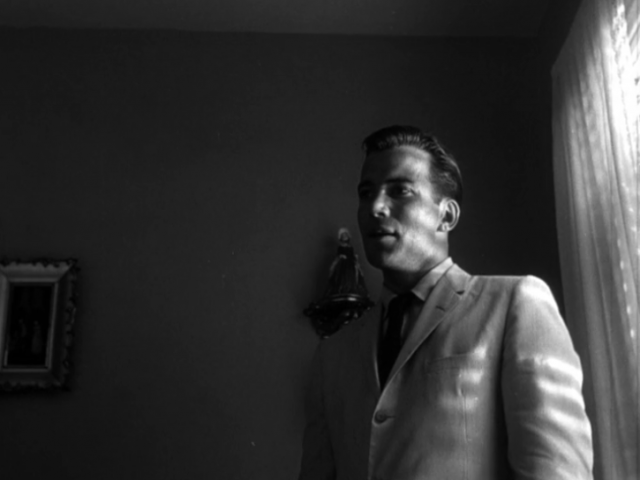
 Exploitation master Roger Corman shot out of the gates in the mid-1950s, directing and/or producing more than three dozen films between 1955 and 1961, directing doomsday disasters (Day the World Ended, Last Woman on Earth) and sci-fi quickies (It Conquered the World, Attack of the Crab Monsters), cheapie Westerns (Gunslinger, The Oklahoma Woman) and teen rave-ups (Sorority Girl, Teenage Doll), crime dramas (Machine-Gun Kelly; I, Mobster) and horror (A Bucket of Blood, The Undead), as well as the tales of Poe (House of Usher, The Pit and the Pendulum). But he tried something a little different with 1962’s The Intruder, a gripping, yet still exploitative, story of integration set in the ultraconservative south. Adapted by Charles Beaumont from his 1959 novel, which itself was inspired by the Little Rock Nine, the film stars William Shatner as Adam Cramer, a self-styled “social reformer” who arrives in the small southern town of Caxton just after integration has become law and just as ten black students, led by Joey Greene (Charles Barnes), are about to join whites at the local high school. Under the auspices of the John Birch-like Patrick Henry Society, Cramer is determined to continue the fight against integration, stirring the locals to potential mob violence through carefully orchestrated speeches filled with hate and lies. He allies himself with wealthy plantation owner Verne Shipman (Robert Emhardt) and cozies up to high school girl Ella McDaniel (Beverly Lunsford), daughter of newspaper editor Tom McDaniel (Frank Maxwell), one of the only reasonable white men in town. The manipulative Cramer will do just about anything to rile up the masses to keep the blacks from ruining America, but his own questionable personal morality might just get in the way, especially as he flirts with Vi (Jeanne Cooper), the wife of traveling salesman Sam Griffin (Leo Gordon).