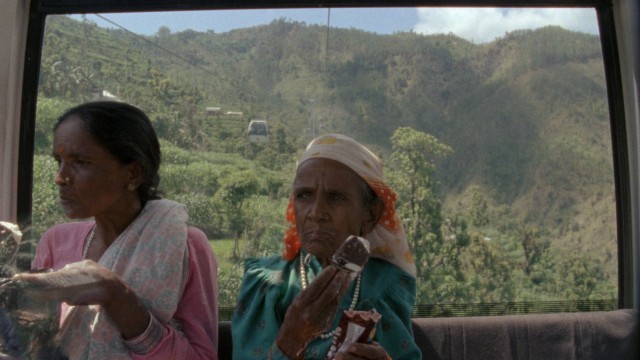
A mother and daughter eat ice cream in experimental documentary MANAKAMANA
MANAKAMANA (Stephanie Spray & Pacho Velez, 2013)
Film Society of Lincoln Center
Walter Reade Theater, 165 West 65th St. at Amsterdam Ave.
Saturday, September 28, 1:30
Howard Gilman Theater, 144 West 65th St. at Amsterdam Ave.
Monday, September 30, 3:30
Festival runs September 27 – October 13
212-875-5601
www.filmlinc.com
www.manakamanafilm.com
 If you’re an adventurous filmgoer who likes to be challenged and surprised, the less you know about Pacho Velez and Stephanie Spray’s Manakamana, the better. But if you want to know more, here goes: Evoking such experimental films as Michael Snow’s Wavelength, Hollis Frampton’s Zorns Lemma, and Andy Warhol’s Screen Tests as well as the more narrative works of such unique auteurs as Jim Jarmusch and Abbas Kiarostami, Manakamana is a beautiful, meditative journey that is sure to try your patience at first. The two-hour film, which requires a substantial investment on the part of the audience, takes place in a cable car in Nepal that shuttles men, women, and children to and from the historic Manakamana temple, on a pilgrimage to worship a wish-fulfilling Hindu goddess. With Velez operating the stationary Aaton 7 LTR camera — the same one used by Robert Gardner for his 1986 documentary Forest of Bliss — and Spray recording the sound, the film follows a series of individuals and small groups as they either go to or return from the temple, traveling high over the lush green landscape that used to have to be traversed on foot before the cable car was built. A man and his son barely acknowledge each other; a woman carries a basket of flowers on her lap; an elderly mother and her middle-age daughter try to eat melting ice-cream bars; a pair of musicians play their instruments to pass the time.
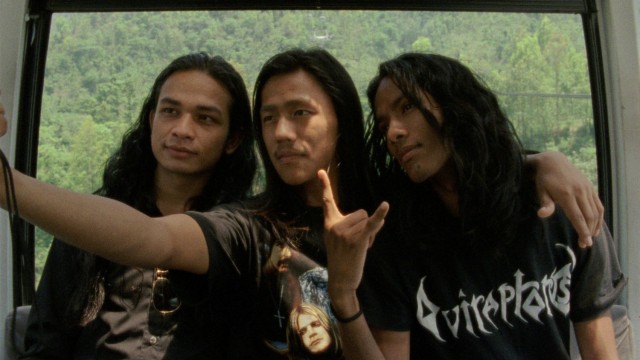
A heavy metal band takes a picture of themselves in meditative documentary
Each trip has its own narrative, which must be partly filled in by the viewer as he or she studies the people in the cable car and the surroundings, getting continually jolted as the car glides over the joins. The film is a fascinating look into human nature and technological advances in this era of surveillance as the subjects attempt to act as normal as possible even though a camera and a microphone are practically in their faces. Produced at the Sensory Ethnography Laboratory at Harvard, Manakamana consists of eleven uncut shots of ten-to-eleven minutes filmed in 16mm, using rolls whose length roughly equals that of each one-way trip, creating a kind of organic symbiosis between the making and projecting of the work while adding a time-sensitive expectation on the part of the viewer. A film well worth sticking around for till the very end — and one that grows less and less claustrophobic with each scene — Manakamana is screening September 28 and 30 in the Motion Portraits section of the fifty-first New York Film Festival at Lincoln Center.


 Seán Ó Cualáín puts one of the most iconic photographs ever of New York City under the microscope in the interesting yet too often slipshod documentary Men at Lunch. In 1932, a photographer snapped a picture of eleven construction workers having lunch while sitting atop a girder on what would become the sixty-ninth floor of the RCA Building in Rockefeller Center. The men are casually talking, having a smoke, and holding white cardboard lunchboxes while dangling their feet some 850 feet in the air, a bustling city below them, Central Park sprawled out behind them. Narrated by Fionnula Flanagan (Ulysses, Waking Ned Devine), the film delves into who the men might be, attempts to figure out whether it was indeed Charles C. Ebbets who took the photo, and seeks to put the picture into the social and cultural context of the depression and the wave of immigration, focusing on the Irish (the film is an Irish production), many of whom went into the construction industry. “This is a photograph in which every element of photography and of New York City kind of come together with spectacular panache,” filmmaker Ric Burns says. But while Ó Cualáín employs captivating archival footage as he tries to solve the photograph’s many mysteries, he extends the focus too far, biting off more than he can chew in a mere seventy minutes, as a handful of talking heads and Niall Murphy’s text make grand statements about the human condition in the twentieth century that are too often a reach, then spends too much time with a pair of Irish characters who believe they are related to two of the men in the picture. Still, the part of the film that zeroes in on the taking of the photograph is absolutely fascinating.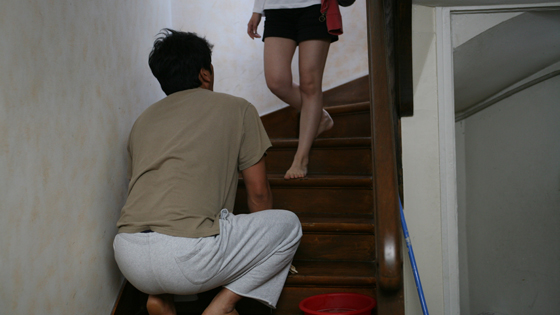
 Korean writer-director Hong Sang-soo returned to the New York Film Festival for the fifth time with Night and Day, a character-driven tale about displacement and loneliness. Youngho Kim stars as Sungam, a married painter in his forties who flees South Korea for France after having been turned in for smoking marijuana with U.S. tourists. A fish out of water in Paris, he settles into a Korean neighborhood, spending most of his time with two young art students, Yujeong (Eunhye Park) and Hyunju (Minjeong Seo). He also meets an old girlfriend, Minsun (Youjin Kim), who is still attracted to him. And every night he calls his wife, Sungin (Sujung Hwang), wondering when he’ll be able to return home. Hong (Woman Is the Future of Man, Tale of Cinema) tells the story in a diary-like manner, with interstitials acting like calendar pages. Sometimes a day can be filled with talk of art, a party, and a chance encounter, while others can consist of a brief, random event with no real bearing on the plot, reminiscent of Jim Jarmusch’s Stranger Than Paradise, just without the existential cynicism and dark humor. As with 2006’s Woman on the Beach, Hong lets Night and Day go on too long (it clocks in at 141 minutes), with too many inconsequential (even if entertaining) vignettes, but it’s so much fun watching Youngho’s compelling performance that you just might not care about the length. Night and Day is screening September 20 at 9:00 as part of the Film Society of Lincoln Center’s “NYFF: Opening Act” series, featuring sixteen films from directors whose latest works will be shown at the fifty-first New York Film Festival, which runs September 27 through October 13. “NYFF: Opening Act” also includes outstanding films as Spike Jonze’s Adaptation., Paul Greengrass’s Bloody Sunday, Hirokazu Kore-eda’s Maborosi, Joel Coen’s Miller’s Crossing, and Kiyoshi Kurosawa’s Pulse. Hong’s delightful Nobody’s Daughter Haewon screens at this year’s New York Film Festival on September 29 and 30.
 Zachary Heinzerling’s