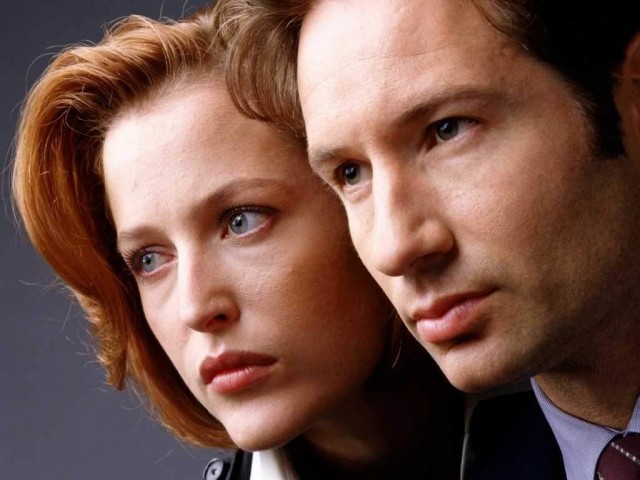
Gillian Anderson and David Duchovny will talk X-FILES and take pictures with fans at New York Comic Con
Jacob K. Javits Convention Center
655 West 34th St. (11th Ave. between 34th & 39th Sts.)
October 10-13, $30-$50 per day, four-day pass $85
www.newyorkcomiccon.com
New York Comic Con continues its exponential growth this year by focusing on the small screen more than ever. The eighth edition, taking place October 10-13 at the Javits Center, includes presentations on a wide range of television programs, including Game of Thrones, Haven, Falling Skies, The Following, The Walking Dead, Robot Chicken, Archer, Bob’s Burgers, Doctor Who, Teen Wolf, Futurescape with James Woods, Marvel’s Agents of S.H.I.E.L.D., Person of Interest, Sleepy Hollow, The League, and others, with the shows’ stars, writers, and producers on hand for screenings, discussions, and Q&As, all free with the price of admission. There are lots of autograph sessions and photo ops as well, but some of them will cost you a pretty penny; it’s $220 to get your picture taken with Patrick Stewart and William Shatner together, or with Gillian Anderson and David Duchovny, who will be talking up The X-Files on Sunday afternoon. Below are our recommendations for this year’s convention; please note that many of the guests will be signing autographs on multiple days.
Thursday, October 10
Autographing Highlights: Zoë Bell, Marissa Jade, Miss Zukie, Kathy Najimi, Joe Quinones, Greg Pack, Greg Rucka, Jamie Tyndall
Women in Comics, with Claudia McGivney, Megan Kociolek, Amy Chu, Becky Cloonan, Emily Weisenstein, Erica Schultz, and Laura Pope-Robbins, 1A15, 3:15
Welcome to the Brass Screen: Steampunk TV and Film, with Bruce Boxleitner, Matt James Daley, Thom Truelove, Trevor Crafts, and Leanna Renee Hieber, moderated by Diana Pho, 1A17, 3:45
Bill Plympton’s Cheatin’ & Kickstarter, with Adam Rackoff, James Hancock, and Bill Plympton, 1A08, 4:15
Carmine Infantino: A VisualLecture Retrospective, with Arlen Schumer, 1A08, 6:45
NYCC Thursday Night Kickoff with Comedy Mutant, featuring Brian Posehn, Janeane Garofalo, Mike Drucker, and Myq Kaplan, Main stage 1-D, 8:00
Friday, October 11
Autographing Highlights: Kristin Bauer, Andrea Cremer, Mick Foley, Joel Grey, Dean Haspiel, Darlene Love, Greg Pak, Raphael Sbarge, Stuart Moore, Veronica Taylor
Hatsune Miku Live Party 2013 in Kansai Special Film Concert at NYCC, 1A23, 11:15 am
He’s Back! Celebrate Chucky’s 25th Anniversary with the Creators & Cast, with Brad Dourif, Danielle Bisutti, Don Mancini, Fiona Dourif, Harry Knowles, and Jennifer Tilly, Main Stage 1-D, 12:15
Game of Thrones with Jerome Flynn, 1A23, 12:30
B. J. Novak’s One More Thing: Stories and Other Stories, with B. J. Novak and Lev Grossman, 1A22, 1:30
Will.i.am’s Wizards and Robots, with will.i.am, 1A23, 1:45
The Walking Dead 10th Anniversary Panel,” with Charlie Adlard and Robert Kirkman, Empire Stage 1-E, 2:45
[Adult Swim] Presents Robot Chicken, with Breckin Meyer, Clare Grant, Keith Crofford, Matthew Senreich, and Seth Green, Main Stage 1-D, 5:00
Oldboy, with Mark Protosevich, Michael Imperioli, and Pom Klementieff, Main Stage 1-D, 6:00
Spotlight on the Fifth Beatle: The Story of Brian Epstein, with Bruce Cohen, Dave Marsh, David Kahne, Vivek J. Tiwary, and Andrew C. Robinson, 1A01, 6:30
The Cyanide and Happiness Show! with Dave McElfatrick, Kris Wilson, and Shawn Coss, 1A10, 8:00
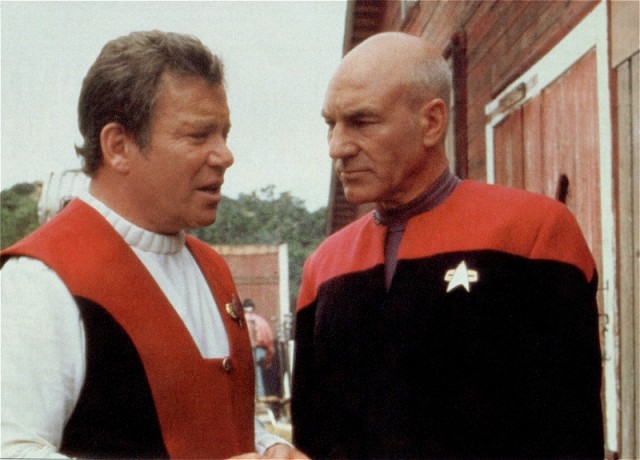
William Shatner and Patrick Stewart will be together again at New York Comic Con
Saturday, October 12
Autographing Highlights: Gillian Anderson, Julie Benz, Bruce Boxleitner, David Duchovny, Boomer Esiason, Hulk Hogan, Jerry “the King” Lawler, Stan Lee, Andrew McCarthy, William Shatner, Neil deGrasse Tyson, Billy West
Archer Discussion and Q&A, with Adam Reed, Aisha Tyler, Amber Nash, Chris Parnell, H. Jon Benjamin, Jessica Walter, Judy Greer, and Lucky Yates, Main Stage 1-D, 11:00 am
Fifty Years of Doctor Who, with Barnaby Edwards, Deborah Stanish, Graeme Burk, JK Woodward, Ken Deep, Robert Smith (TBC), and Andre Tessier, 1A23, 11:15
Spotlight on J. Michael Straczynski, with J. Michael Straczynski, 1A14, 12:15
IFC’s Back to Back Comedy Event: Comedy Bang! Bang! and The Birthday Boys, with members of the Birthday Boys, Reggie Watts, and Scott Aukerman, 1A06, 2:30
Beauty and the Beast Screening and Fan Q&A, with Jay Ryan, Kristin Kreuk, and Matt Mitovich, Main Stage 1-D, 3:45
Marvel’s Agents of S.H.I.E.L.D., with Jeph Loeb, Main Stage 1-D, 5:00
Showrunners, with Des Doyle, Greg Plageman, Ronald D. Moore, Ryan Patrick McGuffey, and Terence Winter, moderated by Tara DiLullo Bennett, 1A23, 5:30
AMC’s The Walking Dead, with Andrew Lincoln, Chad Coleman, Danai Gurira, Lauren Cohan, Melissa McBride, Norman Reedus, and Steven Yeun, moderated by Debra Birnbaum, Main Stage 1-D, 6:30
Wikia (Live) Cosplay Contest, 1A06, 8:30
Sunday, October 13
Autographing Highlights: John Barrowman, Anthony Daniels, Chip Kidd, Gareth David-Lloyd, Simon Fraser, Andrew McCarthy, William Shatner, Gary Sohmers, Patrick Stewart
Sunday Conversation with Dan DiDio, 1A06, 10:45 am
Defiance: A New Earth — with New Rules, with Grant Bowler, Jaime Murray, Julie Benz, Michael Nankin, and Stephanie Leonidas, Main Stage 1-D, 11:00
Person of Interest Special Video Presentation and Q&A, with Amy Acker, Greg Plageman, Kevin Chapman, Sarah Shahi, and Taraji P. Henson, Empire Stage 1-E, 12:15
The Following Special Video Presentation and Q&A, with Connie Nielsen, James Purefoy, Kevin Bacon, Kevin Williamson, Marcos Siega, Shawn Ashmore, and Valorie Curry, Empire Stage 1-E, 1:30
Chozen Screening and Q&A, with Bobby Moynihan, Grant Dekernion, Hannibal Buress, Method Man, and Tom Brady, Main Stage 1-D, 1:30
The Making of Star Wars: Return of the Jedi, with J. W. Rinzler and Jason Fry, 1A23, 2:45
William Shatner Q&A, 1A22, 3:45
Gillian Anderson & David Duchovny Talk X-Files, Main Stage 1-D, 4:00
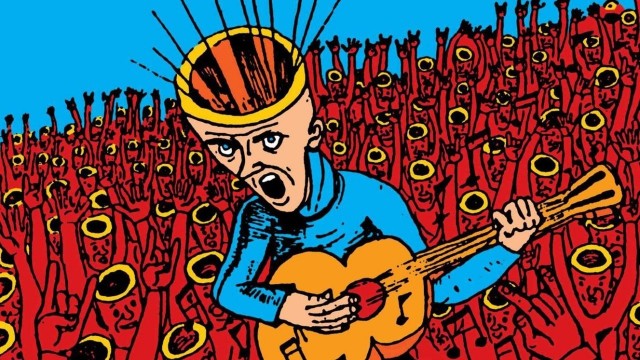
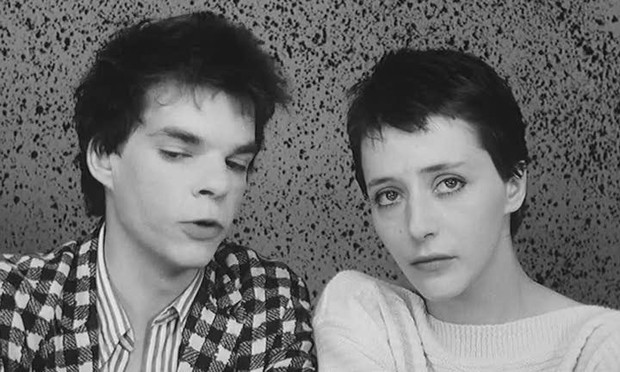
 Jeff Feuerzeig’s The Devil and Daniel Johnston is a sad portrait of fame and folly. The mesmerizing documentary examines the life and career of Daniel Johnston, an outsider artist and musician who has a ravenous underground following. From the time he was a kid, Johnston was obsessed with recording his existence, making deeply personal audiocassettes and inventive Super-8 films, many of which Feuerzeig includes here, revealing Johnston’s curious, unique past. In the mid-1980s, Johnston recorded a pair of homemade tapes, Songs of Pain and More Songs of Pain, that detailed his unrequited love for an acquaintance of his named Laurie. His music quickly developed a cult audience, landing him on MTV and at the prestigious SXSW festival while gaining such fans as Kurt Cobain, Matt Groening, Sonic Youth, and the Butthole Surfers. All the while, he created comic-book-style paintings and drawings that began to be shown in galleries. But as Feuerzeig’s amazing mix of archival footage, home movies, and new interviews reveals, Johnston is also a manic depressive with severe mental problems who cannot survive on his own. At the time of the film’s release, Johnston was in his mid-forties, still living with his Christian fundamentalist parents, seemingly as childlike as ever, unable to understand the realities of his situation. While many people consider him a genius — at the beginning of the film, he is introduced at a live gig as the greatest songwriter in the world, and his art was part of the 2006 Whitney Biennial — it’s also easy to think that he’s being celebrated for all the wrong reasons and that this worship is doing him — and us — more harm than good. Favorite scene: Butthole Surfer Gibby Haynes talking about Johnston while sitting in a dentist’s chair getting his teeth drilled. The Devil and Daniel Johnston is screening October 12-13 at Nitehawk Cinema as part of the CBGB Festival (as well as the continuing Nitehawk series “Music Driven” and “Brunch Screenings”), which also includes such other music-related films as Searching for Sugarman, The Blank Generation, The Stone Roses: Made of Stone, and Twenty Feet from Stardom.
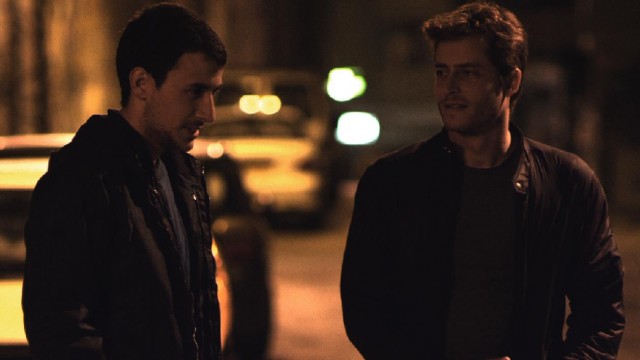
 Israeli-born, L.A.-based director Michael Mayer’s debut feature film, Out in the Dark, is a gripping romantic thriller about two men forced to make dangerous choices if they want their love to survive. One night in a Tel Aviv gay club, Israeli lawyer Roy (Michael Aloni) and Palestinian student Nimr (Nicholas Jacob, in his acting debut) instantly hit it off. Roy works in his father’s business, and his parents (Alon Oleartchik and Cheli Godenberg) accept his sexuality. But Nimr, who lives in Ramallah and has just received a permit to cross the border in order to take an important class in Tel Aviv, has to hide his sexual orientation from his younger sister, Abir (Palestinian singer Maysa Daw), his mother, Hiam (Khawlah Haj), and his older brother, Nabil (Jameel Khouri), who is part of a local gang that has it in for gays and Palestinian collaborators. So when Nimr’s permit is revoked by a hard-line Israeli officer, Gil (Alon Pdut), who insists that Nimr give him information, Roy and Nimr have to fight for their relationship — and, perhaps, their lives. Written by Mayer with Yael Shafrir, Out in the Dark is photographed in intimate, dark close-ups by Ran Aviad that heighten the emotional tension. The story never gets polemic or takes sides, as it shows that there are good and bad people in both Israel and Palestine, providing a microcosm of the long, violent stalemate that has led to so many individuals paying a severe personal price. Winner of Audience Awards at eight film festivals around the world (in addition to other prizes), Out in the Dark is currently screening at Cinema Village.