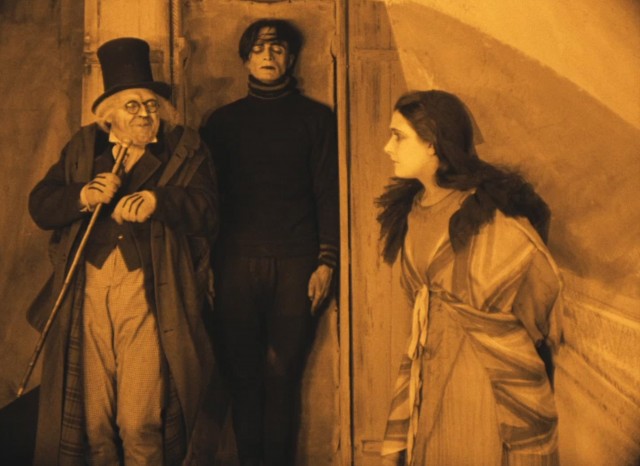
Influential horror classic is brought back to life in stirring new restoration
THE CABINET OF DR. CALIGARI (DAS CABINET DES DR. CALIGARI) (Robert Wiene, 1920)
Film Forum
209 West Houston St.
October 31 – November 6
212-727-8110
www.filmforum.org
www.kinolorber.com
 Back in high school, we saw The Cabinet of Dr. Caligari for the first time in the somewhat dubious “Christian Values in Film” class. The verdict: The Cabinet of Dr. Caligari has no Christian values. But the Caligari we saw back then is rather different from the one we saw earlier this week, a 4K digital restoration from the original camera negative by the Friedrich Murnau Foundation and with a fresh new score by John Zorn. This sparkling Caligari is now the only way to see this truly frightening work, one of the most influential horror films of all time. You can find elements of Paul Wegener’s The Golem, James Whale’s Frankenstein and The Bride of Frankenstein, and Todd Browning’s Dracula — all three of which followed this truly seminal film — in this twisted, unsettling psychological thriller of murder and mayhem involving the mysterious Dr. Caligari (Werner Krauss) and the creepy somnambulist he controls, Cesare (Casablanca’s Conrad Veidt), who predicts the future and eerily walks in his sleep. The tale is told in a frame story by Francis (Friedrich Fehér), who, like his best friend, Alan (Hans Heinrich von Twardowski), is in love with Jane (Lil Dagover). The only problem is that Cesare might have a thing for her as well.
A masterpiece that set high the bar for German Expressionism, The Cabinet of Dr. Caligari might have been shocking when it debuted in 1920, but it’s still shocking today, like nothing you’ve ever seen, with one of the most memorable, enigmatic villains ever put on celluloid. It’s not a traditional silent black-and-white film, instead tinted in blue and gold, with intertitles exploding in a wild green font. The sets, by Hermann Warm, Walter Reimann, and Walter Röhrig, are sharply slanted, with crazy angles and perspectives and backdrops that include unmoving shadows painted right on them; they’re obviously fake and very fragile, adding yet more levels of weirdness. Written by Hans Janowitz and Carl Mayer, photographed by Willy Hameister (irising in and out, occasionally at the same time), and directed by Robert Wiene (Raskolnikov, Der Rosenkavalier), The Cabinet of Dr. Caligari is thick with an ominous, sinister atmosphere that is sheer pleasure; you’ll find yourself smiling at the beauty of it all even as you tense up at the hair-raising proceedings. It is that rare film that works as historical document as well as pure entertainment, a treat for cinema enthusiasts and horror fans alike, especially when the twist ending turns everything inside out and upside down. The Cabinet of Dr. Caligari will be scaring audiences for a week at Film Forum beginning on Halloween, Christian values or not.

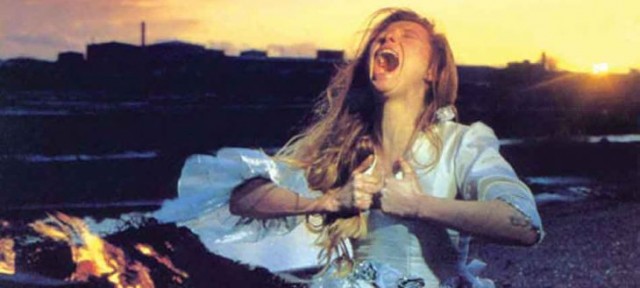

 Shortly after the fatal Deepwater Horizon oil rig explosion on April 20, 2010, dumped more than two hundred million gallons of BP oil into the Gulf of Mexico, Alabama native and award-winning documentarian Margaret Brown (The Order of Myths, Be Here to Love Me: A Film about Townes Van Zandt) returned to the Gulf Coast, where she was raised, in order to make a very personal film about the disaster. But she ended up with so much more in The Great Invisible, a powerful, infuriating exploration of the tragedy and its lingering effects on the environment and local communities in Alabama, Louisiana, and Texas. Showing that the calamity is far from over, Brown speaks with survivor Douglas Brown, the chief mechanic on the rig who talks poignantly about what happened, sharing footage he took of the rig prior to the explosion; survivor Stephen Stone, a roustabout on the rig who now suffers from PTSD; attorney Keith Jones, whose son, Gordon, was one of the eleven workers killed in the explosion, and is now leading the fight to get justice for the victims in court; Latham Smith, a tugboat captain who was called in to help with the cleanup; oil and gas industry veteran Bob Cavnar, author of Disaster on the Horizon: High Stakes, High Risks, and the Story Behind the Deepwater Well Blowout; Roosevelt Harris, who volunteers for the Hemley Road Church of Christ Mobile Food Pantry, delivering food and emotional support to families whose livelihoods have been impacted by the disaster; a group of oil industry executives chatting among themselves; and Kenneth Feinberg, the dispute resolution specialist in charge of administering the BP Deepwater Horizon Disaster Victim Compensation Fund, which has not exactly made much of a difference. BP refused to participate in the film.
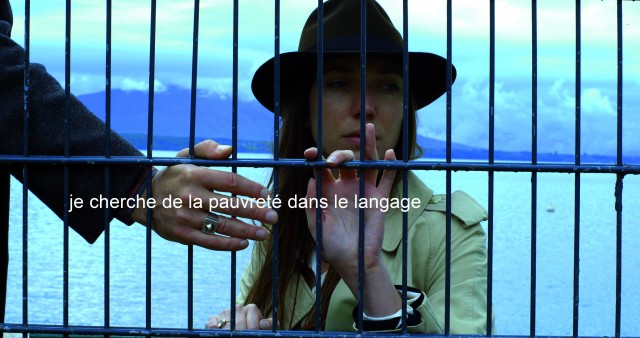
 After the New York Film Festival advance press screening of Jean-Luc Godard’s 3D Goodbye to Language, a colleague turned to me and said, “If this was Godard’s first film, he would never have had a career.” While I don’t know whether that might be true, I do know that Goodbye to Language is the 3D flick Godard was born to make, a 3D movie that couldn’t have come from anyone else. What’s it about? I have no idea. Well, that’s not exactly right. It’s about everything, and it’s about nothing. It’s about the art of filmmaking. It’s about the authority of the state and freedom. It’s about extramarital affairs. It’s about seventy minutes long. It’s about communication in the digital age. (Surprise! Godard does not appear to be a fan of the cell phone and Yahoo!) And it’s about a cute dog (which happens to be his own mutt, Miéville, named after his longtime partner, Anne-Marie Miéville). In the purposefully abstruse press notes, Godard, now eighty-three, describes it thusly: “the idea is simple / a married woman and a single man meet / they love, they argue, fists fly / a dog strays between town and country / the seasons pass / the man and woman meet again / the dog finds itself between them / the other is in one / the one is in the other / and they are three / the former husband shatters everything / a second film begins / the same as the first / and yet not / from the human race we pass to metaphor / this ends in barking / and a baby’s cries.” Yes, it’s all as simple as that. Or maybe not.

 Winner of the FIPRESCI Prize at the Cannes Film Festival and a selection of the New York Film Festival, Climates is a beautifully elegiac look at a desperate relationship set in modern-day Turkey. The film opens with Isa (writer-director Nuri Bilge Ceylan) and Bahar (Ebru Ceylan, Nuri’s real-life wife) visiting desert ruins. As he walks among ancient pillars, taking photos, she watches him from a distance; the silence is deafening. Later, on a beach, they agree to part ways; while he heads back into the arms of Serap (Nazan Kesal), a friend’s lover, she takes a job on a faraway television program, set in the bitter cold and snow. But Isa still can’t get the younger Bahar out of his mind. Climates features long scenes of little dialogue, with cinematographer Gökhan Tiryaki alternating extreme close-ups with gorgeous, nearly empty landscapes, shot in HD digital video, with a haunting piano-based score. Ceylan’s follow-up to Distant, which won the 2003 Jury Grand Prix at Cannes, Climates is a wrenching, challenging tale that will leave audiences emotionally exhausted. Climates is being shown at MoMA on October 30 at 7:30 and November 5 at 4:00 as part of the “Filmmaker in Focus” look at Ceylan, who will introduce the the October 30 screening with actor Mehmet Eryilmaz. The week-long festival runs October 29 to November 5 and also includes Ceylan’s latest film, Kis uykusu (Winter Sleep), in addition to 2011’s Bir Zamanlar Anadolu’da (Once Upon a Time in Anatolia), 2008’s Üç maymun (Three Monkeys), 2002s Uzak (Distant), 1999’s Mayis sikintisi (Clouds of May), and 1997’s Kasaba (The Small Town).
 Called “the most revolutionary group in the history of rock ‘n’ roll” by Lester Bangs,