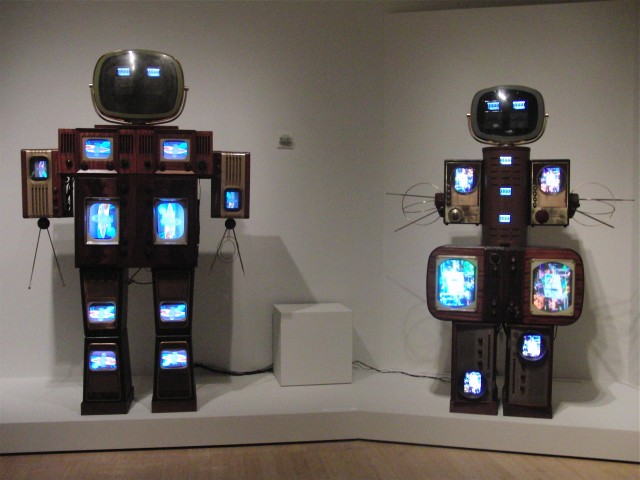
Nam June Paik, “Family of Robot: Father” and “Family of Robot: Mother,” single-channel video sculptures with vintage television and radio casings and monitors, tuner, liquid crystal display, color, silent, 1986 (photo by twi-ny/mdr)
Asia Society Museum
725 Park Ave. at 70th St.
Tuesday – Sunday through January 4, $12, 11:00 am – 6:00 pm (free Fridays 6:00 – 9:00)
212-288-6400
www.asiasociety.org
www.paikstudios.com
I was on the subway late last week, reading one of the chapters in the “Nam June Paik: Becoming Robot” catalog for the splendid exhibition at Asia Society, when I looked up and saw an ad for a company that proclaimed, “The most powerful inventions are playful. . . . The most playful inventions are powerful,” touting a robot head, a remote pet feeder, and a synthar. The advertisement made me immediately think of the life and work of Paik, who instilled his highly technological, often futuristic sculptures, musical compositions, videos, drawings, installations, and live performances with an innate playfulness. If you’re not ready, willing, and able to have fun with the innovative, visionary Paik, then don’t bother going to Asia Society, because the exhibit, which continues through January 4, is nothing if not a whole lot of fun. The chapter I was reading on the subway was “Ok, Let’s Go to Blimpies: Talking about Nam June Paik,” a lively, informative, and, yes, playful discussion between museum director Melissa Chiu, former Paik studio manager Jon Huffman, former Paik studio assistant Stephen Vitiello, and Paik’s nephew, Ken Hakuta, that gets to the very essence of the international artist. Paik, who was born in Korea in 1932, moved to Hong Kong, studied in Japan, and lived and worked in Germany and New York, was way ahead of his time as he experimented with electronic music and images, television circuitry, and robots that could go to the bathroom, but with a unique, personal, warm touch that predated cell phones, social media, and interactive video games. “He wanted to redefine television [not as a] passive object, but [as] an object that we interact with,” Vitiello, who is a multimedia artist in his own right, says in the catalog. “We control our destiny. He was a humanist; he wanted to humanize everything, and technology was just a way of getting more time in which we could make better artwork, better software, have better lives.”
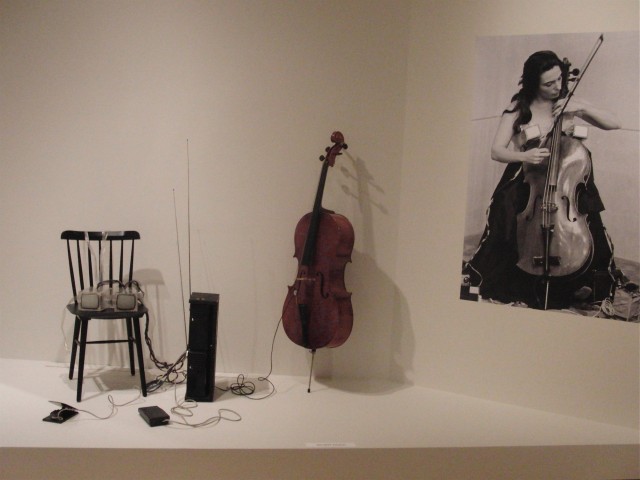
Nam June Paik, “TV Bra for Living Sculpture,” cello, two television sets, microphone, amplifiers, deflection coils, “fussbedienungsgerate,” cables, 1975 (photo by twi-ny/mdr)
The exhibition consists of more than five dozen sculptures, photographs, writings, videos, and other ephemera from throughout Paik’s career. The centerpiece is “Robot K-456,” Paik’s first automated, remote-control-operated, hermaphrotidic robot, which initially could poop beans. (It seems to have lost this function after being purposely hit by a car as part of a major 1982 show at the Whitney.) Also on display is “Family of Robot,” a mother, father, and baby created out of television monitors that blast images across their screens; “Golden Buddha,” a statue watching itself on television (and on which visitors can see themselves as well); “TV Chair,” which features a surveillance camera above and a monitor on the seat; a pair of antique television cabinets on which he has drawn over the surface; a robot brain in a glass dome; and “Three Camera Participation / Participation TV,” which gets a room unto itself, inviting everyone to see colorful, psychedelic projections of themselves in a far corner.
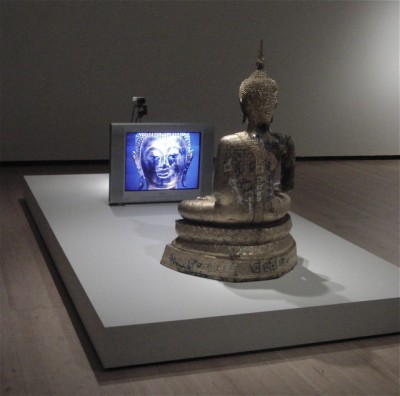
Nam June Paik, “Golden Buddha,” video installation with twenty-seven-inch monitor and closed circuit video camera, painted bronze Buddha with the artist’s additions in permanent oil marker, 2005 (photo by twi-ny/mdr)
Perhaps most fascinatingly, “Becoming Robot” explores the artistic relationship between Paik and classically trained cellist Charlotte Moorman, who would play topless or wearing Paik’s “TV Bra for Living Sculpture” or “Light Bikini.” The show documents various performances, includes a room of many of Moorman’s outfits, and delves into her arrest for indecent exposure while playing Paik’s Opera Sextronique. Nudity also play a role in “Reclining Buddha,” a stone sculpture of a female Buddha relaxing on her side, right hand holding up her head in a classic pose, atop a pair of color monitors depicting a real naked woman in the same position; nearby is a collection of Paik’s decidedly childlike toys. And be sure to allow extra time to watch clips from Paik’s 1984 satellite installation, Good Morning, Mr. Orwell, a different kind of variety show with Moorman, Laurie Anderson, Peter Gabriel, Allen Ginsberg, Merce Cunningham, Philip Glass, and Joseph Beuys, as well as a sampling of Paik’s live performances. In his 1966 Great Bear Pamphlet, “Manifestos,” Paik declared, “Cybernated art is very important, but art for cybernated life is more important, and the latter need not be cybernated.” Eight years later, Paik coined the phrase “electronic superhighway.” As “Becoming Robot” so ably shows, Paik was at the crossroads of technology and culture long before the rest of us, predicting a world that would become obsessed with broadcasting personal information and images on handheld devices that resemble their own personal television stations. All the while, though, he remained philosophical and hopeful about the future, deeply serious about his work but intent on incorporating an intoxicating playfulness that is just plain fun — and decidedly human.
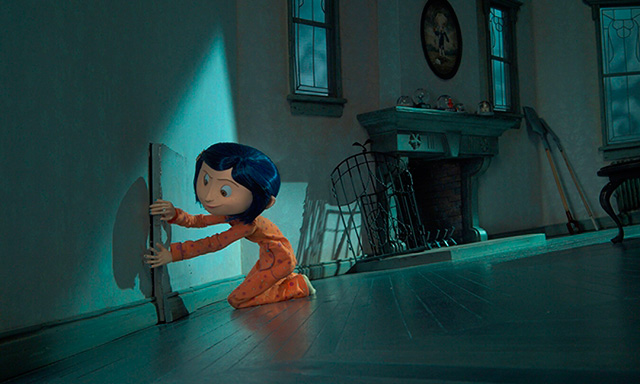
 Coraline Jones (voiced by Dakota Fanning) is an adventurous eleven-year-old in search of some fun and excitement in her new creaky home in Oregon. She finds just what she thinks she was looking for when a rodent introduces her to a hidden passageway that leads to an alternate universe, where replicas of her parents (Teri Hatcher and John Hodgman) are more interested in her and give her whatever she wants. However, this button-eyed Other Mother and Other Father have other plans for her and her real family as well. Written and directed by Henry Selick, Coraline lacks the frantic, nonstop energy of his breakthrough film, Tim Burton’s The Nightmare Before Christmas, but it is still a fun, creepy trip down the Narnia-esque rabbit hole. Combining his trademark stop-motion animation (James and the Giant Peach) with breathtaking stereoscopic 3-D that adds remarkable depth to the images, Selick does a marvelous job bringing to life the popular children’s novel by Newbery Medal-winning author Neil Gaiman (Sandman), who wrote the book for his young daughters. (Full disclosure: In another part of our life, we work for the company that publishes Gaiman’s children’s books, including Coraline.) The supporting cast of characters includes former music-hall divas Miss Spink and Miss Forcible (the Absolutely Fabulous British comedy team of Jennifer Saunders and Dawn French), the wise Cat (Keith David), mouse circus leader Mr. Bobinsky (Ian McShane), and local boy Wybie Lovat (Robert Bailey Jr.), who was created specifically for the movie. Be sure to stick around for one last cool 3-D effect at the end of the credits. Coraline is screening in 3-D on December 20 at 1:00 as part of the Museum of the Moving Image’s “See It Big! Animation” series, which continues through December 28 with such other recent feature-length animated flicks as Marjane Satrapi and Vincent Parronaud’s Persepolis, Ari Folman’s Waltz with Bashir, Brad Bird’s Ratatouille, and Satoshi Kon’s Paprika.

 Back in October, a

 Swedish filmmaker Göran Hugo Olsson brings physician and psychiatrist Frantz Fanon’s seminal 1961 book, The Wretched of the Earth, to bold, vivid life in the empowering documentary Concerning Violence: Nine Scenes from the Anti-Imperialistic Self-Defense. “Every one of us must think for himself — always provided that he thinks at all; for in Europe today, stunned as she is by the blows received by France, Belgium, or England, even to allow your mind to be diverted, however slightly, is as good as being the accomplice in the crime of colonialism,” French philosopher Jean-Paul Sartre wrote in the lengthy preface to the book. For Concerning Violence, Olsson called on Columbia University professor Gayatri Chakravorty Spivak to provide a heavily academic introduction, setting the stage for nine examples of the relationship between settlers and natives, Europeans and Africans, in the 1960s, ’70s, and ’80s. As he did with his previous film,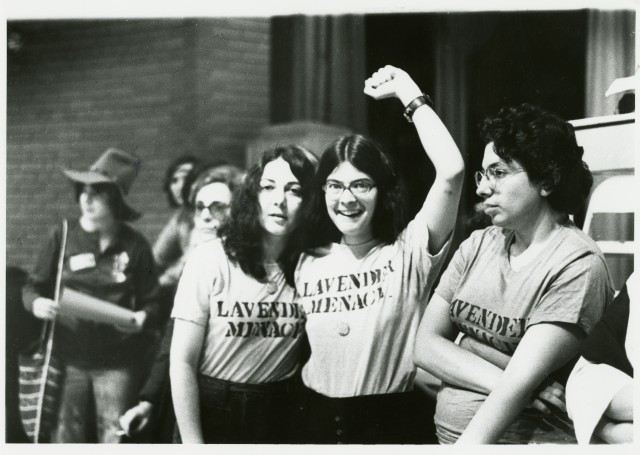
 Emboldened by the civil rights movement, antiwar rallies, and student demonstrations, women across America came together and took to the streets in the mid-to-late 1960s, fighting for liberation from long-held societal beliefs and strictures. Mary Dore’s She’s Beautiful When She’s Angry focuses in on the years 1966 to 1971, when women became activists for their own rights, reclaiming their bodies and redefining gender roles, refusing to be treated like second-class citizens anymore. “It was like all this energy had been pent up in these women for all these years and it just exploded,” says Chicago activist Mary Jean Collins at the beginning of the film. Twenty years in the making, the documentary contains new interviews with more than thirty women who describe their experiences in the women’s liberation movement, giving the inside scoop behind specific marches, strikes, protests, and organizations, as Dore cuts between the speakers today, usually interviewed in their home environment, and rare archival footage and photographs of the women in action more than forty years ago. Dore explores the importance of such books as Betty Friedan’s The Feminine Mystique and the Boston Women’s Health Book Collective’s Our Bodies, Ourselves and speaks to cofounders and early members of such groups as the National Organization for Women, the Chicago Women’s Liberation Union, Gainesville Women’s Liberation, and JANE, which provided underground abortions. All of them fully understand that the fight is far from over, especially with what is currently going on in Congress. “You’re not allowed to retire from women’s issues,” Dallas Women’s Coalition cofounder Virginia Whitehill explains. “You still have to pay attention, ’cause somebody’s gonna try to yank the rug out from under you, and that’s what’s happening now.”