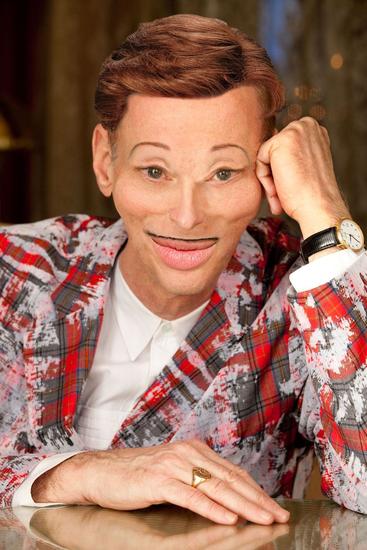
John Waters, “Beverly Hills John,” C-print, 2012 (courtesy of the artist and Marianne Boesky Gallery)
Marianne Boesky Gallery
509 West 24th St. between Tenth & Eleventh Aves.
Tuesday – Saturday through February 14, free, 10:00 am – 6:00 pm
212-680-9889
www.marianneboeskygallery.com
King of Filth John Waters gives Hollywood celebrity culture, and himself, an extremely funny and clever facelift in his latest exhibit at Marianne Boesky in Chelsea. “Beverly Hills John” consists of photography, collage, sculpture, installation, and a new full-length film, his first as writer and director since 2004’s A Dirty Shame. (In the meantime, the Baltimore native has been performing his one-man show, This Filthy World, and writing such books as Role Models and Carsick: John Waters Hitchhikes Across America.) “Separate But Equal” is a black-and-white C-print of a black man drinking from a water fountain labeled “Gay Single,” which is connected to a sink labeled “Gay Married.” In “Library Science,” Waters offers adult takes on classic literature covers, turning, for example, Ian Fleming’s Chitty Chitty Bang Bang into Dion Dermot’s Clitty Clitty Bang Bang and Erskine Caldwell’s God’s Little Acre into Channy Wadd’s God’s Little Faker. Waters pays homage to innovative multimedia artist Mike Kelley, who committed suicide in 2012, with “R.I.P. Mike Kelley,” a miniature sculpture of a cozy living room with a fireplace, comfy chair, and cat urn. The Death character from Ingmar Bergman’s The Seventh Seal hovers over a deplaning John F. Kennedy and Jackie O in “Grim Reaper.” In “Brainiac,” Waters reconstructs a tabloid magazine cover with such headlines as “Joan Didion Hits 250 Pounds!” and “Nude Photos of W. H. Auden Found!” Waters alternates pictures of a flustered Curly from the Three Stooges with shots of rectal exams in “Probe.” (In an odd coincidence, a man named John Waters served as assistant director on the 1933 film Broadway to Hollywood, in which Moe and Curly make cameos as clowns.) “Stolen Jean Genet” is a re-creation of the headstone of French writer and activist Jean Genet, which was actually stolen and is still missing. And in “Mom and Dad,” Waters repurposes stills from William Beaudine’s 1945 film Mom and Dad, which features a notorious sexual hygiene movie used as a terrifying teaching tool.
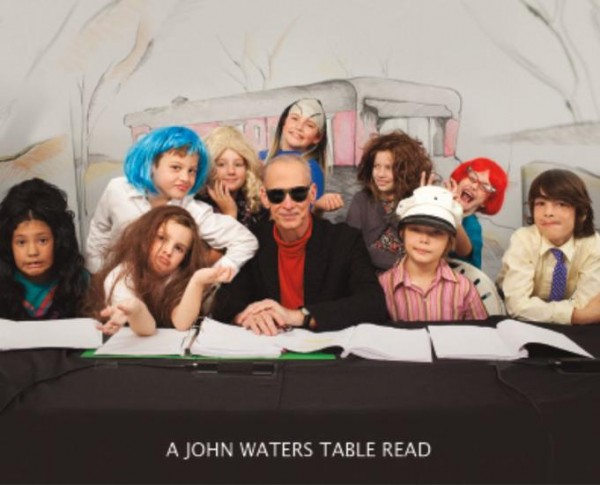
John Waters’s latest exhibit is highlighted by new film showing children reading script of cleaned-up version of PINK FLAMINGOS retitled KIDDIE FLAMINGOS
The centerpiece of the show is the seventy-four-minute Kiddie Flamingos, in which Waters films children doing a table reading of a somewhat, er, watered-down version of the script of Waters’s breakthrough 1972 trailer-park cult black comedy, Pink Flamingos, about Babs Johnson (Divine), her son, Crackers (Danny Mills), her mother, Edie (Edith Massey), their friend Cotton (Mary Vivian Pearce), and their battle with the mean and nasty Marbles (David Lochary and Mink Stole). The children, in various stages of garish makeup, including one boy with a pencil-thin mustache playing the narrator (Waters), don’t always understand what they’re saying, but it’s a riot to watch them tell this hysterical tale of oddballs who have rather extreme eccentricities. Waters, of course, is not above making fun of himself and his own eccentricities as well. The title piece is a creepy self-portrait that depicts him as a victim of plastic surgery gone terribly wrong, in between photos of fellow knife casualties Justin Bieber and Lassie. Sitting empty in the gallery is “Bill’s Stroller,” emblazoned with the names of strip clubs and boasting a spiked leather harness meant for Waters’s fake baby, Bill. (He really does have an angry doll-child he calls Bill who he keeps at home.) And in “Self Portrait #5,” Waters casts himself as a dogcatcher, smiling devilishly at the viewer and holding a carrier with a cute little puppy inside. It’s a wonderfully sly image, emblematic of all of us who treasure Waters’s ongoing counterculture shenanigans, willing to be carried by him wherever he may go as he continues to fight the establishment in his unique, wickedly subversive ways.
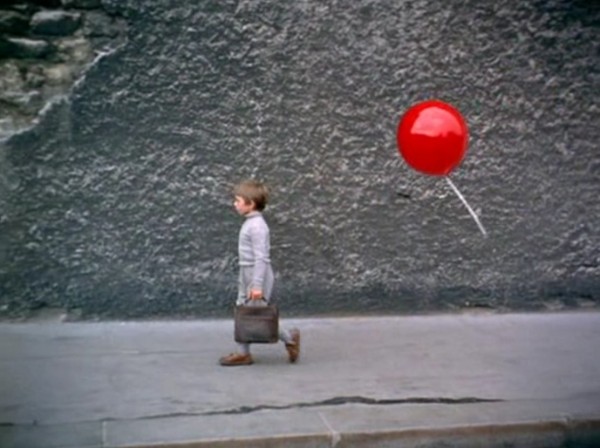
 Lovingly restored several years ago by Janus Films in a new 35mm print, Albert Lamorisse’s The Red Balloon, which won the Palme d’Or at Cannes and an Oscar for Best Original Screenplay, tells the story of a young boy (Pascal Lamorisse, the director’s son) who makes friends with an extraordinary red balloon, which follows him through the streets of Belleville in Paris, waits for him while he is in school, and obeys his every command. But the neighborhood kids are afraid of this stranger and go on a mission to burst the young boy’s bubble. Lamorisse gives life and emotion to the balloon (more than twenty-five thousand were used in the making of the film) in a masterful use of simple special effects well before CGI and other modern technology. The Red Balloon also features the splendid music of Maurice Leroux and the fine photography of Edmond Séchan, which beautifully sets the large red balloon against the gray of the streets and buildings of Paris’s Ménilmontant district. The thirty-four-minute film can also be seen as a parable about Jesus and the birth or Christianity, though it’s best not to read too much into it. The Red Balloon is screening daily February 16-21 at 1:00 at the Museum of Moving Image in conjunction with city schools’ winter break. On February 19 at 2:15, the museum will be hosting “The Red Balloon Animation Adventure,” an hour-long workshop ($5) for children ages six in which kids can create their own little Red Balloon movie.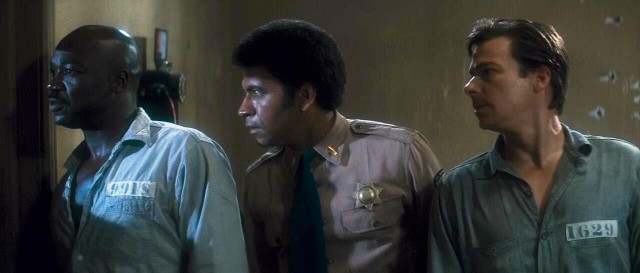
 In his second film as writer, director, producer, and composer (following Dark Star, which he cowrote with Dan O’Bannon), low-budget maestro John Carpenter turns an about-to-be-abandoned police station in the fictional L.A. ghetto of Anderson into the Alamo in the urban-angst thriller Assault on Precinct 13. Setting the stage with a pulsating synth score and a beautifully cheesy opening-credits design, Carpenter captures the rage and unrest burning inside America in the 1970s in this claustrophobic tale of revenge. Austin Stoker stars as Lt. Ethan Bishop, an easygoing cop who is given the supposedly painless job of monitoring a police precinct in South Central Los Angeles on its final day of business, as a few of the last remaining workers pack up boxes and bid the place farewell. But following a police ambush of the Street Thunder gang and the senseless murder of a little girl, an ever-increasing number of gang members soon descend on the station, seeking bloody retribution. Bishop is forced to defend the precinct with secretaries Leigh (Zimmer) and Julie (Nancy Loomis) and dangerous convicts Napoleon Wilson (Darwin Joston) and Wells (Tony Burton) as the power is cut off and their weapons dwindle. The unending stream of gang members swarm around the station like zombies, trying to burst through doors and windows, as the cops and the cons struggle to come up with a plan to save themselves before all hope is lost. “The very least of our problems is that we’re out of time,” Leigh says to Wilson, who replies, “It’s an old story with me. I was born out of time.”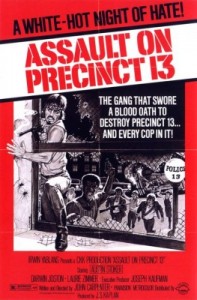

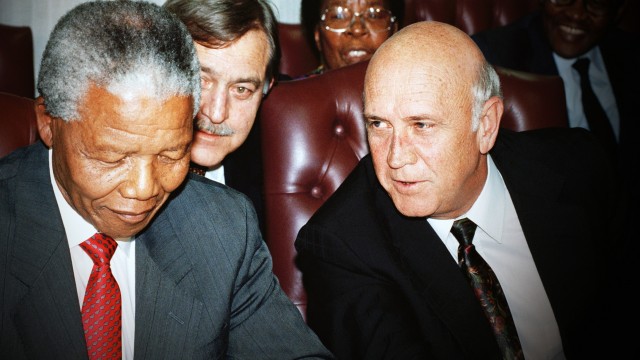
 In The Other Man: F. W. de Klerk and the End of Apartheid, filmmaker Nicolas Rossier examines the legacy of the man who won the 1993 Nobel Peace Prize with Nelson Mandela, painting an intriguing portrait of former South African president Frederik Willem de Klerk, who ended the ban on the African National Congress and ultimately ceded power to Mandela. “I’ve come to the conclusion that apartheid was wrong, that it was morally unjustifiable, and therefore it had to be changed,” de Klerk states emphatically in the film. “And I’m not justifying in any way the wrongs which took place and which was done to the majority of the people living in South Africa in the period of apartheid and separate development.” De Klerk was born into a privileged family, his father one of the chief architects of apartheid, which its supporters prefer to call “separate development.” Taking over the presidency in 1989 from P. W. Botha, de Klerk saw the inevitable downfall of white leadership in South Africa and worked with Mandela to create a new future for the country. Rossier speaks with such anti-apartheid activists as Mathews Phosa, Albie Sachs, Yasmin Sooka, Randall Robinson, and Father Michael Lapsley; such members of de Klerk’s inner circle as Director General David Steward, cabinet ministers Leon Wessels and Roelf Meyer, and friend and foreign ministry spokeswoman Alayne Reesberg; journalists Allister Sparks and Max du Preez; human rights abuse investigator Richard Goldstone; U.S. assistant secretary of state Chester Crocker; former SADF soldier Piet Croucamp; and former South African president Thabo Mbeki, who share wide-ranging opinions and stories about de Klerk as a man and a politician, examining his motives and responsibilities and placing them in context of the changes swirling throughout his country.