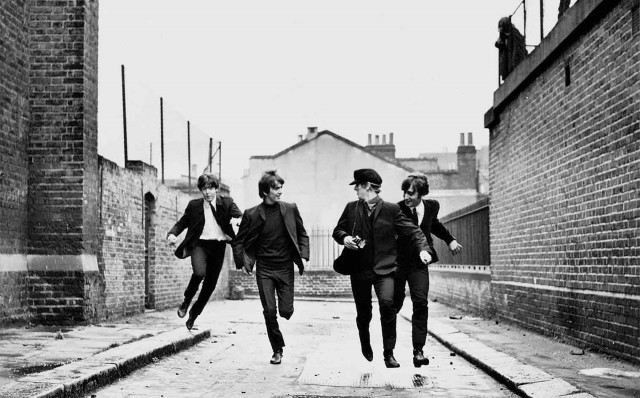
The Fab Four are on the run in A HARD DAY’S NIGHT, screening at Lincoln Center as part of Richard Lester retrospective
A HARD DAY’S NIGHT (Richard Lester, 1964)
Film Society of Lincoln Center, Walter Reade Theater
165 West 65th St. between Eighth Ave. & Broadway
Saturday, August 8, 1:00
Festival runs August 7-13
212-875-5050
www.filmlinc.org
www.thebeatles.com
 The Beatles are invading America again with the fiftieth anniversary restoration of their debut film, the deliriously funny anarchic comedy A Hard Day’s Night. Initially released on July 6, 1964, in the UK, AHDN turned out to be much more than just a promotional piece advertising the Fab Four and their music. Instead, it quickly became a huge critical and popular success, a highly influential work that presaged Monty Python and MTV while also honoring the Marx Brothers, Buster Keaton, Jacques Tati, and the French New Wave. Directed by Richard Lester, who had previously made the eleven-minute The Running Jumping & Standing Still Film with Peter Sellers and would go on to make A Funny Thing Happened on the Way to the Forum, Petulia, and The Three Musketeers, the madcap romp opens with the first chord of the title track as John Lennon, Paul McCartney, George Harrison, and Ringo Starr are running down a narrow street, being chased by rabid fans, but they’re coming toward the camera, welcoming viewers into their crazy world. (George’s fall was unscripted but left in the scene.) As the song blasts over the soundtrack, Lester introduces the major characters: the four moptops, who are clearly having a ball, led by John’s infectious smile, in addition to Paul’s “very clean” grandfather (Wilfrid Brambell, who played a dirty old man in the British series Steptoe and Son, the inspiration for Sanford and Son) and the band’s much-put-upon manager, Norm (Norman Rossington). Lester and cinematographer Gilbert Taylor (Dr. Strangelove or: How I Learned to Stop Worrying and Love the Bomb, Repulsion, Star Wars) also establish the pace and look of the film, a frantic black-and-white frolic shot in a cinema-vérité style that is like a mockumentary taking off from where François Truffaut’s 400 Blows ends. The boys eventually make it onto a train, which is taking them back to their hometown of Liverpool, where they are scheduled to appear on a television show helmed by a hapless director (Victor Spinetti, who would star in Help as well) who essentially represents all those people who are dubious about the Beatles and the sea change going on in the music industry. Norm and road manager Shake (John Junkin) have the virtually impossible task of ensuring that John, Paul, George, and Ringo make it to the show on time, but there is no containing the energetic enthusiasm and contagious curiosity the quartet has for experiencing everything their success has to offer — while also sticking their tongues out at class structure, societal trends, and the culture of celebrity itself.
Lester and Oscar-nominated screenwriter Alun Owen develop each individual Beatle’s unique character through press interviews, solo sojourns (the underappreciated Ringo goes off on a kind of vision quest; George is mistaken by a fashion fop for a model), and an endless stream of spoken and visual one-liners. (John sniffs a Coke bottle; a reporter asks George, “What do you call your hairstyle?” to which the Quiet One replies, “Arthur.”) Oh, the music is rather good too, featuring such songs as “I Should Have Known Better,” “All My Loving,” “If I Fell,” “Can’t Buy Me Love,” “I’m Happy Just to Dance with You,” “This Boy,” and “She Loves You.” The working name for the film was Beatlemania, but it was eventually changed to A Hard Day’s Night, based on a Ringo malapropism, forcing John and Paul to quickly write the title track. No mere exploitation flick, A Hard Day’s Night is one of the funniest, most influential films ever made, capturing a critical moment in pop-culture history and unleashing four extraordinary gentlemen on an unsuspecting world. Don’t you dare miss this glorious eighty-five-minute explosion of sheer, unadulterated joy. The restoration, courtesy of Janus Films, is screening August 8 at the Walter Reade Theater as part of the Film Society of Lincoln Center tribute series “Richard Lester: The Running Jumping Pop Cinema Iconoclast” and will be preceded by The Running Jumping & Standing Still Film. The festival runs August 7-13 and consists of most of the now-eighty-three-year-old Philadelphia native’s films, including Robin and Marian, The Bed Sitting Room, Juggernaut, Cuba, The Royal Flash, and the above-mentioned titles. “Growing up, I always thought of Richard Lester as one of the 1960s’ most typically English filmmakers — not just because of his irreverent and absurd sense of humor and his feel for English life but also for the affectionate way he sent up familiar icons from the Beatles to the Three Musketeers to even Superman,” Film Comment editor and FSLC senior programmer Gavin Smith said in reference to the series. “Imagine my surprise when I first learned he was actually an expat Yank. Regardless, he’s still a great English filmmaker!”
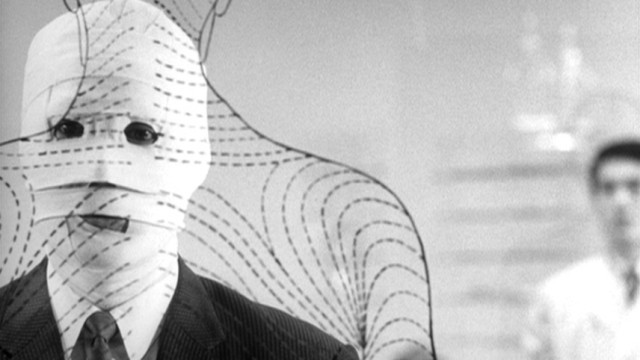
 Kôbô Abe and director Hiroshi Teshigahara collaborated on five films together, including the marvelously existential Woman of the Dunes in 1964 and The Face of Another two years later. In the latter, Tatsuya Nakadai (The Human Condition, Kill!) stars as Okuyama, a man whose face has virtually disintegrated in a laboratory accident. He spends the first part of the film with his head wrapped in bandages, a la the Invisible Man, as he talks about identity, self-worth, and monsters with his wife (Machiko Kyo), who seems to be growing more and more disinterested in him. Then Okuyama visits a psychiatrist (Mikijirô Hira) who is able to create a new face for him, one that would allow him to go out in public and just become part of the madding crowd again. But his doctor begins to wonder, as does Okuyama, whether the mask has actually taken control of his life, making him as helpless as he was before. Abe’s remarkable novel is one long letter from Okuyama to his wife, filled with utterly brilliant, spectacularly detailed examinations of what defines a person and his or her value in society. Abe wrote the film’s screenplay, which tinkers with the time line and creates more situations in which Okuyama interacts with people; although that makes sense cinematically, much of Okuyama’s interior narrative, the building turmoil inside him, gets lost. Teshigahara once again uses black and white, incorporating odd cuts, zooms, and freeze frames, amid some truly groovy sets, particularly the doctor’s trippy office, and Tōru Takemitsu’s score is ominously groovy as well. As a counterpart to Okuyama, the film also follows a young woman (Miki Irie) with one side of her face severely scarred; she covers it with her hair and is not afraid to be seen in public, while Okuyama must hide behind a mask. But as Abe points out in both the book and the film, everyone hides behind a mask of one kind or another. The Face of Another is screening August 7 as part of the Rubin Museum Cabaret Cinema series “Movie Masks,” being held in conjunction with the excellent exhibition
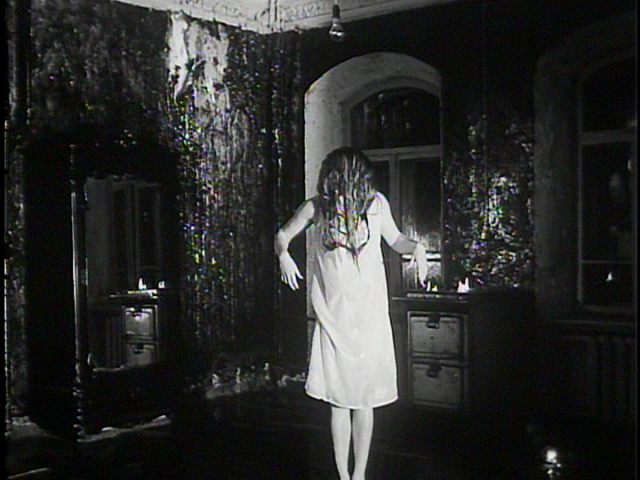
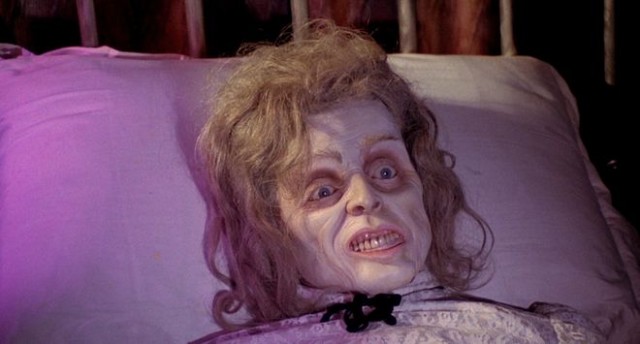
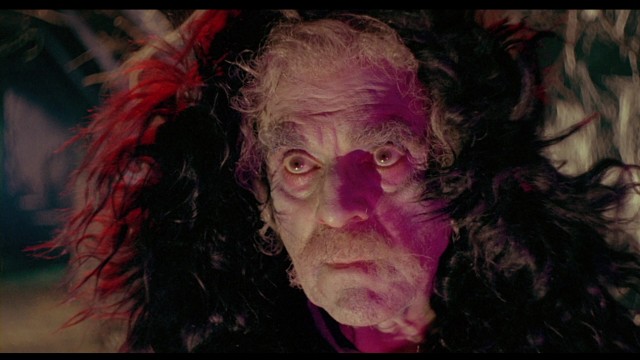
 The film that gave Ozzy Osbourne’s band its name, Black Sabbath is just about everything you could want such a movie to be: cheap, exploitive, and featuring Boris Karloff, with nods to great French and Russian storytellers. (Um, sure . . . of course.) Founded in 1954 by James H. Nicholson and Samuel Z. Arkoff, American International Pictures was responsible for hundreds of low-budget independent films through 1980, specializing in horror, Westerns, blaxploitation, sci-fi, biker flicks, teen delinquency, women in prison, and even beach movies. Anthology Film Archives is paying tribute to the famed studio with a three-part series that begins July 31 by focusing on auteurs who either cut their teeth with AIP or were already well established. It’s quite a list; through September 3, Anthology will be screening works by Francis Ford Coppola, Martin Scorsese, Vincente Minnelli, Brian De Palma, and Roger Corman, who will make several appearances at the downtown movie house. Also on the roster is Italian scaremaster Mario Bava, whose Black Sabbath will be shown August 1, 4, and 8. Black Sabbath is, appropriately enough, an anthology of three short films hosted by Boris Karloff, a kind of melding of Karloff’s Thriller television series with Rod Serling’s Twilight Zone. The Italian-French coproduction was significantly changed by AIP, altering the order of the films and drastically modifying one of the plots. Black Sabbath opens with “A Drop of Water,” supposedly based on a short story by Anton Chekhov. Late one night, nurse Helen Chester (Jacqueline Pierreux) is summoned by an elderly caretaker (Milly Monti) to a stately home where a medium — sporting perhaps the most frightening face ever on a dead person, with dark, deep-set eyes and a viciously wicked smile that makes her look like an evil doll — has died during a séance. After stealing the medium’s ring off her finger, Helen is suddenly taunted by a buzzing fly and drops of water, evoking what was experienced by the killer in Edgar Allan Poe’s “The Tell-Tale Heart,” who was haunted by the unending sound of a beating heart. (Perhaps not coincidentally, AIP was famous for its Poe adaptations.) The conclusion is truly chilling, with a cool little coda.