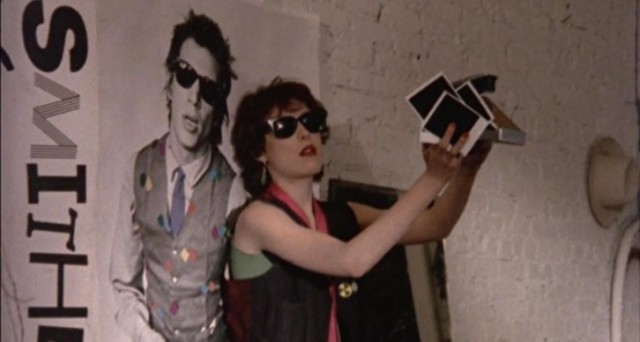
Wren (Susan Berman) is determined to become famous in Susan Seidelman’s SMITHEREENS
SMITHEREENS (Susan Seidelman, 1982)
Metrograph
7 Ludlow St. between Canal & Hester Sts.
July 29 – August 4
212-660-0312
metrograph.com
 I’m a little worried about Metrograph’s weeklong presentation of Susan Seidelman’s underground cult classic, the one and only Smithereens. The Lower East Side art house is proclaiming that it is showing a new 35mm print, but a lot of the charm of the low-budget wonder is its gritty, less-than-polished attitude. I’m afraid it could be like when you hear a crystal-clear old album on CD that sends you back to the vinyl LP so you can hear every beloved scratch and pop. Regardless, Smithereens, the first American indie to be shown in competition at Cannes, is a fab tale set in the East Village punk / new wave scene of the late 1970s, as a tough-talking young woman from the New Jersey suburbs seeks to find her place in the burgeoning city subculture. Susan Berman, who was discovered in the audience at an off-Broadway play, makes her film debut as Wren, an annoying, unlikable wannabe desperate to become part of the music business. Wearing ever-more-fashionable punky get-ups, she wanders the streets seeking fame, plastering Xeroxes of her face all over and claiming to be on the guest list at the Peppermint Lounge. The innocent Paul (Brad Rijn), recently arrived from Colorado and living in his cool van in a postapocalyptic abandoned lot, immediately falls for Wren, but she has her eyes set on Eric (Richard Hell), the leader of a band who has plans to make it big in California. Wren is an unapologetic user, taking advantage of Paul, Eric, her landlady, her family, and her few friends, but Berman imbues her with just enough sublimated tender charm to keep you glued to her trainwreck of a life.
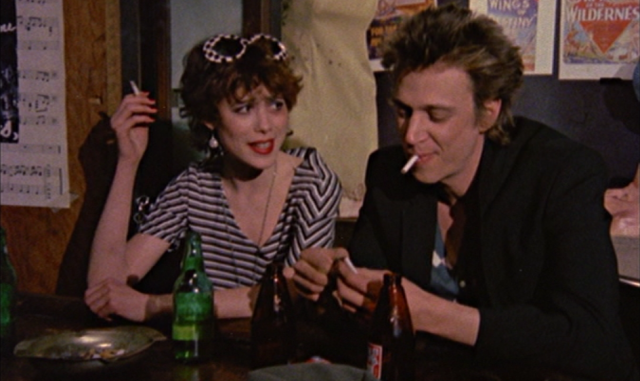
Wren (Susan Berman) latches on to punk musician Eric (Richard Hell) in underground cult classic
Seidelman made Smithereens over the course of eighteen months on a shoestring budget of $40,000, employing fellow NYU students and editing the film during several breaks in production that led to important recasting. The screenplay was written by Peter Askin, who later directed the original off-Broadway version of Hedwig and the Angry Inch, and Ron Nyswaner, who went on to write Swing Shift and The Painted Veil. Cinematographer Chirine El Khadem shot the film on the fly in 16mm, giving it a guerrilla feel that matches the pulsating soundtrack by Glenn Mercer and Bill Million of the Feelies (in addition to songs by the Raybeats and Richard Hell and the Voidoids). Berman, who prepared for the role by watching Federico Fellini’s Nights of Cabiria at Seidelman’s request, is a whirlwind in her first movie of what would be a sparse career, playing Wren with a freewheeling abandon, little caring who she steps on as she desperately seeks some kind of stardom. “I just wanna be in a swimming pool, eating tacos, and signing autographs — that’s all,” she says. You might not like Wren, but you won’t be able to take your eyes off her. Watch out for bit parts played by Amos Poe and Chris Noth. Smithereens will be screening in a new 35mm print at Metrograph July 29 to August 4, with Seidelman (Desperately Seeking Susan, Making Mr. Right) in attendance at the 7:00 show on opening night to talk about this seminal work.

 Perhaps Universal named the fifth Jason Bourne film Jason Bourne because The Bourne Idiocy would probably not have made for very good box office. The fifth entry in the action-espionage series based on the Robert Ludlum character is a lackluster, repetitive bore. Oh, there are plenty of chases, fistfights, and shootouts in locations around the world, but there is rarely any legitimate drama to fill in the gaping plot holes. After skipping The Bourne Legacy, Matt Damon is back as the mysterious government killing machine, still on the run from the CIA, which is now headed by Robert Dewey (an incredibly craggy-faced Tommy Lee Jones). Dewey has hired the Asset (Vincent Cassel) to take out Bourne, who is digging into his past, trying to uncover his father’s (Gregg Henry) role in the top- secret Treadstone program in order to find out more about himself.


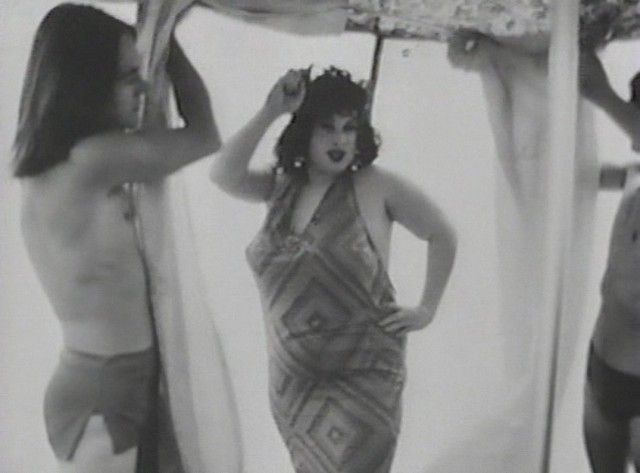
 John Waters will be at IFC Center on August 5 for two special screenings of a newly restored version of one of the Baltimore-born auteur’s craziest early works, Multiple Maniacs, made when the King of Bad Taste, serving as writer, director, producer, cinematographer, and editor, was only twenty-four. The extremely low budget romp begins with barker Mr. David (David Lochary) inviting people into “Lady Divine’s Cavalcade of Perversions,” proclaiming, “This is the show you want. . . . the sleaziest show on earth. Not actors, not paid imposters, but real, actual filth who have been carefully screened in order to present to you the most flagrant violation of natural law known to man.” Of course, that serves as the perfect introduction to the cinematic world of Waters, one dominated by the celebration of sexual proclivities, fetish, salaciousness, indecency, violence, and marginalized weirdos living on the fringes of society. Lady Divine, played by Divine, turns out to be a cheat, the freak show just a set-up for a robbery. Soon Divine is jealous of David’s relationship with Bonnie (Mary Vivian Pearce), hanging out with her topless daughter, Cookie (Cookie Mueller), and being led into a church by the Infant of Prague (Michael Renner Jr.), where she’s brought to sexual ecstasy by Mink (Mink Stole). There’s also rape, murder, Jesus (George Figgs), the Virgin Mary (Edith Massey), and the famed Lobstura. Shot in lurid black-and-white, Multiple Maniacs is a divine freak show all its own, an underground classic that redefined just what a movie could be, a crude, disturbing tale that you can’t turn away from. Waters will participate in a Q&A following the 7:20 show and will introduce the 9:40 show; more screenings of this restored version, from Janus Films, will be announced on August 1 at 6:00 pm.