
Superstar lobbyist (Aaron Eckhart) makes his point in Jason Reitman’s THANK YOU FOR SMOKING
WEEKEND CLASSICS: THANK YOU FOR SMOKING (Jason Reitman, 2006)
IFC Center
323 Sixth Ave. at West Third St.
February 24-26, 11:00 am
Series continues weekends through April 2
212-924-7771
www.ifccenter.com
www.foxsearchlight.com
 Jason Reitman, the son of producer-director Ivan Reitman (Stripes, Ghostbusters, Dave), made his sparkling feature-film debut with the brilliant Thank You for Smoking, a devilishly delightful black comedy based on the novel by acerbic wit Christopher Buckley. Aaron Eckhart gives a riotous performance as Nick Naylor, a fast-talking, handsome, smarmy lobbyist for the Academy of Tobacco Studies, a Big Tobacco laboratory that, remarkably, cannot find a link between cigarettes and health risks. A master of spin, Naylor seems to even believe himself when he tells a young boy dying of cancer that he’s better off smoking. As a grandstanding senator (William H. Macy) plans congressional hearings on the evils of tobacco — especially on teenagers — Naylor is being groomed as the industry’s savior by his high-strung boss (J. K. Simmons) and the Captain (Robert Duvall) while trying to establish a meaningful relationship with his son (Cameron Bright). The fine ensemble also features Katie Holmes as a hot young reporter who’ll go to virtually any length to get a story; Sam Elliott as the Marlboro Man, who is dying of lung cancer; Rob Lowe as a Zen-like Hollywood agent who is considering Naylor’s idea of making cigarette smoking cool in the movies again; and Dennis Miller and Joan Lunden as themselves, adding a bit of reality to the hysterical situation, which might not be as far off from the truth as we might think, especially with President Donald Trump recently promising to enact a ban preventing administration members from becoming lobbyists for five years after they leave government service.
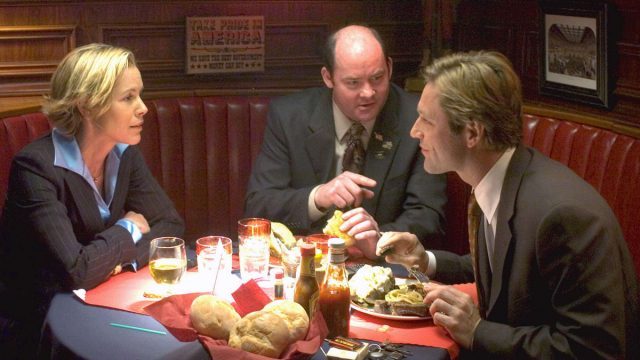
The Merchants of Death (Maria Bello), Aaron Eckhart, David Koechner) plot their next moves in THANK YOU FOR SMOKING
Among the funniest scenes in this wicked film are Naylor’s weekly meetings with the M.O.D. Squad (the Merchants of Death), as the lobbyists for the alcohol (Maria Bello), tobacco (Eckhart), and firearms (David Koechner) industries playfully call themselves. The film is produced by David O. Sacks, who amassed his fortune when he sold his Internet baby, PayPal, to eBay in 2002 and headed straight for Hollywood. Sacks also makes a cameo as an oil lobbyist. The talented Reitman has gone on to make such films as Juno and Up in the Air, earning himself two Oscar nominations for Best Director. Thank You for Smoking is screening in a 35mm print February 24-26 at 11:00 am in the IFC Center Weekend Classics series “Autocratic for the People: An Unpresidented Series of Star-Spangled Satires,” which continues through April 2 with such other political mockeries, parodies, spoofs, and lampoons as Mike Judge’s Idiocracy, Barry Levinson’s Wag the Dog, and Andrew Fleming’s Dick.


 Metrograph is getting ready for the Academy Awards by screening some of its favorite Best Picture champs, beginning February 18 with Michael Curtiz’s Casablanca, followed February 19 by Frank Capra’s It Happened One Night and Kathryn Bigelow’s The Hurt Locker. Based on embedded journalist Mark Boal’s experiences in Iraq, The Hurt Locker follows a three-member Explosive Ordnance Disposal unit as they are called in to defuse a series of dangerous situations involving various kinds of bombs, including IEDs and other life-threatening explosive devices. Team leader Will James (Jeremy Renner) is an expert bomb defuser and maverick who doesn’t follow protocol and likes to live on the edge. Spc. Owen Eldridge (Brian Geraghty) is a greenhorn who just wants to survive the last forty days of their rotation. And Sgt. J. T. Sanborn (Anthony Mackie) likes to go by the book and take no unnecessary chances, which puts him in constant conflict with the unpredictable James. Recalling the second half of Stanley Kubrick’s 1987 Vietnam drama Full Metal Jacket, The Hurt Locker unfolds in a series of harrowing set pieces in which the EOD unit is called in to either safely detonate or defuse explosive devices while under the eyes of local Iraqis, any of whom could potentially be the bomber or a sniper.

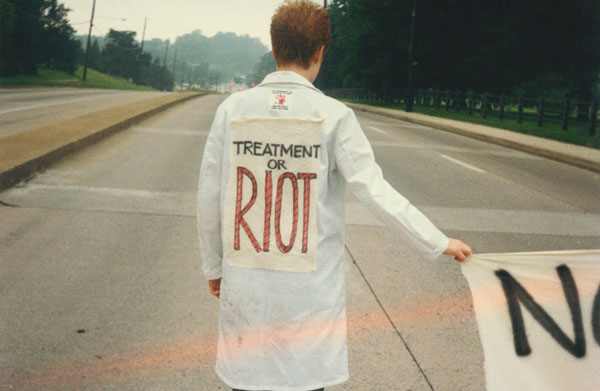
 With protests continuing around the country, and the world, against Donald Trump and his administration, IFC Center is honoring Presidents Day with the special evening “Surviving and Resisting: A Presidents Day Event.” The centerpiece is a screening of the gripping 2012 Oscar-nominated documentary How to Survive a Plague. For his directorial debut, longtime journalist David France, one of the first reporters to cover the AIDS crisis that began in the early 1980s, scoured through more than seven hundred hours of mostly never-before-seen archival footage and home movies of protests, meetings, public actions, and other elements of the concerted effort to get politicians and the pharmaceutical industry to recognize the growing health epidemic and do something as the death toll quickly rose into the millions. Focusing on radical groups ACT UP and TAG (Treatment Action Group), France follows such activist leaders as Peter Staley, Mark Harrington, Larry Kramer, Bob Rafsky, and Dr. Iris Long as they attack the policies of President George H. W. Bush, famously heckle presidential candidate Bill Clinton, and battle to get drug companies to create affordable, effective AIDS medicine, all while continuing to bury loved ones in both public and private ceremonies. France includes new interviews with many key activists who reveal surprising details about the movement, providing a sort of fight-the-power primer about how to get things done. The film also shines a light on lesser-known heroes, several filled with anger and rage, others much calmer, who fought through tremendous adversity to make a difference and ultimately save millions of lives. How to Survive a Plague is screening at 7:30 on February 20, along with three new short documentaries, Jem Cohen’s Birth of a Nation and two works from Laura Poitras’s

 FIAF’s “Comedy on Film: What Makes the French Laugh?” series continues on Valentine’s Day with Jean-Christophe Meurisses’s Apnée, a riotous, ludicrous, hysterical, and often cringeworthy absurdist fable about an anarchic trio of friends/lovers who flit about France doing anything they want, unaware of the consequences of their actions. Céline (Céline Fuhrer), Thomas (Thomas Scimeca), and Maxence (Maxence Tual) are all id, no ego and superego, as they live in their own reality, separate from the rest of what is considered conventional society. Wearing wedding dresses, they try to get married; seeking to relax, they take a bath together in a storefront window; in search of a family, they storm in on an older, empty nest couple. Indeed, they are like three children who don’t know any better, who haven’t reached basic levels of adulthood, but at their core, they just want to be happy, and what’s wrong with that? Writer-director Meurisses’s feature debut, which was nominated for Best First Film at the Cannes Film Festival (the Golden Camera) and the Lumière Awards as well as the