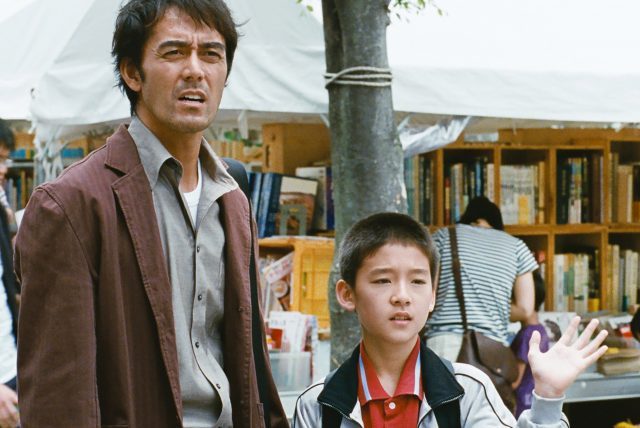
Father (Hiroshi Abe) and son (Taiyo Yoshizawa) face challenges in Hirokazu Kore-eda’s AFTER THE STORM
AFTER THE STORM (UMI YORI MO MADA FUKAKU?) (海よりもまだ深) (Hirokazu Kore-eda, 2016)
IFC Center, 323 Sixth Ave. at Third St., 212-924-7771
Lincoln Plaza Cinema, 1886 Broadway between 62nd & 63rd Sts., 212-757-2280
Opens Friday, March 17
afterthestorm-film.com
 “This isn’t how it was supposed to turn out,” Ryota Shinoda (Hiroshi Abe) says in Hirokazu Kore-eda’s latest masterful family drama and most personal yet, After the Storm. With the twenty-third typhoon of the year on its way, struggling writer Ryota decides to visit his mother, Yoshiko (Kilin Kiki), at the Asahigaoka Housing Complex in Kiyose, Tokyo (where Kore-eda lived for nearly twenty years, until he was twenty-eight). The broke Ryota is hoping to find some hidden treasures left behind by his father, who has recently passed away, to get him out of the financial hole he has dug for himself through a gambling addiction. His ex-wife, Kyoko (Yoko Maki), is threatening to take away his visitation rights with their young son, Shingo (Taiyo Yoshizawa), unless Ryota pays his back child support. To make some quick cash, Ryota has taken a job with a detective agency, where he is not exactly ethical; he claims he took the job as research for his next novel, but he even spies on Kyoko, who has a new boyfriend. As the storm approaches, the characters try to reconnect, and disconnect, forced to face what their lives have become. Written, directed, and edited by Kore-eda, After the Storm is a gentle, eloquent tale, where the smallest of gestures and details are packed with emotional resonance, from Yoshiko attending a class on Beethoven to Ryota purposely scuffing cleats he is buying for Shingo in order to get a discount, from Ryota and Yoshiko trying to eat frozen-solid ices to Ryota finding out something new about his father from a local pawnbroker (Isao Hashizume).
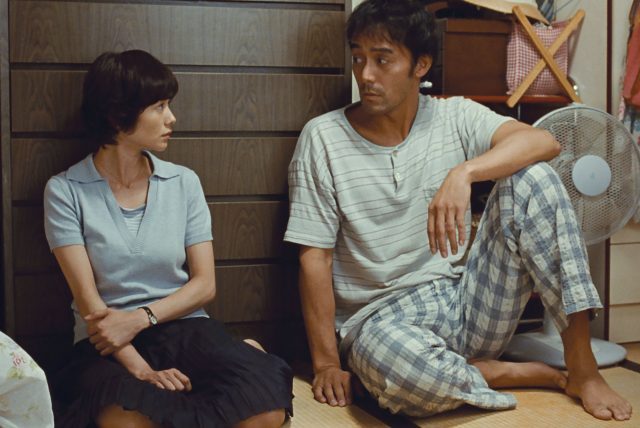
Divorced couple Kyoko (Yoko Maki) and Ryota (Hiroshi Abe) wonder what went wrong in AFTER THE STORM
Ryota is stuck in a rut of his own making, and he doesn’t know how to get out of it, or at least is unwilling to take certain risks despite his need to gamble (and lose). He wants only the best for his son, but Shingo is becoming more and more like him; playing baseball, the boy keeps his bat on his shoulder, striking out looking, trying to work out a walk instead of taking action and swinging away. None of the main adult characters, including Ryota, Kyoko, Yoshiko, and Ryota’s sister, Chinatsu (Satomi Kabayashi), are particularly happy and satisfied with how their lives turned out. The film is sharply photographed by Yutaka Yamazaki and features a soundtrack by singer-songwriter Hanaregumi that just manages to avoid being treacly. Kore-eda, who has made several documentaries as well as such poignant dramas as Our Little Sister, Still Walking, and Like Father, Like Son, fills After the Storm with a tender believability and beautifully drawn, realistic characters portrayed by an outstanding cast of familiar faces who have worked with him before. In his fourth Kore-eda film, the ruggedly handsome and tall Abe (Thermae Romae, Snow on the Blades) gives a profound performance as Ryota, a man who can’t avoid failure even though he knows better. Kore-eda’s visual storytelling style is often compared to Yasujirō Ozu’s, but he has said that After the Storm is more like a film by Mikio Naruse, tinged with sadness and melancholy. In his director’s notes for After the Storm, he also emphasizes how personal the film is to him, explaining, “Incorporating the changes that occurred within me after my mother and father died, it’s the film that is most colored by what I am. After I die, if I’m taken in front of God or the Judge of the Afterlife and asked, ‘What did you do down on Earth?’ I think I would first show them After the Storm.” That’s not such a bad choice.
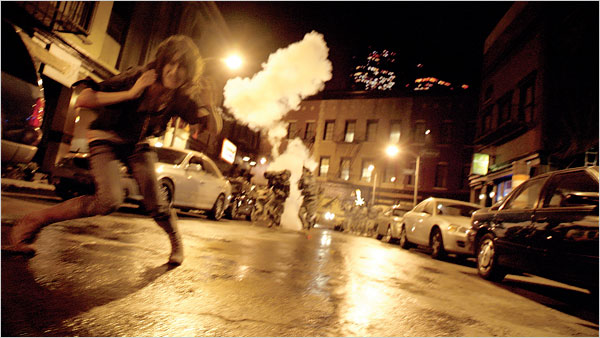
 A surprise going-away party turns into a nightmare in Matt Reeves’s highly anticipated Cloverfield. Michael Stahl-David stars as Rob, a young man who has accepted a promotion that will send him to Japan. Although he is in love with his best friend, Beth (Odette Yustman), he is unable to tell her. But everything changes when the ground starts to shake, buildings begin to collapse, and people are on the run, attempting to escape from an enormous monster on the loose in post-9/11 Manhattan. And when Rob discovers that Beth, who had left the party early, might still be alive, he decides to risk his life and head uptown to save her. He is joined on the dangerous journey by his brother, Jason (Mike Vogel); Jason’s girlfriend, Lily (Jessica Lucas); Lily’s friend Marlena (Lizzy Caplan); and Hud (T. J. Miller), who serves as the comic relief. The entire film is seen through the lens of a video camera that Hud was entrusted with at the party, giving the film the feel of The Blair Witch Project, mixed with such Gotham horror stories as King Kong, The Day After Tomorrow, and the ridiculous 1998 Godzilla remake. Cloverfield, which has an ever-widening back story growing online (similar to that of Lost, which is also the creation of J. J. Abrams), doesn’t try to be anything more than it is — a monster movie set in New York City. The creature is kept hidden for most of the film, which doesn’t make any grand statements about science, humanity, or, really, anything except true love — and brutal death. And yes, there is a secret message hidden in the brief sound clip at the end of the credits. Cloverfield, which was followed by the conceptual sequel 10 Cloverfield Lane, is screening on March 17 and 18 in the Nitehawk Cinema “Midnite Screenings” and “Large and in Charge” series; the latter continues weekends in March with Pacific Rim and the 1958 and 1988 versions of The Blob.
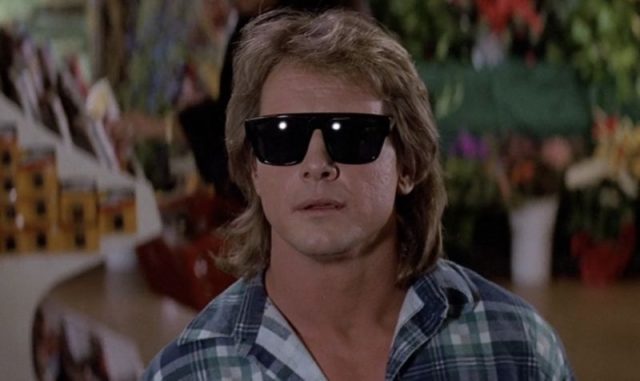
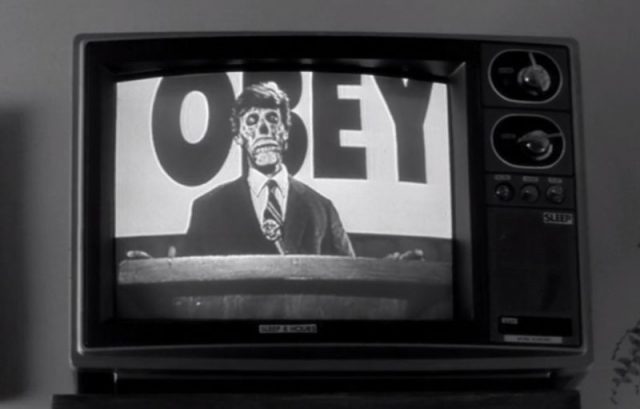
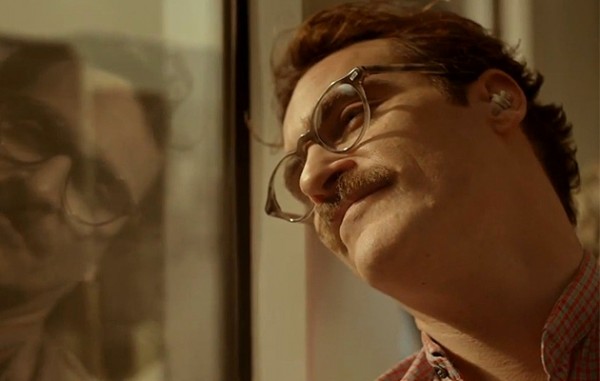
 The brilliant mind of Spike Jonze dazzles again with the spectacularly original romance her. In the very near future, geeky nerd Theodore Twombly (a radiant Joaquin Phoenix) makes his living writing personally commissioned letters for Handwritten Greeting Cards, developing relationships with the people he writes for, considering them family. Meanwhile, he and his wife, Catherine (Rooney Mara), are divorcing, although he is hesitant to sign the final papers. His life takes an unexpected turn when he buys the world’s first AI operating system and slowly falls in love with her during an extremely romantic twenty-first-century-style courtship. The talking OS (the sexy, gravelly voice of Scarlett Johansson), who names herself Samantha, wants to experience the world, so she and Theodore go everywhere together, including on a double date that is pure genius. When he shares his news with his best friend, Amy (Amy Adams), she doesn’t act the slightest bit concerned for his sanity, instead showing true happiness for his blossoming relationship. But as his and Samantha’s love grows, so does their need for something more from each other, which doesn’t always work out as planned.