this week in film and television

FACES PLACES

JR and Agnès Varda have a blast in the masterful Faces and Places

JR and Agnès Varda have a blast with people and animals in the masterful Faces and Places

FACES PLACES (VISAGES VILLAGES) (Agnès Varda & JR, 2017)
Quad Cinema
34 West 13th St. between Fifth & Sixth Aves.
October 6-26
quadcinema.com
cohenmediagroup.tumblr.com

“We’ll have fun making a film,” legendary eighty-eight-year-old Belgian-born French auteur Agnès Varda tells thirty-three-year-old French photographer and street artist JR in Faces Places (Visages Villages), a masterful road movie that may very well be the most fun film you’ll see all year. The unlikely pair first met when Varda, who has made such classics as Cléo from 5 to 7, Vagabond, Jacquot de Nantes, and The Gleaners and I, accepted an invitation from JR, whose practice involves wheat-pasting giant black-and-white photos of men, women, and children on architectural structures, to visit his Paris studio. (JR brought his “Inside Out” art project to Times Square in 2013.) When Varda saw JR’s blow-up of a 1960 self-portrait Varda shot of herself standing in front of a Bellini painting in Venice, the two instantly hit it off and decided to make a film together, heading out in JR’s small photo-booth truck to team up with people in small towns throughout France, including coal miners, dockworkers, farmers, a church-bell ringer, and factory workers. The reactions of the villagers — shrewd, curious, flattered — to JR’s enormous wheat-pasted blow-ups of themselves on their neighborhood walls, barns, abandoned housing, containers, water towers, and other locations are fascinating. “JR is fulfilling my greatest desire. To meet new faces and photograph them, so they don’t fall down the holes of my memory,” Varda, who edited the film with Maxime Pozzi-Garcia, says. Varda and JR make a formidable duo, finding a childlike innocence in their collaboration that is simply captivating to watch.

Cinematic collaboration between Agnès Varda and JR results in stunning visions of humanity

Cinematic collaboration between Agnès Varda and JR results in stunning visions of humanity

Varda continually tries to get JR to remove his ever-present dark glasses, remembering how her friend and colleague Jean-Luc Godard once let her take pictures of him without glasses, but JR prefers to maintain his mystery, a man who photographs tens of thousands of people’s faces around the world while never fully showing his own. Varda, who relies on the “power of imagination,” even sets up an afternoon with Godard at his home in Switzerland, preparing by having JR roll her furiously through the same Louvre galleries the protagonists run through in Godard’s Band of Outsiders, but of course nothing with Godard ever goes quite as planned. “Chance has always been my best asset,” Varda proclaims in the film, and it is chance, and the willingness to enthusiastically embrace every moment of life, that helps give Faces Places its immeasurable charm. The film, which features a playful score by Matthieu Chedid (‑M-) and was executive produced by Varda’s daughter, Rosalie Varda-Demy, subtly tackles socioeconomic issues but is primarily a marvelous celebration of genuine humanity.

THE MINISTRY OF SILLY FILMS: MONTY PYTHON AND BEYOND

Quad Cinema

Mr. Creosote (Terry Jones) is about to explode in Monty Python’s The Meaning of Life

Quad Cinema
34 West 13th St. between Fifth & Sixth Aves.
October 20-26
quadcinema.com
www.montypython.com

On October 5, 1969, an oddly titled sketch comedy show premiered on BBC One, Monty Python’s Flying Circus, written by and starring five very bright, seriously funny British men from Cambridge and Oxford — Graham Chapman, John Cleese, Eric Idle, Terry Jones, and Michael Palin — and an American animator, Terry Gilliam, who had graduated from Occidental College in Los Angeles and had become a British citizen in 1968. The half-hour program regularly skewered the status quo, taking on politics, sports, the arts, England, the medical establishment, family relationships, religion, historical events, class, the military, the police, and, perhaps most of all, television itself. The show ran until 1974, when it began airing on PBS in the United States while the Pythons moved on to the movies. The Quad is celebrating the troupe’s successful transition to cinema with the week-long series “The Ministry of Silly Films: Monty Python and Beyond,” featuring all four official Python movies as well as eight that either starred or was written and/or directed by at least one member of the troupe. The mini-festival begins with one of the funniest, most quotable films ever made, 1974’s Monty Python and the Holy Grail, in which King Arthur (Chapman) goes in search of the ancient relic, accompanied by a ragtag group of knights who encounter a killer rabbit, a wizard, the Bridge of Death, a shrubber, a nasty French taunter, and a collector of the dead. It’s deliriously silly for every second of its ninety-one minutes.

Graham Chapman plays a would-be savior in LIfe of Brian

Graham Chapman plays a would-be savior in Monty Python’s Life of Brian

They followed that up with 1979’s riotous Monty Python’s Life of Brian, which, upon its release, was met with picketing, protests, and even death threats for the Pythons. The film is a gem, telling the story of a poor schlub named Brian Cohen (Chapman) who is mistaken, since birth, for his neighbor, Jesus Christ. Palin gets to play Pontius Pilate, Idle introduces the sing-along classic “Always Look on the Bright Side of Life,” and Chapman adds a memorable turn as the splendidly named Biggus Dickus. Four years later, the gang explored the nature of existence itself in the choppy but often hysterical Monty Python’s The Meaning of Life, which is divided into “The Miracle of Birth,” “Growth and Learning,” “Fighting Each Other,” “The Middle of the Film,” “Find the Fish,” “Middle Age,” “Live Organ Transplants,” “The Autumn Years,” and “Death.” The film includes one of the all-time-great vile scenes, involving Mr. Creosote (Jones) and a snarky waiter (Cleese) offering him a “wafer-thin” mint to finish his meal, as well as such smashing Idle tunes as “Every Sperm Is Sacred” and “Galaxy Song.” The fourth official Python film is 1971’s And Now for Something Completely Different, a collection of more than three dozen skits from the television show, restaged, so they pale in comparison to the original versions; still, it’s an opportunity to see such fab sketches as “How Not to Be Seen,” “Nudge Nudge,” “The Funniest Joke in the World,” “The Dead Parrot,” and “The Lumberjack Song” with other Python fans.

Kevin Kline looks on as John Cleese makes a move on Jamie Lee Curtis in A Fish Called Wanda

Kevin Kline looks on as John Cleese makes a move on Jamie Lee Curtis in A Fish Called Wanda

The highlights of the rest of the series are Charles Crichton’s A Fish Called Wanda, which was written by costars Cleese and Kevin Kline, earning them Oscar nods (Kline also won the award for Best Supporting Actor), and also features Jamie Lee Curtis, Stephen Fry, and Palin as the lisping Otto; Gilliam’s remarkable Brazil, the controversial 1985 drama in which a futuristic society gets buried in red tape, with a cast that includes Jonathan Pryce as poor Sam Lowry, Katherine Helmond as his well-to-do mother with a thing for facelifts, Bob Hoskins, Ian Holm, and a heroic Robert De Niro; and Gilliam’s delightful Time Bandits, a rollicking fairy tale about a group of little people traveling through time and space, meeting up with such historical, hysterical characters as Robin Hood (Cleese), King Agamemnon (Sean Connery), and Napoleon (Holm) while trapped in a battle between the Supreme Being (Sir Ralph Richardson) and the Evil Genius (David Warner). Palin cowrote the film with Gilliam and plays Vincent; the songs are by Python friend and fan George Harrison.

Rat (Eric Idle) and Mole (Steve Coogan) cant believe what they see in The Wind in the Willows (aka Mr. Toad’s Wild Ride)

Rat (Eric Idle) and Mole (Steve Coogan) can’t believe what they see in The Wind in the Willows (aka Mr. Toad’s Wild Ride)

Palin is the lead in Gilliam’s uneven but fun Jabberwocky, a strange adaptation of the Lewis Carroll poem in which Palin is the simple-minded Dennis, an apprentice cooper in love with the horrible Griselda Fishfinger (Annette Badland), asking her to wait for him as he heads out to begin life anew in the big city but soon finds himself battling a giant monster. Jones does not fare quite as well with Erik the Viking, a 1989 comedy starring Tim Robbins as the title character, who goes in search of Valhalla; the stellar cast includes Cleese, Jones, Mickey Rooney, Eartha Kitt, Jim Broadbent, and Imogen Stubbs. Mel Damski’s Yellowbeard, with cowriter Chapman as a tax-evading pirate, also has an amazing cast (Cleese, Idle, Peter Boyle, Cheech & Chong, Marty Feldman, Madeline Khan, James Mason, David Bowie) but goes nowhere; it really is possible to be just too silly. Cleese, Idle, Jones, and Palin all appear in Jones’s The Wind in the Willows (aka Mr. Toad’s Wild Ride), an adaptation of the beloved children’s story by Kenneth Grahame that also boasts Steve Coogan, Nicol Williamson, Fry, and Antony Sher, with songs sung by the Weasels, Rat (Idle), and Mr. Toad (Jones). Perhaps the most surprising film to be part of the festival is Jones’s Personal Services, a drama inspired by the real-life story of brothel madame Cynthia Payne, with Julie Walters and Alec McCowen. It’s now been nearly fifty years since the debut of Monty Python’s Flying Circus, and Gilliam, Cleese, Idle, and Palin are still active, going strong; sadly, Chapman died in 1989 at the age of forty-eight, and Jones has been diagnosed with dementia. Together these six individuals have left quite a mark on the world, seeing it like no one else has.

NANNI MORETTI

Nanni Moretti will be at Metrograph this week to discuss several of his films

Nanni Moretti will be at Metrograph this week to discuss several of his films

Metrograph
7 Ludlow St. between Canal & Hester Sts.
October 18-21
212-660-0312
metrograph.com

Italian writer, director, and actor Nanni Moretti has been making uniquely personal films for more than forty years, comedies and dramas that meld fiction and nonfiction with sociopolitical and religious undertones in which he often plays a major role, as himself or his alter ego, Michele Apicella. An international favorite, Moretti has won major awards at Cannes, Venice, Berlin, and other film festivals as well as numerous David di Donatello trophies, the Italian Oscars. He makes one feature approximately every five years, in addition to many shorts, so each full-length work is a cinematic event. Metrograph is honoring the sixty-four-year-old Moretti by screening five of his works, ranging from 1989’s Palombella Rossa, in which Moretti plays a Communist politician who gets amnesia, to 2006’s Il Caimano, with Moretti as a producer making a film about Silvio Berlusconi; Moretti will participate in a Q&A following the screening. He will also be on hand to introduce 1998’s Aprile, 1993’s Caro Diario, and 2001’s The Son’s Room; the latter two will be followed by Q&As with Moretti as well. This brief series is a real treat, a rare opportunity to not only catch these wonderful films but to see Moretti discussing his craft.

Doctors can’t help Nanni Moretti find out what’s wrong with him in charming Caro Diario

CARO DIARIO (DEAR DIARY) (Nanni Moretti, 1993)
Friday, October 20, 7:00
metrograph.com

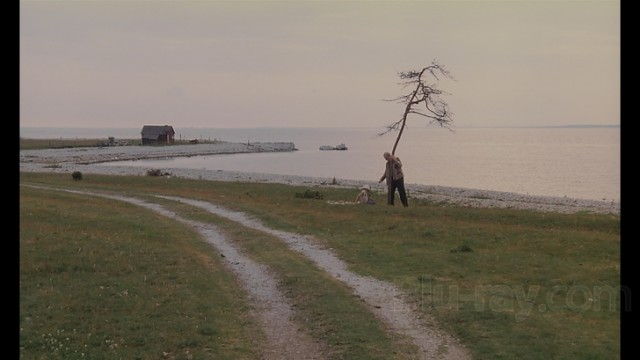
Nanni Moretti’s highly personal and very funny memoir, Caro Diario, is simply wonderful; Moretti plays himself, a filmmaker roaming around Rome on his Vespa and riding into charming little vignettes, including bumping into Jennifer Beals, with whom he’s obsessed. Moretti then travels to the Eolie Islands with his friend Gerardo (Renato Carpentieri), and more comic adventures ensue. The mood changes when Moretti comes down with a rash that doctor after doctor diagnoses differently. This international hit earned Moretti nominations and awards galore, including being named Best Director at the David di Donatello Awards and at Cannes.

Nanni Moretti’s deeply personal The Son’s Room, part of Metrograph retrospective, looks at family tragedy

THE SON’S ROOM (LA STANZA DEL FIGLIO) (Nanni Moretti, 2001)
Saturday, October 21, 4:00
metrograph.com

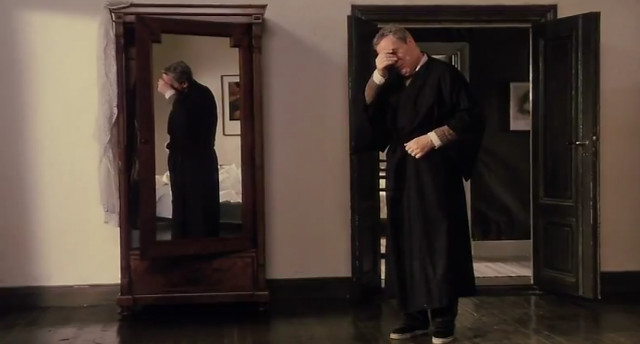
Winner of the Palme D’Or at the 2001 Cannes Film Festival, The Son’s Room is a moving look at life, love, and loss. Italian writer-director-actor Nanni Moretti stars as Giovanni, a psychiatrist who can’t control the dissolution of his family following a terrible tragedy. Moretti (Caro Diario, Ecce Bombo) has made a heart-wrenching work that will always be compared with Todd Field’s powerful In the Bedroom, which came out the same year. Both films examine family tragedy with honesty and believability, but whereas the family in In the Bedroom considers revenge, the father in The Son’s Room, achingly played by Moretti, can’t get over wrongly blaming himself, while his wife (Laura Morante, who won the Best Actress award at Cannes for the role) seeks solace in her son’s girlfriend (Sofia Vigliar), whom she had not known about. Moretti is a deeply personal filmmaker; at times you will feel like you are watching a documentary, and it will break your heart.

BLACK SKIN, WHITE MASKS: CINEMA INSPIRED BY FRANTZ FANON

Pierre Chenal’s Native Son, starring Richard Wright as Bigger Thomas, is part of Frantz Fanon festival at BAM

Pierre Chenal’s Native Son, starring Richard Wright as Bigger Thomas, is part of Frantz Fanon festival at BAM

BAMcinématek, BAM Rose Cinemas
30 Lafayette Ave. between Ashland Pl. & St. Felix St.
October 18-26
718-636-4100
www.bam.org

“I ascribe a basic importance to the phenomenon of language. That is why I find it necessary to begin with this subject, which should provide us with one of the elements in the colored man’s comprehension of the dimension of the other,” Martinique-born philosopher, psychoanalyst, and writer Frantz Fanon explains in the first chapter of his 1952 book, White Skin, Black Masks. The revolutionary continues, “For it is implicit that to speak is to exist absolutely for the other. The black man has two dimensions. One with his fellows, the other with the white man. A Negro behaves differently with a white man and with another Negro. That this self-division is a direct result of colonialist subjugation is beyond question. . . . No one would dream of doubting that its major artery is fed from the heart of those various theories that have tried to prove that the Negro is a stage in the slow evolution of monkey into man. Here is objective evidence that expresses reality. But when one has taken cognizance of this situation, when one has understood it, one considers the job completed. How can one then be deaf to that voice rolling down the stages of history: ‘What matters is not to know the world but to change it.’ This matters appallingly in our lifetime.”

The theories espoused by Fanon, who also wrote the seminal treatise The Wretched of the Earth, about the effects of colonization on the human psyche — and published the year he died, 1961, at the age of thirty-six — have made their way, directly and indirectly, into many films, and BAMcinématek honors that legacy in the series “Black Skin, White Masks: Cinema Inspired by Frantz Fanon,” which runs October 18-26 at BAM Rose Cinemas, featuring such powerful, wide-ranging films as Bill Duke’s Deep Cover, Ousmane Sembène’s Black Girl, Octavio Getino and Fernando E. Solanas’s The Hour of the Furnaces, and Claire Denis’s No Fear, No Die. The opening-night film, Isaac Julien’s Black Skin, White Masks, will be followed by a roundtable discussion with writer and activist Kazembe Balagun, artist Alexandra Bell, and cultural critic Tobi Haslett, moderated by series programmer Ashley Clark. In an era in which “the other” has taken center stage again as refugees search for new homes around the world, hatred, racism, and bigotry are spreading in such countries as the United States, France, and England, and walls are being put up to keep people out, many of Fanon’s philosophies are, sadly, still all-too relevant.

Daniel Autieul and Juliette BInoche star in MIchael Hanekes

Daniel Autieul and Juliette Binoche star in Michael Haneke’s Caché

CACHÉ (HIDDEN) (Michael Haneke, 2005)
Saturday, October 21, 2:00 & 7:30
www.sonyclassics.com/cache

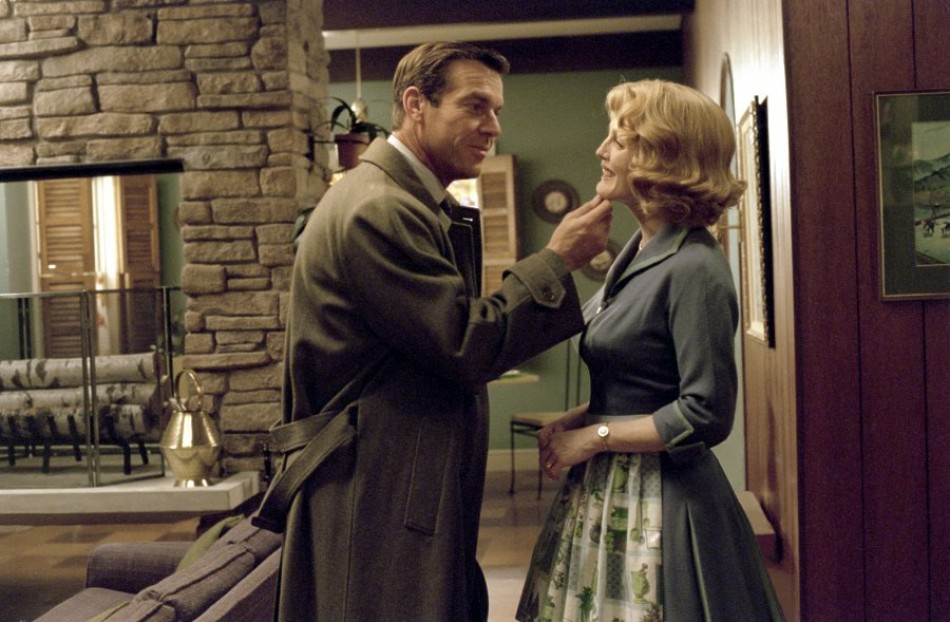
Writer-director Michael Haneke (The Piano Teacher, The White Ribbon) was named Best Director at Cannes for this slow-moving yet gripping psychological drama about a seemingly happy French family whose lives are about to be torn apart. Caché stars Daniel Auteil as Georges, the host of a literary public television talk show, and Juliette Binoche as his wife, Anne, a book editor. One day a mysterious videotape is left for them, showing a continuous shot of their house. More tapes follow, wrapped in childish drawings of a boy with blood coming out of his mouth. Fearing for the safety of their son, Pierrot (Lester Makedonsky), they go to the police, who say they cannot do anything until an actual crime has been committed. As the tapes reveal more information and invite more danger, Georges’s secrets and lies threaten the future of his marriage. Caché is a tense, involving thriller that is both uncomfortable and captivating to watch. Haneke zooms in closely on the relationship between Georges and Anne, keeping all other characters in the background; in fact, there is no musical score or even any incidental music to enhance the searing emotions coming from Auteil and Binoche. Winner of numerous year-end critics awards for Best Foreign Language Film, Caché is screening October 21 at 2:00 and 7:30 at BAM. Oh, and be sure to pay close attention to the long final shot for just one more crucial twist that many people in the audience will miss.

THE BATTLE OF ALGIERS

Members of the FLN hide from French paratroops in Gillo Pontecorvo’s neo-Realist classic The Battle of Algiers

THE BATTLE OF ALGIERS (Gillo Pontecorvo, 1966)
Saturday, October 21, 4:45
www.bam.org

In Italian director Gillo Pontecorvo’s gripping neo-Realist war thriller The Battle of Algiers, a reporter asks French paratroop commander Lt. Col. Mathieu (Jean Martin), who has been sent to the Casbah to derail the Algerian insurgency, about an article Jean-Paul Sartre had just written for a Paris paper. “Why are the Sartres always born on the other side?” Mathieu says. “Then you like Sartre?” the reporter responds. “No, but I like him even less as a foe,” Mathieu coolly answers. In 1961, French existentialist Sartre wrote in the preface to Frantz Fanon’s Wretched of the Earth, the seminal tome on colonialism and decolonialism, “In Algeria and Angola, Europeans are massacred at sight. It is the moment of the boomerang; it is the third phase of violence; it comes back on us, it strikes us, and we do not realize any more than we did the other times that it’s we that have launched it,” referring to European colonization. “There are those among [the oppressed creatures] who assert themselves by throwing themselves barehanded against the guns; these are their heroes. Others make men of themselves by murdering Europeans, and these are shot down; brigands or martyrs, their agony exalts the terrified masses. Yes, terrified; at this fresh stage, colonial aggression turns inward in a current of terror among the natives. By this I do not only mean the fear that they experience when faced with our inexhaustible means of repression but also that which their own fury produces in them. They are cornered between our guns pointed at them and those terrifying compulsions, those desires for murder which spring from the depth of their spirits and which they do not always recognize; for at first it is not their violence, it is ours, which turns back on itself and rends them; and the first action of these oppressed creatures is to bury deep down that hidden anger which their and our moralities condemn and which is however only the last refuge of their humanity. Read Fanon: you will learn how, in the period of their helplessness, their mad impulse to murder is the expression of the natives’ collective unconscious.” Sartre’s brutally honest depiction of colonialism serves as a perfect introduction to Pontecorvo’s film, made five years later and then, unsurprisingly, banned in France. (In 1953, the Martinique-born Fanon, who fought for France in WWII, moved to Algeria, where he became a member of the National Liberation Front; French authorities expelled him from the country in 1957, but he kept working for the FLN and Algeria up to his death in 1961.)

THE BATTLE OF ALGIERS

Terrorism and counterinsurgency take to the streets in Oscar-nominated The Battle of Algiers

In The Battle of Algiers, Pontecorvo (Kapò, Burn!) and screenwriter Franco Solinas follow a small group of FLN rebels, focusing on the young, unpredictable Ali la Pointe (Brahim Haggiag) and the more calm and experienced commander, El-hadi Jafar (Saadi Yacef, playing a character based on himself; the story was also inspired by his book Souvenirs de la Bataille d’Alger). Told in flashback, the film takes viewers from 1954 to 1957 as Mathieu hunts down the FLN leaders while the revolutionaries stage strikes, bomb public places, and assassinate French police. Shot in a black-and-white cinema-vérité style on location by Marcello Gatti — Pontecorvo primarily was a documentarian — The Battle of Algiers is a tense, powerful work that plays out like a thrilling procedural, touching on themes that are still relevant nearly fifty years later, including torture, cultural racism, media manipulation, terrorism, and counterterrorism. It seems so much like a documentary — the only professional actor in the cast is Martin — that it’s hardly shocking that the film has been used as a primer for the IRA, the Black Panthers, the Pentagon, and military and paramilitary organizations on both sides of the colonialism issue, although Pontecorvo is clearly on the side of the Algerian rebels. However, it does come as a surprise that the original conception was a melodrama starring Paul Newman as a Western journalist. All these years later, The Battle of Algiers, which earned three Oscar nominations (for Best Foreign Language Film in 1967 and Best Director and Best Original Screenplay in 1969), still has a torn-from-the-headlines urgency that makes it as potent as ever. The Battle of Algiers is screening on October 21 at 4:45 at BAM.

Documentary uses Swedish archival footage and the words of Frantz Fanon to tell story of colonization and decolonization

Documentary uses Swedish archival footage and the words of Frantz Fanon to tell story of colonization and decolonization

CONCERNING VIOLENCE (Göran Hugo Olsson, 2014)
Wednesday, October 25, 7:00
www.bam.org
www.facebook.com/concerningviolence

Swedish filmmaker Göran Hugo Olsson brings physician and psychiatrist Frantz Fanon’s seminal 1961 book, The Wretched of the Earth, to bold, vivid life in the empowering documentary Concerning Violence: Nine Scenes from the Anti-Imperialistic Self-Defense. “Every one of us must think for himself — always provided that he thinks at all; for in Europe today, stunned as she is by the blows received by France, Belgium, or England, even to allow your mind to be diverted, however slightly, is as good as being the accomplice in the crime of colonialism,” French philosopher Jean-Paul Sartre wrote in the lengthy preface to the book. For Concerning Violence, Olsson called on Columbia University professor Gayatri Chakravorty Spivak to provide a heavily academic introduction, setting the stage for nine examples of the relationship between settlers and natives, Europeans and Africans, in the 1960s, ’70s, and ’80s. As he did with his previous film, The Black Power Mixtape 1967-1975, Olsson uses amazing footage taken by Swedish journalists, including interviews with Christian missionaries, Zimbabwe president Robert Mugabe, reporter Gaetano Pagano, Burkina Faso president Thomas Sankara, black revolutionaries, and privileged white men, combining those stunning images with strong statements from Fanon’s treatise, read by Ms. Lauryn Hill and blasted across the screen in big letters. “Colonialism is not a thinking machine, nor a body endowed with reasoning faculties. It is violence in its natural state, and it will only yield when confronted with greater violence,” Hill states in a steady voice. “Decolonization is always a violent phenomenon. Decolonization is a historical process. It cannot be understood, it cannot become clear to itself except by the movements which give it historical form and content. Decolonization, which sets out to change the order of the world, is, obviously, a program of complete disorder.”

The nine “chapters” take viewers to Angola, Rhodesia, Liberia, Tanzania, Mozambique, Guinea-Bissau, and other current or former African nations, examining institutional racism, wealth and poverty, illegal imprisonment, guerrilla revolutions, the IMF, and the lurking “monster” that is the United States. It draws a brutal, powerful picture that pulls no punches, with expert use of archival footage never seen outside of Sweden. “There is no native who does not dream at least once a day of setting himself up in the settler’s place,” Ms. Hill reads, the words still ringing true today as riots and protests spread throughout the United States and civil wars continue in Africa and other continents. More than fifty years after its publication, The Wretched of the Earth is still a call to action, albeit one steeped in violence, as one can debate how much things have really changed. “The films in the Swedish Archive might have been part of a patronizing perspective at the time, but thirty years later, we think they reveal something important about this time to Europeans, Americans, and Africans — as well as others across the world who have been on either side of colonization, or are experiencing it now,” Olsson points out in his director’s statement. Concerning Violence is screening October 25 at 7:00 at BAM.

NYFF55 SPOTLIGHT ON DOCUMENTARY: VOYEUR

Voyeur

Gerald Foos and Gay Talese discuss voyeurism and journalistic ethics in eye-opening documentary

VOYEUR (Myles Kane & Josh Koury, 2017)
New York Film Festival, Film Society of Lincoln Center
Sunday, October 15, Francesca Beale Theater, $15, 9:00
Festival runs September 28 – October 15
212-875-5601
www.filmlinc.org
www.netflix.com

“I’m a natural person to write about a voyeur because I’m a voyeur myself,” award-winning, bestselling journalist Gay Talese says in Myles Kane and Josh Koury’s Voyeur, which is getting a bonus screening at the New York Film Festival on October 15 prior to debuting on Netflix on December 1. The documentary makes a voyeur of the viewer as well as it follows the thirty-five-year journalistic relationship and offbeat friendship between Talese, longtime New York Times and Esquire writer and author of such books as Honor Thy Father and Thy Neighbor’s Wife, and Gerald Foos, the owner of a Colorado motel who claims he spent decades spying on people from a special crawl space he built above the rooms. In January 1980, Foos, owner of the Manor House Motel, wrote a letter to Talese, offering him a story about what he was doing; Foos considered himself a researcher, not a pervert or a peeping Tom. Using archival footage, news reports, and new interviews, Kane and Koury follow Foos, his second wife, Anita, and Talese as the journalist prepares to write a major piece for the New Yorker in advance of the release of his latest book, The Voyeur’s Motel. New Yorker articles editor Susan Morrison considers Foos a disturbed sociopath in need of attention, while Grove/Atlantic senior editor Jamison Stoltz and publisher Morgan Entrekin have their doubts about the veracity of Foos’s eerily specific tale. So as questions arise about key facts and Talese’s professional ethics, Foos wonders if he should have remained silent — “I’m used to private spaces, places that nobody could see me and I could see them,” he explains — and an angry Talese faces a potentially tarnished legacy.

Voyeur

Gerald Foos turned the Manor House Motel in Colorado into a research facility where he spied on couples having sex

Kane and Koury, who previously collaborated on such documentaries as Journey to Planet X, We Are Wizards, and We Will Live Again, often use a model of the Manor House to depict certain events while also re-creating scenes of Foos watching couples having sex — including one time when Talese joins him in the snooping and experiences a wardrobe malfunction. (Kane and Koury also let the camera lovingly follow Talese as he impeccably dresses himself, every detail crucial to his overall appearance, much like a journalist getting every single fact right.) Over the years, Talese and the Fooses developed a unique kind of bond that is unusual for a writer and his subject, but the erudite Talese, now eighty-five, defends his actions. “My life has pretty much been living through other people’s experiences and to be a very accurate chronicle, an observer, watching other people, listening,” he says. “I take my time, and I am genuinely interested in the people I am writing about because there’s something about them that I feel I can identify with.” It is fascinating to watch the reactions of Foos and Talese as the article comes out, the book is published, and all hell breaks loose. Voyeur raises significant issues about truth in journalism, the writer’s ethical responsibilities, and the lure of salaciousness. Early on, Talese, in his writing bunker filled with decades and decades of carefully organized files — in a way similar to the collections of baseball cards and other objects Foos keeps in his basement — says, “The story never ends. Stories never die. A lot of reporters think when they leave a story, it’s all over. Sometimes it’s just beginning.” Kane and Koury stick with the story and end up with quite a tale, something that is not about to die anytime soon.

HUMAN FLOW

Human Flow

Ai Weiwei takes a close look at the international refugee crisis in Human Flow

HUMAN FLOW (Ai Weiwei, 2017)
Angelika Film Center, 18 West Houston St. at Mercer St., 212-995-2570
Landmark at 57 West, 657 West 57th St. at 12th Ave.
Opens Friday, October 13
www.humanflow.com

This past fall, Chinese dissident artist Ai Weiwei had several concurrent exhibitions in New York City that dealt with the international refugee crisis. At Deitch Projects in SoHo, “Laundromat” included racks of clothing that had been worn by Syrian refugees at the Idomeni refugee camp in Iraq, all freshly cleaned and pressed, as if ready to give the migrant men, women, and children a new lease on life. Among other items, the gallery show also featured several monitors playing footage that Ai had shot in various refugee camps, film that has now been turned into the stunning documentary Human Flow. In 2016, Ai and his crew traveled to twenty-three countries, visiting dozens of camps in a year in which it was estimated that there were as many as 65 million displaced people around the world, fleeing war, poverty, famine, and persecution. In his first full-length documentary, Ai moves from macro to micro, shooting at a variety of scales. He uses drones to photograph tent cities in the desert from high above — reminiscent of the photography of Edward Burtynsky, turning individual items into parts of a vast pattern — along with gorgeous scenes of deserts and seascapes and intimate cell-phone footage and handheld camera shots that put viewers right in the middle of these makeshift villages, where some families live for decades. Ai, with his scruffy gray beard and in a hoodie, is often shown not only taking cell-phone videos but helping out and mingling with the refugees as dinghies arrive on the shores of Lesbos, Greece, or playfully trading passports with a refugee. Throughout the film, men and women stand proudly, often in traditional dress, looking directly at the camera for extended lengths of time, establishing their unique individuality, putting faces to what is most often seen in news clips as swaths of people struggling to survive. As Ai travels to each successive camp, he posts relevant quotes from writers and philosophers from that nation, from Turkish poet Nazim Hikmet, the Dhammapada Buddhist scripture, and Persian poet Baba Tahir to Kurdish poet Sherko Bekas, Syrian poet Adonis, and U.S. president John F. Kennedy. Details about the situations are sometimes delivered news-crawl-style, along the bottom of the screen.

Human Flow

Ai Weiwei gets deeply involved in situation in Human Flow

In addition to giving voice to the refugees themselves — “Where am I supposed to start my new life?” one woman asks — Ai speaks with crisis workers on the ground and United Nations officials and other experts, such as UNHCR Communications Officer Boris Cheshirkov, Princess Dana Firas of Jordan, Human Rights Watch Emergencies Director Peter Bouckaert, UN High Commissioner for Refugees Filippo Grandi, UNHCR Pakistan Senior Operation Coordinator Marin Din Kajdomcaj, UNICEF Lebanon representative Tanya Chapuisat, former Syrian astronaut Mohammad Fares, Dr. Cem Terzi of the Association of Bridging Peoples, and Dr. Kemal Kirişci, a senior fellow at the Brookings Institution who gets right to the point, explaining, “It’s going to be a big challenge to recognize that the world is shrinking, and people from different religions, different cultures, are going to have to learn to live with each other.” The powerful, immersive film was edited by Niels Pagh Andersen, who worked on Joshua Oppenheimer’s searing The Act of Killing and The Look of Silence, from nine hundred hours of footage, with a score by Karsten Fundal and a dozen cinematographers, among them Ai, Christopher Doyle, Zhang Zanbo, Konstantinos Koukoulis, and Johannes Waltermann. “The more immune you are to people suffering, that’s very, very dangerous. It’s critical for us to maintain this humanity,” one woman says, and that gets right to the heart of the film. Human Flow is very personal to Ai, whose own battles with Chinese authorities and exile — he spent much of his childhood in a hard labor camp in the Gobi Desert because his father, a poet and intellectual, was part of a revolutionary group, and as an adult Ai has been imprisoned, placed under house arrest, and beaten for his activism — were detailed in the Ai Weiwei: Never Sorry. A masterful Conceptualist whose work explores sociocultural elements through a historical lens, Ai has always believed that artists have a responsibility to reveal the truth, and that’s precisely what he does in Human Flow, with a determined fearlessness to do what’s right.

In one of the film’s most heart-wrenching moments, thirteen thousand refugees, mostly from Syria, Iraq, and Afghanistan, walk through the Greek countryside toward the Macedonian border, only to find that a fence has been erected and the entrance is now closed, leaving them with nowhere to go. It’s a harrowing scene, but Ai is no mere doomsayer. There are many shots in the film that show children running about and playing, laughing and smiling for the camera, still filled with hope for a better life. It’s the rest of the world’s job to make that happen, and as Ai exemplifies, every one of us can make a difference. Human Flow opens at the Angelika and the Landmark at 57 West on October 13; Ai will participate in Q&As following the 7:00 screening at the Landmark on October 13 and after the 1:50 show on October 14 at the Angelika. The film is being released in conjunction with the Public Art Fund project “Ai Weiwei: Good Fences Make Good Neighbors,” consisting of dozens of installations and interventions in all five boroughs: at Doris C. Freedman Plaza, the Washington Square Arch, the Unisphere, Essex Street Market, the Cooper Union, bus shelters, lampposts, newsstand kiosks, and other locations, furthering Ai’s artistic ideas about immigrant bans and the treatment of refugees, spread across a city he called home in the 1980s.

THY FATHER’S CHAIR

THY FATHER’S CHAIR

A cleaning crew has its work cut out for it in Alex Lora and Antonio Tibaldi’s Thy Father’s Chair

THY FATHER’S CHAIR (Alex Lora & Antonio Tibaldi, 2015)
Village East Cinema
181-189 Second Ave. at 12th St.
Opens Friday, October 13
212-529-6998
www.citycinemas.com

Directors Antonio Tibaldi and Alex Lora put the viewer right in the middle of twin brothers Abraham and Shraga’s desperately crowded and traumatic situation in the compulsively watchable observational documentary Thy Father’s Chair. After their parents died, the slovenly, unmarried Jewish scholars just plain stopped cleaning up after themselves, allowing newspapers, magazines, food, garbage, kitty litter, and myriad other items to pile up around them. They were not collectors hoarding valuable possessions or personal mementos; they were simply unable to organize anything or throw stuff away in their Brooklyn apartment. Only when their upstairs tenant stopped paying rent in protest, demanding they clean their place — the tenants had to deal not only with bad odors from the brothers’ apartment but with vermin as well — do they seek out assistance, hiring an Israeli man named Hanan of Home Clean Home to come and make their apartment safe and livable again. But it’s no easy task, as Abraham watches Hanan and his hazmat-suited team very carefully, continually trying to talk them out of tossing away certain items HCH insists must go; meanwhile, Shraga just moans on and on as he downs bottles of wine. (One of the only ways to tell the identical twins apart is by the wine stains on Shraga’s white shirt.)

“What the hell! Nobody’s helping me,” Abraham cries out. “We are here to help you!” Hanan says. “You’re not going to help me. You’re going to tell me what to do,” Abraham replies. Later, Abraham tells Hanan, “What is it, a punishment?” Hanan responds, “It’s not punishment. I’m trying to help you; you’re not working with me.” Abraham just can’t bear to get rid of what is clearly mostly junk and garbage, including vastly outdated electronic equipment and canned food. The only item that the brothers search for that is indeed worth keeping is their megillah scroll, but that is the exception. Abraham also agonizes over his father’s favorite chair, not wanting Hanan to take it yet debating whether he is even worthy enough to sit in it. “The Torah wants everything to be clean, but unfortunately we veered from it,” he concedes. The brothers actually do understand what is going on, that their hoarding is patently absurd and dangerous, but they are powerless to stop it.

THY FATHER’S CHAIR

Documentary focuses on Brooklyn twin brothers who have serious hoarding problem

Director and cinematographer Tibaldi and director and editor Lora cast no judgment on the two men; the filmmakers work, much like the Maysles brothers did, like flies on the wall, recording the crazy things going on in this railroad apartment in Midwood for eight days. Complicating matters, Tibaldi couldn’t always get the kinds of shots he wanted, as he was physically limited as to where he could stand because of the mounds of filth. There’s no back story; we find out almost nothing about who Abraham and Shraga are and what they have done with their lives, what their hopes and dreams might have been, other than what little they reveal of themselves onscreen, which is dominated by an overwhelming fear of things being taken away from them. There are also no talking heads offering expert opinions or psychological evaluations about the brothers and their situation.

Both melancholic and absurdly funny, the twins’ predicament is sort of what would happen if the Beale women of Grey Gardens had mated with Homer Lusk Collyer and Langley Wakeman Collyer, the famous hoarding brothers who died less than two weeks apart in their Harlem brownstone, no longer able to survive their suffocating surroundings. Bjarke Kolerus and Simon Don Eriksen’s gentle music also doesn’t comment on the ridiculousness of it all, instead treating it with understanding. “I feel sorry and sad to see you sad,” Hannan tells Abraham, who replies, “I feel bad about the stuff that’s being thrown out, but it has to be done,” trying to convince himself that it’s all going to be okay. The Father’s Chair, which is dedicated to Chantal Akerman, opens Friday, October 13, at the Village East and will be preceded by Artemis Shaw and Alexander Lewis’s 2016 short Single Room Occupancy.