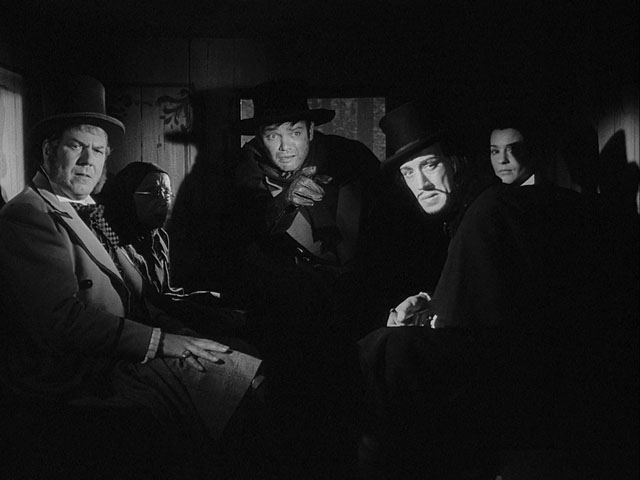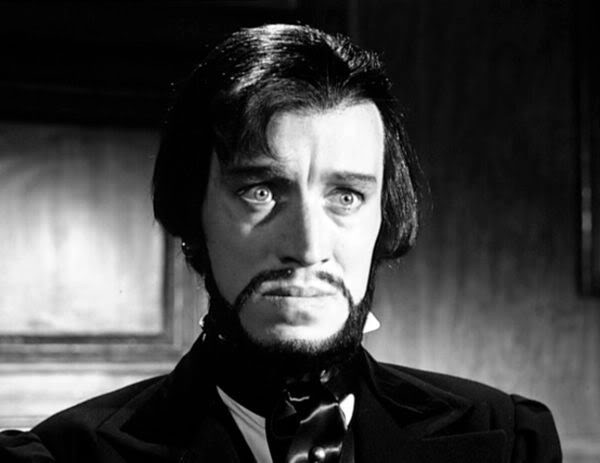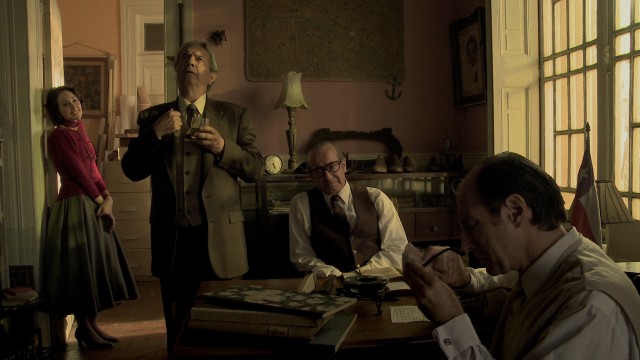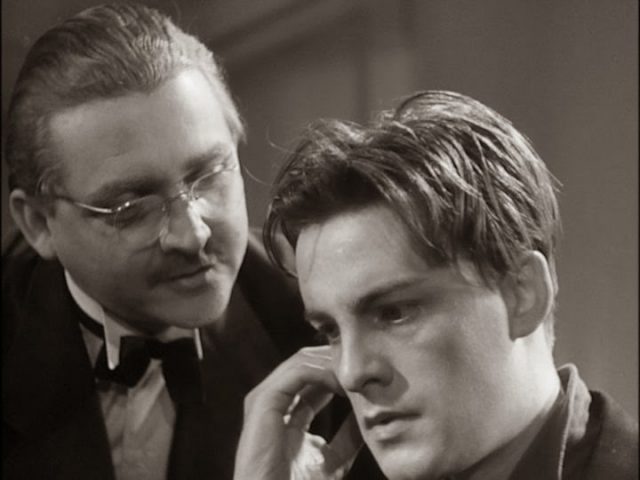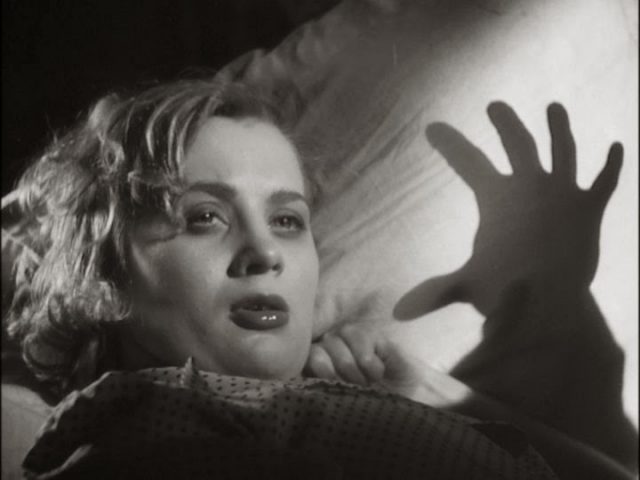
Joseph Cotten is on the run from a jealous husband in Orson Welles’s recently rediscovered and restored Too Much Johnson
TOO MUCH JOHNSON (Orson Welles, 1938)
MoMA Film, Museum of Modern Art
11 West 53rd St. between Fifth & Sixth Aves.
Wednesday, January 3, 1:30
Thursday, February 15, 1:30
212-708-9400 www.moma.org
In August 2013, a 35mm nitrate workprint containing the raw footage of what was to be Orson Welles’s professional debut as a film director was discovered in a warehouse in Pordenone, Italy, home of an annual silent film festival. Consisting of sixty-six unedited, purposefully silent minutes, the film had been shot to accompany the Mercury Theatre’s streamlined staging of William Gillette’s 1894 farce, Too Much Johnson. Unfortunately, when the theatrical production opened in 1938 in a Connecticut theater, the filmed segments couldn’t be shown, spoiling the show’s chances to eventually make it to Broadway — various reports claim that the footage was not finished in time; the Stony Creek Theater lacked the proper projector; Paramount, which owned the rights to the play, demanded a fee; or it just wasn’t safe to screen the film in the theater. But you can see the raw footage at MoMA on January 3 and February 15 at 1:30, the first screening accompanied by a live score by Ben Model, the second by Makia Matsumara. Restored and preserved by George Eastman House,Too Much Johnson is a wacky, breathless tale of lust, passion, and betrayal, as Leon Dathis (Edgar Barrier) catches his wife (Arlene Francis) cheating on him with the dapper Augustus Billings (Joseph Cotten). Dathis sets out after Billings, chasing him through the streets, around a basket shop, and across the rooftops of Lower Manhattan, predominantly in the Meatpacking District — if you look closely, you can see the elevated railroad tracks that became the High Line. Dathis is joined by residents and storekeepers from the neighborhood and a pair of Keystone Kops (John Houseman and Herbert Drake) as they desperately try to catch the cad. The cast also includes Ruth Ford as Billings’s wife, Mary Wickes as Mrs. Battison, and Howard I. Smith as Cuba plantation owner Joseph Johnson.
The hats come off in rediscovered Welles footage meant to accompany Mercury Theatre stage production
In his cinematic debut, Cotten, who would team up with Welles on The Magnificent Ambersons, Citizen Kane, Journey into Fear, and The Third Man, shows quite an aptitude for slapstick comedy, à la Harold Lloyd, fearlessly portraying Billings, doing all the stunts himself, including several very dangerous ones. Meanwhile, Lenore Faddish (Virginia Nicolson, Welles’s wife at the time) and Harry MacIntosh (Guy Kingsley) are preparing to go to Cuba together (Tomkins Cove along the Hudson doubles for Cuba), which does not make her father (Eustace Wyatt) very happy. Welles and cinematographer Harry Dunham use silent-film tropes, from fast-paced action to overemoting to lush close-ups — and yes, the dastardly villain actually twirls his mustache — as well as what would become Welles’s trademark deep focus; the uncut footage features multiple takes, scenes shot from different angles, funny mistakes made by the cast and crew, clearly fake palm trees, a duel without swords, and long takes that would have likely been edited down later. One of the funniest bits involves Dathis and hats, which leads into a suffragette march. The whole thing is a hoot, but just be prepared and know that it’s not a fully realized, fully chronological story with a beginning, middle, and end. Fans of Welles, silent comedies, and Cotten will go crazy for it. And yes, the title means what you think it does. (You can see a home-movie clip of Welles directing the film here.) Too Much Johnson is screening as part of the MoMA series “Modern Matinees: Considering Joseph Cotten,” which runs January 3 to February 28 and also includes the Welles collaborations in addition to Shadow of a Doubt, Gaslight, Duel in the Sun, The Abominable Dr. Phibes, Soylent Green, Hush…Hush, Sweet Charlotte, and other films by the underrated radio, TV, stage, and screen star, who was never nominated for an Oscar, Emmy, Grammy, or Tony.
Ai Weiwei takes a close look at the international refugee crisis in Human Flow
HUMAN FLOW (Ai Weiwei, 2017) Quad Cinema, 34 West 13th St. between Fifth & Sixth Aves., 212-255-2243, Wednesday, January 3, 4:30 BAMcinématek, BAM Rose Cinemas, 30 Lafayette Ave. between Ashland Pl. & St. Felix St., 718-636-4100, Wednesday, January 3, 7:00 www.humanflow.com
On January 3, Chinese dissident artist Ai Weiwei will travel from Manhattan to Brooklyn, participating in two Q&As following screenings of his stunning new documentary, Human Flow. This past fall, Ai had several concurrent exhibitions in New York City that dealt with the international refugee crisis. At Deitch Projects in SoHo, “Laundromat” included racks of clothing that had been worn by Syrian refugees at the Idomeni refugee camp in Iraq, all freshly cleaned and pressed, as if ready to give the migrant men, women, and children a new lease on life. Among other items, the gallery show also featured several monitors playing footage that Ai had shot in various refugee camps, film that has now been turned into Human Flow. In 2016, Ai and his crew traveled to twenty-three countries, visiting dozens of camps in a year in which it was estimated that there were as many as 65 million displaced people around the world, fleeing war, poverty, famine, and persecution. In his first full-length documentary, Ai moves from macro to micro, shooting at a variety of scales. He uses drones to photograph tent cities in the desert from high above — reminiscent of the photography of Edward Burtynsky, turning individual items into parts of a vast pattern — along with gorgeous scenes of deserts and seascapes and intimate cell-phone footage and handheld camera shots that put viewers right in the middle of these makeshift villages, where some families live for decades. Ai, with his scruffy gray beard and in a hoodie, is often shown not only taking cell-phone videos but helping out and mingling with the refugees as dinghies arrive on the shores of Lesbos, Greece, or playfully trading passports with a refugee. Throughout the film, men and women stand proudly, often in traditional dress, looking directly at the camera for extended lengths of time, establishing their unique individuality, putting faces to what is most often seen in news clips as swaths of people struggling to survive. As Ai travels to each successive camp, he posts relevant quotes from writers and philosophers from that nation, from Turkish poet Nazim Hikmet, the Dhammapada Buddhist scripture, and Persian poet Baba Tahir to Kurdish poet Sherko Bekas, Syrian poet Adonis, and U.S. president John F. Kennedy. Details about the situations are sometimes delivered news-crawl-style, along the bottom of the screen.
Ai Weiwei gets deeply involved in situation in Human Flow
In addition to giving voice to the refugees themselves — “Where am I supposed to start my new life?” one woman asks — Ai speaks with crisis workers on the ground and United Nations officials and other experts, such as UNHCR Communications Officer Boris Cheshirkov, Princess Dana Firas of Jordan, Human Rights Watch Emergencies Director Peter Bouckaert, UN High Commissioner for Refugees Filippo Grandi, UNHCR Pakistan Senior Operation Coordinator Marin Din Kajdomcaj, UNICEF Lebanon representative Tanya Chapuisat, former Syrian astronaut Mohammad Fares, Dr. Cem Terzi of the Association of Bridging Peoples, and Dr. Kemal Kirişci, a senior fellow at the Brookings Institution who gets right to the point, explaining, “It’s going to be a big challenge to recognize that the world is shrinking, and people from different religions, different cultures, are going to have to learn to live with each other.” The powerful, immersive film was edited by Niels Pagh Andersen, who worked on Joshua Oppenheimer’s searing The Act of Killing and The Look of Silence, from nine hundred hours of footage, with a score by Karsten Fundal and a dozen cinematographers, among them Ai, Christopher Doyle, Zhang Zanbo, Konstantinos Koukoulis, and Johannes Waltermann. “The more immune you are to people suffering, that’s very, very dangerous. It’s critical for us to maintain this humanity,” one woman says, and that gets right to the heart of the film. Human Flow is very personal to Ai, whose own battles with Chinese authorities and exile — he spent much of his childhood in a hard labor camp in the Gobi Desert because his father, a poet and intellectual, was part of a revolutionary group, and as an adult Ai has been imprisoned, placed under house arrest, and beaten for his activism — were detailed in the Ai Weiwei: Never Sorry. A masterful Conceptualist whose work explores sociocultural elements through a historical lens, Ai has always believed that artists have a responsibility to reveal the truth, and that’s precisely what he does in Human Flow, with a determined fearlessness to do what’s right.
In one of the film’s most heart-wrenching moments, thirteen thousand refugees, mostly from Syria, Iraq, and Afghanistan, walk through the Greek countryside toward the Macedonian border, only to find that a fence has been erected and the entrance is now closed, leaving them with nowhere to go. It’s a harrowing scene, but Ai is no mere doomsayer. There are many shots in the film that show children running about and playing, laughing and smiling for the camera, still filled with hope for a better life. It’s the rest of the world’s job to make that happen, and as Ai exemplifies, every one of us can make a difference. Ai will participate in Q&As following the 4:30 screening at the Quad as part of the “One Shots” series and after the 7:00 show at BAMcinématek, the latter moderated by Laura Poitras (Citizenfour, Astro Noise). The film was released in conjunction with the Public Art Fund project “Ai Weiwei: Good Fences Make Good Neighbors,” consisting of dozens of installations and interventions in all five boroughs: at Doris C. Freedman Plaza, the Washington Square Arch, the Unisphere, Essex Street Market, the Cooper Union, bus shelters, lampposts, newsstand kiosks, and other locations, furthering Ai’s artistic ideas about immigrant bans and the treatment of refugees, spread across a city he called home in the 1980s.
Since 1997, producer and curator Ron Diamond has been presenting The Animation Show of Shows, an annual collection of animated short films from around the world, celebrating the vast array of innovation in the medium. The nineteenth edition of the series opens December 29 at the Quad, featuring sixteen works from Belgium, Canada, France, Germany, England, Sweden, Switzerland, and the United States, with an overarching theme of finding one’s place and seeking connections in a world exploding with natural beauty despite our growing dependence on technology. The ninety-minute compilation opens with Quentin Baillieux’s thumping music video for Charles X’s “Can You Do It,” which equates the street and the elite via a horse race through Los Angeles. That is followed by Lia Bertels’s exquisite Tiny Big, consisting of individual 2D hand-drawn scenes of “everyday dancers possessed by the spirits of earth, love & money,” made up of minimalist black-and-white line drawings with occasional bursts of color, backed with subtle sounds of wind and water, along with spare piano music based on Puccini’s Madame Butterfly, and boasting a wry sense of humor. Two-time Oscar winner Pete Docter’s (Up, Inside Out) 1990 short, Next Door, is about a young girl with a vast imagination playing outside, annoying the old man who lives next door; she is surrounded by circles, while he is trapped in a square environment. Jac Clinch’s The Alan Dimension follows the travails of a middle-aged man named Alan, who can see six minutes into the future, believing that he is “the next step in cognitive evolution,” becoming obsessed with his power and angering his wife; BAFTA nominee Clinch uses stop-motion, 2D, and CG animation that includes photographic backgrounds that enhance the overall atmosphere. Paul Julian and Les Goldman’s 1964 warning, Hangman, which was made for classrooms and is based on a poem by Maurice Ogden, has been lovingly restored and is as relevant as ever; the film unfolds like a picture book brought to life, with frames reminiscent of paintings by Dali and de Chirico and narration by Herschel Bernardi.
In The Battle of San Romano, Georges Schwitzgebel animates the painting by Paolo Uccello about the war between Florence and Siena; Aurore Gal, Clémentine Frère, Yukiko Meignien, Anna Mertz, Robin Migliorelli, and Romain Salvini’s Gokurosama is like a computer game loaded with sight gags as a woman is taken to a mall chiropractor; Kobe Bryant honors himself with the autobiographical Dear Basketball, directed by Disney veteran Glen Keane and with a score by Oscar-winning composer John Williams; Alan Watts narrates David O’Reilly’s Everything; Steven Woloshen’s Casino is set to Oscar Peterson’s “Something Coming” and drawn directly on film stock; Alexanne Desrosiers’s Les Abeilles Domestiques sees humanity as “domestic bees,” one long take of a hive mind comprising cool visual and aural connections; Tomer Eshed’s Our Wonderful Nature: The Common Chameleon riffs on nature documentaries; Elise Simard uses mixed media on paper, cut-out animation, photography, and video in Beautiful Like Elsewhere; and Robert Löbel & Max Mörtl’s Island builds a bizarre community out of playful shapes, colors, and sounds. Perhaps the most realistic and emotional film is Parallel Studio’s Unsatisfying, a series of quick clips of things going wrong over melancholy music; its popularity led to the Unsatisfying challenge, in which people were invited to animate other failures, which you can see here. Which brings us to the pièce de résistance, Niki Lindroth von Bahr’s Hollywood musical takeoff, The Burden, about loneliness and existential anxiety experienced by night workers, starring upright fish at the Hotel Long Stay, mice at a fast-food restaurant, monkeys at a call center, and dogs in a supermarket. The characters break out into song, making such declarations as “I have no one to be with / I don’t know why / Or actually I do know why” and “But I have my own dreams / my own needs / I don’t demand much / My life is drifting away.” The models and puppets are all handmade, the score was written by Hans Appelqvist and recorded live by a sixteen-piece orchestra, and the choreography and camera angles are worthy of Busby Berkeley. It’s a statement of our times, and a deeply entertaining and thought-provoking one at that. Over the years, The Animation Show of Shows has screened three dozen shorts that went on to garner Oscar nominations, with ten winning the award. Several of the works in the nineteenth edition are deserving of awards as well, first and foremost The Burden, which has deservedly taken home many international prizes.
Actor and stand-up comic Kumail Nanjiani and Emily Gardner (Zoe Kazan) explore love and romance in The Big Sick
THE BIG SICK (Michael Showalter, 2017)
MoMA Film, Museum of Modern Art
11 West 53rd St. between Fifth & Sixth Aves.
Friday, December 29, $12, 7:30
Series runs through January 12
212-708-9400 www.moma.org www.thebigsickmovie.com
Michael Showalter’s surprise summer hit, The Big Sick, is a heart-wrenchingly bittersweet romantic comedy loosely based on the real life of Pakistani American actor and comic Kumail Nanjiani. It would do a disservice to call the film, which was produced by Judd Apatow and Barry Mendel, a mere romcom, as it is so much more, taking on religion, assimilation, responsibility, culture, and personal identity with intelligence and wit. Kumail plays an Uber driver and stand-up comedian gigging at a Chicago club with fellow comics CJ (Bo Burnham), Mary (Aidy Bryant), and his doofy roommate, Chris (Kurt Braunohler). Kumail spends a lot of time at his parents’ suburban home, the heart of his family, where his mother, Sharmeen (Zenobia Shroff) and father, Azmat (Anupam Kher), continually invite single young Pakistani women to “drop by” to meet him, determined to arrange a proper marriage for their son. However, Kumail has started sort-of seeing a blond American woman, Emily Gardner (Zoe Kazan), after she playfully heckles him at a gig. As their relationship gets more serious, Kumail still hasn’t told his parents or his brother, Naveed (Adeel Akhtar), jeopardizing their future, but when Emily is struck by a sudden illness, Kumail reevaluates who he is and what he desires out of life. Emily’s illness also forces him to get to know her parents, Beth (Holly Hunter) and Terry (Ray Romano), who at first want nothing to do with him.
Beth (Holly Hunter) and Terry (Ray Romano) wait for news on their daughter in Michael Showalter’s The Big Sick
Written by Nanjiani (The Meltdown with Jonah and Kumail, Silicon Valley) and freelance journalist and author Emily V. Gordon ( SuperYou: Release Your Inner Superhero, The Carmichael Show), The Big Sick is as gripping as it is funny. The characters are well defined, and the plot is filled with both delightful and shocking twists and turns that will have you on the edge of your seat, tears at the ready, particularly if you don’t know what ultimately happened to Kumail and Emily in actuality. Nanjiani is adorably understated playing a version of himself, while Emmy nominee Kazan (Ruby Sparks, Olive Kitteridge) is charming and quirky as Emily; the two have an instant chemistry that makes the stop-and-go beginning of their relationship thoroughly involving. Emmy winner Romano (Everybody Loves Raymond, Men of a Certain Age) and Oscar and Emmy winner Hunter (The Piano, Saving Grace) are terrific as Emily’s parents, who have some issues of their own to resolve aside from Kumail and Emily. (As a side note, the scene where Beth gets into a fight with a heckler was inspired by a real incident in which Hunter heckled a tennis player at the US Open.) Bryant (Saturday Night Live, Danger & Eggs) and musician and stand-up comic Burnham provide solid, um, comic relief, while Shroff and Kher excel as Kumail’s parents, who insist that Kumail follow tradition, regardless of what he wants for himself. One of the best films of the year, The Big Sick is screening December 29 at 7:30 in MoMA’s annual series “The Contenders,” which consists of films the institution believes will stand the test of time; it continues through January 12 with such other 2017 works as James Mangold’s Logan, James Gray’s The Lost City of Z, Steven Spielberg’s The Post, and Greta Gerwig’s Lady Bird.
Alain Cohen makes a sparkling debut in Claude Berri’s semiautobiographical masterpiece, The Two of Us
THE TWO OF US (LE VIEIL HOMME ET L’ENFANT) (Claude Berri, 1967)
Quad Cinema
34 West 13th St. between Fifth & Sixth Aves.
Opens Friday, December 22
Series runs December 29 – January 4
212-255-2243 quadcinema.com
The Quad is celebrating the holidays with “A Very Berri Christmas,” a wide-ranging ten-film tribute to French writer, director, producer, actor, and distributor Claude Berri that includes such favorites as Jean de Florette, Manon of the Spring, and Le Sex Shop. The series kicks off December 22 with the U.S. premiere of the fiftieth anniversary 4K restoration of Berri’s semiautobiographical debut feature, the extraordinary WWII coming-of-age drama The Two of Us. “In November 1943, I was eight years old . . . and already a Jew,” Berri, who was born Claude Berel Langmann, says in voice-over at the start of the film, which is based on his real-life experiences when he was sent to live with a gentile family during the war. Young Claude Langmann (Alain Cohen) can’t help getting into trouble even though his father (Charles Denner) keeps trying to make him understand that Jews have to lay low and stay below the radar in German-occupied Paris. But soon Claude’s exasperated father and loving mother (Zorica Lozic) send him off to the Grenoble countryside to stay with Mémé (Luce Fabiole) and Pépé (Michel Simon), an older couple who don’t know that he’s Jewish. They become surrogate grandparents for Claude, who builds a particularly special relationship with Pépé, an animal lover who blames the world’s ills on the Jews, the Communists, the Bolsheviks, and the English. He regularly chastises his son, Victor (Roger Carel), who is married to Suzanne (Sylvine Delannoy). Pépé prefers the company of his treasured fifteen-year-old dog, Kinou, who has his own chair at the dinner table and sleeps in bed with Mémé and Pépé. As Pépé sings the praises of Vichy leader Marshal Philippe Pétain, Claude continues to wreak more than his share of havoc, from getting in fights at school to flirting with Dinou (Elisabeth Rey), the daughter of Maxime (Paul Préboist), a farmer whose son (Didier Perret) can’t keep his finger out of his nose.
The Jewish Claude (Alain Cohen) and the anti-Semitic Pépé (Michel Simon) form a unique bond in sensitive and beautiful WWII drama
The Two of Us, whose French title translates as The Old Man and the Child, is anchored by spectacular performances by newcomer Cohen, whose maternal grandparents were killed at Auschwitz, and Simon (L’Atalante,Boudu Saved from Drowning), in one of his last roles following a debilitating accident with makeup dye. Despite being only nine years old, Cohen, who would go on to play Claude in two other films by Berri, shows an innate understanding of his character’s complexities; Claude knows how to push adults’ buttons, as revealed by his sly smiles. He subtly taunts Pépé about his anti-Semitism, at one point teasing the old man about the size and shape of his nose. Cohen even looks directly into the camera a few times, as if he’s aware that we’re watching him. Simon won the Silver Bear at the Berlin Film Festival for his portrayal of Pépé, a big, lovable, gentle man with a tender humanity except for his dangerous political views; Berri does not apologize for him but instead depicts him as someone who doesn’t really know any better and perhaps might just learn something from Claude. Berri also throws in a playful reference to a frying pan, a key object in his Oscar-winning 1962 short, Le Poulet, about a hen. The 4K restoration of The Two of Us is sensational, bringing out the sharp details of Jean Penzer’s black-and-white photography, which combines beautifully with Georges Delerue’s gorgeous, understated score. The Two of Us is an unforgettable film, relentlessly charming despite its serious subject matter, with one of the all-time-great performances by a child. “A Very Berri Christmas” continues December 29 through January 4 with such other films as Germinal, Male of the Century, Uranus, and Je vous aime, which boasts a spectacularly attractive cast as Catherine Deneuve tries to discover what went wrong with former lovers Gérard Depardieu, Jean-Louis Trintignant, and Serge Gainsbourg.
Iconic Chinese star Ruan Lingyu gives one of her best performances in silent classic The Goddess
THE GODDESS (SHEN NU) (Wu Yonggang, 1934)
Film Society of Lincoln Center, Walter Reade Theater
144 West 65th St. between Eighth Ave. & Broadway
Thursday, December 21, 8:30
Series runs December 13 – January 7
212-875-5050 www.filmlinc.org
Wu Yonggang’s directorial debut, The Goddess, made for Lianhua Film Company after he worked as a designer for the Shaw brothers, is a socially conscious, emotive tale about one woman’s struggle to give her young son a better life than her own. The seventy-three-minute silent film opens with a series of shots by cinematographer Hong Weilie that follows the evening light, from the setting sun to a man on a ladder lighting a street corner oil lamp to an apartment window seen from the outside. Wu then cuts to inside the room, revealing a dressing table with lots of makeup, then a pair of dresses hanging on the wall, and a doll. The camera next rises from an empty basket on the floor to a nervous woman (Ruan Lingyu) cradling a baby. She looks at a clock; it is time for her to leave her child and walk the streets of the city to make money. It’s a melancholy scene in a melancholy film, but the unnamed prostitute is no mere hooker with a heart of gold; she is a determined yet fragile woman who will do anything for her son, Shuiping (Keng Li). Running from the police, she is helped by Zhang (Zhang Zhizhi), a low-level gangster who decides to become her pimp, regularly taking her money and threatening her future, and that of her son’s. Whenever she attempts to raise her station, particularly when she saves enough money to send Shuiping to private school, there is always something that brings her back down.
A prostitute (Ruan Lingyu) dreams of a better life for her son (Keng Li) in Wu Yonggang’s The Goddess
Writer-director Wu also designed the sets, which include German Expressionist-type buildings and alleyways along with blinking neon towers and stores. Large columns increase in number, as if creating bars around the woman. Holding on to Shuiping, the woman is seen through Zhang’s spread legs, trapped. Using soft focus, superimposition, and slow fades — the camera cannot get enough of Ruan’s expressive face — Wu depicts her nightly travails as she smokes cigarettes and looks for her next customer. In one memorable scene, Wu shows only feet on the sidewalk as she is propositioned and accepts. But he never sentimentalizes the fallen woman, instead making her a tragic example of societal ills in 1930s China, especially gender and class hierarchies, as explained by the school’s principal. “She is a human being and has her human rights — so does her son,” he says. Unfortunately, most everyone else does not agree. The Goddess is a silent film classic, a major success in China; Wu (The Desert Island, Loyal Family) remade it with sound in 1938 as Rouge Tears. Sadly, Ruan, a huge star, had serious personal problems and committed suicide in 1935, at the age of twenty-four, a victim of gossip and physical abuse; Stanley Kwan’s award-winning 1992 biopic, Centre Stage, detailed her life, with Maggie Cheung playing Ruan. (Visual artist Isaac Julien re-created scenes from The Goddess with Zhao Tao and also cast Cheung as Goddess of the Sea in his nine-screen 2013 MoMA installation, Ten Thousand Waves.) The Chinese title, shennü, refers to both a goddess and a prostitute; Wu, and Ruan, reveals that one does not preclude the other. The Goddess is screening December 21 at the Walter Reade Theater in the Film Society of Lincoln Center series “Emotion Pictures: International Melodrama,” with live piano accompaniment by Donald Sosin. The series, which divides its more than fifty films into four categories — Silent Screen, Hollywood’s Golden Age, International Classics, and Modern/Postmodern Drama — continues through January 7 with works by Yasujirô Ozu, Arturo Ripstein, Charlie Chaplin, Pedro Almodóvar, Clint Eastwood, Guy Maddin, Douglas Sirk, Leo McCarey, Rainer Werner Fassbinder, Vincente Minnelli, Terence Davies, and many more.
Rock Hudson and Jane Wyman star in Douglas Sirk’s gorgeous Technicolor emotional melodrama All That Heaven Allows
ALL THAT HEAVEN ALLOWS (Douglas Sirk, 1955)
Film Society of Lincoln Center, Walter Reade Theater, Francesca Beale Theater
144/165 West 65th St. between Eighth Ave. & Broadway
Wednesday, December 13, 6:30
Monday, January 1, 7:00
Series runs December 13 – January 6
212-875-5050 www.filmlinc.org
Forget about It’s a Wonderful Life, Miracle on Thirty-Fourth Street, and endless versions of A Christmas Carol; our favorite holiday movie is Douglas Sirk’s sensationally strange and beautiful All That Heaven Allows, which you can see December 13 and January 1 as part of the Film Society of Lincoln Center’s four-week, fifty-four-movie, get-out-your-handkerchiefs series “Emotion Pictures: International Melodrama.” Rock Hudson and Jane Wyman, who played characters who fell in love in Sirk’s Magnificent Obsession, are at it again in All That Heaven Allows. This time around, Hudson is Ron Kirby, a softhearted, hunky gardener who prefers a simple, outdoorsy life yet is drawn to Cary Scott (Wyman), an older widow who is firmly entrenched in her community’s country-club lifestyle with her best friend, Sara (Agnes Moorehead). Kirby and Cary begin a passionate affair but when they decide to wed, the snooty members of the town’s social register are thoroughly appalled and do everything in their power to drive them apart because of class, wealth, and age differences. (At thirty-seven, Wyman was a mere eight years older than Hudson in real life.) Meanwhile, Cary’s kids, high schooler Kay (Gloria Talbott) and college student Ned (William Reynolds), find their mother’s impending marriage to Kirby disgusting and distasteful as well, preferring she marry Harvey (Conrad Nagel), a plain, sexless widower. In 1950s America, women were still subservient to the needs of men and to raising their children, not permitted by society to lead their own lives and make decisions for themselves, especially when it came to their sexuality. The film features an essentially nonreligious belief system that is embodied by Kirby, who is inspired by the writings on naturalism and the true meaning of success espoused by Henry David Thoreau in Walden. Indeed, the outside world is central to the film; Sirk and his longtime cinematographer, Russell Metty, let the camera linger on trees, lakes, snow banks, and deer. Flowers abound indoors and out, and windows always look out on beautiful scenery, as if paintings, accompanied by Frank Skinner’s equally lush score and Bill Thomas’s colorful costumes.
It all makes for the kind of candy-coated America that David Lynch turned upside down and inside out in Blue Velvet and that directly influenced Todd Haynes’s 2002 Sirk homage, Far from Heaven, in which white Connecticut housewife Cathy Whitaker (Julianne Moore), who is married to a closeted white executive (Dennis Quaid), becomes perhaps too friendly with her black gardener (Dennis Haysbert), a melding of All That Heaven Allows and Sirk’s Imitation of Life. (Both Far from Heaven and Imitation of Life are part of the series as well.) At one point, Kirby talks about how his best friend learned to be his own man. “And you want me to be a man,” Cary says. “Only in that one way,” Kirby responds, playfully looking over at Cary; it’s as if Hudson is teasing her about his real-life sexuality. People’s double nature is reflected throughout, as Sirk and Metty use fireplace screens, windshields, mirrors, and even a television set to create physical separation between characters as well as the inner and outer parts of the same character. In addition, there is a vast array of ties, cravats, scarves, ascots, bow ties, and other articles of clothing that everyone wears around their necks, as if their true feelings are always being choked and hidden. It’s a magnificent film, richly textured and multilayered, not nearly as cynical and tongue-in-cheek as some claim it to be. All That Heaven Allows is screening December 13 and January 1 in “Emotion Pictures: International Melodrama,” which divides its films into four categories: Silent Screen, Hollywood’s Golden Age, International Classics, and Modern/Postmodern Drama, with works by Yasujirô Ozu, Martin Scorsese, Pier-Paolo Pasolini, Charlie Chaplin, Pedro Almodóvar, Clint Eastwood, Federico Fellini, Youssef Chahine, David Lean, Rainer Werner Fassbinder, Vincente Minnelli, Max Ophüls, and many more.
Sergey Urusevsky’s dazzling camera work is a character unto itself in The Cranes Are Flying
THE CRANES ARE FLYING (Mikhail Kalatozov, 1957)
Sunday, December 17, 4:00
Saturday, December 30, 3:30 www.filmlinc.org
Even at a mere ninety-seven minutes, Mikhail Kalatozov’s The Cranes Are Flying is a sweeping Russian antiwar epic, an intimate and moving black-and-white tale of romance and betrayal during WWII. Veronika (Tatyana Samojlova) and Boris (Aleksey Batalov) are madly in love, swirling dizzyingly through the streets and up and down a winding staircase. But when Russia enters the war, Boris signs up and heads to the front, while Veronika is pursued by Boris’s cousin, Mark (Aleksandr Shvorin). Pining for word from Boris, Veronika works as a nurse at a hospital run by Boris’s father, Fyodor Ivanovich (Vasili Merkuryev), as the family, including Boris’s sister, Irina (Svetlana Kharitonova), looks askance at her relationship with Mark. The personal and political intrigue comes to a harrowing conclusion in a grand finale that for all its scale and scope gets to the very heart and soul of how the war affected the Soviet people on an individual, human level, in the family lives of women and children, lovers and cousins, husbands and wives.
Unforeseen circumstances trap Veronika (Tatyana Samojlova) in wartime Russia in Mikhail Kalatozov’s masterful The Cranes Are Flying
The only Russian film to win the Palme d’Or at Cannes by itself, The Cranes Are Flying is a masterful work of art, a searing portrait of the horrors of war as seen through the eyes of one desperate woman. Adapting his own play, Viktor Rozov’s story sets up Boris and his family as a microcosm of Soviet society under Stalin; it’s no coincidence that the film was made only after the leader’s death. It’s a whirlwind piece of filmmaking, a marvelous collaboration between director Kalatozov, editor Mariya Timofeyeva (Ballad of a Soldier), composer Moisey Vaynberg (the opera The Passenger), and cinematographer Sergey Urusevsky, who also worked with Kalatozov on I Am Cuba and The Unsent Letter; Urusevsky’s camera, often handheld, is simply dazzling, whether moving through and above crowd scenes, closing in on Samojlova’s face and Batalov’s eyes, or twirling up at the sky. Poetic and lyrical, heartbreaking and maddening, The Cranes Are Flying is an exquisite example of the power of cinema. You can see it December 17 and 30 in the Film Society of Lincoln Center series “Emotion Pictures: International Melodrama,” which also features works by D. W. Griffith, F. W. Murnau, Oscar Micheaux, Nicholas Ray, George Cukor, Ida Lupino, Leo McCarey, Ritwik Ghatak, Mikio Naruse, Jacques Demy, Lars von Trier, Guy Maddin, and many more.
Oharu (Kinuyo Tanaka) lives a life filled with misery after misery in Mizoguchi melodrama
THE LIFE OF OHARU (SAIKAKU ICHIDAI ONNA) (Kenji Mizoguchi, 1952)
Monday, December 18, 1:30
Saturday, January 6, 3:45 www.filmlinc.org
We used to think that Aki Kaurismäki’s The Match Factory Girl was the saddest film ever made about a young woman who just can’t catch a break, as misery after misery keeps piling up on her ever-more-pathetic existence. But the Finnish black comedy has nothing on Kenji Mizoguchi’s The Life of Oharu, a searing, brutal example of the Buddhist observation of impermanence and the role of women in Japanese society. The film, based on a seventeenth-century novel by Ihara Saikaku, is told in flashback, with Oharu (Kinuyo Tanaka) recounting what led her to become a fifty-year-old prostitute nobody wants. It all starts to go downhill after she falls in love with Katsunosuke (Toshirô Mifune), a lowly page beneath her family’s station. The affair brings shame to her mother (Tsukie Matsuura) and father (Ichiro Sugai), as well as exile. The family is redeemed when Oharu is chosen to be the concubine of Lord Matsudaira (Toshiaki Konoe) in order to give birth to his heir, but Lady Matsudaira (Hisako Yamane) wants her gone once the baby is born, and so she is sent home again, without the money her father was sure would come to them.
Mizoguchi’s The Life of Oharu is an elegant film about one woman’s struggle to survive in a cold world
Over the next several years, Oharu becomes involved in a series of personal and financial relationships, each one beginning with at least some hope and promise for a better future but always ending in tragedy. Nevertheless, she keeps on going, despite setback after setback, bearing terrible burdens while never giving up. Mizoguchi (Sansho the Bailiff, The 47 Ronin, Street of Shame) bathes much of the film in darkness and shadow, casting an eerie glow over the unrelentingly melodramatic narrative. Tanaka, who appeared in fifteen of Mizoguchi’s films and also became the second Japanese woman director (Love Letter, Love Under the Crucifix), gives a subtly compelling performance as Oharu, one of the most tragic figures in the history of cinema. Winner of the International Prize at the 1952 Venice International Film Festival, The Life of Oharu is screening December 18 and January 6 in the Film Society of Lincoln Center series “Emotion Pictures: International Melodrama,” which also features works Teuvo Tulio, Fei Mu, George Kuchar, Todd Haynes, Wong Kar Wai, Terence Davies, Leos Carax, Wu Yonggang, Robert Stevenson, and many more.
Letty Mason (Lillian Gish) is being driven crazy by internal and external sources in The Wind
THE WIND (Victor Sjöström, 1928)
December 19, 8:30 www.filmlinc.org
Victor Sjöström’s 1928 now-classic silent film The Wind stars Lillian Gish as Letty Mason, a young woman traveling from Virginia to Texas to live with her cousin Beverly (Edward Earle). Traveling from the cultured, civilized East to what was still the wild West, the uncertain Letty must confront the fierceness of nature head-on — both human nature and the harsh natural environment. On the train, she is wooed by cattleman Wirt Roddy (Montagu Love), but her fears grow as she first sees the vicious wind howling outside the train window the closer she gets to her destination. Once in Sweetwater, she is picked up by her cousin’s neighbors, the handsome Lige Hightower (Lars Hanson), and his goofy sidekick, Sourdough (William Orlamond). Both men take a quick liking to Letty, who seems most attracted to Wirt. Soon Beverly’s wife, Cora (Dorothy Cumming, in her next-to-last film before retiring), becomes jealous of Letty’s closeness with her husband and kids and kicks her out, leaving a desperate Letty to make choices she might not be ready for as the wind outside becomes fiercer and ever-more dangerous. The Wind is a tour de force for Gish in her last silent movie, not only because of her emotionally gripping portrayal of Letty but because she put the entire production together, obtaining the rights to the novel by Dorothy Scarborough, hiring the Swedish director and star Hanson, and arguing over the ending with the producers and Irving Thalberg. (Unfortunately, she lost on that account, just about the only thing that did not go the way she wanted.)
Letty Mason (Lillian Gish) and Lige Hightower (Lars Hanson) have some tough decisions to make in Victor Sjöström’s silent classic
Sjöström (The Phantom Carriage, The Divine Woman), who played Professor Isak Borg in Ingmar Bergman’s Wild Strawberries, and cinematographer John Arnold create some dazzling effects as a twister threatens and Letty battles both inside and outside; she is regularly shot from the side, at the door of the shack where she lives, not knowing if she’d be safer inside or outside as the wind and sand blast over her. The film, an early look at climate change, was shot in the Mojave Desert in difficult circumstances; to get the wind to swirl, the crew used propellers from eight airplanes. Dialogue is sparse, and the story is told primarily in taut visuals. A restored 35mm print of The Wind with the original music and effects soundtrack is screening December 19 in the Film Society of Lincoln Center series “Emotion Pictures: International Melodrama.”