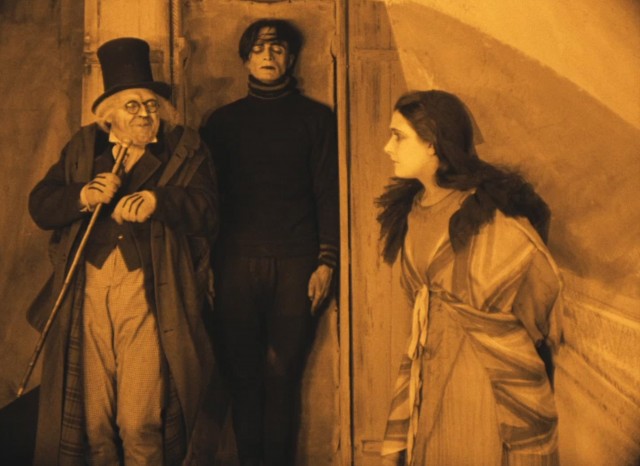
Influential horror classic is brought back to life in stunning restoration and new live score at Baryshnikov Arts Center
THE CABINET OF DR. CALIGARI (DAS CABINET DES DR. CALIGARI) (Robert Wiene, 1920)
Baryshnikov Arts Center, Jerome Robbins Theater
450 West 37th St. between Ninth & Tenth Aves.
Wednesday, March 14, $25, 7:30
646-731-3200
bacnyc.org
www.kinolorber.com
 A few years ago, Robert Wiene’s 1920 silent classic, The Cabinet of Dr. Caligari, was released in a stunning 4K restoration, giving audiences the chance to see it as if for the first time. Now you can hear it as if for the first time as well, as the Baryshnikov Arts Center will be showing it on March 14 at 7:30 with a new score by Stephen Prutsman, performed live by the Puck Quartet. Back in high school, we saw The Cabinet of Dr. Caligari for the first time in the somewhat dubious “Christian Values in Film” class. The verdict: The Cabinet of Dr. Caligari has no Christian values. But the Caligari we saw back then is rather different from the digital restoration, made from the original camera negative by the Friedrich Murnau Foundation. This sparkling Caligari is now the only way to experience this truly frightening work, one of the most influential horror films of all time. You can find elements of Paul Wegener’s The Golem, James Whale’s Frankenstein and The Bride of Frankenstein, and Todd Browning’s Dracula — all three of which followed this truly seminal film — in this twisted, unsettling psychological thriller of murder and mayhem involving the mysterious Dr. Caligari (Werner Krauss) and the creepy somnambulist he controls, Cesare (Casablanca’s Conrad Veidt), who predicts the future and eerily walks in his sleep. The tale is told in a frame story by Francis (Friedrich Fehér), who, like his best friend, Alan (Hans Heinrich von Twardowski), is in love with Jane (Lil Dagover). The only problem is that Cesare might have a thing for her as well.
A masterpiece that set the bar high for German Expressionism, The Cabinet of Dr. Caligari might have been shocking when it debuted in 1920, but it’s still shocking today, like nothing you’ve ever seen, with one of the most memorable, enigmatic villains ever put on celluloid. It’s not a traditional silent black-and-white film, instead tinted in blue and gold, with intertitles exploding in a wild green font. The sets, by Hermann Warm, Walter Reimann, and Walter Röhrig, are sharply slanted, with crazy angles and perspectives and backdrops that include unmoving shadows painted right on them; they’re obviously fake and very fragile, adding yet more levels of weirdness. Written by Hans Janowitz and Carl Mayer, photographed by Willy Hameister (irising in and out, occasionally at the same time), and directed by Wiene (Raskolnikov, Der Rosenkavalier), The Cabinet of Dr. Caligari is thick with an ominous, sinister atmosphere that is sheer pleasure; you’ll find yourself smiling at the beauty of it all even as you tense up at the hair-raising proceedings. It is that rare film that works as historical document as well as pure entertainment, a treat for cinema enthusiasts and horror fans alike, especially when the twist ending turns everything inside out and upside down.
You can get a taste for the new score in the above video; pianist, conductor, and composer Prutsman has collaborated with such groups as the St. Paul Chamber Orchestra and the Kronos Quartet, and in 2011 he wrote a new score for the Baryshnikov Arts Center’s screening of Buster Keaton’s 1924 comedy Sherlock, Jr. “I was well aware of the cardinal rule that film music ought never take attention away from the film itself; hence a complex yet cheap Schoenberg-like allusion would no doubt detract from the visual. I decided to ‘sprinkle’ dodecaphonic elements here and there,” Prutsman says of his Caligari score, “yet most of what one hears can be described as imitations of either post-romantic concert, salon, theater, or carnival music around the turn of the 19th century.” The Puck Quartet consists of violinists Lily Holgate and Kenneth Trotter, violist Katharine Dryden, and cellist Liam Veuve.
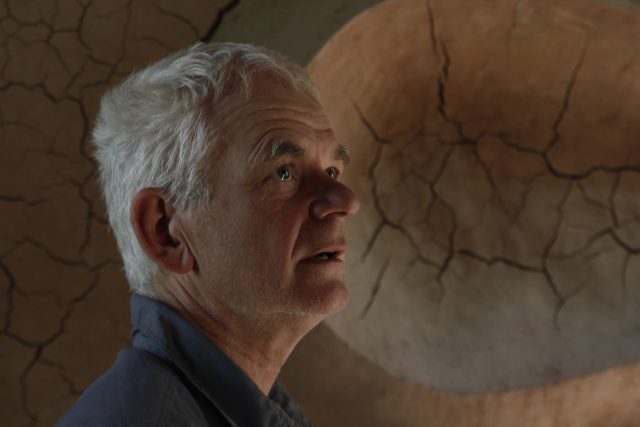
 Thomas Riedelsheimer follows up Rivers and Tides, his 2001 documentary about British artist Andy Goldsworthy, with Leaning into the Wind — Andy Goldsworthy, another fascinating journey with the peripatetic sculptor who uses the world as his canvas, Earth’s natural treasures as his materials. Goldsworthy finds simple pleasures in a beam of light in a cave, a tree fresh with ripe avocados, and walking barefoot on a homemade clay floor. Just as rain starts, he lies down on the street and lets the water pour over him; after a moment, he gets up, leaving a fading, dry outline of his body behind. He plucks leaves and lines them up an outdoor staircase until they form a lovely colored strip that passersby observe as if telling them which way to go. He carves out human shapes in stone to form chambers people can lie in. He has an “intense relationship” with the color yellow. He operates a jackhammer in a quarry. He works with flower petals, mud, twigs, fallen trees, huge rocks — basically, whatever he encounters on his travels can become part of his oeuvre. “I’m still just trying to make sense of the world,” he says. He is like a kid in a candy store as he takes a difficult path among a row of not-too-sturdy bushes or marvels at ants making their way across a forest passage, climbs trees in order to cast a shadow on the grass, and trudges through a stream to get to a favorite log. Many of his spur-of-the-moment works are temporary, to be seen only by himself and his assistant, his daughter Holly, unless captured on film, although plenty of art institutions do hold his work: His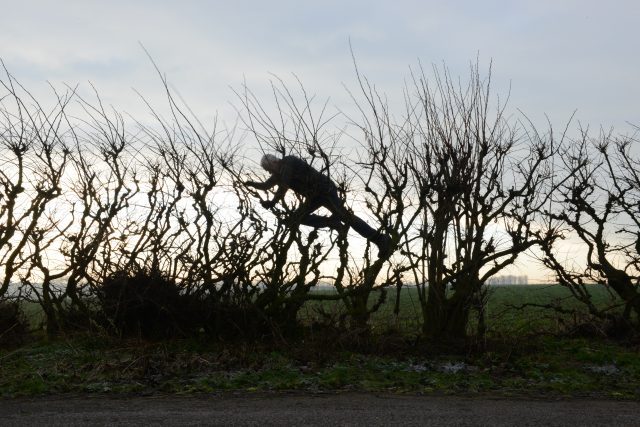
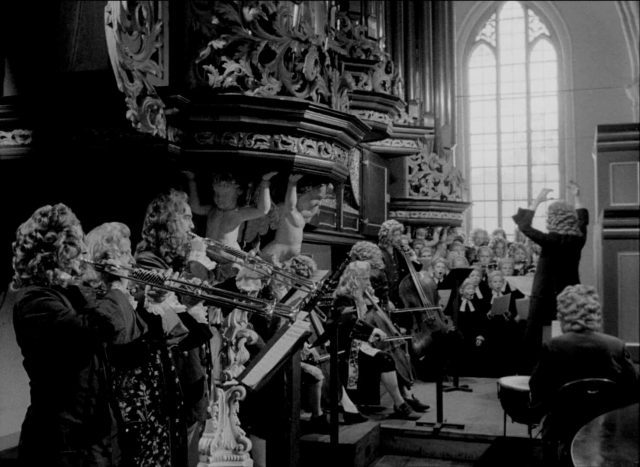
 Jean-Marie Straub and Danièle Huillet’s debut feature, The Chronicle of Anna Magdalena Bach, looks and sounds better than ever in a fiftieth anniversary restoration print that opened at the Quad on March 2. Exquisitely written, directed, and edited by the longtime partners, the film is a multilayered romance made on an exceedingly tight budget, shot in sublime black-and-white and recorded with live music. The life of Johann Sebastian Bach (Dutch musician and conductor Gustav Leonhardt) is told primarily through voiceover narration by his second wife, Anna Magdalena Bach (Christiane Lang, in her only movie), reading selections from her fictionalized journal; the film also includes letters penned by Johann, close-ups of music manuscripts, and concert posters and programs. The vast majority of the film consists of extended performances of Bach works by professional musicians (the Austrian baroque ensemble Concentus Musicus Wien, conducted by Nikolaus Harnoncourt, who plays the prince of Anthalt-Cöthen and sings a solo in the film). The musicians appear onscreen, wearing period costumes and wigs and playing in some of the actual locations where Bach’s compositions were originally heard; in addition, the music was recorded and synced live with the performances, not added in postproduction. There are only a few scenes with dialogue and actors, and they feel somewhat out of place when they appear. The music is simply magnificent, consisting of excerpts and complete versions of such compositions as Brandenburg Concerto No. 5, Suite #1 in D, Magnificat in D major, Cantata BWV 205, the opening chorus of St Matthew Passion, Cantata BWV 42: Sinfonia, Ascension Oratorio, Clavier-Uebung, Goldberg Variations, and the Art of Fugue. There are few cuts within scenes; cinematographers Giovanni Canfarelli Modica, Saverio Diamante, and Ugo Piccone keep their cameras focused and steady, with occasional slow tracking shots.