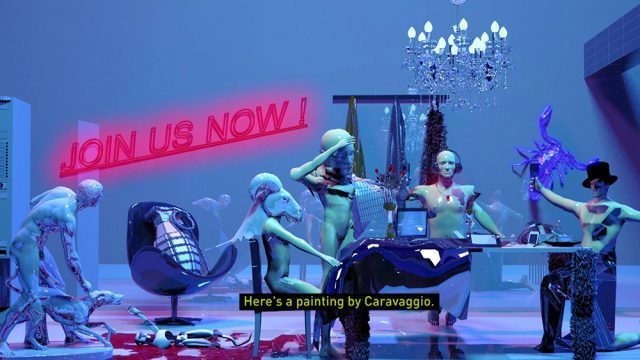
Eva Papamargariti created the visuals for minute #18 of the first episode of Lorna Mills’s Ways of Something (courtesy of the artist and TRANSFER)
WAYS OF SOMETHING (Lorna Mills, 2014-15)
Museum of the Moving Image, Bartos Screening Room
35th Ave. at 36th St., Astoria
Sunday, March 25, $15 (includes museum admission), 5:30
718-777-6800
www.movingimage.us
In his seminal 1972 book and BBC television series Ways of Seeing, British writer, critic, and artist John Berger explored how we encounter artistic images, from European oil paintings to advertisements and color photography. Regarding publicity images, Berger, who passed away in January 2017 at the age of ninety, said, “I believe that in many respects, these images continue that tradition. I’ve been critical of many things in that tradition, of our culture, of some of the values which it celebrates and I have illustrated my arguments by using the modern means of reproduction.” A kind of update of Walter Benjamin’s 1935 essay “The Work of Art in the Age of Mechanical Reproduction,” Ways of Seeing looks at paintings by Leonardo, Botticelli, Van Gogh, Hals, Caravaggio, Ingres, Rubens, and others as well as commercials, taking on issues of surveillance, gender, religion, sexuality, nudity, voyeurism, class, envy, identity, and glamour in society since the Renaissance. It is more than just a primer about art; it is an ingenious guide for how to experience all that we see every day, and it is still remarkably relevant in the digital age and the advent of social media, YouTube, and the selfie.
In 2014-15, Canadian new media artist Lorna Mills (Abrupt Diplomat, At Play in the Fields of the Lord) reimagined Berger’s show by creating four episodes that use Berger’s original narration, highlighted by his slight slurring of his “R”s, but had new visuals made by more than a hundred artists, who were responsible for one minute each; they also designed the subtitled captioning of everything that is said during their sixty seconds. Among the participating artists were Jaakko Pallasvuo, Dafna Ganani, Matthew Williamson, Marisa Olson, Eva Papamargariti, Faith Holland, Alfredo Salazar-Caro, Andrea Crespo, Jesse Darling, Morehshin Allahyari, Shana Moulton, Amy Lockhart, Luke Painter, and Mills herself. The artists incorporate film and video, archival footage, computer animation, and futuristic graphic design that replaces the original images; some of the artists digitally manipulate the works being discussed, but most transport viewers to high- and low-tech fantastical worlds. On March 25 at 5:30, Mills (minute #24 of episode four), Papamargariti (minute #18 of episode one), Allahyari (minute #14 of episode #4), Salazar-Caro (minute #24 of episode one), and Holland (minute #29 of episode one) will be at the Museum of the Moving Image for a screening of Mills’s series, followed by a discussion and a Q&A. Be sure to check out “The GIF Elevator” as well, an installation that last year featured Mills’s Yellowwhirlaway and is currently showing work by Dain Fagerholm.
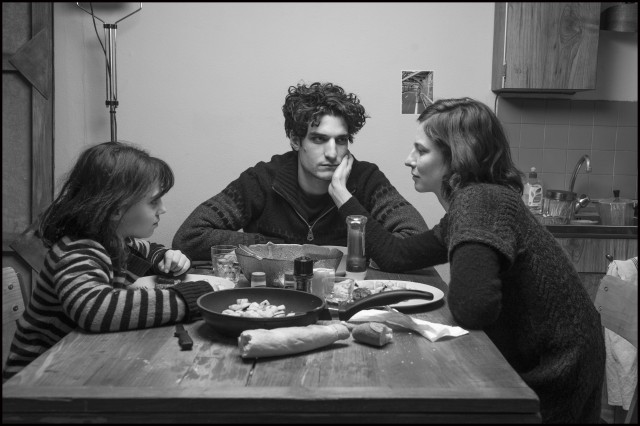
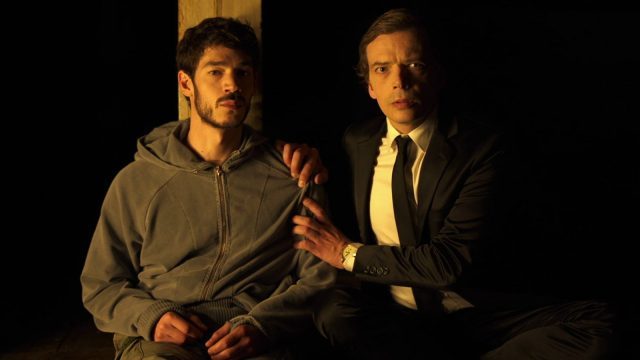
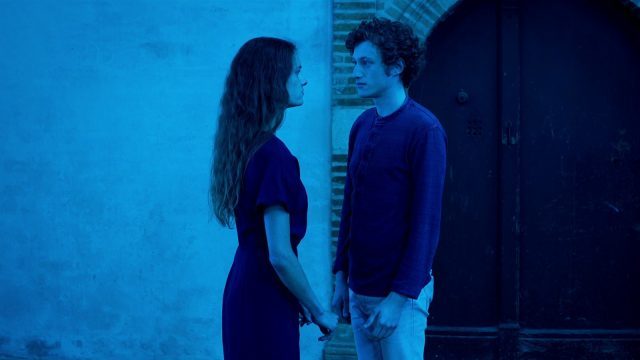
 Nearly fifty years after the release of his first film, the short Les enfants désaccordés, post-New Wave auteur Philippe Garrel has made one of his most intimate and personal works, the deeply sensitive drama Jealousy. Garrel’s son, Louis, who has previously appeared in his father’s Regular Lovers, Frontier of the Dawn, and A Burning Hot Summer, stars as Louis, a character based on Garrel’s own father, essentially playing his own grandfather. As the film opens, Louis, an actor, is leaving his wife, Clothilde (Rebecca Convenant), for another woman, Claudia (Anna Mouglalis). A talented but unsuccessful actress, Claudia immediately bonds with Louis’s young daughter, Charlotte (Olga Milshtein). But soon jealousies of all kinds — professional, romantic, maternal, paternal, residential, and financial — affect all the characters’ desires to find happiness in life.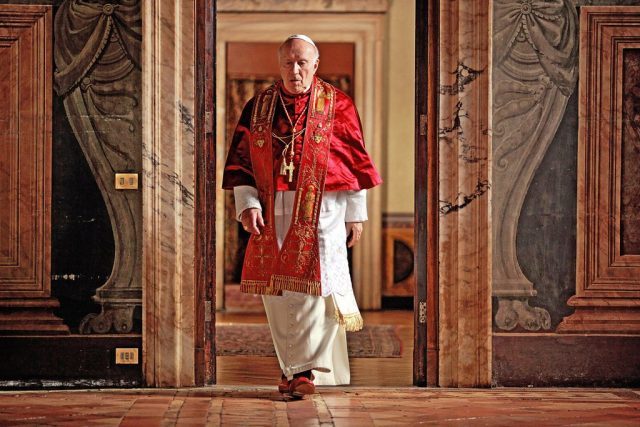
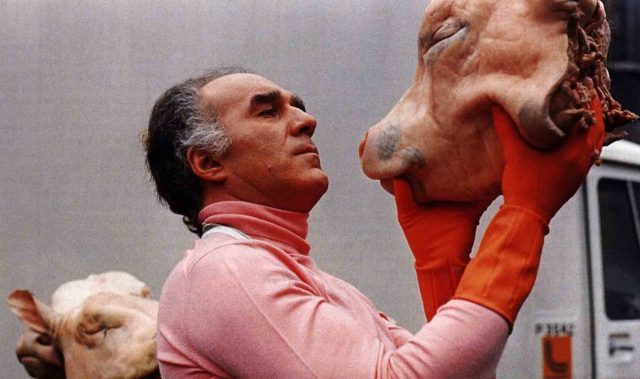
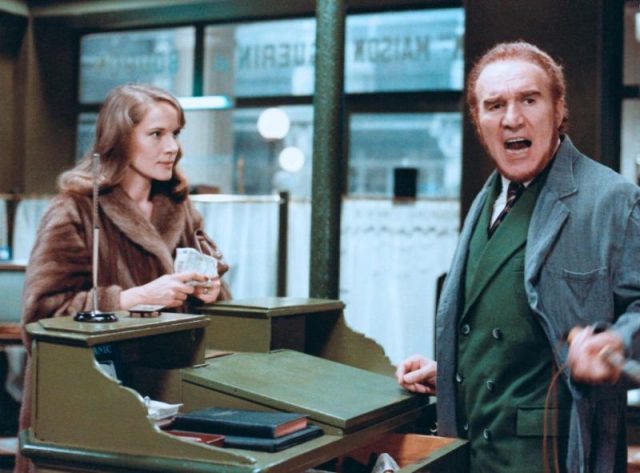
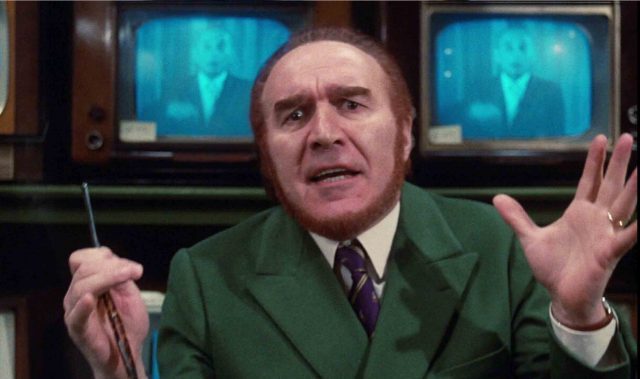
 Fed up with their lives, four old friends decide to literally eat themselves to death in one last grand blow-out. Cowritten and directed by Marco Ferreri (Chiedo asilo, La casa del sorriso), La Grande Bouffe features a cast that is an assured recipe for success, bringing together a quartet of legendary actors, all playing characters with their real first names: Marcello Mastroianni as sex-crazed airplane pilot Marcello, Philippe Noiret as mama’s boy and judge Philippe, Michel Piccoli as effete television host Michel, and Ugo Tognazzi as master gourmet chef Ugo. They move into Philippe’s hidden-away family villa, where they plan to eat and screw themselves to death, with the help of a group of prostitutes led by Andréa (Andréa Ferréol). Gluttons for punishment, the four men start out having a gas, but as the feeding frenzy continues, so does the flatulence level, and the men start dropping one by one. While the film might not be quite the grand feast it sets out to be, it still is one very tasty meal. Just be thankful that it’s not shown in Odoroma. Winner of the FIPRESCI Prize at the 1973 Cannes Film Festival, La Grande Bouffe is screening March 17, 18, 19, and 22 in Film Forum’s Michel Piccoli series. Bon appetit!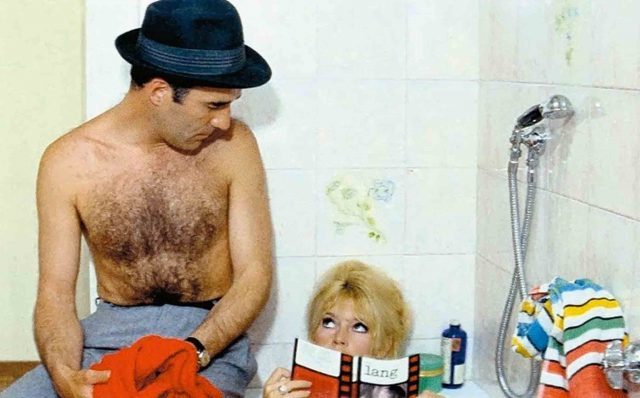
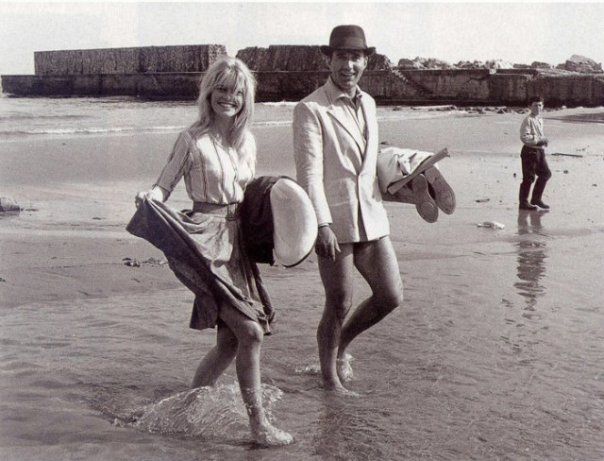
 French auteur Jean-Luc Godard doesn’t hold back any of his contempt for Hollywood cinema in his multilayered masterpiece Contempt. Loosely based on Alberto Moravia’s Il Disprezzo, Contempt stars Michel Piccoli as Paul Javal, a French screenwriter called to Rome’s famed Cinecittà studios by American producer Jeremy Prokosch (Jack Palance ) to perform rewrites on Austrian director Fritz Lang’s (played by Lang himself) adaptation of The Odyssey by ancient Greek writer Homer. Paul brings along his young wife, the beautiful Camille (Brigitte Bardot), whom Prokosch takes an immediate liking to. With so many languages being spoken, Prokosch’s assistant, Francesca Vanini (Giorgia Moll), serves as translator, but getting the various characters to communicate with one another and say precisely what is on their mind grows more and more difficult as the story continues and Camille and Paul’s love starts to crumble. Contempt is a spectacularly made film, bathed in deep red, white, and blue, as Godard and cinematographer Raoul Coutard poke fun at the American way of life. (Both Godard and Coutard appear in the film, the former as Lang’s assistant director, the latter as Lang’s cameraman — as well as the cameraman who aims the lens right at the viewer at the start of the film.)