this week in film and television

HUDSON RIVER PARK’S 20th ANNIVERSARY SUMMER OF FUN

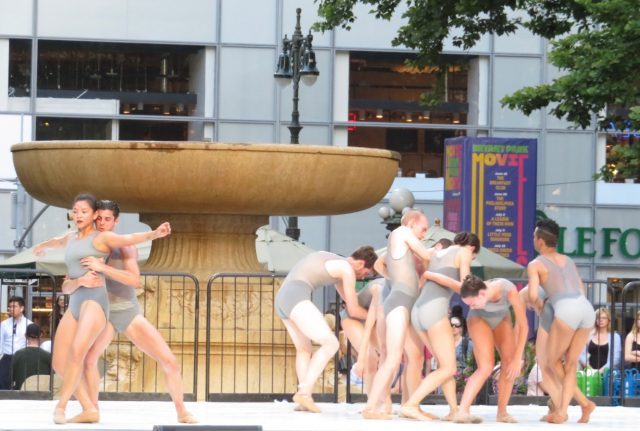
Outdoor screening of The Wedding Singer is part of Hudson River Parks

Outdoor screening of The Wedding Singer is part of Hudson River Park’s twentieth anniversary of free summer programming

Hudson River Park, Pier 45
Cross at Christopher St.
Saturday, June 2, free, 9:00 am – 10:00 pm
hudsonriverpark.org

Hudson River Park is celebrating its twentieth anniversary of hosting free summer events with an all-day festival on June 2 with a diverse slate of activities, beginning in the morning with Healthy on the Hudson workouts at 9:00 and 10:45 and an eco walk at 10:00. Other highlights include a science show, magic with Kid Ace, live Sunset on the Hudson music, Sunset Salsa dancing led by Talia Castro-Pozo with Mitch Frohman and the Bronx Horns, and a twentieth-anniversary screening of Frank Coraci’s The Wedding Singer, starring Adam Sandler and Drew Barrymore. Among this season’s free programs are Hudson RiverFlicks — Big Hit Wednesdays, Hudson RiverFlicks — Family Fridays, Jazz at Pier 84, Sunset on the Hudson, the annual Blues BBQ, the Hudson River Dance Festival, Sunset Salsa, Big City Fishing, Healthy on the Hudson, Hudson RiverKids, Hudson River Nature Walk, and more.

BROOKLYN MUSEUM FIRST SATURDAY: QUEER WORDS, QUEER WORLDS

t’ai freedom ford

First Saturday program at Brooklyn Museum includes screening of The Revival: Women and the Word and live performance by cast member t’ai freedom ford

Brooklyn Museum
200 Eastern Parkway at Washington St.
Saturday, June 2, free (“David Bowie is” requires advance tickets, $25), 5:00 – 11:00
212-864-5400
www.brooklynmuseum.org

Gay pride and diversity are the themes of the Brooklyn Museum’s free First Saturday program on June 2. There will be a live performance by the New York City Gay Men’s Chorus; a community talk on zines with Shawn(ta) Smith-Cruz and Elvis Bakaitis, moderated by Maya Harder-Montoya; a hands-on art workshop in which participants can make a pride notebook inspired by David Bowie and “Radical Women”’s Virginia Errázuriz; a drink-and-draw event with live models styled by the Phluid Project and Jag & Co. and tunes spun by DJ Illexxandra; a screening of The Revival: Women and the Word (Sekiya Dorsett, 2016), with performances by t’ai freedom ford and Be Steadwell and an introduction by director Dorsett, hosted by SafeWordSociety; a screening of the latest episode of Viceland’s My House, followed by a talkback with cast members Tati 007, Jelani Mizrahi, and Alex Mugler, executive producer Elegance Bratton, showrunner Sean David Johnson, and producers Giselle Bailey and Nneka Onuoraha; Joy, a celebration of queer and trans people of color with music, games, dance-offs, and guest DJs Nappy Nina and Rimarkable, hosted by bklyn boihood; pop-up poetry with Wo Chan and Charles Theonia; pop-up gallery talks on “Radical Women: Latin American Art, 1960–1985” by teen apprentices; and the community talk “NYC Trans Oral History Project” with Jeanne Vaccaro, activist Bianey Garcia-D la O, poet El Roy Red, and podcast producer Cassie Wagler. In addition, the galleries will be open late so you can check out “William Trost Richards: Experiments in Watercolor,” “David Levine: Some of the People, All of the Time,” “Infinite Blue,” “Radical Women: Latin American Art, 1960–1985,” “Cecilia Vicuña: Disappeared Quipu,” “Ahmed Mater: Mecca Journeys,” “A Woman’s Afterlife: Gender Transformation in Ancient Egypt,” and more. However, please note that advance tickets are required to see “David Bowie is,” at the regular admission price.

THE ACADEMY AT METROGRAPH: SIDEWAYS WITH ACADEMY AWARD WINNER JIM TAYLOR AND WINE RECEPTION

Paul Giamatti and Thomas Haden Church discuss merlot and more in Alexander Payne’s Sideways

SIDEWAYS (Alexander Payne, 2004)
Metrograph
7 Ludlow St. between Canal & Hester Sts.
Friday, June 1, 7:00
212-660-0312
metrograph.com
www.foxsearchlight.com

The “Academy at Metrograph” series, a yearlong residency for the Academy of Motion Picture Arts and Sciences at the Lower East Side cinema house, concludes June 1 at 7:00 with Sideways, eclectic director Alexander Payne’s fourth film, following the underseen Citizen Ruth, the excellent Election, and the overrated About Schmidt. Sideways is fabulously entertaining from start to finish, a smart, inventive, very funny dark comedy about friendship and love set in California wine country. Paul Giamatti stars as Miles, a schlumpy wine connoisseur who is having trouble getting over his divorce and the failure of his massive novel to get published. His best friend, Jack (Thomas Haden Church), is getting married, so the two head off on a road trip, with Miles looking forward to sampling fine wine, and Jack anticipating sampling fine women. While Jack finds what he is looking for in Stephanie (Sandra Oh, who was married to Payne at the time), Miles seems hell-bent on not allowing himself to enjoy life, even as a beautiful woman with a deep appreciation of the grape (the excellent Virginia Madsen in what should have been a career-redefining performance) shows an interest in him. You definitely do not have to be a wine drinker to fall in love with this marvelous movie, one of the best of 2004; it was nominated for Best Director, Best Picture, Best Supporting Actress (Madsen), and Best Supporting Actor (Haden Church), and screenwriters Jim Taylor and Payne won for Best Adapted Screenplay. Taylor will be at Metrograph to talk about the movie, which will be preceded by a screening of Jeff Fowler’s 2004 Oscar-winning short, Gopher Broke, and followed by a wine tasting with vintages provided by Francis Ford Coppola Winery.

HAMMER’S HOUSE OF HORROR, PART I — THE CLASSIC YEARS (1956–1967): THE MUMMY

Christopher Lee is about to get wrapped up in murderous trouble in THE MUMMY

Christopher Lee is about to get wrapped up in murderous trouble in Hammer classic The Mummy

THE MUMMY (Terence Fisher, 1959)
Quad Cinema
34 West 13th St. between Fifth & Sixth Aves.
Friday, June 1, 8:20, Saturday, June 2, 6:25, and Saturday, June 9, 1:00
Series runs May 30 – June 19
212-255-2243
quadcinema.com

Perhaps the best part of the Quad series “Hammer’s House of Horror, Part I: The Classic Years (1956–1967)” can be found in its very name: Part I, which means there will be even more to come. The first part begins May 30, consisting of thirty-two favorites from the London-based production company, which specialized in resurrecting monsters and presenting them for the first time in color, including the Mummy. Knighted British actor Christopher Lee might be best known to the younger generations as the evil wizard Saruman in the Lord of the Rings and Hobbit films, but over the course of more than two hundred movies Lee, who passed away last June at the age of ninety-three, also portrayed Fu Manchu, Georges Seurat, Sherlock Holmes, Rasputin, Count Dracula, Frankenstein’s monster, and the Mummy. Lee is the immortal wrapped character in Terence Fisher’s 1959 Hammer favorite, The Mummy, a remake of Karl Freund’s 1932 original starring Boris Karloff. On an archaeological excavation in Egypt, John Banning (Peter Cushing), his father, Stephen Banning (Felix Aylmer), and his uncle, Joseph Whemple (Raymond Huntley), discover the vast tomb of Princess Ananka (Yvonne Furneaux). Warned by an Egyptian zealot, Mehemet Bey (George Pastell), to leave the tomb undisturbed, the older Banning instead reads from the Scroll of Life, unleashing the murderous mummy Kharis (Lee), who had dutifully protected his princess centuries before. Three years later, Bey arrives in England with Kharis, determined to have the mummy wreak vengeance on the three men who dared disrespect Princess Ananka and the god they both served, Karnak.

The Mummy is a horror hoot, one of the scary-fun monster movies that were trademarks of Hammer productions. Writer Jimmy Sangster (Blood of the Vampire, The Horror of Frankenstein) and director Fisher (The Phantom of the Opera, The Earth Dies Screaming) get right to the point, avoiding grand statements and instead gleefully satisfying pop culture’s fascination with ancient ritual and religion while being sure to embrace all the genre tropes, including a local drunk (Gerald Lawson), a disbelieving lawman (Eddie Byrne), and a beautiful woman (Furneaux) who might just hold the secret that will save everyone. Veteran Hammer cinematographer Jack Asher keeps the look of the film lovingly murky in the present and pastel-colored in the past, while Franz Reizenstein’s score ebbs and flows right on time. It’s always a treat to see Cushing and Lee side-by-side; they made twenty-two films together, from Hamlet and Moulin Rouge to The Curse of Frankenstein, Horror of Dracula, The Hound of the Baskervilles, The Gorgon, and Night of the Big Heat, the last five all directed by Fisher, and The Mummy is one of their best. While the erudite Cushing struggles to make sure he limps with the same bad leg from scene to scene, the tall, magnetic Lee acts up a storm with just his piercing eyes, which shine a glow that goes much deeper than just a zombielike killer’s. Sure, it gets silly at some points and clichéd at others, but hey, it’s a Hammer horror film. The Mummy is screening on June 1, 2, and 9; “Hammer’s House of Horror” continues at the Quad through June 19 with such other Hammer hits (and non-hits) as The Abominable Snowman, The Brides of Dracula, Frankenstein Created Woman, One Million Years B.C., The Hound of the Baskervilles, The Quatermass Experiment, Rasputin: The Mad Monk, The Stranglers of Bombay, The Nanny, Ten Seconds to Hell, and Die! Die! My Darling.

SPLIT SCREENS FESTIVAL

Jean Smart is one of the special guests at IFC Centers split Screens Festival

Jean Smart is one of the special guests at IFC Center’s Split Screens Festival

IFC Center
323 Sixth Ave. at West Third St.
Wednesday, May 30 – Sunday, June 3
212-924-7771
www.ifccenter.com
www.splitscreensfestival.com

There once was a time when television was considered vastly inferior to the movies, although that is hard to believe now. Actors and directors eschewed the boob tube, even though so many great actors and directors actually got their start there, in series and live dramas. But we’re now in the midst of another golden age of the small screen, with hundreds of cable channels and streaming services, and IFC Center is celebrating the television explosion with the Split Screens Festival, which runs May 30 through June 3. Fifteen programs, including advance screenings and panel discussions, are being presented, involving such shows as The Americans, Westworld, Divorce, Billions, Better Call Saul, Younger, and The Outer Limits and featuring such guests as Jean Smart, Damson Idris, Jeffrey Wright, Debi Mazar, Walter Mosley, David Costabile, Thomas Haden Church, and Vanguard Award winner Sandra Oh. Below are only some of the highlights.

Wednesday, May 30
Farewell, Comrades! The Americans Finale Viewing Party, screening and discussion with Jen Chaney and Alan Sepinwall, moderated by Matt Zoller Seitz, 9:30

Thursday, May 31
Smart TV: The Many Faces of Jean Smart, with Jean Smart, $15, 7:00

Sandra Oh will receive Vanguard Award at Split Screens Festival

Sandra Oh will receive Vanguard Award at Split Screens Festival on June 3

Friday, June 1
Money in the Bank: David Costabile on Billions, with David Costabile, $15, 6:00

Acting Machine: Westworld’s Jeffrey Wright, with Jeffrey Wright, $15, 7:30

Saturday, June 2
Do Not Adjust Your Set: Journey to The Outer Limits, including screening of classic Demon with a Glass Hand episode starring Robert Culp, with Stephen Bowie, Reba Wissner, Wallace Stroby, and Daniel Kraus, $15, 11:00 am

The Women Behind the Camera: Four Top TV Directors on Showing vs. Telling, with Tricia Brock, Gillian Robespierre, Julie Anne Robinson, and Lauren Wolkstein, $15, 2:45

Sunday, June 3
Damn Fine Coffee: Twin Peaks Fan Theories, with Jeremiah Beaver, J. C. Hotchkiss, Matthew C., Andreas Halskov, Samantha McLaren, Donald McCarthy, and Connor Ratliff, $15, 11:00 am

Dead Girls: A TV Obsession, with Alice Bolin, Megan Abbott, and Sarah Weinman, $15, 5:00

SUMMER 1993

Summer 1993

Paula Robles and Laia Artigas give superb performances in Carla Simón’s award-winning Summer 1993

SUMMER 1993 (Carla Simón, 2017)
Film Society of Lincoln Center
Elinor Bunin Munroe Film Center, Francesca Beale Theater
144 West 65th St. between Broadway & Amsterdam Ave.
Opens Friday, May 25
212-875-5050
www.filmlinc.org
summer1993.oscilloscope.net

Named Best First Feature at the 2017 Berlinale, Summer 1993, Carla Simón’s autobiographical full-length debut, is an exquisite, deeply involving tale about an extraordinary young girl facing a new life after both her parents die of AIDS. Six-year-old Frida (Laia Artigas) must move from Barcelona to La Garrotxa in the Catalan countryside, where she will live with her uncle Esteve (David Verdaguer), her mother’s brother; his wife, Marga (Bruna Cusí); and their four-year-old daughter, Anna (Paula Robles). Unsurprisingly, Frida has a difficult time adjusting. When she plays with other kids and skins her knee, a scared mother whisks away her child immediately, afraid of the virus. Frida begins acting out, first in small ways, then in bigger ones, taking advantage of her cousin Anna’s caring, innocent nature. She somewhat relaxes when her grandparents (Fermí Reixach and Isabel Rocatti) and other friends and relatives visit, including Lola (Montse Sanz), Angela (Berta Pipo), Irene (Etna Campillo), and Cesca (Paula Blanco), but going back to Barcelona is not an option. Esteve keeps giving his niece the benefit of the doubt while Marga grows more and more worried about Frida’s behavior, which becomes more complex and dangerous, especially toward Anna. All the while, Frida feigns innocence, until even she realizes she may be taking things too far.

Summer 1993

Esteve (David Verdaguer) and Marga’s (Bruna Cusí) life changes when their niece comes to live with them in Summer 1993

Summer 1993 plays out like an intricate, intellectual horror film, reminiscent of such genre classics as Robert Mulligan’s The Other, Mervyn LeRoy’s The Bad Seed, and even Richard Donner’s The Omen, though without any supernatural elements. Frida is not inherently evil, but from the minute she tells Anna not to touch her doll collection, it is clear she is teetering on the brink. Artigas, who was cast after Simón had interviewed nearly one thousand other children, is absolutely riveting as Frida, in complete control of her complicated character, her knowing eyes revealing wisdom well beyond her years. Cinematographer Santiago Racaj’s camera adores Artigas, exploring her face and expertly revealing her point of view. Accompanied by a lovely, emotive score, the camera is almost always in motion, sometimes just the slightest bit, representing Frida’s slightly askew, on-edge world. Robles is a charmer as Anna, seemingly too young to know what she is doing as an actress yet physically and emotionally right on target. Cusí excels as Marga, who is suspicious of Frida early on but understands that she is a girl in the midst of terrible grief, in desperate need of real connection to deal with her loss. Writer-director Simón uses water as a threat throughout the film, the pure, fresh liquid, from a bathtub to a swimming pool to a forest stream, a counterpart to the diseased blood that might have been passed down to Frida from her parents. At its core, Summer 1993 is a wise, heartfelt drama about the fears of both adults and children as they try to find their place in an ever-shifting world that can be as cold and cruel as it can be warm and loving.

A FISTFUL OF DOLLARS

(images  courtesy  of  MGM  /  Cineteca  di  Bologna  /  Park  Circus)

Clint Eastwood introduces the Man with No Name in Sergio Leone’s A Fistful of Dollars (photo courtesy MGM / Cineteca di Bologna / Park Circus)

A FISTFUL OF DOLLARS (PER UN PUGNO DI DOLLARI) (Sergio Leone, 1964)
Metrograph
7 Ludlow St. between Canal & Hester Sts.
May 25-31
212-660-0312
metrograph.com

Clint Eastwood made a name for himself on the big screen playing the Man with No Name in Sergio Leone’s 1964 spaghetti Western, A Fistful of Dollars, which is being shown in a new 4K restoration at Metrograph May 25-31. In his first lead movie role, Eastwood, the costar of the television series Rawhide, is a gunslinger draped in a poncho and smoking a small cigar who rides on a mule into San Miguel, a tiny town in the middle of nowhere, home to an ongoing feud between the gun-running Baxters and the liquor-dealing Rojos. The stranger decides to play both sides against the middle, caring only that he earns lots of cash. “Never saw a town as dead as this one,” the stranger tells saloon owner Silvanito (Jose Calvo), who explains, “The place is only widows. Here you can only get respect by killing other men, so nobody works anymore.” The stranger hears the sound of banging outside and says, “Somebody doesn’t share your opinion.” Silvanito opens the window to reveal old man Piripero (Joe Edger) making coffins. “You’ll be a customer,” Silvanito tells the stranger with assurance. The stranger goes back and forth between the Baxters, led by the sheriff (W. Lukschy), and the Rojos, who follow the dangerous, unpredictable Ramón (Gian Maria Volontè). Also caught up in the Hatfield-McCoy battle are the sheriff’s wife, Consuelo (Margherita Lozano), and brother, Antonio (Bruno Carotenuto), along with Rojo brothers Benito (Antonio Prieto) and Esteban (S. Rupp) and their enforcer, Chico (Richard Stuyvesant). Ramón, meanwhile, has his eyes set on Marisol (Marianne Koch), who is married to Julio (Daniel Martín), who does not want to get involved in any fighting. Carefully watching it all is Juan de Díos (Raf Baldassarre), who rings the church bell at every death.

The Italian-German-Spanish production is a remake of Akira Kurosawa’s Yojimbo, which led to legal entanglements when the Japanese auteur demanded, well, a fistful of dollars in financial compensation. According to Christopher Frayling’s Sergio Leone — Something to Do with Death, Leone received a note from Kurosawa that read, “Signor Leone — I have just had the chance to see your film. It is a very fine film, but it is my film. Since Japan is a signatory of the Berne Convention on international copyright, you must pay me.” Frayling also suggests that Leone was influenced by Dashiell Hammett’s Red Harvest and Carlo Goldoni’s Servant of Two Masters and did not feel he was stealing only from Kurosawa. In The BFI Companion to the Western, Frayling quotes Leone as saying, “Kurosawa’s Yojimbo was inspired by an American novel of the serie-noire so I was really taking the story back home again.” (For a montage of similarities between the two films, check out this video.). Regardless, A Fistful of Dollars, made for about two hundred grand, set the standard for the new genre, and Eastwood was its antihero. He and Leone would team up again on the sequel, For a Few Dollars More, which is not a direct remake of Kurosawa’s Yojimbo follow-up, Sanjuro, as well as The Good, the Bad, and the Ugly, the best of the Dollars Trilogy.

(photo courtesy  MGM / Cineteca di Bologna / Park Circus)

Clint Eastwood watches his back in first of the Dollars Trilogy (photo courtesy MGM / Cineteca di Bologna / Park Circus)

Fistful is steeped in violence and death, from Iginio Lardani’s rad title sequence of silhouettes in black, white, and blood red to an early shot of the stranger riding under a noose and giving it a long look. Whereas Toshirô Mifune played the bodyguard in Yojimbo with a devilish glee, Eastwood — in a role that had been previously offered to Henry Fonda, Charles Bronson, James Coburn, and others — is much more serious as the Man with No Name, who would become more sympathetic in future outings. The extremely poor dubbing only adds to the film’s magnificence. To enhance its foreign appeal to American audiences, several members of the cast and crew appear under pseudonyms in the credits, including Leone (Bob Robertson), cinematographer Massimo Dallamano (Jack Dalmas), actor Gian Maria Volontè (John Wells), and composer Ennio Morricone (Leo Nichols or Dan Savio). There is no mention of Kurosawa or Yojimbo anywhere.