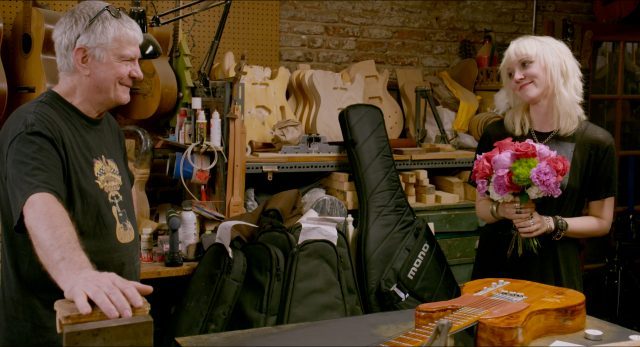
Rick Kelly and Cindy Hulej are a mutual admiration society in Carmine Street Guitars
NEW YORK FILM FESTIVAL: CARMINE STREET GUITARS (Ron Mann, 2018)
Film Society of Lincoln Center
West 65th St. between Eighth Ave. & Broadway
Saturday, October 6, Walter Reade Theater, 4:15
Monday, October 8, Francesca Beale Theater, 2:30
Festival runs through October 14
212-875-5610 www.filmlinc.org
In the second half of Ron Mann’s utterly delightful and unique documentary Carmine Street Guitars, a well-dressed, well-groomed young man enters the title store in Greenwich Village and identifies himself as Adam Shalom, a Realtor who is selling the building next door. Shalom tries to talk about square footage, but Carmine Street Guitars founder and owner Rick Kelly barely looks up as he continues cleaning a fret. It’s a critical, uncomfortable moment in an otherwise intimate and inviting film; throughout the rest of the eighty-minute documentary, the soft-spoken Kelly talks guitars and craftsmanship with a stream of very cool musicians and his punk-looking young apprentice, Cindy Hulej. But Shalom’s arrival harkens to one of the main reasons why Mann made the movie: to capture one of the last remaining old-time shops in a changing neighborhood, a former bohemian paradise that has been taken over by hipsters and corporate culture, by upscale stores and restaurants and luxury apartments. You’ll actually cheer that Kelly gives Shalom such short shrift, but you’ll also realize that Shalom and others might be knocking again at that door all too soon.
Rick Kelly welcomes “instigator” Jim Jarmusch to his Greenwich Village shop in Carmine Street Guitars
The rest of the film is an absolute treat. Mann follows five days in the life of Carmine Street Guitars; each day begins with a static shot of the store from across the street, emphasizing it as part of a community as people walk by or Kelly, who was born in Bay Shore, arrives with a piece of wood he’s scavenged. The camera then moves indoors to show Kelly and Hulej making guitars by hand, using old, outdated tools and wood primarily from local buildings that date back to the nineteenth century. Kelly doesn’t do computers and doesn’t own a cell phone; he leaves all that to Hulej, who posts pictures of new six-strings on Instagram. Meanwhile, Kelly’s ninetysomething mother, Dorothy, works in the back of the crazily cluttered store, taking care of the books with an ancient adding machine. Over the course of the week, they are visited by such musicians as Dallas and Travis Good of the Sadies (who composed the film’s soundtrack), “Captain” Kirk Douglas of the Roots, Eleanor Friedberger, Dave Hill of Valley Lodge, Jamie Hince of the Kills, Nels Cline of Wilco, Christine Bougie of Bahamas, Marc Ribot, and Charlie Sexton. Bill Frisell plays an impromptu surf-guitar instrumental version of the Beach Boys’ “Surfer Girl.” Stewart Hurwood, Lou Reed’s longtime guitar tech, talks about using Reed’s guitars for the ongoing “DRONES” live installation. “It’s like playing a piece of New York,” Lenny Kaye says about the guitars made from local wood while also referring to the shop as part of the “real village.”
Mann, the Canadian director of such previous nonfiction films as Grass, Know Your Mushrooms, and Comic Book Confidential, was inspired to make the movie at the suggestion of his friend Jarmusch, who in addition to directing such works as Stranger Than Paradise (which featured Balint), Down by Law, and 2016 NYFF selection Paterson is in the New York band Sqürl. Plus, it was Jarmusch who first got Kelly interested in crafting his guitars with wood from buildings, “the bones of old New York,” resulting in Telecaster-based six-strings infused with the history of Chumley’s, McSorley’s, the Chelsea Hotel, and other city landmarks. Carmine Street Guitars, which is far more than just mere guitar porn, is screening in the Spotlight on Documentary section of the New York Film Festival on October 6 and 8, with Mann participating in Q&As after each show, joined by special guests, including Kelly and Hulej on October 6. The film will be preceded by the world premiere of eighty-seven-year-old Manfred Kirchheimer’s thirty-nine-minute Dream of a City, a collage of 16mm black-and-white images of construction sites and street scenes taken between 1958 and 1960, set to music by Shostakovich and Debussy. Kirchheimer (Stations of the Elevated) will also be at both Q&As as well as the October 6 free NYFF Docs Talk with Alexis Bloom, James Longley, Mark Bozek, and Tom Surgal, moderated by Lesli Klainberg.
Giant fluffy puppies get in the way of a Portuguese soccer star’s dreams in Diamantino
NEW YORK FILM FESTIVAL: DIAMANTINO (Daniel Schmidt & Gabriel Abrantes, 2018)
Film Society of Lincoln Center
West 65th St. between Eighth Ave. & Broadway
Thursday, October 4, Walter Reade Theater, 9:30
Friday, October 5, Howard Gilman Theater, 6:30
Saturday, October 13, Howard Gilman Theater, 9:15
Festival runs through October 14
212-875-5610 www.filmlinc.org
At the fifty-sixth annual New York Film Festival, you can catch a documentary, foreign-language picture, political thriller, high-tech crime chiller, comedy, romantic melodrama, fantasy and sci-fi, and more — all in one wildly entertaining film. Diamantino, Gabriel Abrantes and Daniel Schmidt’s full-length feature debut, is an absurdist multigenre mashup that is as tense as it is funny, an unpredictable romp that evokes Ernst Lubitsch, Howard Hawks, Michel Gondry, Philip K. Dick, South Park, Cinderella, James Bond, Being There,Minority Report, and Au Hasard Balthazar while feeling wholly original. Carloto Cotta stars as the title character, Diamantino Matamouros, a Portuguese soccer star à la Cristiano Ronaldo (pre-sexual assault allegations) who sees giant fluffy puppies when he is on the field. After botching a penalty kick in the World Cup Final, the stupendously beautiful star learns that his beloved father and mentor (Chico Chapas) has died. His evil twin sisters, Sónia (Anabela Moreira) and Natasha (Margarida Moreira), become his agents and make a secret deal with the mysterious Dr. Lamborghini (Carla Maciel) and a government minister (Silva Joana). Meanwhile, investigators Aisha Brito (Cleo Tavares) and Lucia (Vargas Maria Leite) — lovers who are soon to be married — are looking into Diamantino’s finances and devise a plan to get close to him by having Aisha pose as a male refugee named Rahim who Diamantino adopts as his son.
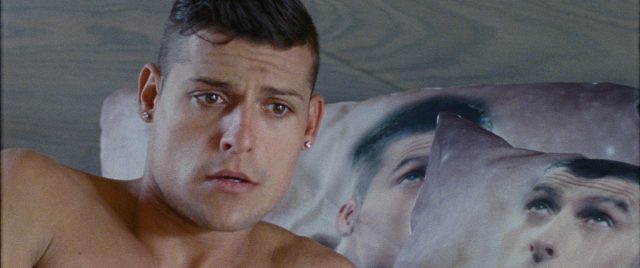
Diamantino Matamouros (Carloto Cotta) is surrounded by images of himself in Gabriel Abrantes and Daniel Schmidt’s dazzling feature debut
Everyone except his sisters, who know better, thinks he is some kind of genius mastermind, but Diamantino is actually an addled simpleton who understands very little about life. He enjoyed playing soccer, likes eating Nutella and whipped cream sandwiches, and, following his tearful retirement, hangs out with his cat, Mittens, and dedicates himself to raising Rahim, who he does not realize is actually a grown woman. He’s reminiscent of Chance the Gardener (Peter Sellers) in Being There, but his airheaded statements — which are outrageously funny — are seldom mistaken for brilliance, except when he’s manipulated into making fascistic political statements he doesn’t understand.
Diamantino is stunningly photographed by Charles Ackley Anderson, who quickly adapts the film’s visual style as it switches from fantasy to love story to futuristic thriller, with numerous memorable shots, including Lucia in a white nun’s habit on a motorbike, Diamantino and Rahim sleeping on pillows with large images of the soccer star’s head, and a huge fluffy puppy playing goal in the championship game. American-born directors and longtime collaborators Abrantes and Schmidt, who edited the film with Raphaëlle Martin-Holger, show a deep love and respect for movies, infusing Diamantino with charm and energy, humor and compassion, honoring, in their own way, the history of cinema. The rest of the cast and crew do their part as well, from art director Bruno Duarte and composers Ulysse Klotz and Adriana Holtz to the Moreira sisters and multidisciplinary Portuguese star Manuela Moura Guedes as television interviewer Gisele. Winner of the Grand Jury Prize at Cannes Critics’ Week, Diamantino is screening in the Projections section of the New York Film Festival on October 4 and 5, with Schmidt and Abrantes participating in Q&As after each show. Also, an October 13 screening at 9:15 has just been added.
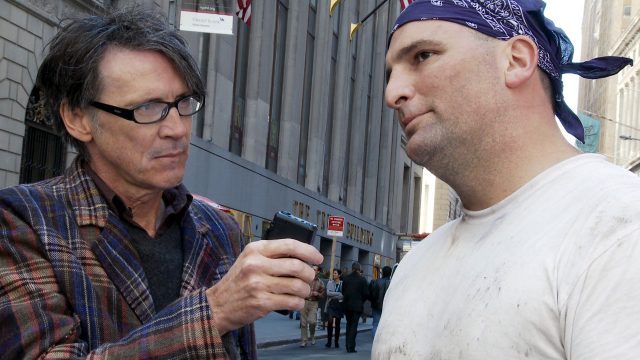
Clay Pigeon interviews construction worker Mark Paris in One October
ONE OCTOBER (Rachel Shuman, 2017)
Nitehawk Cinema
136 Metropolitan Ave. between Berry St. & Wythe Ave.
Thursday, October 4, 7:15
718-384-3980 oneoctoberfilm.com nitehawkcinema.com
In October 2008, in the midst of the Barack Obama / John McCain presidential election and the mortgage crisis, filmmaker Rachel Shuman took to the streets of New York City with Clay Pigeon, host of The Dusty Show on WFMU, interviewing people as they made their way across Manhattan and other boroughs. The Boston-born, Beacon-based Shuman intended to capture a moment in time and not release the film until after Obama’s second term ended to see how life in the city changed. The result is One October, a kind of love letter to who we were, are, and will be. Inspired by Chris Marker’s 1963 film Le Joli Mai, in which the French director interviewed people on the streets of Paris, Shuman follows Pigeon, Radio Shack mini tape recorder in hand, as he wanders through Central Park, Harlem, Washington Square Park, the Lower East Side, Madison Square Park, the Financial District, the Brooklyn Bridge, Willets Point, Tompkins Square Park, and other locations, approaching a series of men and women who share fascinating details about their personal and professional lives; the Iowa-born Pigeon has an innate knack for quickly understanding his subjects, asking intuitive questions that often surprise them. He speaks with a former freelance photographer who now works construction to make more money for his family, an ambitious lawyer who wants to work at the UN, a mixed-race couple sitting on a bench, a woman railing against the gentrification of Harlem, and a homeless man who turns the tables on the soft-spoken Pigeon. “It’s always interesting to see how the random collection of souls falls together and how the next chapter bears fruit or lies fallow,” he says on his radio show.
In between interviews, cinematographer David Sampliner beautifully photographs trees, buildings, storefronts, statues, the Halloween Parade, political rallies, the Columbus Day Parade, a housing protest, the Blessing of the Animals at the Cathedral Church of St. John the Divine, birds flying across blue skies, Muslims praying at the end of Ramadan, and Jews performing the ritual of Tashlich, casting away their sins by throwing pieces of bread into the East River. The shots, which include classic New York restaurants as well as institutions that have since closed, are accompanied by a bittersweet score by Paul Brill, featuring cellist Dave Eggar. Director, editor, and producer Shuman (Negotiations) has created a loving warning about the future of a city that has been undergoing major changes since October 2008. Executive produced by three-time Oscar nominee Edward Norton, the hour-long One October is having a special October screening at Nitehawk Cinema as part of the “Representation” series, which highlights the scarcity of women directors in the industry; the film will be preceded by Jon Bunning’s fifteen-minute short The Tables, about Ping-Pong in Bryant Park, and followed by a Q&A with Shuman and WFMU host Amanda Nazario.
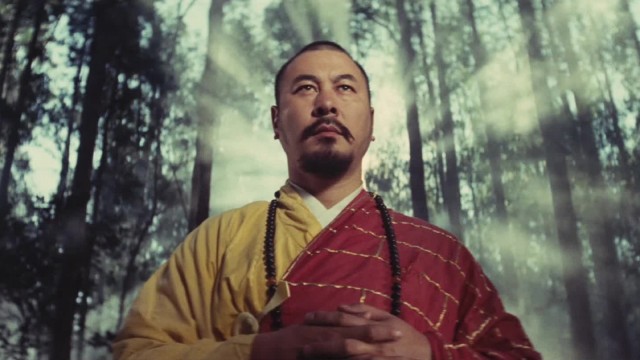
King Hu’s A Touch of Zen is a trippy journey toward enlightenment
NEW YORK FILM FESTIVAL: A TOUCH OF ZEN (King Hu, 1969)
Film Society of Lincoln Center, Howard Gilman Theater
165 West 65th St. between Eighth Ave. & Broadway
Tuesday, October 2, 6:30
Festival runs through October 14
212-875-5610 www.filmlinc.org
Watching King Hu’s 1969 wuxia classic, A Touch of Zen, brings us back to the days of couching out with Kung Fu Theater on rainy Saturday afternoons. The highly influential three-plus-hour epic features an impossible-to-figure-out plot, a goofy romance, wicked-cool weaponry, an awesome Buddhist monk, a bloody massacre, and action scenes that clearly involve the overuse of trampolines. Still, it’s great fun, even if it is way too long. (The film, which was initially shown in two parts, earned a special technical prize at the 1975 Cannes Film Festival.) Shih Jun stars as Ku Shen Chai, a local calligrapher and scholar who is extremely curious when the mysterious Ouyang Nin (Tin Peng) suddenly show up in town. It turns out that Ouyang is after Miss Yang (Hsu Feng) to exact “justice” for the corrupt Eunuch Wei, who is out to kill her entire family. Hu (Come Drink with Me, Dragon Gate Inn) fills the film with long, poetic establishing shots of fields and the fort, using herky-jerky camera movements (that might or might not have been done on purpose) and throwing in an ultra-trippy psychedelic mountain scene that is about as 1960s as it gets. A Touch of Zen is ostensibly about Ku’s journey toward enlightenment, but it’s also about so much more, although we’re not completely sure what that is. The film is screening on October 2 at 6:30 as part of the fifty-sixth New York Film Festival’s Retrospective tribute to Pierre Rissient, Cannes film scout, publicist, producer, distributor, etc., who believed, “It is not enough to love a film. One must love it for the right reasons!” Rissient passed away in May at the age of eighty-one; the sidebar also includes such other films that Rissient championed as Lino Brocka’s Manila in the Claws of Light, Clint Eastwood’s Play Misty for Me, Fritz Lang’s House by the River, and Joseph Losey’s Time without Pity.
Sundance-winning documentary reveals the many sides of musician and activist M.I.A.
MATANGA/MAYA/M.I.A. (Steve Loveridge, 2018)
IFC Center
323 Sixth Ave. at West Third St.
Opens Friday, September 28
212-924-7771 www.ifccenter.com www.miadocumentary.com
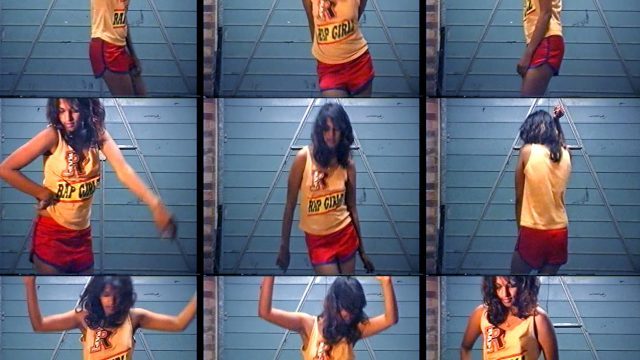
In the mid-1990s, Steve Loveridge and Maya Arulpragasam met at St. Martin’s College and became friends. Over the last twenty years, Loveridge and Maya — better known as M.I.A. — have collaborated on songs and videos, leading up to the documentary Matangi/Maya/M.I.A., an intimate portrait of Arulpragasam, from her childhood days as Matangi in Sri Lanka, where her father was the founder of the Tamil Resistance Movement, to her teen years as Maya, a developing artist, and finally as M.I.A., the controversial music star and political activist who has released such albums as Arular, Kala, and 2016’s AIM, which she claimed would be her last. Maya has been filming herself since she was very young, and she opened up her vast archives to Loveridge, who sifted through nearly nine hundred hours of recordings to make his first film. Loveridge shows Maya working on her music, protesting for peace, and famously raising her middle finger while performing with Madonna at the Super Bowl. M.I.A. is a powerhouse onstage — I was blown away by an October 2007 concert at Terminal Five — but Loveridge reveals her more sensitive and vulnerable sides in addition to her fierce ambition and pride in who she is and where she is from. Matangi/Maya/M.I.A. is now playing at IFC Center; before attending several postscreening Q&As, Loveridge discussed the film with twi-ny, giving thoughtful, extremely honest, and provocative answers to questions about his friendship with Maya, his feelings about the music industry, and his future as a filmmaker.
twi-ny: What was it that first attracted you to Maya at art school?
Steve Loveridge: She was confident. I was very shy and I think she was much better at meeting people, finding ways to access different places. She took me on lots of adventures and made London seem like a playground.
Also, in our work — I think the other students and tutors on the course kind of looked down on pop culture — music videos, TV movies, mainstream film — but Maya and I, being a gay guy and a brown girl, maybe we saw more value and significance in what pop culture could mean and how it could reach and create change in the world because we had personal experience of it changing our ideas of ourselves, helping us have a vision of who we could become, and being a lifeline when we were teenagers and we didn’t have any people the same as us around to guide us in real life.
twi-ny: Could you tell back then that she was primed for international stardom?
sl: Yes. I think everybody’s got a story, everyone is interesting — but if you’re a poor person and don’t have a “way in” to the arts, or any connections, you have to have a special kind of confidence and robustness to go and knock on doors and ask to be let in, because no one’s going to do it for you. She had that. It took a while for her to find the right door, but she was looking for a way in every day.
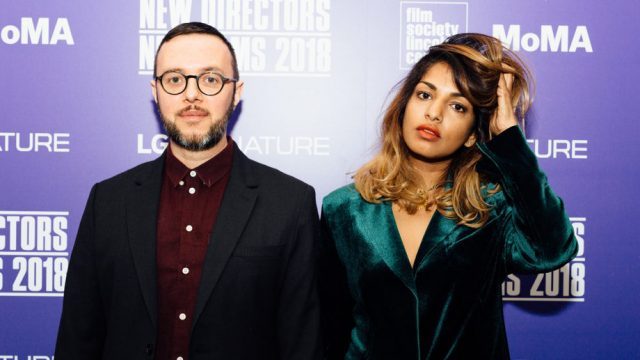
Steve Loveridge and M.I.A. at New York premiere of documentary at Film Society of Lincoln Center at New Directors/New Films festival (photo by Sean DiSerio)
twi-ny: Do you think it is easier or harder to make a documentary about someone you know so well?
sl: Ordinarily, I’d say it’s harder. I think objectivity is too difficult and I would question the wisdom of a friend making a film about a friend. But in this circumstance I feel like Maya, and her family, and the Tamil community were so jaded and mistrustful of the media and interviewers that this story had to be trusted to someone who had earned that trust on a personal level.
twi-ny: In the film, Maya says that she originally wanted to become a documentary filmmaker, and that is evidenced by how much footage she compiled over the years. Did she ever stray from being the subject and instead act like a director or editor? How involved in the process was she?
sl: It was vital from the outset that she wasn’t involved in the edit at all. Even though we’re friends, just to keep things clear, we got a lawyer and did a contract that said I had final cut and she wasn’t allowed into the edit suite. I think that’s amazing trust on her part — I would never ever let someone do that with my personal videos. Especially as she hadn’t watched most of them for years.
twi-ny: What was it like sifting through her archives?
sl: It was emotional and also very educational — I learnt a lot more about her family story. It also reminded me of why I became her friend in the first place.
twi-ny: Was there anything that she declared was off-limits?
sl: On a couple of the tapes she’s chatting to people about me when she’s in a bad mood, and it’s funny eavesdropping on conversations about you that people had fifteen years ago.
twi-ny: How many hours of footage was available?
sl: It was very difficult to deal with the amount of material. There was about seven hundred hours of vérité filming, one hundred of media archive of M.I.A., about thirty hours of performance. One of the hardest things was watching footage of her and talking about her all day and then also trying to maintain a friendship — it was too much, so we had to take a break from each other for a bit and not really talk much.
twi-ny: Regarding that, there were some issues between you, Maya, and her record label, leading to your posting that you “would rather die than work on this.” How did that all get settled? It certainly appears that you and M.I.A. are on good terms again, if there ever really were problems.
sl: Yeah, the problem wasn’t Maya (although I did think she coulda stepped in and helped me out a bit more — it’s hard for a little filmmaker to deal with Interscope, Roc Nation, and all these music industry people all on your own!).
The basic problem was that I worked on the film for a whole year in 2012, with it funded by Interscope, and then suddenly one day they just stopped the funding — but not in a professional, courteous way; they just didn’t pay their bills, stopped answering the phone, and left the production company just guessing. I got angry that Maya’s management weren’t interested in helping me sort the situation and we had a fight about it.
Part of the frustration was that in 2013, Sri Lanka was controversially chosen to host the Commonwealth Heads of Government Meeting, which felt like a real blow to the Sri Lankan Tamil community in their quest for some kind of accountability for the human rights abuses that had happened at the end of the civil war in 2009.
Maya was really, really keen to get the film out in some form that year, in case it helped raise awareness in some tiny way, so it was difficult feeling blocked by her own team.
In the end, the situation was resolved by scrapping the whole project with the record label. I went away and got a job, forgot about the movie for a year, and then in 2014 we found funding from Cinereach, a New York not-for-profit who had seen the trailer I leaked online and got in touch. We started again from scratch with a whole different approach. Making the film in the independent documentary space instead of from inside the music industry transformed it completely, and I was able to make a film that matched my vision.
So when Maya says the film took seven years, or ten years, like she keeps telling interviewers — it wasn’t all my fault! It really only took from 2014 to 2017, which apparently isn’t that bad for a feature doc, especially as I was a first-timer and had nearly nine hundred hours of material.
twi-ny: Are you fully satisfied with the final product? Is the Maya onscreen the Matangi/Maya/M.I.A. you’ve known for more than twenty years?
sl: I am. It’s definitely only about a certain aspect of her story — I focused on her cultural identity and how she negotiates being all these different things at once, and I think it does a good job at evoking what that feels like to be around. People describe the film as “messy in a good way,” and that’s how she feels. I left out all the gossipy relationship stuff with boyfriends, and it’s not really a traditional music doc in that there’s not much of her artistic process or output other than when it serves the identity narrative. But I feel like her music and art are out there and available for people to discover and dip into as much as they like.
twi-ny: Do you have a favorite song/album/video of hers?
sl:“The Message” is great, on her third album [Maya] — whoever wrote that is a genius. [Ed. note: The song was cowritten by Loveridge with Sugu Arulpragasam, Maya’s brother.] But my favorite is always “Galang” because it was the first thing. When the record label sent us the first pressing, it was so exciting holding a vinyl record in my hand that she’d actually made, and then doing the video with all her stencil artwork in it and seeing it on YouTube, it felt like some kind of validation and like the world was suddenly opening up for us.
twi-ny: This is your first feature documentary; do you plan on making more films in the future?
sl: Maybe — I’d certainly never sign up for something again where I only get paid based on hitting certain stages; making this film has crippled my personal finances, and it’s going to be hard to ever contemplate doing that again! I honestly sometimes feel like filmmaking is really only for rich people. But I love stories and storytelling and maybe I’ve learnt enough about the things that slowed this project down to not make the same mistakes again and I could do it in a way that can work for me creatively and financially.
Film Society of Lincoln Center, Walter Reade Theater, Elinor Bunin Munroe Film Center, Alice Tully Hall
West 65th St. between Broadway & Amsterdam Ave.
September 28 – October 14
212-875-5601 www.filmlinc.org/nyff2018
The fifty-sixth annual New York Film Festival is under way, consisting of more than two weeks of international shorts, features, documentaries, experimental works, and immersive, interactive virtual reality presentations. There are documentaries about Roger Ailes, Steve Bannon, Carmine Street Guitars, Maria Callas, the Memphis Belle, Bill Cunningham, and Watergate; retrospective tributes to Dan Talbot and Pierre Rissient; talks with Claire Denis, Alfonso Cuarón, Alice Rohrwacher, Errol Morris, Jia Zhangke, Mariano Llinás, Willem Dafoe, Morgan Neville, Frederick Wiseman, and Ed Lachman; revivals of such films as Edgar G. Ulmer’s Detour, Mikhail Kalatozov’s I Am Cuba, and Ronald Neame’s Tunes of Glory; and postscreening Q&As with Jodie Foster, Michael Almereyda, Richard Thompson, Alex Gibney, Elizabeth Holtzman, Lesley Stahl, Emma Stone, Julian Schnabel, Joel and Ethan Coen, Laetitia Casta, Elisabeth Moss, Eric Stoltz, Robert Pattinson, Olivier Assayas, Tamara Jenkins, Vincent Lacoste, Carey Mulligan, Jake Gyllenhaal, and many others. Below is a list of at least one highlight per day; keep checking twi-ny for reviews and further information.
Saturday, September 29
Special Events: The Other Side of the Wind (Orson Welles, 2018), Alice Tully Hall, $25, 2:15
Sunday, September 30
Revivals: Enamorada (Emilio Fernández, 1946), Howard Gilman Theater, $17, 12 noon
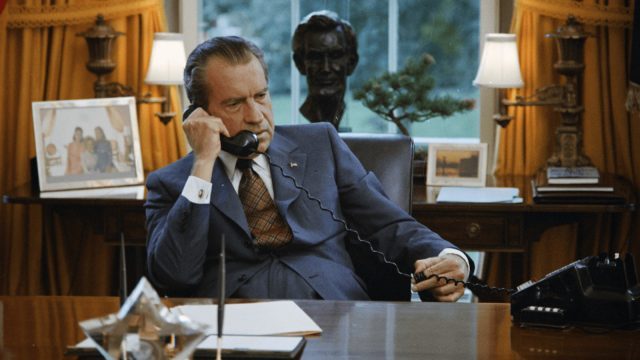
Charles Ferguson documentary takes a new look at Watergate break-in and its aftermath
Monday, October 1
Free Events — NYFF Live: In Conversation with Frederick Wiseman, moderated by Kent Jones, EBM Amphitheater, free, 7:00
Tuesday, October 2
Retrospective: A Touch of Zen (King Hu, 1971/75), Howard Gilman Theater, $17, 6:30
Wednesday, October 3
Talks — On Cinema: Claire Denis, Walter Reade Theater, $25, 6:00
Thursday, October 4
Retrospective: Mother India (Mehboob Khan, 1957), Howard Gilman Theater, $17, 6:30
Friday, October 5
Projections: Your Face (Tsai Ming-liang, 2018), Howard Gilman Theater, $17, 4:30
Saturday, October 6
Talks — Directors Dialogues: Alfonso Cuarón, Walter Reade Theater, free, 2:30
Sunday, October 7
Talks — Film Comment Live: Filmmakers Talk, with Louis Garrel, Jodie Mack, Alex Ross Perry, and Albert Serra, EBM Amphitheater, free, 7:00
Monday, October 8
Special Events: An Afternoon with Barry Jenkins, in Conversation with Darryl Pinkney, Alice Tully Hall, $25, 12 noon
Tuesday, October 9
Retrospective: My Dinner with André (Louis Malle, 1981), Howard Gilman Theater, $17, 6:30
Wednesday, October 10
Retrospective: The American Friend (Wim Wenders, 1977), Howard Gilman Theater, 6:30
Thursday, October 11
Convergence: iNK Stories – Fire Escape: An Interactive VR Series (Navid Khonsari, 2018), followed by a Q&A, EBM Amphitheater, 6:00 & 7:30
Friday, October 12
Convergence: Virtual Reality Documentary Program, featuring My Africa (David Allen, 2018), narrated by Lupita Nyong’o, The Drummer (Ana Kler, 2017), and the world premiere of Hope Amongst the Haze (Tiffany Hill, 2018), EBM Amphitheater, $10, 4:00 & 6:00
Saturday, October 13
Spotlight on Documentary — Divide and Conquer: The Story of Roger Ailes (Alexis Bloom, 2018), Howard Gilman Theater, $25, 2:45
Sunday, October 14
Special Events: The Wild Pear Tree (Nuri Bilge Ceylan, 2018), Francesca Beale Theater, $25, 12 noon
Siblings Elan and Jonathan Bogarín use a dollhouse re-creation of their beloved grandmother’s home in excavating her life in 306 Hollywood
306 HOLLYWOOD (Elan and Jonathan Bogarín, 2018)
Quad Cinema
34 West 13th St. between Fifth & Sixth Aves.
Opens Friday, September 28
212-255-2243 www.306hollywood.com quadcinema.com
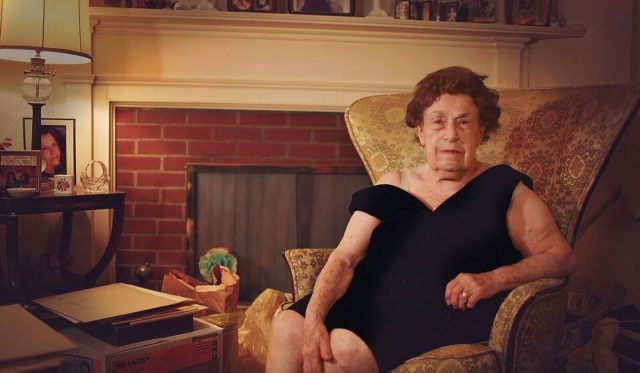
Psychoanalysts Sigmund Freud and Carl Jung both used the metaphor of a house to represent the whole of a person and his or her psyche. Siblings Elan and Jonathan Bogarín explore that concept in 306 Hollywood, an imaginative documentary in which they seek to define who their beloved late grandmother was — and where she is after her death. In 2011, Annette Ontell passed away at the age of ninety-three. In her will, she left her home of sixty-seven years, a relatively basic suburban house at 306 Hollywood Ave. in Hillside, New Jersey, to Elan and Jonathan, who at first were encouraged by their mother, Marilyn Ontell, to sell it. But after funeral director Sherry Anthony tells the siblings that it is believed that following a death, the soul of the deceased hovers around its home for nearly a year, they changed their mind. “You have eleven months to make your grandmother tangible again,” she explains. And the Bogaríns take that time to turn the house into an archaeological dig, excavating through physical items that spur memories of the past to celebrate the life of their beloved grandmother. “As far as we knew, the house was her world,” Jonathan says. “When you lose someone you love, you start to look for new ways to understand the world,” Elan adds.
Imaginative documentary by her grandchildren explores the life and times of Annette Ontell
Elan and Jonathan use re-creations, home movies, family photographs, and filmed interviews they made with Annette, a fashion designer who was married to an accountant named Herman, every year from 2001 to 2011, in which she honestly and entertainingly shares her thoughts about her long life, including discussions of death. The siblings, who employ a visual sense of humor and magical realism akin to that of a Wes Anderson movie combined with the documentary style of Chantal Akerman and Agnès Varda, speak with their mother, Annette’s daughter, Marilyn Ontell, as well as fashion conservator Nicole Bloomfield; Rockefeller archivist Robert Clark; Biblioteca Casanatense librarian Isabella Ceccopieri and director Rita Fioravanti; archaeologist Jan Gadeyne; and MIT physicist and novelist Alan Lightman, who all offer views about interpreting physical and psychological aspects of a person’s life, from items they collected to papers they saved to the clothes they wore. Two of the most compelling scenes involve clothing; Elan and Jonathan film their grandmother trying to put on dresses, with the help of her daughter, that she made more than half a century before. Annette sits in a chair in her bra and panties, her aging body mostly exposed to the camera, as she insists she won’t fit into the chic clothes. Later, Bloomfield performs a forensics-like investigation on the dresses, offering yet more information about Annette.
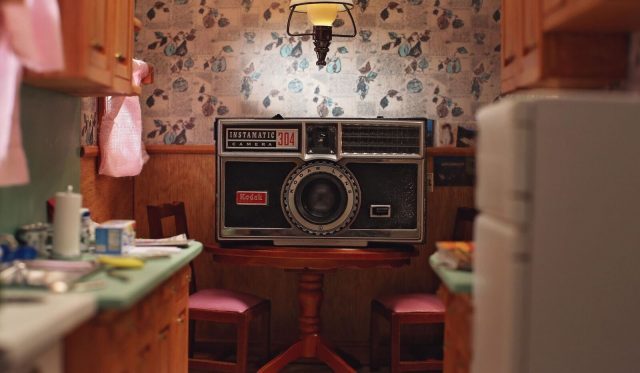
Elan and Jonathan also have a precise miniature version of the house made by Rick Maccione of Dollhouse Mansions and often film inside it, playing with the scale of history, time, and memory and the role of the camera in recording the past. “It was plain to me that the house represented a kind of image of the psyche,” Jung wrote. But as Jonathan notes at one point, “Grandma’s house isn’t a home anymore. It’s a ruin.” And finally, Lightman asks, “Where is she?,” declaring that question to be the “great mystery of existence.” After watching 306 Hollywood, which the Bogaríns directed, produced with Judit Stalter, edited with Nyneve Laura Minnear and composer Troy Herion, and photographed with Alejandro Mejía, you’ll have a very clear picture of who Annette Ontell was — and you’ll wonder about who your own late relatives were, in addition to where they might be at this very moment. The Sundance hit opens September 28 at the Quad, which will host numerous postscreening Q&As with the filmmakers, Herion, Mejía, and such organizations as POV, the Wassaic Project, New York Women in Film & Television, Cinema Tropical, and WeCroak.
 In the second half of Ron Mann’s utterly delightful and unique documentary Carmine Street Guitars, a well-dressed, well-groomed young man enters the title store in Greenwich Village and identifies himself as Adam Shalom, a Realtor who is selling the building next door. Shalom tries to talk about square footage, but Carmine Street Guitars founder and owner Rick Kelly barely looks up as he continues cleaning a fret. It’s a critical, uncomfortable moment in an otherwise intimate and inviting film; throughout the rest of the eighty-minute documentary, the soft-spoken Kelly talks guitars and craftsmanship with a stream of very cool musicians and his punk-looking young apprentice, Cindy Hulej. But Shalom’s arrival harkens to one of the main reasons why Mann made the movie: to capture one of the last remaining old-time shops in a changing neighborhood, a former bohemian paradise that has been taken over by hipsters and corporate culture, by upscale stores and restaurants and luxury apartments. You’ll actually cheer that Kelly gives Shalom such short shrift, but you’ll also realize that Shalom and others might be knocking again at that door all too soon.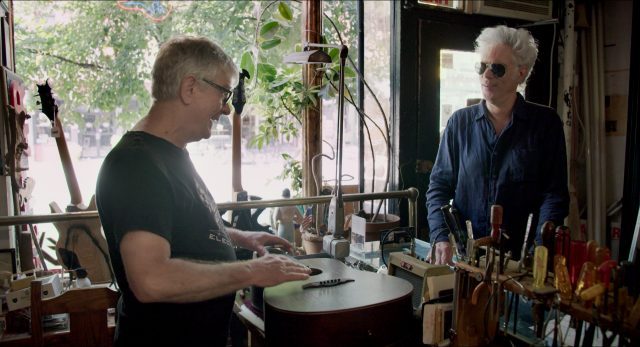

 Watching King Hu’s 1969 wuxia classic, A Touch of Zen, brings us back to the days of couching out with Kung Fu Theater on rainy Saturday afternoons. The highly influential three-plus-hour epic features an impossible-to-figure-out plot, a goofy romance, wicked-cool weaponry, an awesome Buddhist monk, a bloody massacre, and action scenes that clearly involve the overuse of trampolines. Still, it’s great fun, even if it is way too long. (The film, which was initially shown in two parts, earned a special technical prize at the 1975 Cannes Film Festival.) Shih Jun stars as Ku Shen Chai, a local calligrapher and scholar who is extremely curious when the mysterious Ouyang Nin (Tin Peng) suddenly show up in town. It turns out that Ouyang is after Miss Yang (Hsu Feng) to exact “justice” for the corrupt Eunuch Wei, who is out to kill her entire family. Hu (Come Drink with Me, Dragon Gate Inn) fills the film with long, poetic establishing shots of fields and the fort, using herky-jerky camera movements (that might or might not have been done on purpose) and throwing in an ultra-trippy psychedelic mountain scene that is about as 1960s as it gets. A Touch of Zen is ostensibly about Ku’s journey toward enlightenment, but it’s also about so much more, although we’re not completely sure what that is. The film is screening on October 2 at 6:30 as part of the fifty-sixth New York Film Festival’s Retrospective tribute to Pierre Rissient, Cannes film scout, publicist, producer, distributor, etc., who believed, “It is not enough to love a film. One must love it for the right reasons!” Rissient passed away in May at the age of eighty-one; the sidebar also includes such other films that Rissient championed as Lino Brocka’s Manila in the Claws of Light, Clint Eastwood’s Play Misty for Me, Fritz Lang’s House by the River, and Joseph Losey’s Time without Pity.