this week in film and television

DAYS OF AWE: PHILIPPE LESAGE’S WHO BY FIRE

Aliocha (Aurelia Arandi-Longpre) and Jeff (Noah Parker) get close in Who by Fire

WHO BY FIRE (COMME LE FEU) (Philippe Lesage, 2024)
Film at Lincoln Center
Elinor Bunin Munroe Film Center, Francesca Beale Theater
144 West Sixty-Fifth St. between Broadway & Amsterdam Ave.
March 14-20
www.filmlinc.org
www.kimstim.com

Winner of the Grand Prix from the Generation 14plus International Jury at the 2024 Berlinale, Quebecois writer-director Philippe Lesage’s Who by Fire (Comme le feu) is two and a half hours of angst, anger, and jealousy, a coming-of-age drama with a harrowing final fifteen minutes.

One of the special prayers recited during the Jewish High Holidays is the poetic psalm Unetaneh Tokef, which describes repentance, prayer, and charity and includes the following lines: “How many shall pass away and how many shall be born, / Who shall live and who shall die, / Who shall reach the end of his days and who shall not, / Who shall perish by water and who by fire, / Who by sword and who by wild beast, / Who by famine and who by thirst, / Who by earthquake and who by plague, / Who by strangulation and who by stoning, / Who shall have rest and who shall wander, / Who shall be at peace and who shall be pursued, / Who shall be at rest and who shall be tormented, / Who shall be exalted and who shall be brought low, / Who shall become rich and who shall be impoverished.” That quote, which was adapted by Canadian singer-songwriter Leonard Cohen into the 1974 song “Who by Fire,” captures the essence of the film, which opens March 14 at Lincoln Center, with Lesage participating in Q&As at the 6:15 screening March 14 and the 3:15 show on March 15.

The story unfolds at a secluded cabin in the gorgeous Canadian woods of Haute-Mauricie, where film director Blake Cadieux (Arieh Worthalter) has invited his former longtime collaborator, screenwriter Albert Gary (Paul Ahmarani), to spend some time. Joining Albert are his college-age daughter, Aliocha (Aurelia Arandi-Longpre), his seventeen-year-old son, Max (Antoine Marchand-Gagnon), and Max’s best friend, the shy, uneasy Jeff (Noah Parker). After a successful series of fiction films, Blake and Albert had a falling out, as the former turned to documentaries and the latter to animated television.

Blake lives with his editor, Millie (Sophie Desmarais), housekeeper, Barney (Carlo Harrietha), cook, Ferran (Guillaume Laurin), and dog, Ingmar (Kamo). Also arriving are well-known actress Hélène Falke (Irène Jacob) and her partner, Eddy (Laurent Lucas).

Over the course of several days, there is a lot of cigarette smoking and wine drinking, discussions about art and responsibility, sexual flirtations, and angry arguments between Blake and Albert that go beyond nasty, in addition to hunting, fishing, and white water rafting in the great outdoors, not all of which goes well.

Three uncut dinner scenes anchor Philippe Lesage’s Who by Fire

Who by Fire is anchored by three uncut ten-minute dinner scenes in which tensions flare, primarily involving Blake and Albert, including one in which oenophile Albert accuses Blake of switching out one of his wines. In two of the scenes, cinematographer Balthazar Lab’s camera remains motionless on one end of the long table, while in the third the camera eventually moves around to focus on Albert having an episode.

But at the center of the story is Jeff, who is awkward in his thoughts and actions. The film opens with Albert, his children, and Jeff driving on a deserted highway to be met by Blake’s helicopter. The first shot inside the car is of two young people with their hands on their knees; we don’t see their faces but can feel that at least one of them wants to touch the other. We soon learn that it is Aliocha — whose name in Russian translates to “defender of men” — and Jeff (the one who wants their hands and legs to meet). Later, after Max tells Jeff that he once caught his sister looking at S&M porn, Jeff makes a misguided play for her and, shunned, runs into the woods with his tail between his legs and becomes lost. After he is rescued, he grows mad at Blake when he catches the director and Aliocha in an intimate moment.

Most of the characters are either unlikable or not fully defined, so spending more than two and a half hours with them is a lot to ask. The cast does its job admirably, finding their way around some of Lesage’s occasionally meandering script. Cédric Dind-Lavoie’s droning score ranges from lilting to elegiac. A party scene that ends with the characters singing and dancing to the B-52’s song “Rock Lobster” starts out fun but quickly becomes something else, no mere break from the glum atmosphere.

Lesage (Les démons, Genèse) expertly balances the claustrophobic interior scenes by glorying in the beauty of nature, with outdoor scenes that celebrate the world outside. But not everyone is as comfortable as he is in those surroundings, leading to one tragedy that is followed by an even worse one, at least as far as manipulating an audience goes.

Who by Fire raises many of the questions asked in the Unetaneh Tokef, and he answers some of them while leaving plenty open to interpretation, as does Cohen when he asks, “And who shall I say is calling?”

[Mark Rifkin is a Brooklyn-born, Manhattan-based writer and editor; you can follow him on Substack here.]
NORDIC UTOPIA: BLACK ARTISTS FINDING FREEDOM IN SCANDINAVIA

William Henry Johnson paintings are a highlight of “Nordic Utopia?” show at Scandinavia House (photo by twi-ny/mdr)

NORDIC UTOPIA? AFRICAN AMERICANS IN THE 20th CENTURY
Scandinavia House
58 Park Ave. at 38th St.
Tuesday – Saturday through March 8, free
212-847-9740
www.scandinaviahouse.org

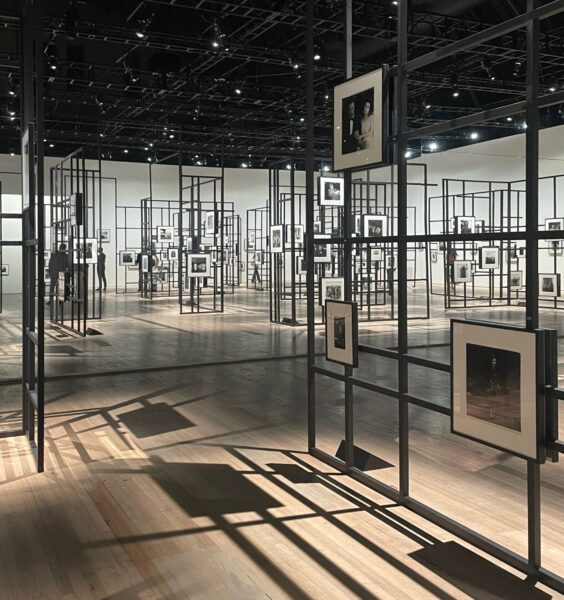
One of the best gallery shows right now in New York City is the small but revelatory “Nordic Utopia? African Americans in the 20th Century” at Scandinavia House, which explores the surprising connection between African American jazz musicians and Denmark, Finland, Norway, and Sweden. Continuing through March 8, “Nordic Utopia?” comprises painting, drawing, photography, ceramics, sculpture, music, and video by and about Black artists who left the United States for calmer pastures in Scandinavia.

“It was the first time in my life that I felt a real, free man,” visual artist and collector Howard Smith said in a 1976 interview about moving to Finland in 1984 after teaching at Scripps College in California. “So much so that one day I was walking down the street, I panicked because I suddenly realized that I had no further need for armor. I felt absolutely naked. In the United States you could not possibly walk down the street feeling free, spiritually unclothed, because you always felt that you are subject to attack. Well, here I am walking and I suddenly realize I have no armor whatsoever. I felt light as a feather — and it was frightening.” Smith, who died in 2021, has ten works on view, including several depictions of flowers, the small stoneware sculpture Female, the white porcelain Frida, and the 1986 Calligraphy Plate.

Sweet jazz floats in the air as visitors make their way through the three sections: “Creative Exploration & Cross Pollination,” “Lifelong Residency & Lasting Careers,” and “Travels & Sojourns,” encountering photos of Josephine Baker (including one by Helmer Lund-Hansen of the Black Venus in a white fur, cradling black and white baby dolls), Babs Gonzales, Fats Waller, Coleman Hawkins, and Dexter Gordon, who settled in Scandinavia from 1962 to 1976; “Since I’ve been over here, I felt that I could breathe, you know, and just be more or less a human being, without being white or black, green or yellow,” the LA-born saxophonist told DownBeat magazine.

Dexter Gordon at Jazzhus Montmarte, silver gelatin print, 1964 (photo by / courtesy of Kirsten Malone)

In Hans Engberg’s 1970 two-part documentary Anden mands land, an ex-pat writer explains, “I’m in a new man’s land. Here, I’ve found friends, buddies, and allies.” Eight surrealist paintings by New York City native Ronald Burns take viewers on a fantastical journey involving floating women, complex grids, a carousel, “Mental Costumes,” and a pair of dizzying renderings of “The Triumph of Nature.” The highlight of the show are six oil paintings by William Henry Johnson, three portraits, two gorgeous landscapes (Sunset, Denmark and A View Down Akersgate, Oslo), and the captivating Boats in the Harbor, Kerte-minde.

As the exhibition approaches its final weeks, there are a handful of special programs happening. On February 22 at 3:00, cocurators Ethelene Whitmire and Leslie Anne Anderson and scholars Denise Murrell and Tamara J. Walker will gather for a free two-hour symposium. On February 25 at 2:00 ($5), Sámi author and journalist Elin Anna Labba will discuss her book The Rocks Will Echo Our Sorrow!, about the expulsion of the Sámi from northern Norway and Sweden, in a virtual talk with moderator Mathilde Magga. On February 26 at 6:30 ($13), Scandinavia House will screen Bertrand Tavernier’s 1986 film about Dexter Gordon, ’Round Midnight, followed by a conversation with New Yorker film critic Richard Brody and Gordon’s widow, Maxine, author of Sophisticated Giant: The Life and Legacy of Dexter Gordon. And on March 5 at 5:30, ASF’s Emily Stoddart will lead a free guided tour of the show.

[Mark Rifkin is a Brooklyn-born, Manhattan-based writer and editor; you can follow him on Substack here.]
THE ROAD TO FREEDOM: FAITH RINGGOLD’S FOR THE WOMEN’S HOUSE

Formerly incarcerated women Enid “Fay” Owens, Nancy Sicardo, and Mary Baxter check out Faith Ringgold’s For the Women’s House in Paint Me a Road Out of Here

PAINT ME A ROAD OUT OF HERE (Catherine Gund, 2024)
Film Forum
209 West Houston St.
Opens Friday, February 7
212-727-8110
www.filmforum.org

“No one and nothing is safe at a prison, including the guards, the inmates, the walls, the furniture, and especially that painting,” author and activist Michele Wallace says in Catherine Gund’s moving and passionate documentary Paint Me a Road Out of Here, opening February 7 at Film Forum.

Author of such books as Black Macho and the Myth of the Superwoman and Dark Designs and Visual Culture, Wallace is the daughter of children’s book writer, painter, sculptor, and performance artist Faith Ringgold. The work she is referring to is her mother’s 1972 For the Women’s House, an eight-foot-by-eight-foot mural that was commissioned for the New York City Correctional Institution for Women on Rikers Island.

Before starting the mural, Ringgold visited the institution and met with some of the women. “I knew that each one wanted to be inspired, to renew their life,” she says in the film. “They wanted to be out of there, of course. And it was obvious to me that the reason why many of them were there was because they had a lack of freedom. I asked the women, ‘What would you like to see in this painting that I’m going to do to inspire you?’ And one girl said, ‘I want to see a road leading out of here.’”

The large canvas is divided into eight triangular sections depicting women in nontraditional roles, including as professional basketball players, a bus driver, a police officer, a priest, a lawyer, a construction worker, and US president, accompanied by quotes from Rosa Parks and Coretta Scott King.

“Almost every single profession in that painting was not open to women in 1971,” curator Rujeko Hockley points out. She also equates prisons with museums, noting, “Black people were held captive in one institution and excluded from the other.”

Gund traces the history of For the Women’s House, delving into its conception, detailing how it was painted over in white by prison employees in 1988, and examining its restoration and the very strange journey it took as the Brooklyn Museum attempted to acquire it in order to save it from potential oblivion. She also places it in context within Ringgold’s career, looking at her seminal 1967 breakthrough gallery show, featuring such powerful and important works as Die, The Flag Is Bleeding, and The American People Series #19: US Postage Commemorating the Advent of Black Power. She meets with Ringgold in her studio, on her porch, and at the New Museum, which eventually hosted her revelatory career retrospective, “American People,” in 2022.

The director balances that narrative with the inspirational tale of Mary Enoch Elizabeth Baxter, who gave birth while incarcerated and fought to right her life through art and activism after serving time. Baxter returns to the Riverside Correctional Facility in Philadelphia in 2022 and installs a mural comprising multiple affirmations, providing hope for the women there through art. She also developed a friendship with Ringgold.

Gund (Born to Fly: Elizabeth Streb vs. Gravity, Chavela), who participated in freeing the painting after first encountering it in late 2021, speaks with Michael Jacobson, who was the commissioner of the Dept. of Corrections in the mid-1990s when the painting virtually disappeared; artist and author Michelle Daniel Jones, who teamed up with Baxter to put on an exhibition; curators Hockley and Catherine Morris, who staged “We Wanted a Revolution: Black Radical Women, 1965–85” at the Brooklyn Museum in 2017; Rikers corrections officer Barbara Drummond, who led the fight to preserve For the Women’s House; and ACA gallerist Dorian Bergen, who explains about Ringgold’s early work, “These are among the most important paintings of the twentieth century. History had to catch up with Faith.”

The artworks shown in the film will be eye-opening to viewers who are not familiar with Ringgold’s oeuvre, from the aforementioned pieces to Childhood, The Fall of America, Sojourner Truth Tanka: Ain’t I a Woman, Uptight Negro, and Flag Is Bleeding. “I became an artist so that I could tell my story,” Ringgold, who dressed in splashy outfits with sparkling accoutrements, says, and what a story it is.

A New York City native, Ringgold passed away in New Jersey in 2004 at the age of ninety-three. Her remarkable legacy will live on in the hearts and minds of her many fans, fellow artists, and incarcerated and formerly incarcerated women who find freedom in what she stood for.

As curator and author Nicole R. Fleetwood declares, “I think art is disruptive, and I think art disrupts lazy thinking.”

There is no lazy thinking when it comes to Faith Ringgold.

[There will be a series of postscreening discussions at Film Forum, presented by the New Museum and the Women’s Community Justice Association on February 7 at 7:00, the Center for Art & Advocacy on February 8 at 7:00, the Vera Institute of Justice and Silver Art Projects on February 13 at 7:00, the New York Women’s Foundation and the Center for the Study of Women and Society at the Graduate Center on February 18 at 6:30, and the Guggenheim on February 20 at 6:30.]

[Mark Rifkin is a Brooklyn-born, Manhattan-based writer and editor; you can follow him on Substack here.]
GONE FISHING: ROB TREGENZA BRINGS UNIQUE WWII DRAMA TO MoMA

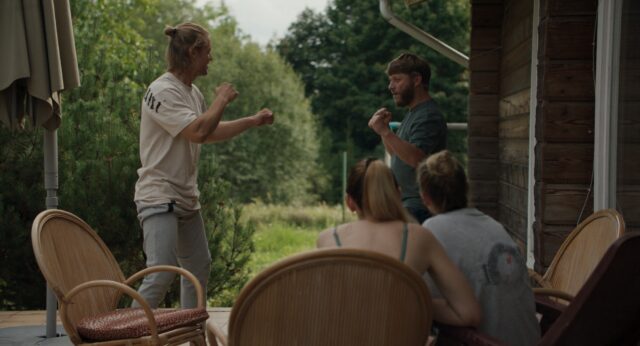
Anna Kristiansen (Ellen Dorrit Petersen) and Adam Honderich (Andreas Lust) are caught up in WWII intrigue in Rob Tregenza’s The Fishing Place (courtesy Cinema Parallel)

THE FISHING PLACE (Rob Tregenza, 2024)
MoMA, the Museum of Modern Art
The Debra and Leon Black Family Film Center
11 West Fifty-Third St. between Fifth & Sixth Aves.
February 6-12
www.moma.org

Rob Tregenza’s The Fishing Place is a tour de force of filmmaking, and the writer-director isn’t shy about making sure the audience knows it. The movie, divided into three sections that Tregenza refers to as “flows,” opens with a shot of a boat out at sea, shown in the negative, a ghostly white in a gray, gloomy seascape that slowly reverses into color over Earecka Tregenza and Jason Moody’s melancholic score. We are then introduced to the three protagonists via superimpositions and fades that point toward memory, as well as through mysterious, virtually impossible camera movements forward.

It’s 1945 in a small Norwegian town, and Anna Kristiansen (Ellen Dorrit Petersen) is a Nazi prisoner working as a housekeeper for Klaus (Eindride Eidsvold), a wealthy collaborator. Adam Honderich (Andreas Lust) is a newly arrived German Lutheran priest. Nazi officer Aksel Hansen (Frode Winther) orders Anna to work for Honderich for three days and spy on him, as it’s suspected that the priest is part of the resistance.

Anna becomes the focus in a stunning six-and-a-half-minute scene at a small party being thrown by Klaus for Aksel; Anna works with the cook (Lena Barth-Aarstad) and a maid (Ingvild Holthe Bygdnes), serving Klaus and Aksel in addition to Willie (Peder Herlofsen), a young man who would rather be reading his book; a man (Jonas Strand Gravli) trying to convince Klaus to invest in his electronic gadgets; the elegant, wheelchair-bound Margit (Gjertrud L. Jynge) and her doctor (Ola Otnes); among others. It’s intense and almost interminably slow-paced; every sound — a footstep, a glass being put on a tray, background music — feels as if we’re on a precipice, every element desperate to break free. The stunning sound design, also highlighted by boots in the snow, a crackling fire, and gunshots, is by Øyvind Rydland.

Soon after the party, Anna finds a frightened child named Ada (Ella Maren Alfsvåg Jørgensen) hiding out in a shack on Honderich’s property. Later, a local man visits Honderich, bringing him a fish that seems to be more of a threat than a gift, and comments on his priestly dress. Honderich says, “Unfortunately, I didn’t have much choice.” The man responds in an ominous tone, “We all have a choice, don’t we?”

Margit makes a surprising confession to the priest. The doctor takes Anna for a ride in his automobile and shares his suspicions of who she is and what she is doing there. In his church, which bursts with colors that stand out in the otherwise bleak but beautiful snowy winter landscape, Honderich suddenly is filled with fire and brimstone. As the camera circles an old fishing boat where Honderich and Aksel have cast out their lines, the colors morph into a hellish red. “Are you happy with yourself?” the priest asks. The Nazi officer replies, “No. And you know it.”

In another dazzling sequence, the camera goes down a horizontal row of characters who one at a time share brief thoughts and then appear again at the other end, with no cuts. “Don’t look back,” the priest prophetically warns us.

Later, after a fadeout, we can hear talking behind-the-scenes as a scene is readied; a man claps the slate and we see the cast and crew in action in a virtuosic twenty-minute crane shot that starts with indoor close-ups before heading outside and almost flying away. Tregenza is the cinematographer, but camera operators Pål Bugge Haagenrud and Art Eng deserve huge kudos, as does editor Elise Olavsen.

Kansas native Tregenza (Talking to Strangers, Gavagai) mixes in a little Ingmar Bergman and Jean-Luc Godard in The Fishing Place, which was partly inspired by the work of philosophers Henri Bergson and Gilles Deleuze. “The self is only a threshold, a door, a becoming between two multiplicities,” the latter wrote in A Thousand Plateaus: Capitalism and Schizophrenia, as well as “Bring something incomprehensible into the world!”

The Fishing Place is making its North American theatrical premiere February 6–12 at MoMA; Tregenza will be at the museum for a Q&A following the 6:30 show on opening night.

[Mark Rifkin is a Brooklyn-born, Manhattan-based writer and editor; you can follow him on Substack here.]
BLIND JUSTICE: RUNNING FOR LIBERATION AT ST. ANN’S

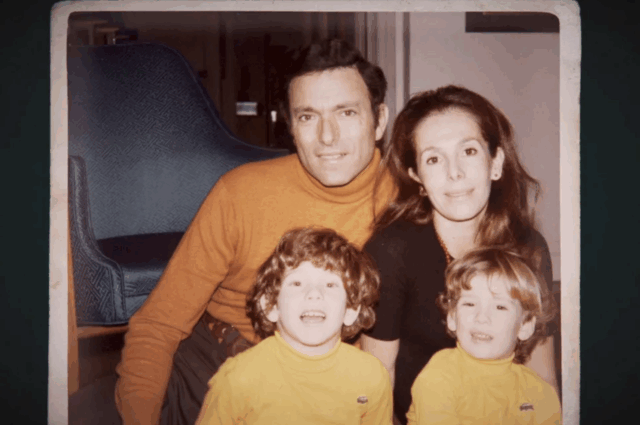
A woman (Ainaz Azarhoush) and her husband (Mohammad Reza Hosseinzadeh) contemplate freedom in Blind Runner (photo by Amir Hamja)

BLIND RUNNER
St. Ann’s Warehouse
45 Water St.
Tuesday – Sunday through January 24, $49-$69
stannswarehouse.org
utrfest.org

In September 2022, Iranian journalist Niloofar Hamedi was incarcerated for reporting on the controversial death of Mahsa Amini, a twenty-two-year-old Kurdish-Iranian woman who died in a hospital shortly after being arrested for not wearing a hijab; the case was followed around the world. While in prison, Hamedi began running while her husband, Mohamad Hosein Ajoroloo, ran outside the building, preparing for a marathon. In June 2023, he told the New York Times, “Niloofar believes that enduring prison is like training for a marathon. Daily suffering. But imagining the joy of the finish line cancels out all the pain.”

That story, and others involving political imprisonments, served as inspiration for Iranian writer-director Amir Reza Koohestani’s haunting Blind Runner, continuing at St. Ann’s Warehouse through January 24 as part of the Under the Radar festival.

Éric Soyer’s set is a deep, dark area with two long, horizontal lines of light. At either side is a small camera, the projections of which appear on the large screen in back. The sublime video design is by Yasi Moradi and Benjamin Krieg, with stark lighting by Soyer, tense music by Phillip Hohenwarter and Matthias Peyker, and contemporary costumes by Negar Nobakht Foghani.

As the audience enters the space, actors Ainaz Azarhoush and Mohammad Reza Hosseinzadeh are already onstage, standing in concerned poses. Soon they each approach stanchions on opposite sides where they alternately write and erase such morphing phrases as “Based on a true story,” “Based on an actual story,” “Based on true history,” “Based on an actual history,” “Based on a factual history,” “Based on fiction history,” “Fact,” and “Fiction” before the husband concludes, “This is a theater.” Thus, we are instantly reminded that while what we are about to experience is artifice, it has been born out of fact, but whose facts? The playwright’s? The Iranian government’s? Ours in New York City, in America?

At first, the husband visits the wife once a week and they talk every day on the phone; in between their meetings, they run across the stage, each in a different strip of light, moving in opposing directions that signal the growing gap between them. She points out to him that everything they are saying and doing is being closely watched and recorded, like they are trapped in a spiderweb. While he values the visits and phone calls, she is becoming tired of them, as she has to carefully parse her words so as not to get him — or her — in trouble. This lack of communication frustrates him, since he wants to know the truth about how she is being treated and is adamant that he will get her released. “False hopes are worse than despair,” she admonishes.

Running is at the center of Amir Reza Koohestani’s Blind Runner at St. Ann’s Warehouse (photo by Amir Hamja)

He asks her, “Why don’t you just give me a ring to say that you’re fine?” She quickly answers, “Why should I lie?”

At her request, he meets with a blind marathoner named Parissa (Azarhoush) who lost her sight during a political protest and wants him to be her guide runner for an upcoming competition in Paris. He is apprehensive about it, but his wife thinks it is a good opportunity. “It’s not just running,” he explains. “It’s a matter of rhythm. You need to be in sync together.”

It’s clear he is not just talking about his potential professional relationship with Parissa, especially when his wife is not worried that he his traveling to Europe with another woman as the contentious Illegal Migration Bill is about to be passed in England.

Presented by the Mehr Theatre Group in Persian with English supertitles, the sixty-minute Blind Runner is a bleak, mysterious, and deeply involving play about the physical, psychological, and emotional choices we make as individuals and as a society and the consequences that result. Justice around the world can be blind, but the answer is not running away, or remaining silent, even as the risks grow and private and public freedom is jeopardized.

Koohestani himself started running after the Green Movement in Iran was suppressed, an activity he considered “an alternative to the demonstrations that were no longer being held and the freedom that had left us again for the umpteenth time,” he writes in a program note. His hypnotic play, also inspired by the case of imprisoned student activist Zia Nabavi, captures that feeling, with its hard-hitting dialogue and striking visuals that zoom in on the characters’ faces and merge their bodies when they are running, leading to a powerful conclusion. It is sometimes difficult to know where to look — at the two actors, at their projections on the screen, or at the supertitles above — but Azarhoush and Hosseinzadeh deliver beautifully human performances that ground the narrative.

In conjunction with Blind Runner, St. Ann’s is hosting the exhibition “Unseen Iran: A Celebration of Iranian Art & Culture,” featuring works by Tahmineh Monzavi (street photography), Shirin Neshat (the Villains triptych and Divine Rebellion related to the Arab Spring riots), Bahar Behbahani (Warp and Woof from her “Through a Wave, Darkly” series ), and Safarani Sisters (the video painting Awake) in addition to a Persian Tea Room where you can sip tea and relax before the show.

[Mark Rifkin is a Brooklyn-born, Manhattan-based writer and editor; you can follow him on Substack here.]

BLACK LODGE: DAVID T. LITTLE AND THE FUTURE OF OPERA

Timur Bekbosunov stars onstage and onscreen in David T. Little’s Black Lodge (photo by Matthew Soltesz)

BLACK LODGE: LIVE MULTIMEDIA EXPERIENCE
BRIC Arts Media House
647 Fulton St., Brooklyn
January 11-15, $35-$150
bricartsmedia.org
prototypefestival.org

“Art is not a mirror with which to reflect society but a hammer with which to shape it” is a popular quote attributed to Bertolt Brecht — and a favorite of contemporary composer David T. Little’s. Born and raised in the New Jersey countryside, Little is a renaissance man when it comes to opera. He was inspired to become a composer after being enthralled by Danny Elfman’s gothic score for The Nightmare Before Christmas, which he saw when he was fifteen; he later played drums in a rock band and got into musical theater and the avant-garde before turning to classical music.

He incorporates these elements and more into each of his works, which explore sociopolitical issues in unique and subtle ways. JFK is a two-hour grand opera that takes place the day before JFK’s assassination; Soldier Songs tells the story of a young veteran suffering from PTSD; and What Belongs to You is based on Garth Greenwell’s novel about an American teacher obsessed with a hustler in Sofia, Bulgaria.

In these and other pieces, Little, a two-time Grammy nominee, reshapes expectations of what opera is and can be while working with a wide range of impressive collaborators in multiple genres of music, movement, and film. This weekend, his seventy-minute industrial opera Black Lodge makes its New York debut, running January 11–15 at BRIC Arts Media in Brooklyn; it’s part of the Prototype festival, a coproduction of Beth Morrison Projects and HERE that focuses on new multidisciplinary opera and musical theater works.

The live multimedia experience, set in a bardo where a writer (Timur Bekbosunov) struggles with his demons and encounters a mysterious woman (Jennifer Harrison Newman), features a libretto by poet Anne Waldman, sound by Garth MacAleavey, lighting by Matthew Steinberg, film written and directed by Michael Joseph McQuilken and photographed by Daniele Sarti, and performances by tenor Timur and the Dime Museum and the Isaura String Quartet, who present such songs as “Electric Cerberus,” “The Hungry Ghost Who Sings in Lamentation,” and “Premonition of the Worm.” Timur and his band appeared at the inaugural Prototype in 2013, as did Little’s Soldier Songs; the opening night of Black Lodge includes an immersive concert by Timur and the Dime Museum, while the January 12 show at 5:00 will be followed by an artist conversation.

In a twi-ny talk, Little discussed his eclectic taste in music, collaboration, bearing witness, and grappling with big questions.

David T. Little navigates through the world of opera in unique and inventive ways (photo courtesy David T. Little / Instagram)

twi-ny: You have composed works for string quartets, percussion quartets, contemporary ensembles, solo cello, church choirs, and others, with music styles ranging from classical and operatic to rock, goth, metal, and punk. What type of music did you listen to growing up? How did your taste become so eclectic?

david t. little: I grew up in a house that was full of music. For one, classic musicals, so music theater was in my DNA from the start. Also in heavy rotation at the time was ’50s/’60s pop (aka “oldies” at the time), Johnny Mathis, the Ink Spots, Dave Brubeck, Peter, Paul, & Mary, and the Kingston Trio. Then a little later — through my stepparents — Harry Chapin, Willie Nelson, and Garth Brooks crept in, all great musical storytellers.

Around age ten or so I started to discover harder/heavier music: Run-DMC and the Beastie Boys, the Cure, and hair metal; then Led Zeppelin; then through friends: Public Enemy, Megadeth, Guns n’ Roses, Nine Inch Nails, Ministry . . . then Pantera, then Napalm Death, Morbid Angel, etc. I also had an aunt who made a copy for me of Pink Floyd’s The Wall, which was life-changing. And when I was fifteen I went to a summer program at Berklee to study jazz drumming, where I heard a Naked City cover band (seriously) which blew my mind. The Rite of Spring came not long after, as would a period of intense obsession with Oingo Boingo, and a few years later a similar obsession with Ani Difranco, Dar Williams, and Utah Phillips.

And this whole time I was also playing in a fife and drum corps, playing Revolutionary and Civil War–era tunes, performing onstage in musicals, and exploring classical music. My grandfather was a great lover of classical music and played the organ. I heard a lot of music for the first time through him. My stepfather also had a lot of records of classical music, which I’d listen to: one that had [Charles Ives’s] “The Unanswered Question” and [Sergei Prokofiev’s] “The Love for Three Oranges Suite” was especially transformative.

So I don’t know, I think I just always loved music! If there was music to be heard, I wanted to hear it. I certainly had likes and dislikes, but it was never about genre per se. It was just about what spoke to me and didn’t — that’s still how I listen, and I still listen to a really wide range.

twi-ny: That wide range is also evident in many of the famous figures who have influenced and/or inspired your work, from JFK, Iggy Pop, and Spalding Gray to Robert Johnson and the Freedom Riders. In the case of Black Lodge, it’s David Lynch, William S. Burroughs, and Antonin Artaud. Do you see any commonalities in these people, specifically the last three?

dtl: Writing a piece of music provides a great opportunity to think about big questions, and I think for me each of these figures you mentioned poses some kind of a big question through their life or their work about something that felt really important to me at the time.

I also want to mention a few others whose names might not be as widely known: Last Nightfall was inspired by Rufina Amaya, the only survivor of the massacre at El Mozote. and the sky was still there was inspired by the story of my friend Amber Ferenz separating from the US military. And of course there are all of the people who lent their voices to Soldier Songs: Amber, of course, but also Justen Bennett, Rich Girardin, my grandfather Joe Little, uncle Gene Little, and stepfather Gene Woznicki. And of course Remedios Varo, Leonora Carrington, and Lou Harrison (in “The Conjured Life”) and Utah Phillips (in “Valuable Natural Resources”). I think some of this may be about documentary, about bearing witness to events, and people, what they did and how they lived.

But sometimes it is less clear. This was definitely the case with Lynch, Burroughs, and Artaud. I was initially drawn to what I saw as common threads in their work, which made me ask whether there was any influence between them. Not finding evidence of that, the really interesting questions started to emerge: If they hadn’t influenced each other, what accounted for the commonalities? This then became about the psychological and the spiritual. That, to me, is where the piece really lives.

These are three figures whose work stares the dark and difficult squarely in the face, and they were doing so — I believed — in search of some kind of spiritual balm. This was something I was grappling with at that time myself, which stemmed from questions to do with depression, escape, transcendence, spirituality, and the darker parts of life, including processing trauma. I found that Lynch, Burroughs, and Artaud all grappled with some versions of these issues (and others) through their work.

As I wrote the piece, winnowing my way through a dark and strange ten-year-long path, I was trying to move toward some sort of light at the end of the tunnel, which I thankfully found. I think those who have traveled a similar road will feel this story in the piece, even as the narrative itself is more abstract.

twi-ny: During the pandemic, you virtually reimagined Soldier Songs with Johnathan McCullough for Opera Philadelphia, where Black Lodge premiered online. What was it like turning Black Lodge into an in-person live presentation in front of an audience — and essentially doing the opposite with Soldier Songs?

dtl: It has been a really thrilling process full of discoveries! It is amazing to see how the brain tries to parse what it is seeing and hearing during the live show. Like, you know that Timur is singing live, but he is so synced with his image on the screen, you start to hear the live sound as recorded. Similarly with the visual world — the live image and the film somehow blur in your perception, making you doubt your senses. It really messes with you in a terrific way that feels totally perfect for what Black Lodge is exploring.

twi-ny: Timur is remarkable in it. Did you always have him and his band in mind when you were putting the show together?

dtl: My partner in crime! Yes — Timur was the voice of the piece from the beginning, absolutely! He’s so amazing. I first heard them perform at Prototype, actually, all the way back in 2013. His performances of both Nine Inch Nails’ “Closer” and Klaus Nomi’s “Total Eclipse” just blew my mind, and I knew immediately that I needed to work with him and the band, who are equally amazing. It has been a real pleasure to build this piece for and with him.

twi-ny: You are program chair at Mannes at the New School, where you teach New Opera Labs. What are your thoughts about the future of opera, based on what your students are doing and the success of such festivals as Prototype? A lot has changed over the last twenty-five years in the world of opera.

dtl: I think the opera world right now is also full of big questions. During the pandemic, there was such an eruption of inventiveness and creativity, because we needed to pivot somehow just to survive. To me that was the “shock doctrine” moment our field really needed, and I had high hopes. But since things reopened, a big part of the field has just gone back to their prepandemic plans, as if pretending that we hadn’t been permanently altered by what we experienced in those years! Add to this the fact that things have become very expensive to produce and you have an industry that has grown more risk averse, which are not great conditions for new work.

The good news is that most artists don’t tend to think or care about this stuff. We’re going to make the work we need to make, that feeds our souls, and then we’ll figure out how to put it onstage. My students at Mannes (and our alums) are doing tremendous work in this area — rethinking what opera can (and will) be moving forward — and, like always, we will find a way to make those pieces happen as a community.

All this to say, the operatic future I imagine is, by and large, the same as the world I came up in: a DIY scene where artists make work they love and make performances happen despite impossible odds. This, to me, is where the most interesting work has always originated, work that then gets taken up by forward-looking opera companies and producers. I’m grateful for festivals like Prototype and producers like Beth Morrison who continue to provide vital support to the artists who really see the future and insist on taking us there.

[Mark Rifkin is a Brooklyn-born, Manhattan-based writer and editor; you can follow him on Substack here.]
MORGAN LIBRARY GOES KAFKAESQUE FOR FRANZ CENTENNIAL

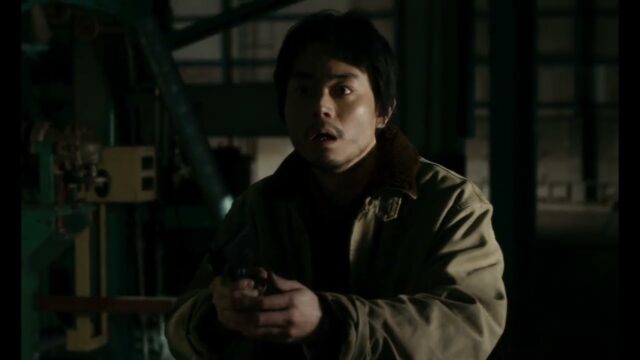
Andy Warhol, Portrait of Franz Kafka, silkscreen print, 1980 (courtesy of Ronald Feldman Gallery, New York © the Andy Warhol Foundation for the Visual Arts / Artists Rights Society (ARS), New York / Ronald Feldman Gallery, New York)

FRANZ KAFKA: PROGRAMS
Morgan Library & Museum
225 Madison Ave. at 36th St.
Tuesday – Sunday through April 13, $13-$25
www.themorgan.org

There are not a lot of authors whose name has been acknowledged as a legitimate adjective in Merriam-Webster’s dictionary, and even fewer of those adjectives have been used as the name of a musical. In fact, the only one might be Kafkaesque, which is used for anything that relates to Czech-born German-language writer Franz Kafka and has “a nightmarishly complex, bizarre, or illogical quality.”

Last fall, James Harvey’s musical comedy Kafkaesque! opened off-off-Broadway at Theatre 154 in the West Village, about one American family experiencing predicaments inspired by Kafka’s writings. The first song gets right to the point when Kafka sings, “By age forty I was dead / never had kids and I never wed / the words I wrote were hardly read / but now I’m an adjective.”

Kafka and his work have grown in stature since his passing in June 1924 at the age of forty from tuberculosis, leaving behind a literary legacy that includes the novels The Castle, The Trial, and Amerika and such influential stories as “The Judgment,” “In the Penal Colony,” and “The Metamorphosis.”

The Morgan Library is celebrating that legacy with the simply titled exhibition “Franz Kafka,” continuing through April 13. The show features original notebooks and manuscripts, letters about vegetarianism and his first hemorrhage, postcards, illustrated pages, family photos, handwritten aphorisms, first editions, architectural models, a diary, and other ephemera, primarily from the Bodleian Library, organized into such sections as “Life and Times: Health and Illness,” “Life and Times: Jewishness,” “Journeys: Around Europe,” and “Journeys: Of the Imagination.”

In his catalogue essay “Kafka’s Life and World,” British editor Ritchie Robertson writes, “Even during his final illness he kept writing. In March 1924 he wrote his last story, ‘Josefine, the Singer or The Mouse-People,’ and on his death-bed he corrected the proofs of the volume, A Hunger Artist: Four Stories, in which the story was included. ‘Josefine’ is a masterpiece of Kafka’s gentle, self-deprecating humour, and ends with the unexplained disappearance of the heroine and the narrator’s reflection that she will not be much missed. She ‘will lose herself happily in the numberless host of our people’s heroes, and, since we don’t go in for history, she will soon, redeemed and transfigured, be forgotten, like all her brethren.’”

Kafka often wrote about the unexplained, but he never disappeared from the public consciousness and will not soon be forgotten. The Morgan exhibition, held in conjunction with the centennial of Kafka’s death, is supplemented by a series of programs that delve further into Kafka’s life and world, ranging from panel discussions to special tours, workshops, lectures, and live music; below is the complete schedule.

Postcard to Ottla Kafka, Schelesen (Želízy), December 1918. MS. Kafka 49, fol. 79r (jointly owned by the Bodleian Library and the Deutsches Literaturarchiv Marbach © the Bodleian Library, University of Oxford)

Thursday, January 9
Kafkaesque: Creative Responses to Kafka, with Joshua Cohen, Maira Kalman, and Josh Luxenberg, Gilder Lehrman Hall, $25, 7:00

Friday, January 10
Virtual Spotlight Tour | Franz Kafka: The Making of an Icon, Zoom, sold out, 12:30

Wednesday, February 5
Virtual Lecture | Benjamin Balint: Kafka’s Last Trial, with author Benjamin Balint, Zoom, free with advance RSVP, noon

Gallery Tour | Franz Kafka with Benjamin Balint, Engelhard Gallery, free with museum admission, 2:00

Wednesday February 19
Winter Break Family Program | Franz Kafka Storytime and Artmaking, with readings of author Larissa Theule and illustrator Rebecca Green’s Kafka and the Doll, free with museum admission, 2:00

Thursday, March 6
Concert | Philip Glass’s “Metamorphosis,” with pianist Jenny Lin, actor Saroi Tsukada, and bassist Lindsay Rosenberg, followed by a discussion with music publisher Richard Guerin, Gilder Lehrman Hall, $40, 7:00

Friday, March 14
Lecture | “Daylight at the Exit”: Women Translating Kafka, with Michelle Woods, Gilder Lehrman Hall, free (advance RSVP recommended), 6:00

Wednesday, April 9
Lecture | Nahma Sandrow: Kafka and the Vagabonds, with playwright and Yiddish theater scholar Dr. Nahma Sandrow, J. Pierpont Morgan’s Library, $20, 6:00

[Mark Rifkin is a Brooklyn-born, Manhattan-based writer and editor; you can follow him on Substack here.]