UNDER THE RADAR: KANJINCHO
Japan Society
333 East 47th St. at First Ave.
January 8–11, $63 japansociety.org utrfest.org
Kinoshita Kabuki makes its North American debut at Japan Society with a rousing adaptation of the 1840 Kabuki classic Kanjincho (“The Subscription List”), reimagining it as a contemporary hip-hop and pop-culture-infused theatrical experience.
Based on the Noh play Ataka, the original Kanjincho was written by Namiki Gohei III, with nagauta songs by Kineya Rokusaburo IV and choreography by Nishikawa Senzo IV. Company founder Yuichi Kinoshita has modernized the text, with a new score by Taichi Kaneko and movement by Wataru Kitao, resulting in a tense and thrilling eighty-minute drama about loyalty, revenge, and the borders that separate people not only geographically but by race, gender, class, and power in the past and present.
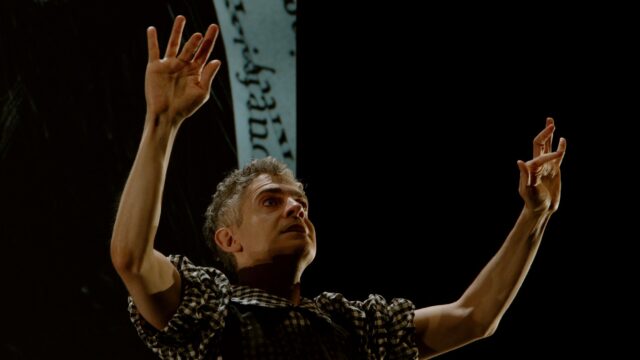
Inspired by actual twelfth-century events, Kanjincho tells the story of half brothers Lord Minamoto-no Yoritomo and General Minamoto Yoshitsune around the time of the Genpei War. Yoritomo has become the first shogun of the Kamakura shogunate, but he distrusts the motives of the military hero Yoshitsune (Noemi Takayama) and has demanded his capture. Yoshitsune, disguised as a porter, heads out on the seldom used Hokurokudō road with the brave and loyal Benkei (Lee V) and four shitenno (armed retainers), Kamei Rokuro (Kazunori Kameshima), Kataoka Hachiro (Hiroshi Shigeoka), Suruga Jiro (Yuya Ogaki), and Hitachi (Yasuhiro Okano), who are pretending to be mountain priests collecting donations on their way to repair Todaiji Temple in Nara. In fact, they are seeking safety in Michinoku with the Fujiwara clan.
When they reach the Ataka Barrier checkpoint, one of many set up throughout Japan to stop Yoshitsune, they are met by Mr. Togashi (Ryotaro Sakaguchi) and his four guards (Kameshima, Shigeoka, Ogaki, and Okano), who are determined to bring Yoshitsune back and behead him in front of Yoritomo. Togashi has been told that Yoshitsune is traveling with a group of fake mountain priests, so he is suspicious of them. “I’m gonna make every last damn mountain priest grovel at Mr. Togashi’s feet!” one of the guards declares.
Togashi decides to test Benkei with a series of questions about their mission and Buddhism that turns into a sensational verbal duel in which Benkei shows off his considerable mental acuity, impressing Togashi, who is leaning toward letting them pass even as one of his guards believes that the lowly porter is Yoshitsune. The cat-and-mouse game continues through a picnic with a transistor radio and contemporary snacks, the four shitenno breaking out into a J-pop boy band, and Benkei enjoying a whole lot of sake.
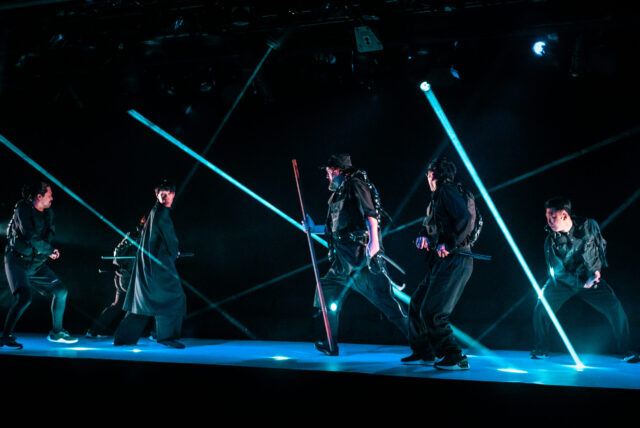
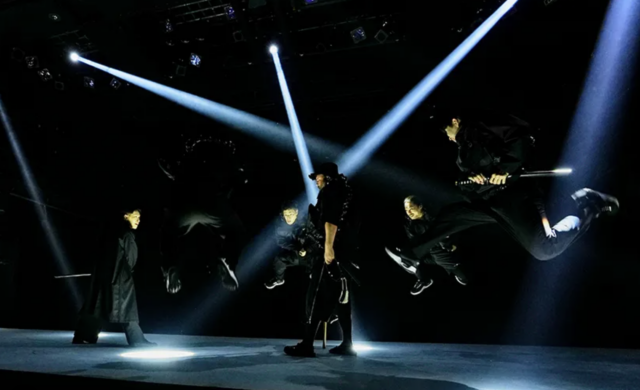
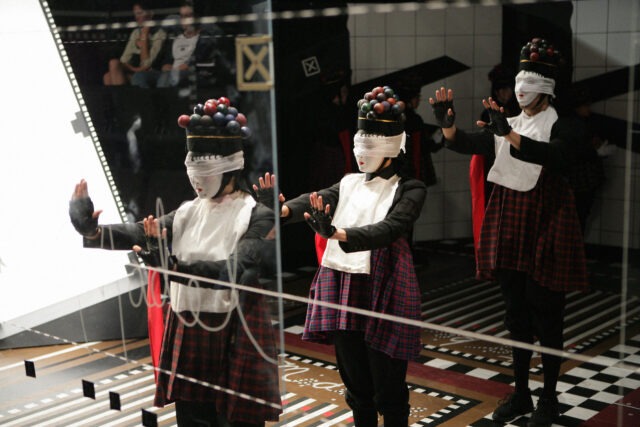
Beautifully directed and designed by Sugio Kunihara (Tokaido Yotsuya Kaidan,Shin Suikoden), Kanjincho — the English title, “The Subscription List,” refers to the scroll of supposed temple donors Togashi asks Benkei to reveal — takes place on a raised horizontal hanamachi (“flower path”) platform behind which two rows of the audience sit. The characters are dressed by Haruki Okamura in modern-day black militaristic gear except for Yoshitsune, who wears a wide-brimmed hat and carries a large walking stick, and Togashi, who is in more regal attire. The sound, by Daisuke Hoshino and Chiharu Tokida, includes moments of silence amid forest noises and Kaneko’s loud electronic and rap score.
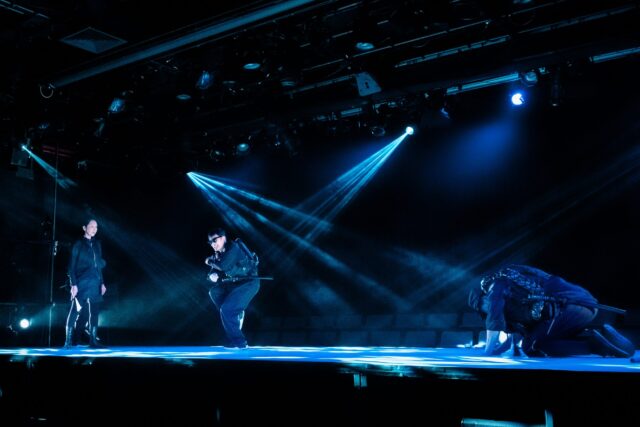
Lighting designers Masayoshi Takada, Arisa Nagasaka, and Naruya Sugimoto nearly steal the show with spectacular effects, from pinpoint laserlike beams, slow, shadowy atmospheres, and an occasional subtle white bar on the floor that represents the numerous barriers separating the characters. “No matter how much I care about you / I can’t hold on to you / because of the borderline / You’re right next to me / but still so far away,” the pseudo–boy band sings in Japanese, except for the word borderline, which they say in English, connecting East and West. The East-West relationship is further developed by Kitao’s choreography, which incorporates traditional kabuki (primarily by Takayama) and hip hop, as well as by the casting of Benkei, portrayed by the outstanding Lee V, a caucasian poetry slam champion who was born in the United States; he evokes David Harbour as Sheriff Hopper in Stranger Things.
At its heart, Kinoshita’s adaptation attempts to break down barriers without preaching, even as the shitenno proclaim, “Equality for all!” and “Everyone’s the same! No more discrimination!” Having the same four men play the shitenno and the guards, running from one side of the stage to the other to indicate who they are without changing costumes — one actor apologizes for coughing first as a shitenno, then as a guard, equating the two despite their being enemies — packs a powerful message, especially in America today, as ICE agents patrol the streets of major cities rounding up citizens and legal and illegal immigrants alike.
Kunihara and Kinoshita may be delivering a warning, but they do so with a masterful sense of fun that transcends all our differences.
[Mark Rifkin is a Brooklyn-born, Manhattan-based writer and editor; you can follow him on Substack here.]
Elevator Repair Service’s Ulysses is a highlight of the January performance festival season (photo by Maria Baranova)
Every January, many of us begin the new year with resolutions to make positive changes in our lives; I find the best way to start that is by checking out the latest in cutting-edge and experimental theater, music, dance, opera, film, and other forms of entertainment. Performance festivals abound this month, at tiny venues you’ve never heard of, places you’ve always wanted to go to but haven’t yet, and well-known spaces you haven’t been to in years.
You now have the chance to fill those voids at such festivals as Under the Radar, Prototype, Exponential, Out-Front!, Live Artery, Winter Jazzfest, New Ear, the Fire This Time, and PhysFestNYC, none of them costing nearly as much as a Broadway show. As sound designer Mark Anthony Thompson says in the below video, “Get out of your house and be with people.”
Here are only some of the highlights of this exhilarating time to try something that might be outside your comfort zone — or right up your alley.
UNDER THE RADAR: IN HONOR OF JEAN-MICHEL BASQUIAT
New York Theatre Workshop
79 East Fourth St. between Second & Third Aves.
Tuesday – Sunday, January 7–18, $35 www.nytw.org utrfest.org
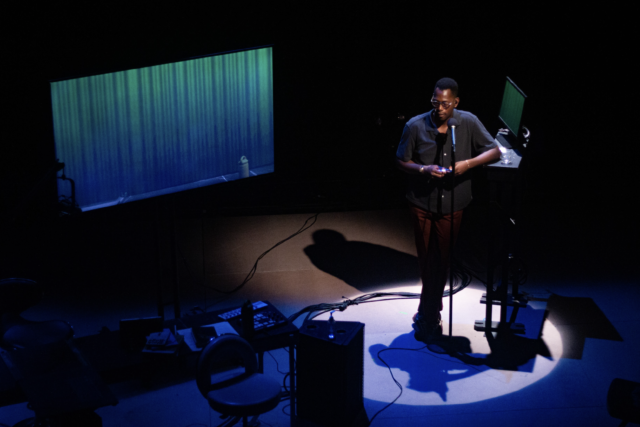
Obie-winning actor, playwright, rapper, and director Roger Guenveur Smith has staged such solo shows as A Huey P. Newton Story, about the founder of the Black Panthers, Frederick Douglass Now, in which he embodies the nineteenth-century abolitionist and orator, and Juan and John, which explored the real-life 1965 fight between Major League pitcher Juan Marichal and catcher John Roseboro. For the 2026 Under the Radar festival, he will perform In Honor of Jean-Michel Basquiat, about his friendship and collaboration with the highly influential Brooklyn-born artist and musician who died of a heroin overdose in 1988 at the age of twenty-seven. Smith and Basquiat met during their LA club years in the 1980s; Smith created the character of Smiley, inspired by Basquiat, for the 1989 Spike Lee film Do the Right Thing. The sixty-minute piece features live sound design by Mark Anthony Thompson; the January 8 and 15 performances will be followed by a Q&A.
UNDER THE RADAR: KANJINCHO
Japan Society
333 East 47th St. at First Ave.
January 8–11, $63 japansociety.org utrfest.org
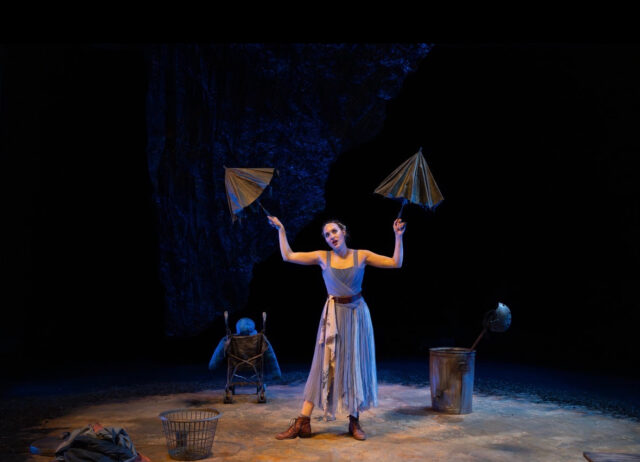
Yuichi Kinoshita reimagines the 1840 Kabuki classic Kanjincho (“The Subscription List”) as a contemporary hip-hop and pop-culture-infused theatrical experience, making its North American premiere at Japan Society January 8–11 as part of Under the Radar. The eighty-minute show is set in the twelfth century, around the Genpei War, a civil clash between the Taira and Minamoto clans. The work is performed by the Kyoto-based Kinoshita Kabuki, all dressed in black, and directed by Sugio Kunihara on a runway-like hanamachi (“flower path”) platform that juts into the audience, with the first two rows on the stage itself. The story concerns war, betrayal, race, and class as refugees attempt to cross borders, giving it a modern-day relevance. The company’s previous works include Musume Dojoji,Shinju Ten no Amijima, and Sannin Kichisa. The 7:30 show on January 8 will be followed by a reception; the 7:30 performance on January 9 will conclude with an artist Q&A. Ticket holders are invited to visit the immersive exhibition “Chiharu Shiota: Two Home Countries” with complementary same-day admission.
UNDER THE RADAR: ALL THAT FALL
Mabou Mines@122CC
150 1st Ave. at Ninth St.
January 8–26 www.maboumines.org utrfest.org
“It is our desire to create, as Beckett says, ‘a text written to come out of the dark,’” director JoAnne Akalaitis says about Mabou Mines’s tenth production of a work by Samuel Beckett, the absurdist black comedy All That Fall, following such presentations as Cascando,Happy Days,Play, and Worstward Ho over the course of the company’s fifty-six-year history. The seventy-five-minute one-act radio play will be performed by Randy Danson, Jesse Lenat, Steven Rattazzi, Tony Torn, Tẹmídayọ Amay, Wendy vanden Heuvel, Lila Blue, and Sylvan Schneiderman as part of Under the Radar. “What have I done to deserve all this, what, what?” the frail Mrs Maddy Rooney moans to bill broker Mr Tyler, later adding, “Have you no respect for misery?” I saw Trevor Nunn’s splendid version in 2013 starring Michael Gambon and Eileen Atkins and can’t wait to see what Akalaitis (Beckett’s First Love,BAD NEWS! I was there . . .) has in store for us this time around, with a set by Thomas Dunn, lighting by Jennifer Tipton, sound by Bruce Odland, costumes by Andreea Mincic, and projections by Jeri Coppola. Expect the unexpected.
Founded in 2005, “Winter Jazzfest celebrates the music as a living entity, wherein history collides with the future in every note. Creative improvisation in the digital age continues to stimulate thought and emotion of its listeners, embracing innovation, defying instrumental boundaries and the old cliches of ‘What is Jazz?’” The festival runs January 8–13 and is highlighted by the Manhattan Marathon on January 9, boasting forty-five shows at Le Poisson Rouge, Nublu, DROM, City Winery, Close Up, Zinc, and the Bitter End, featuring Nels Cline’s “Songs from Lovers,” the Getdown, James Carter, David Murray, Lady Blackbird, and many more.
Drita Kabashi stars in Sara Farrington’s Euripides adaptation at the Tank (photo by Carol Ostrow)
APAP: A TROJAN WOMAN
Theater 98 at the Tank
312 West Thirty-Sixth St. between Eighth & Ninth Aves.
January 10-11, $23-$42 apap365.org/conference thetanknyc.org
“A Trojan Woman exists inside an act of modern warfare, inspired by an early moment in the Russian war against Ukraine that affected me deeply,” playwright Sara Farrington explains in a note about her adaptation of Euripides’s 415 BCE Greek tragedy The Trojan Women. Originally performed at the outdoor Theatro Attikou Aldous/Katina Paxinou Attica Grove Theater in Athens, Greece, in July 2023, A Trojan Woman will be at the Tank January 10-11 as part of the APAP (Association of Performing Arts Professionals) festival, directed by Meghan Finn and starring Drita Kabashi as Irina; the costumes are by Suzanne Bocanegra, with video by Ana Veselic. Farrington has previously collaborated with her husband, Reid Farrington, on such productions as BrandoCapote,CasablancaBox, and Dora Maar, always providing a unique take on the world and theater itself; Sara is currently working on Dr. Uncanny Presents: Moreau ’96, a musical based on the 2014 documentary Lost Soul: The Doomed Journey of Richard Stanley’s Island of Dr. Moreau. She is also the author of the popular Theater Is Hard. on Substack.
Ian Andrew Askew and Johnnie Cruise Mercer will present world premieres at Out-FRONT! Fest (photos by Maria Baranova and Johnnie Cruise Mercer)
OUT-FRONT! FESTIVAL: IAN ANDREW AND JOHNNIE CRUISE MERCER
Judson Memorial Church
243 Thompson St. at 55 Washington Square South
Saturday, January 10, and Sunday, January 11, free with advance RSVP (suggested donation $28.52) pioneersgoeast.org www.judson.org
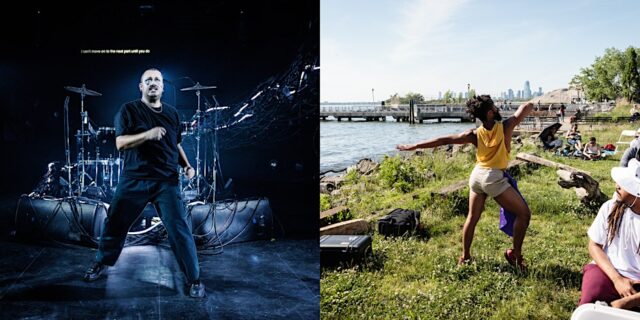
Pioneers Go East Collective’s multidisciplinary Out-FRONT! Fest “champions the voices of LGBTQ and Feminist artists for a lively exchange of art and culture.” Curated by Gian Marco Riccardo Lo Forte, Remi Harris, Philip Treviño, and Joyce Isabelle, the 2026 edition runs January 5–11, with works by such performers as Dominica Greene, Suzzanne Ponomarenko, Alexa Grae, Sugar Vendil, Jo Warren, Owen Prum, and Corentin JPM Leven at Judson Memorial Church. On January 10 and 11, Ian Andrew Askew will present the world premiere of SLAMDANCE punk lessons, which explores sociopolitical aspects of moshing and violence, followed by the world premiere of Johnnie Cruise Mercer’s Mercies of a Butterfly, “a movement allegory about resilience.” All tickets are free with suggested donation and are going fast.
Wally Cardona and Molly Lieber restage David Gordon’s 1975 duet in original SoHo loft (b&w photo by Babette Mangolte; color photo by Daqi Fang)
LIVE ARTERY: TIMES FOUR / DAVID GORDON: 1975/2025
New York Live Arts / Pick Up Performance Co. Studio
541 Broadway between Spring & Prince Sts.
January 11–13, $33.85 newyorklivearts.org
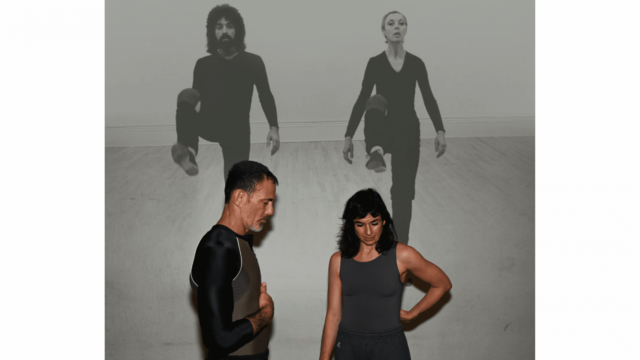
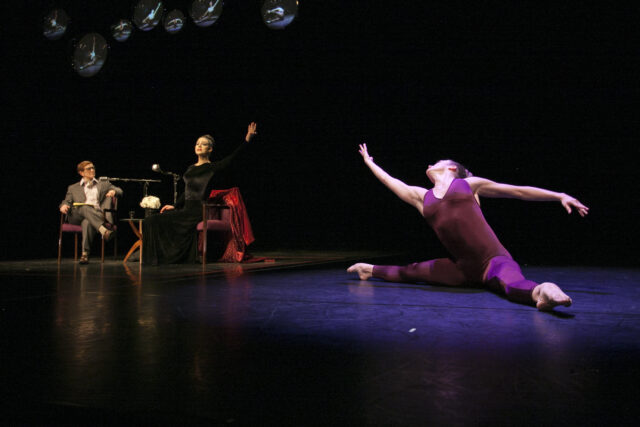
Two of my favorite dancer-choreographers, Wally Cardona and Molly Lieber, have teamed up for Times Four / David Gordon: 1975/2025, an adaptation of David Gordon’s 1975 duet with his wife and muse, Valda Setterfield, that will run January 11–13 as part of New York Live Arts’ Live Artery festival. The work will be presented in the same SoHo loft where Obie and Bessie winners Gordon and Setterfield debuted it fifty years ago; Times Four has not been seen in its entirety since then. In 2021, Gordon asked Cardona, who is married to playwright Ain Gordon, David and Valda’s son, if he wanted to perform something from his archives. Cardona was instantly interested in Times Four, an unusual, relatively unknown piece, but Gordon rejected that. However, after both Gordon and Setterfield died, the former in 2022 at the age of eighty-five, the latter in 2023 at eighty-eight, Cardona decided to resurrect Times Four in their honor. “I think that they, especially Valda, would be very happy that we are doing this piece and that we are performing something,” Cardona told choreographer, dancer, director, and NYLA head Bill T. Jones in an online interview. Cardona (Interventions,The Set Up) and Lieber (Rude World,Gloria) reconstructed the piece from a video rehearsal, Setterfield’s handwritten notes, photographs, and other ephemera, as no footage of the full original duet, which is done in silence, exists. The audience will sit in folding chairs on all four sides of the loft.
Eric Berryman shares African American toasts in Wooster Group’s Get Your Ass in the Water and Swim Like Me (photo by Marika Kent)
UNDER THE RADAR: GET YOUR ASS IN THE WATER AND SWIM LIKE ME
Joe’s Pub, the Public Theater
425 Lafayette St. at Astor Pl.
Monday, January 12, and Tuesday, January 13, $36 utrfest.org publictheater.org
In 2019, the Wooster Group production of The B-Side: “Negro Folklore from Texas State Prisons,” a Record Album Interpretation earned a Drama Desk nomination for Unique Theatrical Experience for Eric Berryman’s multimedia adaptation of a 1965 LP compiled by Bruce Jackson, consisting of performances by inmates of color on segregated agricultural prison farms. Writer and actor Berryman and director Kate Valk followed that up with Get Your Ass in the Water and Swim Like Me, which is having an encore presentation at Joe’s Pub as part of Under the Radar. This time Berryman dives deep into Jackson’s 1974 book and 1976 disc, Get Your Ass in the Water and Swim Like Me: Narrative Poetry from Black Oral Tradition, a collection of folktales known as toasts, made for heroes and antiheroes in the Black storytelling canon. The tales are filled with tawdry sex and extreme violence — bullets are flying everywhere — but as funny as they are, there’s also an underlying sense of discomfort, particularly with a primarily white audience, as the stories contain stereotypes reminiscent of minstrelsy. Berryman compares over-the-top characters to Greek myths, where such figures as Hercules and Jason “would do stupid shit because they knew it would help them uh, uh, more quickly achieve kleos, and get kleos . . . A community creates the heroes that they need.” Berryman (Primary Trust,Toni Stone) is not just sharing old fables but exploring Black identity then and now. At one point he digresses into a discussion of his own name, how disappointed he is to be anchored with the plain “Eric” when he has relatives called Qasim, Idris, Indira, Akeem, Alenka, and Adia. (He does note that there is a Gary but does not share that it’s his uncle, Grammy-winning jazz saxophonist Gary Bartz.) The show concludes with the all-time favorite “Stackolee,” a tale of murder and mayhem that has been recorded in different versions by Mississippi John Hurt, Doc Watson, Wilbert Harrison, Long Cleve Reed, Lloyd Price, and Nick Cave and the Bad Seeds, among others, its familiarity spotlighting the centrality rather than the marginalization of the Black experience in American popular culture.
PhysFestNYC: BILL BOWERS: IT GOES WITHOUT SAYING
Stella Adler Center for the Arts
65 Broadway
Tuesday, January 13, $20, 7:30 & 9:00 www.physfestnyc.org
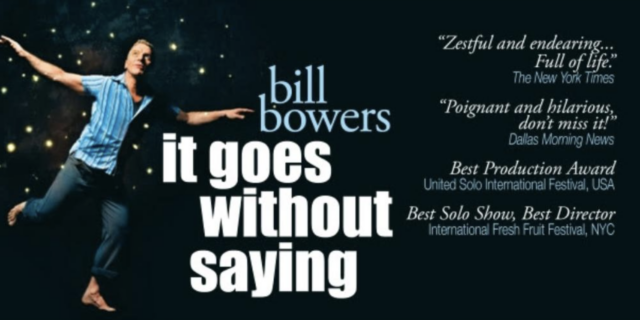
PhysFestNYC was started in 2024 as “a community-focused festival that celebrates, enriches, and envisions our field of physical theater . . . [which] tends to be experimental, innovative, and genre-breaking.” The third annual event, taking place January 8–18 at the Stella Adler Center for the Arts, consists of workshops, panel discussions, masterclasses, and live performances. On January 13, Bill Bowers will present the one-man show It Goes without Saying, which delves into his life and career from his childhood in Montana to studying with Marcel Marceau and appearing in several Broadway productions.
Christopher-Rashee Stevenson, Vin Knight, and Scott Shepherd rehearse for NYC premiere of ERS’s Ulysses (photo by Joan Marcus)
UNDER THE RADAR: ULYSSES
Martinson Theater, the Public Theater
425 Lafayette St. at Astor Pl.
January 13 – February 15, $109 publictheater.org utrfest.org
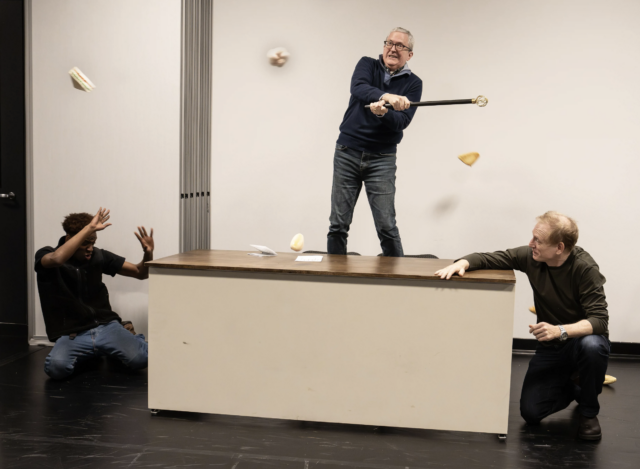
Elevator Repair Service follows up its farewell performance of the eight-hour Gatz at the Public with its adaptation of James Joyce’s Ulysses, clocking in at a mere two hours and forty minutes. Directed by John Collins, who has previously tackled such literary biggies for ERS as The Sound and the Fury and The Sun Also Rises in addition to Gatz, the show stars Dee Beasnael, Kate Benson, Maggie Hoffman, Vin Knight, Christopher-Rashee Stevenson, Stephanie Weeks, and codirector and dramaturg Scott Shepherd, with sets by dots, costumes by Enver Chakartash, and projections by Matthew Deinhart. Joyce is having a bit of a renaissance onstage recently, with a rare revival of Joyce’s only play, Exiles, last winter and Colin Murphy’s The United States vs. Ulysses at the Irish Arts Center last spring; ERS’s Ulysses, part of Under the Radar, promises to be the best of the bunch.
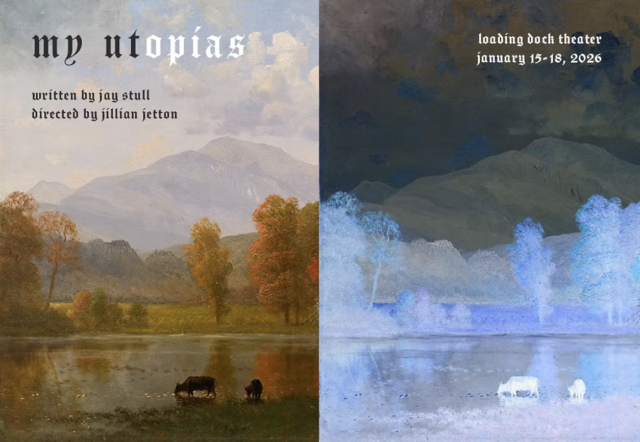
Writer Jay Stull (The Capables,Rantoul and Die) and director Jillian Jetton have put together a fantastic cast for my utopias, running at the Loading Dock Theatre as part of the Exponential Festival: Brittany Bradford, Ugo Chukwu, Fernando Gonzalez, Melissa Hurst, Jon Norman Schneider, Colleen Werthmann, and Julyana Soelistyo. The show is about a kind of postapocalyptic nightmare in New York City as a group of survivors wonder what the future holds.
Paul Lazar and Annie-B Parson stage first revival of Richard Foreman’s What to wear at BAM (photo by Scott Groller)
PROTOTYPE: WHAT TO WEAR
Brooklyn Academy of Music
BAM Strong Harvey Theater
651 Fulton St. at Ashland Pl.
January 15-18 www.bam.org www.prototypefestival.org
“Don’t finish what you start,” reads one of ninety-four notecards collected in experimental theater maestro Richard Foreman’s posthumously published book No Title. Fortunately, Foreman, the founder of the Ontological-Hysteric Theater who died last January at the age of eighty-seven, finished much of what he started, including more than eighty plays, operas, films, and books. The seven-time Obie winner and Guggenheim and MacArthur Fellow turned the theater and opera community inside out and upside down with such influential avant-garde works as Sophia = (Wisdom) Part 3: The Cliffs,Pandering to the Masses, and Elephant Steps. In the past year and a half, Object Collection presented the world premiere of Foreman’s Suppose Beautiful Madeline Harvey, the Wooster Collective staged 1987’s Symphony of Rats, and the Segal Center Film Festival on Theater and Performance held a retrospective of Foreman’s movies and videos. Big Dance Theater’s Paul Lazar and Annie-B Parson are now reviving, for the first time since its premiere, Foreman and Michael Gordon’s 2006 surreal post-rock opera What to wear, running January 15–18 at the Harvey as part of the Prototype and BAM’s Next Wave festivals. Foreman wrote the libretto and directed the original; Gordon composed the music, which will be performed by Bang on a Can All-Stars. The cast is highlighted by St. Vincent, sopranos Sarah Frei and Sophie Delphis, mezzo Hai-Ting Chinn, and tenor Morgan Mastrangelo, along with an ensemble of more than a dozen vocalists and dancers.
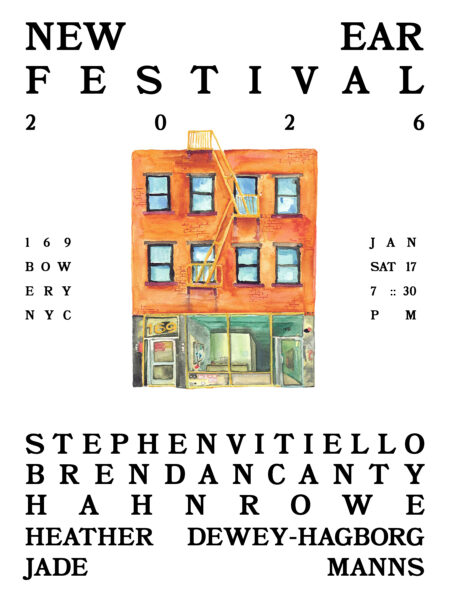
NEW EAR FESTIVAL: NIGHT 02
Fridman Gallery
169 Bowery between Delancey & Broome Sts.
Saturday, January 17, $22.46–$43.57, 8:00 withfriends.events
The Fridman Gallery’s annual New Ear multimedia festival showcasing “time-based art in all its forms” is highlighted by an impressive roster of performers on January 17, consisting of dancer and choreographer Jade Manns, artist and biohacker Dr. Heather Dewey-Hagborg, and the live debut of the trio of sound artist Stephen Vitellio, Fugazy drummer Brendan Canty, and multi-instrumentalist and producer-engineer Hahn Rowe, supporting their sophomore LP, Second. Talullah Calderwood, Sue Huang, and Konjur Collective open the three-day fest on January 16, while La Frae Sci, Ben Shirken x Dorothy Carlos, and Lucky Dragons close things out on January 18.
Fire This Time fest features ten-minute works by six playwrights
THE FIRE THIS TIME FESTIVAL: TEN-MINUTE PLAY PROGRAM
The Apollo Stages at the Victoria
233 West 125th St. between Frederick Douglass & Adam Clayton Powell Jr. Blvds.
January 23–31, $51.25 www.firethistimefestival.com
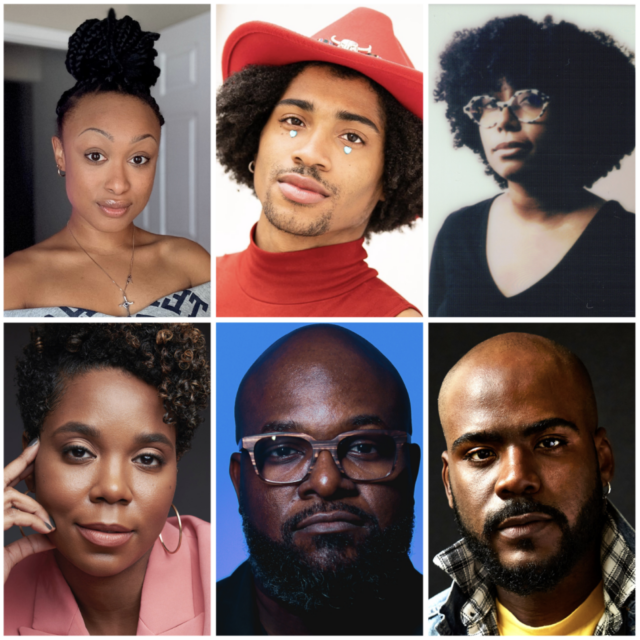
Founded in 2009 by Kelley Nicole Girod, the Fire This Time Festival, now in its seventeenth year, “provides a platform for early career playwrights of African and African American descent.” The 2026 iteration comprises six ten-minute shows at the Apollo Stages at the Victoria: Teniia Micazia Brown’s Everything But–, Preston Crowder’s Black to Save the Day, Mo Holmes’s Clumsy, Naomi Lorrain’s DNR, DeLane McDuffie’s Goose, and Donathan Walters’s White Diamond.
[Mark Rifkin is a Brooklyn-born, Manhattan-based writer and editor; you can follow him on Substack here.]
The Holy Blues is part of all-new evenings of Alvin Ailey American Dance Theater season at City Center (photo by Steven Pisano)
ALVIN AILEY AMERICAN DANCE THEATER
New York City Center
131 West 55th St. between Sixth & Seventh Aves.
December 3 – January 4, $45-$195 www.alvinailey.org www.nycitycenter.org
It’s been a time of change for Alvin Ailey American Dance Theater. This has been the first year without the shining light of Judith Jamison, the beloved Ailey dancer and artistic director who passed away last November at the age of eighty-one. That month, her successor, Robert Battle, became a resident choreographer with the Paul Taylor Dance Company. And this past spring, longtime Ailey dancer and Juilliard Dance Division dean Alicia Graf Mack was named the fourth artistic director in the history of AAADT.
“This monumental season draws deeply on Alvin Ailey’s legacy rooted in celebrating the resilience of the human spirit while extending its truth and bold virtuosity to reflect this moment in time and our hopes for the future,” Graf Mack said in a statement about the company’s upcoming annual City Center residency. “Each new creation shares the utterly distinctive voice of its choreographer, testifying to the vitality of the tradition Mr. Ailey gave us and the gifts of spirit that Judith Jamison so lovingly nurtured. I am grateful and honored to be a caretaker of this ever-changing continuum of inspiration, along with Matthew Rushing and the company of brilliant dancers whose artistry will move us all as we take our next steps forward.”
Running December 3 through January 4, the 2025 City Center season features the company premiere of Medhi Walerski’s Blink of an Eye, set to J. S. Bach’s violin sonatas and partita, and a new production of Jamison’s duet A Case of You, originally a birthday tribute to Chairman Emerita Joan Weill, danced to Diana Krall’s version of the Joni Mitchell song.
There are five world premieres from a wide range of choreographers. Inspired by Geoffrey Holder’s book Black Gods, Green Islands, about Trinidad and Tobago, Cuban American theater director and arts educator and activist Maija García’s Jazz Island celebrates the Afro-Caribbean diaspora, with original music by jazz trumpeter Etienne Charles. Matthew Neenan’s Ailey debut, Difference Between, is set to music by MacArthur fellow and two-time Obie winner Heather Christian, who sings in “Tomorrow”: “Difference between. Deference, reverence, sever its shoots on the bean / Sanity, brevity, bravery, levity — these are the virtues / are any restored or recorded or / pored over once the romance of it leaves?”
Superstar Jamar Roberts, the company’s first resident choreographer, follows up such gems as Ode,A Jam Session for Troubling Times, and Holding Space with Song of the Anchorite, a reimagining of Alvin Ailey’s 1961 solo Hermit Songs, set to jazz trumpeter Avishai Cohen’s interpretation of a Ravel adagio. In Embrace, Fredrick Earl Mosley incorporates tunes by Stevie Wonder, Kate Bush, Etta James, Maxwell, Ed Sheeran, Des’ree, and P!nk in exploring the intimacy of human connection.
And Urban Bush Women founder and Ailey Artist in Residence Jawole Willa Jo Zollar, collaborating with current Ailey dancer Samantha Figgins and former company member Chalvar Monteiro, looks to the concepts of the Ring Shout and the Door of No Return in The Holy Blues, named after the title of Alvin Ailey’s journal. The twenty-five-minute piece debuted at BAM in June; in a company interview, Figgins explained, “Through life, we have these hills and valleys, our human suffering and our pleasure, our delight, our bliss, our joy, and The Holy Blues is a chance to watch that journey of a group of people — a community, of course, but all individuals — how they tackle the challenges of bringing themselves up out of whatever pain they may be in, out of whatever life throws at them, and how they are able to create something beautiful out of it.”
The thirty-two dancers will also perform the Ailey classics Memoria,Night Creature,Pas de Duke,Masekela Langage,A Song for You,Opus McShann,For Bird — with Love,Love Songs,Reflections in D,Hidden Rites, and Cry; Ronald K. Brown’s Grace; Lar Lubovitch’s Many Angels; Rushing’s Sacred Songs; Elisa Monte’s Treading; and Alonzo King’s Following the Subtle Current Upstream. Many of the programs will conclude with the one and only Revelations, six with live music. In addition, the Saturday family matinees will be followed by a Q&A.
“I join with the entire company in welcoming Alicia Graf Mack in her new role as our artistic director,” Rushing said in a statement. “Her great respect for and commitment to the Ailey mission, along with the perspective and integrity that informs her vision, will help elevate everything we do. We are excited to welcome audiences to New York City Center this holiday season to be uplifted by cherished classics and remarkable new works as the curtain goes up on the next chapter in Ailey’s extraordinary story.”
[Mark Rifkin is a Brooklyn-born, Manhattan-based writer; you can follow him on Substack here.]
Jack Ferver reimagines Our Town through a deeply personal queer lens in My Town (photo by Jeremy Jacob)
MY TOWN
NYU Skirball Center for the Performing Arts
566 La Guardia Pl.
November 21-22, $42-$57, 7:30 nyuskirball.org jackferver.com
“Oh, earth, you’re too wonderful for anybody to realize you,” Emily Webb says in Thornton Wilder’s Our Town. “Do any human beings ever realize life while they live it? — every, every minute?”
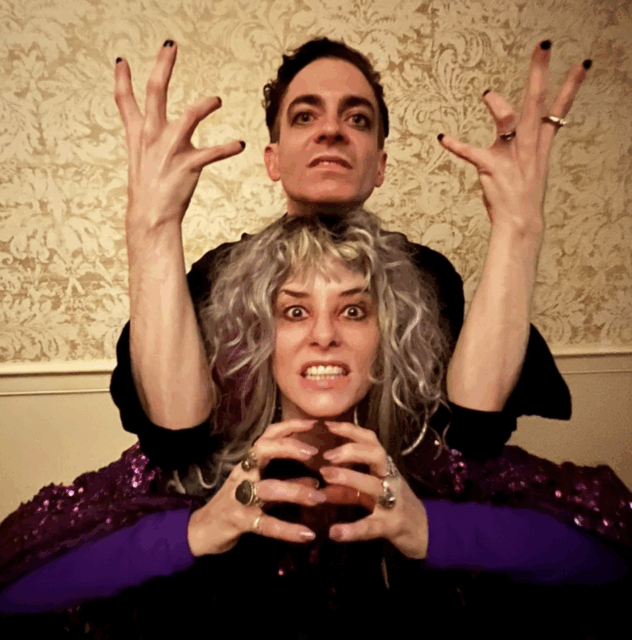
Dancer, actor, choreographer, and professor Jack Ferver has been sharing their unique and impassioned realizations about life in deeply personal and intensely funny and frightening shows since 2007; their works are complex, intoxicating fusions of pop culture, Hollywood glitz and glamour, childhood trauma, and loneliness, filtered through a distinctively queer sensibility. Their latest piece, My Town, running November 21 and 22 at the NYU Skirball Center, incorporates Emily, a romantic idealist who serves as the heart and soul of Wilder’s 1938 Pulitzer Prize–winning drama about the fictional early-twentieth-century American community of Grover’s Corners.
In a 2010 review of Rumble Ghost, an intimate story about the search for a missing child inspired by the 1982 film Poltergeist, I noted that Ferver “once again makes viewers squirm for a whole range of reasons.” For more than fifteen years, they have both challenged and delighted audiences with such obsessive yet relatable pieces as All of a Sudden, a reimagination of Tennessee Williams’s 1959 melodrama Suddenly, Last Summer; Night Light Bright Light, an examination of the 1964 suicide of dancer, actor, and choreographer Fred Herko; and Everything Is Imaginable, in which Ferver is like a devilish cherub paying tribute to Judy Garland and Martha Graham while asking us all to take stock of our lives.
“Artists are the stomachs of society. We digest the indigestible,” they told me in a 2012 interview focusing on Two Alike. “That means we explore all terrains. Gender and sexuality roles are assigned or taken in hopes of a sense of self, as a branch of the ego. And the ego begins with ‘Me, not me.’ As an artist I make my work so that people donʼt feel as lonely as I have felt. Therefore my work expands into something more akin to ‘I am you.’”
It’s been six years since Ferver presented a major work, yet they’ve been extraordinarily busy, teaching, choreographing for other creators, curating an upcoming Graham exhibition at Bard, making the film Nowhere Apparent with their partner, Jeremy Jacob, and revisiting the Little Lad, the bizarrely affecting character they played in a 2007 Starburst commercial for its new berries and cream flavor that went viral during the pandemic.
I recently met with Ferver over Zoom, discussing the creative process, Wilder and Williams, the Little Lad, growing up in Wisconsin, pets, and more.
Jack Ferver introduces Nomi to Tuki over Zoom (screenshot by twi-ny/mdr)
twi-ny: Oh, who’s that?
jack ferver: Here’s Nomi. She is a Parson Terrier and we got her in February of ’21 from a really great rescue org, Korean K9. Who’s that baby?
twi-ny: This is Tuki. She’s Maine Coon and Siberian, with a little Ragdoll. And she’s just adorable and cute and fluffy. This is all fur. She’s not very heavy. It’s just fur, and look at that tail!
jf: She’s so sweet. I know that we’re very blessed with our animal angels.
jf: Nomi was four. We had been looking for a dog for a while and she looked so sad. She had come from breeding and also a meat market. My partner said, “This looks like the saddest dog I’ve ever seen.” And I said, “Let’s go get her.” And then we got her and she’s just completely changed my life. We have both changed. They said, I don’t think she’ll ever play. Our trainer wasn’t sure if she ever would. And she plays every morning. I mean, I’ve really moved upstate, for two reasons. One was because of Bard, where I’m a professor. The other was that she was just so happy up here. But in just a moment, she will need to go back to the city.
twi-ny: Since I last saw you, you became a TikTok sensation with the Little Lad, garnering two million followers. How did that come to be?
jf: Well, someone had posted the commercial during the lockdown and told people to do things with it. I wasn’t on TikTok. Friends of mine were and started messaging me, saying there’s all these people impersonating that character and using the advertisement.
It was the fall of 2021, so we’re still kind of in the lockdown. Like, how are we returning? There’s just this day where I said, I’m not going to do anything. I don’t have the capacity or the bandwidth. And then there was this day where I said, Just go to Fourteenth Street and get a wig and do it. And I did; I did one post and overnight it had hundreds of thousands of followers.
And then within a few months it was a million and then it went up to two million. And my partner, Jeremy Jacob, who’s a visual artist and a filmmaker and made the video and music for My Town, we made one film together where the Little Lad is trying to track down their mom, who is supposedly Anna Wintour. We did that. I did some other long-format YouTubes and a bunch of TikToks and people really loved it. I haven’t opened TikTok in so long. The Little Lad hasn’t shown themselves since, wow, July 2023, which was pretty much when I started working on this show. I loved doing it.
I think a benefit that I hadn’t foreseen with it was I was really curious how my work would get to places in America where it’s simply not going to tour. There are curators in cities in America who wouldn’t feel comfortable with my work, with its queerness and its femmeness and its examination of trauma, and also use the use of humor.
I started to receive all of these emails from young people who had found the Little Lad and then found my website; there were some incredibly touching emails. Years ago, when I started making my work, I saw how broke I was going to be. I said, Well, you better have a good sentence, like one that you can remember, because this is going to be so hard. It certainly has been.
What I always loved from art was that it made me feel less alone. So that was my sentence, that I’d make work for people to feel less alone. And so to receive emails from people who were able to then get this material that I saw no way of ever getting to them. . . . Also, in the lockdown, I opened up almost all of the works of mine that I have documentation for, which aren’t all of them, but for all the ones I do, I opened them for free on my website so that people would have access to that. And I’ve kept it open because it’s my way of dealing with what we have culturally and what we don’t — or rather don’t have in terms of support culturally.
twi-ny: That also relates to the audience, which wants to know Jack Ferver. So much of your work is about queer isolation; it really all comes together with Little Lad and the two million followers —
jf: Little Lad was such a place of just complete play. In a lot of my pieces, there has been playfulness. There’s also been, and I think probably always will be, a lot of darkness, a lot of dealing with really difficult material. So to have this other [creation] that’s not close to me, I think that was also the thing that was so fun, that it was so far from me.
Someone who was so important to me when I was growing up was Paul Reubens. I was eight when Pee-Wee was coming out. And so to be a lonely, queer, bullied kid who saw this queer-in-every-which-way character taking up space, having a lot of fun. . . . I don’t think the Little Lad would have ever existed if it hadn’t been for Paul Reubens. Pee-wee was so informative for the Little Lad. I certainly didn’t think about it when I did the commercial.
I was paid very little for it, because this was before YouTube was monetized. And it was like the Twin Peaks of commercials. It was so strange, so desired that it instantly went to YouTube and was being watched there. It stopped running on the networks, so that stopped the paychecks.
twi-ny: I was looking back at the last time I saw one of your live shows, and it’s been a while.
jf: It’s been a long time.
twi-ny: Over the last six years, you played Arkadina in The Seagull: The Rehearsal, you did It’s Veronique at Hesse-Flatow, you worked with Parker Posey on Abracadabra. Oh, you were talking before about having fun; I had a blast at The Last Bimbo of the Apocalypse, which you choreographed. So much fun, and very serious elements too. You also did Is Global Warming Camp? at MASS MoCA. And now you’re curating a Martha Graham exhibition, one of your heroes, at the New York Public Library. I kind of know why you haven’t been around for six years.
Jack Ferver and Parker Posey collaborated on Abracadabra (Instagram photo courtesy Jack Ferver)
jf: The last show in New York was Everything Is Imaginable; we did it in 2018 and it came back in 2019. And then that year, I was also the AIDS Oral History fellow with Jeremy at the New York Public Library of the Performing Arts, the Jerome Robbins Dance Division. So that year of 2019 through 2020 was spent with that archive.
We did a lecture performance in January of 2020. Working with that archive answered so many questions for me, or I would say really reified answers I had about where people were who would be mentors for me and what had happened with funding. It was an incredible and devastating event. It was an audience that was filled with a lot of women who afterwards said, “Thank you for saying my friend’s name, which I haven’t heard in years.” And then in rolled this pandemic and the lockdown and I left and went and lived at Parker’s and taught and wrote and really had time to reassess and have space and to think about what it was that I wanted to do artistically, in many aspects of life, and then because art is the big forerunner of what I do in my life, what I wanted to do. So much of the lockdown was spent writing and then the MASS MoCA show came up, which I started working on in 2021 and it went up in 2022. Then Jeremy and I made [Nowhere Apparent] through All Arts. It’s still streaming on the All Arts platform.
With MASS MoCA, it was this question, I’ve created this show, am I gonna try and get these presenters from NYC or from wherever to come to North Adams in the early fall? I really had met full burnout with trying to do that with presenters.
So at that time, Garen Scribner, who was in Everything Is Unimaginable, was changing paths to being a manager and said, I would love to be your manager. And I said, Great. So then Jay Wegman, who used to be the artistic director of Abrons, had given me free space for ten years when he was there. That’s how I made most of my work. And so Garen said, Let’s have a conversation with Jay, who was now at Skirball.
twi-ny: That’s the connection.
jf: I’ve been working on [My Town] since the summer of 2023. I’ve never worked harder on a piece. A lot of the things that are, I would say, more familiar if I look back at some of the formal things in my work, such as the use of film, that isn’t there. It begins sheerly by fiction of a story that’s not me, that’s about a schoolteacher and her student in 1911 in this town that I live in now, and then through trauma time starts to collapse.
A lot of characters emerge through this show, which is also something very different. And there’s a different approach to the solo format, which I might be doing for quite a while, I think, inside of my work. Through this work, I’m literally having more time alone. That Joan Didion quote: “Do not complain. Work harder. Spend more time alone.” And so my writing practice and my movement practice have just had so much more space.
I love teaching at Bard. I feel so grateful that I love to teach so much, and I feel so grateful I’m at Bard, which makes total sense for the way I work. It’s so interdisciplinary, and I work with professors from different parts of the college.
twi-ny: Are you hopeful for our next generation of writers and performance artists?
jf: That really solidified for me too during the AIDS Oral History Project, that I’m one of the bridge makers. We’ll never fix that gap, and we’ll never heal that canyon. But some of us will work to help build the bridge and those students, our students, will continue to be that bridge.
This piece has just been — oh, Mark, if I performed it a thousand times, I would never perform it for as many hours as I’ve rehearsed it.
twi-ny: It’s a solo piece.
jf: It is.
twi-ny: You’re very influenced by previous media: plays, movies, television, like Black Swan,Poltergeist,Suddenly, Last Summer,The Maids. So you’ve chosen in this case to take on Our Town, which is maybe the most famous play for its numerous characters.
jf: Yes.
twi-ny: And you’ve turned it into this one-person show. Why Our Town?
jf: A lot of the work had already been made. And then there was this moment where the character of Emily Webb emerged for me. And it emerged at a point in the process when, in the way I was talking and describing things, I was reminded of the stage manager. Then Emily Webb arrived and also Simon Stimson, the “queer-coded” chorus leader who hangs himself. I talked about both of them in Is Global Warming Camp? I talked about their deaths in that piece. And I was curious about why this woman meets her death in childbirth and then the queer-coded one hangs himself.
So I became really interested in tapping into, perhaps, could Emily get revenge with the stage manager before going back to the cemetery? It’s a very brief moment in the show. I was contacted by the Wilder estate; I felt very happy to be contacted by them. There’s nothing really of Our Town in there. There’s a part where it’s my fantasy if Emily got to confront the stage manager. But I think where I see the haunting of Our Town in it is that there’s someone describing things that aren’t there, that aren’t onstage. So many of my works don’t have a set. They generally have taken place in an “empty space,” to quote Peter Brook. It’s this thing of me using the power of my imagination to evoke the audience’s power of imagination. So much of that for me came from dance, but I also really see where that also comes from this experiment that Wilder did for America.
As Wilder’s essay that he put out to the American theatergoers says, you were just here for the soporific and for the baubles and for being entertained and you are asleep at the wheel. And so I’m gonna strip everything down. I connected very much in that way with Wilder. I will use language to evoke where we are. So that is where Our Town happens from. And I’d also say, yes, that I’m so many characters through this work. I’m very rarely me. And if I am, it’s some aspect of self. What I see from my work is that the stage is the psyche. It’s the psychic space.
I think this has been true of all of my work. And now it’s very clear to me that I am playing all of the aspects of self that get shattered in trauma and then jockey for attention. So when I’ve worked with a cast, they have also been aspects of self or aspects of whether they’re coming to it from a more narcissistic position or from a more victimized position.
They are all the shattered aspects that happen from trauma, and they will look to jockey and fight and spar to get the audience’s attention, to get the attention of the witnessers.
twi-ny: I wonder if that’s why you often don’t have a lot of set design. You were talking about this black space inside yourself or inside your mind, and right now you’ve chosen to be on Zoom in a dark corner.
jf: [laughs] Yes, this is where I do take my calls.
twi-ny: Last night I saw The Seat of Our Pants at the Public Theater, a musical adaptation of Wilder’s The Skin of Our Teeth. So clearly his estate is having fun with people taking Thornton to other levels.
jf: Well, I think of Wilder and I think of Williams; I would love to, if I ever have it in me, to write a more narrative play — I’ve always been so curious of what it would be like for the two of them at a bar. They were obviously so creative, so utterly American, and very angry, incredibly angry artists, and a lot of their work comes from revenge. It’s clear on the page. Our Town is a deeply vengeful play. It is so much of an agony of how people are not waking up and are not being awake to the present moment.
I wish that we had more of that content of trying to wake us up. I mean, we’re so polarized; I’m the billionth person to say that. That’s not new news of how polarized we are, so inside of our own vectors, and so unwilling to see the other person.
twi-ny: It’s very scary. So Emily Webb took what you were already working on in this other direction, gave another part to it. What was the initial genesis before Our Town was even on the page?
jf: First it was Wisconsin Death Trip, the book by Michael Lesy, which has those photos and police records from the late 1800s into the early 1900s.
twi-ny: That’s where you grew up, in Wisconsin.
jf: I did. I grew up relatively close to where a lot of that material for that book takes place. So first there was that, and then, as I went on, that began to fall away. And because I was researching where I grew up, what was it like as the town was forming, and what was it like where I am now? Because they look very similar. Where I have landed looks very similar to where I grew up, which is a big shock because I was very, “I’m getting out of this town.” That real queer kid adventure of “I’m going to move to New York City and . . .”
twi-ny: Be a star!
jf: Yeah. Where I grew up was on the Wisconsin River, on the train tracks facing the Wisconsin Ferry Bluffs. And now I live on Amtrak. Just down the street are the train tracks, the Hudson River, and the Catskills. So I thought, Okay, let me do research between these two towns. Then that began to fall away. I don’t know where this story came from of this schoolteacher and her student in 1911 in a town that is maybe this town that I live in now. And I wrote this really long, incredibly detailed, graphic, honestly . . . novella. I started to read it to a friend of mine and I said, This is going to be my next piece. And he said, Well, it can’t be because you’ve written a novella and no one will sit through this. You could do this as a book on tape. I think I was at page twenty and still reading what was going on for them. And he said, You can’t. What’s the show? It’s a show. We’re not going to sit through . . .
twi-ny: Five hours of . . .
jf: Yeah, five hours of reading a story. That was what began. I think part of where that came from was really this interest in what happens to this schoolteacher, who’s marked as a woman in my script but she might possibly be a trans man, though she doesn’t have language for that at that time.
I won’t say more than that of what happens to her and the student. But I decided to have there be a traumatic event that rips through time. And that will tie this town back to Wisconsin, and I thought about portals and trauma and how we have memories of places that perhaps we’ve been or haven’t been. I thought about amnesis, this recollection of something that we haven’t experienced but feels very familiar, a knowledge of something that we haven’t directly experienced. What is that? There’s so much that opened, I believe, inside of the collective consciousness during the lockdown, and I’m so curious about what it will be to keep those psychic doors open, art’s ability to keep those psychic doors open. I started going through those doors: I’ll take a long walk to the cemetery, I’ll take a run through the woods. I don’t think if I was spending so much time alone and in nature . . . I don’t know if these doors would have opened that way.
twi-ny: That’s fascinating. Speaking of opening doors, My Town is going to be at Skirball. I’m thinking of the shows that I’ve seen of yours, they take place mostly in great spaces but small ones; this one is huge. How did Skirball and its size figure into the work?
jf: Immediately I knew that Jeremy was gonna have to make a video. It’s too big of a space. At one point it was a duet and then I cut that part. [laughs] There was another section that happened in this show that is another show. It’s just another show, and maybe I will make that other show.
But that duet needed to just go away. There were actual scenic pieces that were going to be constructed. And as it went on, I just thought the way that my experience of going to Skirball has been . . . they do screenings of films there. I’ve never seen a film screened there, but there’s times where it reminds me that I could be coming here to see the first screening of The Phantom of the Opera. It has this very grand theater feeling to it. So I wanted Jeremy to make a video that wouldn’t be illustrative to what I was saying but that would provide another element of projection, which I mean both literally and metaphorically, so that there would also be this projective element that’s happening while I am working through all of these projections and the audience is projecting onto me, onto the roles I’m playing, and then also dealing with their projections of this projection. So that was where the screen came from. There’s a large screen that’s behind me that I wouldn’t say I interact with as much as it is functioning as another part of the mind. And in the ways that, as Freud said, we’re always doing at least two things. And formally, I thought there needs to be something more here for the audience.
Jack Ferver plays multiple aspects of their self in My Town (photo by Jeremy Jacob)
And then Jeremy went further and said, I also think the whole piece has to be underscored, and so wrote an entire score — pending on how I do it. Every show is slightly different every time. This show has very specific reasons why it’s different every time that I won’t say; I’ll just leave that a secret. So it rides somewhere between sixty and sixty-five minutes, and the score has cues in it that’s from my text. I foresee our collaboration continuing on in that way. I always knew it was going to be me; at one point I thought it might be two people. Then I was like, Nope, it’s just me. Me and this video. I was also really interested in the size of it, and one person out there trying to work through something really difficult, because that is also what I experience people to be like right now. They have community and they have friends, but a lot of the people I see or what I see reflected back are a lot of people feeling very isolated in a very huge space.
twi-ny: Well, I’ve seen several solo shows at Skirball; it is a huge space. I’m not trying to scare you —
jf: Fortunately, I first got to do this piece at EMPAC in Troy, New York. We had a technical residency there, and I had it set up so it would feel the same as Skirball. So I’ve already tested it out.
For me, it’s the hardest performance I’ve ever done. It’s a gauntlet. I pretty much don’t stop moving through the majority of it. The text is so incredibly dense, and because I’m dealing with temporal disorder it has tricky syntax shifts that are . . .
twi-ny: But that’s your own fault. You gave it to you.
jf: I run best on a muddy track. I really wanted to let go of a lot of things and go through these doors that were opening and really listen to this writing that was coming through. In the lockdown, I wrote at least sixty pages of poetry that maybe no one will ever see. There are two poems that made it into this piece, modified. And there are reasons that they’re in the work, which I won’t say. I think it gets explained as the piece goes on. My desire for pushing my writing and pushing the psychological iconographies of my choreography has always continued to grow. So I wanted to push myself to do the hardest thing I had done so far.
twi-ny: Judging by what I’ve seen of your work previously, I know how hard you push yourself and how much you open up and reveal of yourself. I can’t wait to see this one.
jf: Yes. I’m terrified. It’s a piece that is so terrifying and so freeing all at once. But I don’t think the piece works as well if that’s not the state that I’m in. I’ve made it so that there’s no way to do it not terrified. Formally it’s just so hard, and again it has a psychological reason in it, which is when we hunt for memories and when we try to understand and make sense of extreme trauma and the way that the massive crush of heterogeneous voices falling upon us while we ask for something good to be done creates such a hardship of not becoming bitter, not shutting down, not coldly and decisively picking a lane and sticking to it.
Allowing oneself to remain open is something that I also wanted this work to encourage people to do and really to do through also what I don’t see much of right now, which is mystery and humor, and not easy humor — I mean, I’m great at that, but the humor that comes from recognition.
[There will be a talkback with Ferver following each performance. Mark Rifkin is a Brooklyn-born, Manhattan-based writer and editor; you can follow him on Substack here.]
Martha@BAM — The 1963 Interview re-creates classic conversation with Martha Graham (photo by By Peter Baiamonte)
MARTHA@BAM — THE 1963 INTERVIEW
BAM Fisher, Fishman Space
321 Ashland Pl.
October 28 – November 1, $55, 7:30 www.bam.org
On March 31, 1963, dance writer and educator Walter Terry interviewed legendary dancer and choreographer Martha Graham at the 92nd St. Y. Early in the seventy-seven-minute conversation, Terry asked Graham about her attraction to Greek history and mythology.
“There seems to be a way of going through in Greek literature and Greek history all of the anguish, all of the terror, all of the evil and arriving someplace. In other words, it is the instant that we all look for, or the catharsis, through the tragic happenings,” she responded. “Everyone in life has tragic happenings, everyone has been a Medea at some time. That doesn’t mean that you’ve killed your husband or that you’ve killed your children. But in some deep way, the impulse has been there to cast a spell — to use every ounce of your power, and that’s true of a man as well as a woman, for what one wants.”
It’s classic Graham; you can now catch a staged re-creation of the discussion in Martha@BAM — The 1963 Interview, running October 20 through November 1 at BAM’s intimate Fishman Space as part of the Next Wave Festival.
In 1996, dancer and choreographer Richard Move began the “Martha@” series, in which they portray Graham, combining text and movement. In 2003, they starred as Graham in the film portrait Ghostlight. In 2011, in commemoration of the twentieth anniversary of Graham’s passing in 1991 at the age of ninety-six, Move presented Martha@ — The 1963 Interview at New York Live Arts, with Move as Graham, and Tony-winning actress and playwright Lisa Kron (Well,Fun Home) as Terry, accompanied by dancers Catherine Cabeen and Katherine Crockett. For the 2025 revival, Move, Kron, and Cabeen are reprising their roles, joined by Taiwanese dance maker PeiJu Chien-Pott, who, like Cabeen, is a former Martha Graham Dance Company member.
Move, who has collaborated with MGDC as a choreographer and performer, conceived and directed the sixty-minute production, which takes place on Gabriel Barcia-Colombo and Roberto Montenegro’s relatively spare set, centered by two chairs, a small table, and two microphones where Graham and Terry talk. Barcia-Colombo and Montenegro also designed the props the dancers use in their performance, as well as the lush, elegant costumes, immediately recognizable as part of Graham’s oeuvre. Among the other works that are brought to life are Clytemnestra,Errand into the Maze, and Appalachian Spring.
There is no video of the original interview, only audio, which you can stream here.
At the end of the interview, after bringing up comedy, Terry says, “The great characteristic of movement with Martha Graham is not only her fabulous gallery of heroines of the theater but also characteristic is the movement of one of the great dancers of all time, and I’m so glad she could be with us today. Thank you, Martha.”
To which I add, thank you, Richard Move, Lisa Kron, Catherine Cabeen, PeiJu Chien-Pott, and BAM.
[Mark Rifkin is a Brooklyn-born, Manhattan-based writer and editor; you can follow him on Substack here.]
Wen Hui and Eiko Otake share personal moments involving war in moving piece at BAM (photo by Maria Baranova)
WHAT IS WAR
BAM Fisher, Fishman Space
321 Ashland Pl.
October 21-25, $55, 7:30 www.bam.org/whatiswar
“Why, eighty years after the end of the Second World War, do we still have wars?” Eiko Otake and Wen Hui’s What Is War posits.
It’s a potent question, one that the two interdisciplinary artists explore in the powerful seventy-minute presentation, continuing at BAM’s Fishman Space through October 25. There’s purposely no question mark after the title because the show does not intend to provide any answers; instead, it’s more about personal experience.
Eiko, who was born and raised in postwar Japan and has lived in New York City since 1976, and Wen, who grew up in China during the Cultural Revolution and is based in Frankfurt, Germany, have been friends for thirty years. During the pandemic, they made the award-winning video diary No Rule Is Our Rule, after Eiko’s visit to China to collaborate with Wen was cut short.
They are now out on the road touring What Is War, which combines text, movement, and film to tell each of their stories and how they overlap. The show begins with a video clip of the two talking, projected on the large back wall. After a few minutes, Eiko humorously checks with Wen to make sure she is recording their conversation, admitting that she sometimes forgets to flip the switch and ends up having to do it all over again. It’s the last laugh of the evening.
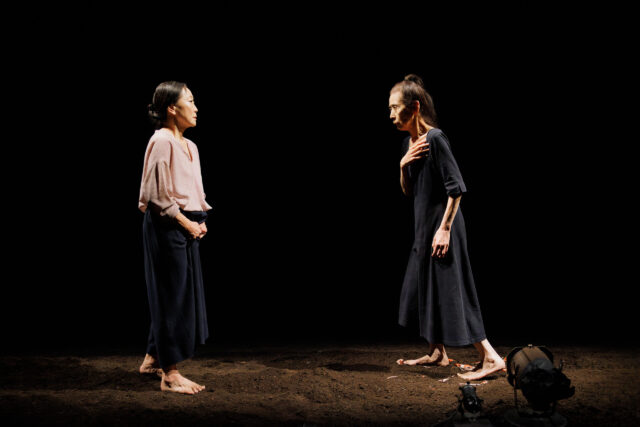
The two women then appear at opposite sides of the black box theater, Eiko in a long, dark dress, Wen in a light blouse and long black skirt. Both barefoot, they walk agonizingly slowly toward each other across a narrow strip of dirt, a kind of graveyard where they meet in the middle, digging up the past. In front of archival footage, Wen explains how her grandmother died during the Japanese bombing of Kunming in December 1941; Wen’s mother was only five at the time. “I never had a chance to meet my grandmother,” she says. “I did not even know her name.”
Eiko Otake and Wen Hui come together and break apart in What Is War (photo by Maria Baranova)
Eiko shows a photo of her parents’ wedding, projected onto an angled hanging cloth at stage right. “They married on August 10th, 1945, one day after the atomic bombing of Nagasaki and five days before Japan’s surrender,” she says, detailing how her father pretended to have tuberculosis to avoid military service. “Wen Hui, when I visited you in China and spent time with your mom, I felt really glad my father lied.”
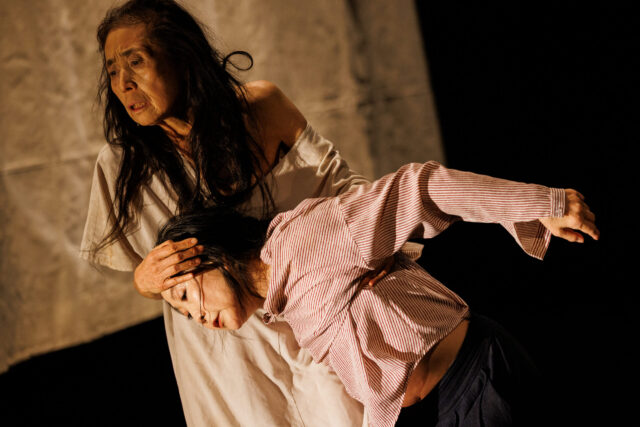
Throughout the piece, which is dramatically lit by David A. Ferri, Eiko and Wen come together and drift apart, sometimes tenderly, sometimes with more force, as Eiko discusses the bombing of Tokyo by America, which killed one hundred thousand Japanese in six hours; Wen goes to a hospital to cheer up wounded soldiers during the Sino-Vietnamese War; Eiko points out the antiwar statements in Japan’s postwar constitution; and Eiko and Wen travel to the Lijixiang Comfort Station in Nanjing, where sex slaves were made available to the Japanese army. (Today the facade of one of the buildings is covered with contemporary photos of the women.)
At times, the performers push a horizontal mirror on wheels around the stage, which provides provocative reflections while also implicating the audience in the action.
In one of the most harrowing moments, Eiko recalls the late Japanese writer Kyoko Hayashi, who grew up in Shanghai, asking her, “Bodies I saw on August 9 had no outlines. Otake-san, when you perform, can you please think of such a body, a body without outlines?”
What Is War is a hard show to watch; Eiko and Wen pull no punches as they bare their souls and their bodies, using the past as a way to try to build a better, safer, more caring future, probably in vain if current events are any evidence. Any metaphors are in the movement itself; everything else unfolds as a bold, direct accusation of man’s seemingly never-ending thirst for battle, power, and domination.
Fortunately, each performance concludes with a catered gathering in the downstairs lounge, where Eiko and Wen are eager to speak with attendees and hear their thoughts on the work and on war, with plenty of smiles and hugs.
[Mark Rifkin is a Brooklyn-born, Manhattan-based writer and editor; you can follow him on Substack here.]
Tiler Peck (left) will team up with Michelle Dorrance and others for “Turn It Out” at City Center (photo by Christopher Duggan)
TURN IT OUT WITH TILER PECK & FRIENDS
New York City Center
131 West 55th St. between Sixth & Seventh Aves.
October 16-19, $45-$125 www.nycitycenter.org
“I initially didn’t want to be a ballerina,” New York City Ballet principal dancer Tiler Peck tells Emma Memma in a recent Instagram post about her new children’s book, XO Ballerina Big Sis: Wisdom and Advice from the Heart (DK, October 21, $16.99). “I wanted to dance. I will say I love to dance. It’s just that I grew up in a studio where I tried all styles, and ballet was my least favorite.”
Thankfully, the Bakersfield-born Peck, who began her training at the age of two, followed her mother’s guidance and took the ballet route, entering the School of American Ballet when she was twelve and becoming an NYCB apprentice, a member of the corps de ballet, a soloist, and, in October 2009, at the age of twenty, a principal dancer. Peck has originated featured roles in such works as Kyle Abraham’s Love Letter (on shuffle), Benjamin Millepied’s Quasi una Fantasia, Angelin Preljocaj’s Spectral Evidence, and Alexei Ratmansky’s Pictures at an Exhibition.
During the pandemic lockdown, Peck expanded her horizons on Instagram, dancing with her father and her dog, giving lessons from her mother’s kitchen, and providing sunshine on dark days with her infectious enthusiasm.
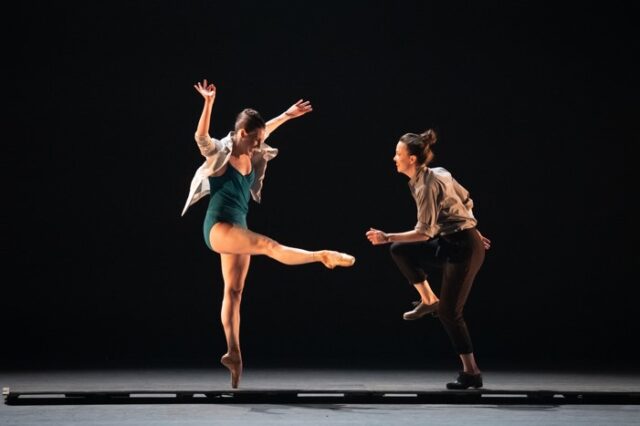
Peck is now curating a special program running October 16-19 at New York City Center, “Turn It Out with Tiler Peck & Friends,” where she will be joined by such dancers as India Bradley, Christopher Grant, Chun Wai Chan, Byron Tittle, Lex Ishimoto, Quinn Starner, Roman Mejia, and Mira Nadon, performing William Forsythe’s The Barre Project, Blake Works II, set to music by James Blake; Peck’s Thousandth Orange, with live music by Caroline Shaw; Alonzo King’s pas de deux Swift Arrow, with music by Jason Moran; and the new commission Time Spell, a collaboration with Michelle Dorrance and Jillian Meyers, set to music by Aaron Marcellus and Penelope Wendtlandt. There will be a community talkback after the October 17 show with Peck and her friends, most likely including her new husband, Mejia.
“It’s literally like a party onstage,” Peck says in the above video, a party you won’t want to miss.
[Mark Rifkin is a Brooklyn-born, Manhattan-based writer and editor; you can follow him on Substack here.]