this week in dance

ARDEN — BUT, NOT WITHOUT YOU

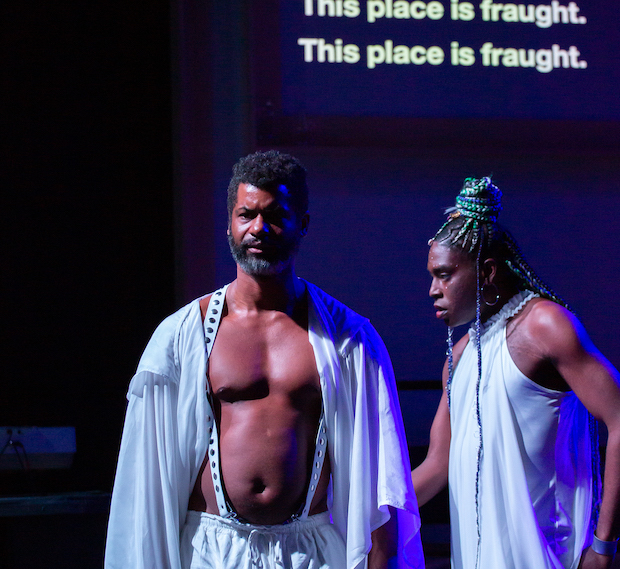
Flea artistic director Niegel Smith faces a reckoning with Jack Fuller in return to live performances in front of an audience (photo © Hunter Canning)

ARDEN — BUT, NOT WITHOUT YOU
Flea Theater, the Sam
20 Thomas St. between Broadway & Church St.
Wednesday – Sunday through March 6, $17-$37
theflea.org

Arden — But, Not Without You is a ritual cleansing of the Flea, a messy, scattershot baptism looking toward a new era. Named for the forest in Shakespeare’s comedy As You Like It, which itself was named for the Bard’s mother-in-law, the show is described by standout performer Diana Oh in the program as “Four Generations of Deeply Intimately Bound All-Kinds-of-Doing-Shit Artists sharing of themselves in a Tender-Ass Room full of Queer Femme Shamanic Energy who Genuinely and Gently Welcome You: Social Anxieties, Yummy Freakiness, and All.”

In June 2020, Flea performer Bryn Carter had a public exchange with the theater’s artistic director, Niegel Smith, and producing director, Carol Ostrow, accusing the Flea of racism, sexism, nonpayment of actors, BIPOC and LGBTQIA+ ignorance, bullying, and body shaming. Ostrow left the company, and the resident troupe, the Bats, was eliminated. Smith and the Flea have pledged a “new path forward,” promising “a dedicated focus on Black, brown, and queer artists in experimental theater [that] comes at a moment in which a national spotlight is shining widespread — and longstanding — on the inherent value of BIPOC voices.”

Founded in a Tribeca storefront in 1996 by Jim Simpson and Sigourney Weaver, the Flea moved first to White St. and now Thomas, where it has several theater spaces. Its inaugural production following the pandemic lockdown and its new guidelines and mission is Arden, a slapdash collaboration, codirected by Smith and Nia Witherspoon, that boasts all-star talent while also serving as a communal acknowledgment and mass healing. While the beginning and ending are moving and powerful, most of what comes in between feels dogmatic and exhortative, as if we’re listening in on the Flea making confession, something that needs to be done in private.

When you check in, you are given a card to fill out with two prompts: “1. Describe the last time someone touched you. 2. What is a question that you want to find the answer to?” As you approach the upstairs Sam, you can first stop at “Journey to the Clearing,” an empty chair with fluorescent lighting and a tree branch seemingly floating, and an altar featuring items and offerings from the company. Once inside the theater, you bring your card to a table where the masked Peter Born and Okwui Okpokwasili turn the comments into song as audience members find their seats, which surround the central floor space except for the far corner, where a band will later play. It’s an engaging way to form everyone into a kind of collective, which is further enhanced by Born’s sparse set that features four hanging light fixtures, bulbs surrounded by family photos and mirrors.
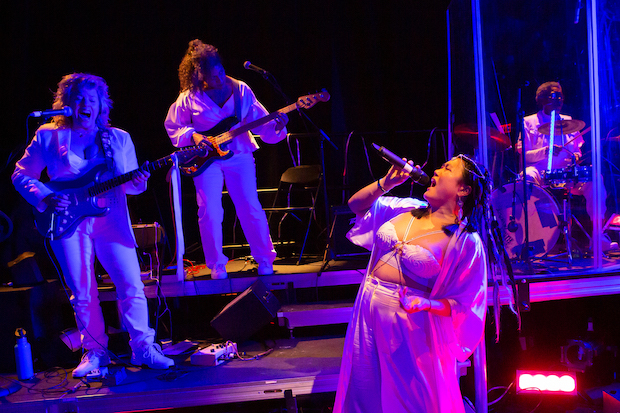
Diana Oh steals the show in Arden — But, Not Without You (photo © Hunter Canning)

The singing morphs into “Do Not Let Go,” in which Born and Okpokwasili, who are married and have previously worked together on such projects as Pent Up: A Revenge Dance, Poor People’s TV Room, and Bronx Gothic, proclaim, “I want to know / Who stands beside me / When I tell you / this house is in ruins. / total collapse / is looming. / The storm is surging / The walls are caving in. . . . Will you / Welcome the storm? / Will you / Praise the bones / wrested from the wreckage / And build anew?”

Smith and Harlem MC, composer, and musician Jack Fuller next take a backward “spirit walk” following a rectangular chalk outline. “This place is fraught,” Smith declares. “This place has celebrated a vision of Black and brown folks / dependent on white saviors. / This house is in ruins. . . . I choose to fight / I fight for this artistic home.” This section proves flat and didactic, overemphasizing the theme of the rededication of the Flea.

Other company members join in the walk as the soundtrack turns to a captivating story by multidisciplinary artist Carrie Mae Weems detailing a powerful childhood memory, accompanied by footage of her mother giving a speech. It’s a gripping story about secrets and deception, love and betrayal. Following a trance dance, Diana Oh takes over, becoming our host while blasting out a few raucous, energetic songs, joined by guitarist Viva Deconcini, percussionist Bernice “Boom Boom” Brooks, bassist and cellist Serena Ebony Miller, and Fuller on keyboards. Linda Cho dresses them all in flowing white costumes that harken back to Greek statuary.

Oh, a multidisciplinary artist, takes hold of the room, getting the audience to hum along with her, improvising a recommendation letter supporting a creator of color, and singing like she’s leading a revival meeting. She seemed to be genuinely shocked when one person in the audience essentially professed their love for Oh; otherwise, she was firmly in command. The show would have benefited from more Oh and less Smith.

In As You Like It, Touchstone the fool tells Rosalind and Celia, “Ay, now am I in Arden; the more fool I; when I was at home, I was in a better place: but travellers must be content.” In the Flea’s Arden — But, Not Without You, not everyone can see the forest through the trees.
BODYTRAFFIC

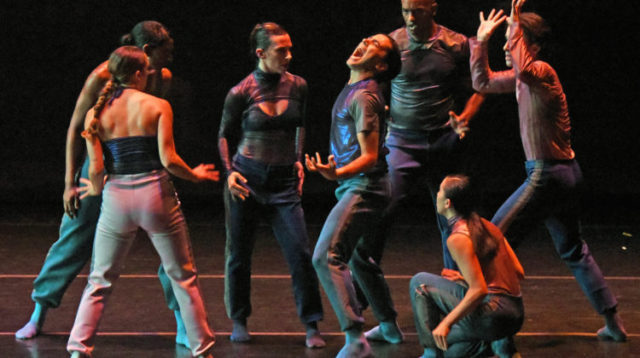
Micaela Taylor’s SNAP is part of BODYTRAFFIC program at the Joyce

BODYTRAFFIC
Joyce Theater
175 Eighth Ave. at 19th St.
March 1-6, $41-$61
212-645-2904
www.joyce.org
bodytraffic.com

“There’s nothing quite like coming home,” BODYTRAFFIC artistic director Tina Finkelman Berkett writes in a program note about the LA company’s upcoming presentation at the Joyce. “Growing up in NYC, I dreamt of performing on the Joyce stage, and each time our company returns is incredibly meaningful.”

Finkelman Berkett used the pandemic lockdown to reimagine the troupe, which she founded in 2007 with Lillian Barbeito, and the results can be seen March 1-6. The show begins with the world premiere of Baya & Asa’s The One to Stay With, which takes on corporate greed; the cast consists of associate artistic director Guzmán Rosado, Joan Rodriguez, Katie Garcia, Pedro Garcia, Whitney Schmanski, Jordyn Santago, Tiare Keeno, and dance captain Ty Morrison, with music by Tchaikovsky, Russian Brass Brand, and Béla Bartók.

Following a set change, Finkelman Berkett truly returns to the Joyce stage with the New York premiere of Fernando Hernando Magadan’s (d)elusive minds, a duet she will perform with Rosado, set to Schubert’s Trio Pour Piano, Violon Et Violoncelle En Mi Bemol, Op. 100. It was inspired by Dora Garcia’s “All the Stories” and the true story of a man with Capgras syndrome who killed his wife, thinking she was a duplicate, and spent fifteen years in an institution believing his real wife was still alive, writing to her every day. Magadan’s scenic design includes a near-semicircle of paper along with a chair and a typewriter.

After intermission, TL Collective artistic director and former BODYTRAFFIC dancer Micaela Taylor’s SNAP will make its New York premiere, with Alana Jones, Joseph Davis, Katie Garcia, Santiago, Keeno, Rodriguez, and Morrison moving and grooving to James Brown, with original music by Shockey and costumes by Kristina Marie Garnett. The piece is meant to snap people out of their complacency while celebrating the diversity of Los Angeles.

The evening concludes with Alejandro Cerrudo’s PACOPEPEPLUTO, a work for three male soloists originally choreographed for Hubbard Street Chicago in 2011, with Rodriguez, Pedro Garcia, and Rosado or Davis hoofing it to Dean Martin’s “In the Chapel in the Moonlight,” “Memories Are Made of This,” and “That’s Amoré.” In addition, there will be a curtain chat on March 2.

RASHAAD NEWSOME: ASSEMBLY

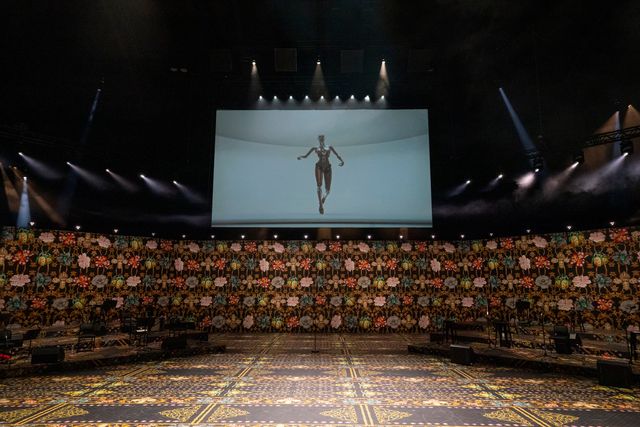
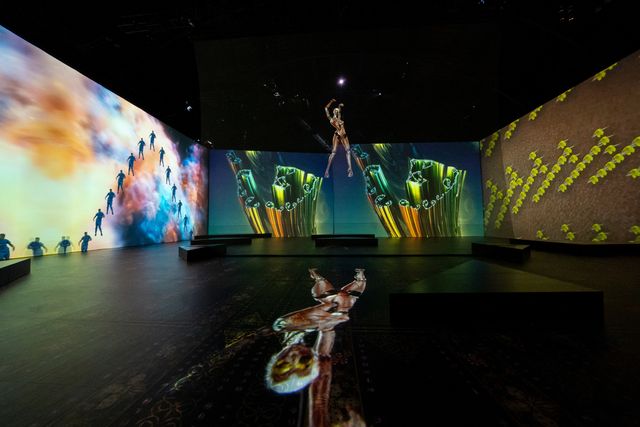
Rashaad Newsome’s Assembly is an immersive multimedia exploration of the intersection of humanity and technology (photo by Stephanie Berger Photography / Park Avenue Armory)

ASSEMBLY
Park Ave. Armory, Wade Thompson Drill Hall
643 Park Ave. at Sixty-Seventh St.
Tuesday – Sunday through March 6, $18 exhibition, $40 performances
www.armoryonpark.org
rashaadnewsome.com

The Muthaship has landed — and taken root inside Park Ave. Armory’s 55,000-square-foot Wade Thompson Drill Hall. New Orleans–born interdisciplinary artist Rashaad Newsome’s immersive multimedia installation Assembly is an open call to end colonialism, white supremacy, systemic racism, homophobia, and other societal ills based in bigotry and inequality, through music, movement, art, and storytelling grounded in Black queer culture. A kind of group healing focusing on opportunity, Assembly is hosted by Being the Digital Griot, an artificial intelligence project Newsome developed at Stanford’s Institute for Human-Centered AI (HAI).

When you enter the hall, you are met by Wrapped, Tied & Tangled, a thirty-foot-tall scrim on which a series of performers in bright red, yellow, and blue costumes appear to be dancing and drawing in space while a robotic voice makes affirmations. “Dig into your mind. Welcome to your insides,” Being offers in a gentle, caring tone. “I am here to listen and provide you with a new beginning for your journey. . . . There is only breath, heartbeat, rhythm, and peace. . . . No matter what, you are enough. . . . You are the most beautiful you. You are the master of your own self. You are radiant. You are divine. Always. Ever. Only. Enough. This is your solution. An infinite everything.” The dancers morph into one another — and then into Being, as if we all are one and the same, a spiritual melding of humanity and technology.

Large screens surround the scrim on three sides; to your right, the dancer in yellow moves proudly, with an army of tiny dancers arranged on their head like cornrows, while to the left, the dancer in blue moves in the universe, where miniature dancers align like stars. The screens in front feature computer-generated diasporic imagery of flowers, fractals, twerking, and abstract shapes seemingly coming to life. And behind you, above the entrance, site-specific projections interact with the wall and windows, from more dancers and flashing lights to a facade evoking a plantation house collapsing and figures emerging in silhouette. The textile-like flower imagery is repeated as wallpaper and across the floors.

Tuesday through Sunday at 1:00, 3:00, and 5:00 (free with general admission), workshops are held on the other side of the far screens, in a 350-seat classroom that also serves as a live performance venue Tuesday through Saturday evenings at 9:00 ($40). In the workshop, the onscreen Being leads the class through a series of movements the AI relates to oppression, suppression, the power of consumption, the culture of domination, the ownership of narrative, and freedom by exploring voguing and its highly stylized modes of catwalking, duckwalking, spin dipping, and ballroom.

Being hosts an interactive workshop as part of Assembly (photo by Stephanie Berger Photography / Park Avenue Armory)

Speaking about how spin dips conclude with falling to the floor, Being explains, “I see that collapse as the transgressive moment when we let go of the binary of imperfect and perfect and engage in the incredible pedagogy of resistance by thinking critically about our process, acknowledging that we don’t have the visionary skills at that moment to make the most liberatory decision and then stop, reflect, and try again.” Workshop participants are invited to come down from their seats and join in the movement. “Floor performance leads into the embodied pedagogy aspects of vogue femme, centering the erotic and rejecting the patriarchal legacy of the mind-body split,” Being says. After Being’s presentation, audience members can share their thoughts and ask questions of the AI, who supplies analytical answers generated by key words and algorithms through which Being continues to learn.

The AI also celebrates their father, Newsome, and declares that author, activist, and feminist bell hooks, who passed away on December 15 at the age of sixty-nine, is their spiritual mother, while strongly suggesting that we read Paulo Freire’s 1968 book Pedagogy of the Oppressed to better understand what we are all facing as a society. The text of the presentation was inspired by the writings of hooks, Audre Lord, Alok Vaid-Menon, and Assembly performer Dazié Rustin Grego-Sykes. Among the other performers are rappers Ms. Boogie, TRANNILISH, and Bella Bags, a ten-piece band, opera singer Brittany Logan, and a six-member gospel choir. The choreography is by Wrapped dancers Kameron N. Saunders, Ousmane Omari Wiles, and Maleek Washington, with music by Kryon El and booboo, lighting by John Torres, scenography by New Affiliates (Ivi Diamantopoulou and Jaffer Kolb), and sound by Robert Aiki Aubrey Lowe and Mark Grey.

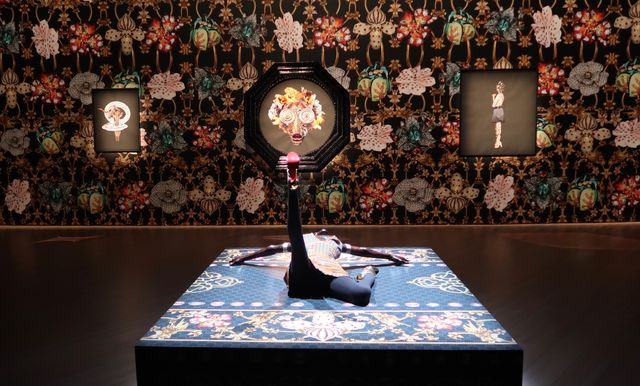
Ansista has a leg up in front of Twirl, Isolation, and Formation of Attention (photo by twi-ny/mdr)

Around the back of the classroom is a semicircle of other works by Newsome, who is based in Brooklyn and Oakland. At either end are Ansista and Thee Variant, lifesize iterations of Being, one wearing red heels and a West African print dress, the other styled like a dominatrix with spiky black leather pants, stilettos, and a helmet mask, with warped facial parts that are also evident in nine framed collages featuring such titles as Isolation, Formation of Attention, It Do Take Nerve, O.G. (Oppositional Force), and JOY! In addition, there are monitors at either end of the armory hallway and in the gift shop, showing the twerking video Whose Booty Is This, the 2015 King of Arms parade and coronation, and the 2021 postapocalyptic Build or Destroy. Be sure to check out the cases in the shop, as Newsome has snuck in some hand-carved mahogany and resin African objects alongside the armory’s historic pieces, including Adinkra, Gemini, Brolic, and Unity. On February 20, the armory hosted the salon “Captcha: Dancing, Data, Liberation,” an all-day seminar examining art, technology, and Black queer culture and quantum visual language that you can watch here.

Given the history of hate and oppression that Assembly takes on, it is a surprisingly hopeful, forward-thinking installation, as Newsome envisions a “utopian future [of] beloved togetherness” at the intersection of humanity and technology, where “racial hierarchies and biases” can be overcome through what he calls a “real reboot.” Being and Assembly are only the beginning.

FOUR QUARTETS

Pam Tanowitz Dance’s Four Quartets makes its New York City debut February 10–12 at BAM (photo by Maria Baranova)

FOUR QUARTETS
BAM Howard Gilman Opera House
Peter Jay Sharp Building
230 Lafayette Ave.
February 10–12, $25-$95, 7:30
718-636-4100
www.bam.org
pamtanowitzdance.org

T. S. Eliot’s 1936–42 epic Four Quartets poem begins with a two-part epigraph from Greek philosopher Heraclitus that warns, “Although logos is common to all, most people live as if they had a wisdom of their own. . . . The way upward and the way downward are the same.” Those words sound particularly relevant today as America battles through a pandemic and socioeconomic and racial inequality and injustice that are threatening the stability of our democracy. Heraclitus also wrote, “It is better to conceal ignorance than to expose it.” Meanwhile, Friedrich Nietzsche claimed, “Heraclitus was an opponent of all democratic parties.”

In 2018, Bronx-born, Westchester-raised choreographer Pam Tanowitz debuted her take on Eliot’s poem, as Four Quartets made its world premiere at Bard SummerScape; it is now coming to the BAM Howard Gilman Opera House for three performances, February 10–12. The seventy-five-minute piece features all-star collaborators, with music by Finnish composer Kaija Saariaho played by NYC orchestral collective the Knights, images by American abstract minimalist Brice Marden, costumes by Reid Bartelme and Harriet Jung, sets and lighting by Clifton Taylor, sound by Jean-Baptiste Barriére, and text performed live by Tony nominee and multiple Obie winner Kathleen Chalfant. (Bard’s recording of the audio was the first authorized version by a woman and an American.) The dancers are Kara Chan, Jason Collins, Dylan Crossman, Christine Flores, Zachary Gonder, Lindsey Jones, Victor Lozano, Maile Okamura, and Melissa Toogood.

“Making Four Quartets has changed me as an artist forever,” Tanowitz says in the above behind-the-scenes Bard documentary, There the Dance Is, which was filmed during the pandemic. “I’m not scared of failure. I’m not scared to imagine. And I’m not scared to take risks. I was before.”

“Burnt Norton,” the first section of Four Quarters, is an eerie reminder of what is happening in the United States and around the world today as we look toward a fraught future: “Time present and time past / Are both perhaps present in time future / And time future contained in time past. / If all time is eternally present / All time is unredeemable. / What might have been is an abstraction / Remaining a perpetual possibility / Only in a world of speculation. / What might have been and what has been / Point to one end, which is always present. / Footfalls echo in the memory / Down the passage which we did not take / Towards the door we never opened / Into the rose-garden. My words echo / Thus, in your mind. / But to what purpose / Disturbing the dust on a bowl of rose-leaves / I do not know. / Other echoes / Inhabit the garden. Shall we follow?”

Tickets are going fast for the show, which is part of BAM’s “New York Season,” consisting of works by local creators, so act now if you want to see this widely praised production. Up next at BAM are Kyle Abraham’s An Untitled Love at BAM Strong’s Harvey Theater, running February 23–26, and longtime favorite SITI Company’s final physical theater presentation, The Medium, at BAM Fisher March 15–20. You can also catch Tanowitz’s Bartók Ballet, her first commission for New York City Ballet, at Lincoln Center’s David H Koch Theater on February 22 and 23, a work for eleven dancers set to Béla Bartók’s String Quartet No. 5.

SoloDuo DANCE FESTIVAL

In-person SoloDuo Dance Festival is set for February 6-7 at Dixon Place

SoloDuo DANCE FESTIVAL
Dixon Place
161A Chrystie Pl. between Rivington & Delancey Sts.
Sunday, February 6, 6:00 & 8:00, and Monday, February 7, 7:30, $15-$25
212-219-0736
dixonplace.org
www.whitewavedance.org

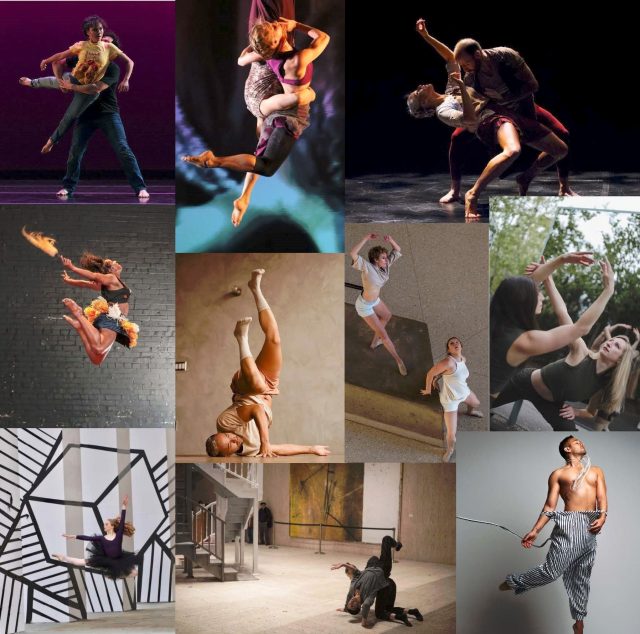
In November 2020, Young Soon Kim’s Brooklyn-based White Wave troupe had to go virtual with its SoloDuo Dance Festival, presenting filmed excerpts of its long-running work-in-progress iyouuswe II. This year, White Wave will be holding its sixth annual SoloDuo Dance Festival at Dixon Place, with three in-person shows on February 6 and 7. The festival features solos and duets by more than two dozen emerging and midcareer choreographers, from companies and individuals from across the country. Below is the full lineup.

Sunday, February 6, 6:00
CoreDance Contemporary (NY)
Corian Ellisor Dance (GA)
Scott Autry (NY)
Yu.S.Artistry (NY)
THE MARK dance company (NC)
sk|dancers (IN)
Santiago Rivera (CA)
Kevin Toyo (NY)
Li Chiao-Ping Dance (WI)
Obremski/Works (NY)

Sunday, February 6, 8:00
Elizabeth Shea Dance (IN)
New York Theatre Ballet (NY)
FUSE Dance Company (CA)
East by North Dance Theatre (NY)
John Beasant III (TX)
University of Arizona School of Dance (AZ)
Metanoia Dance (NY)
Constance Nicolas Vellozzi (NY)
Koin & Co (NY)
Charlotte Adams & Dancers (AZ)
WHITE WAVE Young Soon Kim Dance Company (NY)

Monday, February 7, 7:30
ZINC Movement Co. (NH)
Quianna Simpson (OH)
Smutek Dance (MI)
Amos Pinhasi (NY)
DiMauro Dance (NY)
HR Dance (NY)
Alison Cook Beatty Dance (NY)
Lindsey Bramham Howie (NC)
Elise Knudson (NY)
WHITE WAVE Young Soon Kim Dance Company (NY)

BALLETS WITH A TWIST: MIRAGE

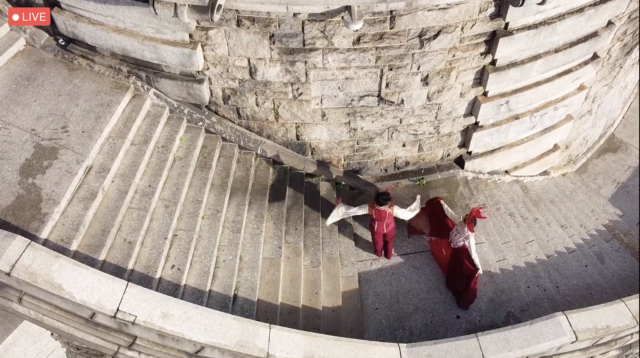
Double Vision is one of several new works being previewed in Ballets with a Twist watch parties

Who: Ballets with a Twist
What: Virtual watch parties for short-film series
Where: Twist Theater online
When: Friday, January 21, 8:00 & 10:00; Saturday, January 22, 2:00, 8:00 & 10:00, free
Why: Tribeca-based Ballets with a Twist has been offering a unique twist on ballet for more than twenty-five years. The company’s short works are all named for and inspired by potent potables, performed together as Cocktail Hour: The Show. Among the pieces that combine drama, humor, mystery, and romance are Absinthe, Grappa, Martini, Zombie, Champagne, Boilermaker, Cuba Libre, and Hot Toddy.

Because of the pandemic lockdown and the continuing spread of various variants, the troupe, founded in 1996 by artistic director and choreographer Marilyn Klaus, has moved outdoors for its latest presentation, Mirage, a four-part suite being livestreamed for free on January 21-22 at 8:00 and 10:00, with an additional matinee viewing on Saturday at 2:00. The short film was directed, photographed, and edited by Emma Huibregtse, with choreography by Klaus, original music by Stephen Gaboury, and costumes by designer Catherine Zehr.

In Ranch Water, Dorothea Garland struts with a top hat on the troupe’s roof. In La Paloma, Garland glories across an old airstrip in Brooklyn, almost floating away in colorful costumes. In Smooth Criminal, Andres Neira channels Michael Jackson at the historic Queens Unisphere. And in Double Vision, real-life partners Claire Mazza and Alejandro Ulloa promenade at a masked ball on the steps of an abandoned castle in Harlem.

After the performances, members of the cast and crew in the studio discuss their process, including Klaus, Gaboury, Zehr, Jennifer Buonamia, Mackenzie Frey, Tori Hey, Margaret Hoshor, Amy Gilson, and Haley Neisser. Mirage is a mere aperitif for the upcoming stage version to be held later this year, which will also feature animated projections by Huibregtse and lighting by Dan Hansell. So grab your cocktail of choice, settle in, and join one of the watch parties taking place this weekend.

MOLLY LIEBER & ELEANOR SMITH: GLORIA REHEARSAL (excerpt)

Who: Molly Lieber & Eleanor Smith, James Lo, Tatyana Tenenbaum
What: Streaming performance and live virtual discussion
Where: Baryshnikov Arts Center online
When: Live Zoom discussion January 19, free with RSVP, 5:00; performance available on demand through January 24 at 5:00, free
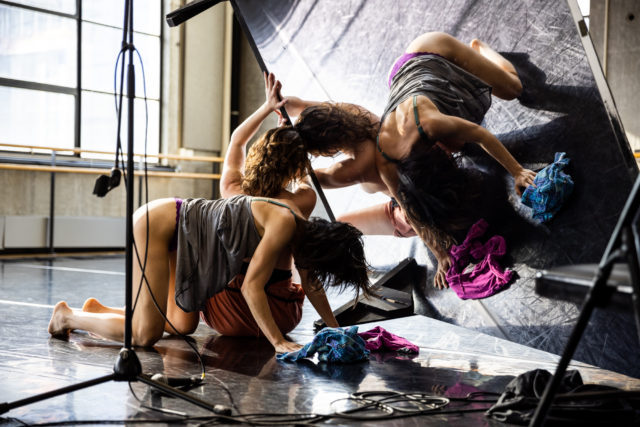
Why: Molly Lieber and Eleanor Smith, who have been creating dance works together for more than fifteen years, debuted their latest piece, Gloria, made during the pandemic, outdoors at Abrons Arts Center this past May. The indoor premiere is scheduled for April 8-9 at New York Live Arts. In the meantime, you can catch an extensive rehearsal of Gloria — a name shared by Lieber’s baby — as part of Baryshnikov Arts Center’s excellent digital programming. In the ninety-minute work, Lieber and Smith redefine female objectification, incorporating microphones and mic stands, large mirrors on wheels, and folding chairs as they move about BAC’s rehearsal space, asserting control over their physical form as women. The soundtrack evolves from a long silence, interrupted by screams from Lieber, Smith singing “Getting to Know You” from The King and I, and Lieber mumbling Dan Hill’s “Sometimes When We Touch,” to snippets of patriotic marches, traffic, birds, and Laura Branigan’s 1982 hit, “Gloria.” (The wide-ranging sound design is by James Lo.)

Molly Lieber and Eleanor Smith’s Gloria rehearsal excerpt continues online through January 24 (photo by Maria Baranova)

At one point, Lieber puts the microphone all over Smith’s skin, giving voice to her body. “It’s too much,” Smith repeats later, reflecting on the expectations of others. Lieber and Smith entwine themselves on the floor, take off and put back on their costumes, morph into emotional positions that often evoke sexual contact, and dare the patriarchal system to question who they are and what they want out of life, determined to survive amid all the maelstrom, especially the mass grief caused by the coronavirus crisis. As in such earlier works as Body Comes Apart, Basketball, Rude World, Tulip, and Beautiful Bone, Gloria is emotionally and physically exhausting as Lieber and Smith push each other to the extreme — and then keep going.

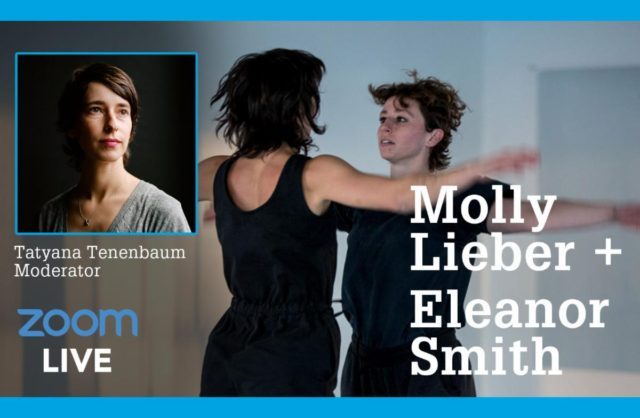
The piece was filmed and edited by the extraordinary Tatyana Tenenbaum, whose previous virtual work for BAC includes Holland Andrews’s Museum of Calm, River L. Ramirez’s Ghostfolk, and a celebration of the fiftieth anniversary of Merce Cunningham’s Landrover. Gloria is available for streaming through January 24 at 5:00. On January 19 at 5:00, Lieber and Smith will take part in a live discussion over Zoom, joined by Lo and moderated by Tenenbaum.