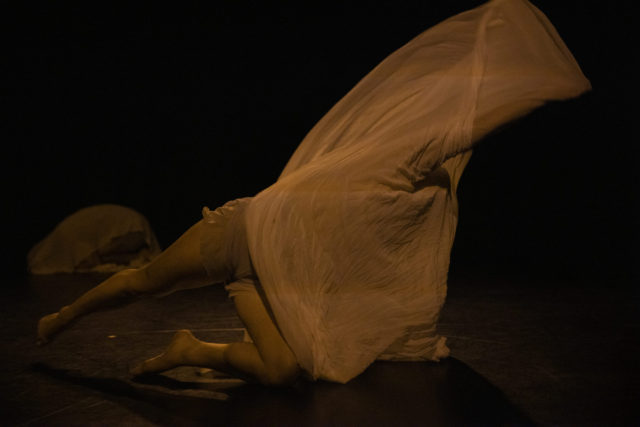
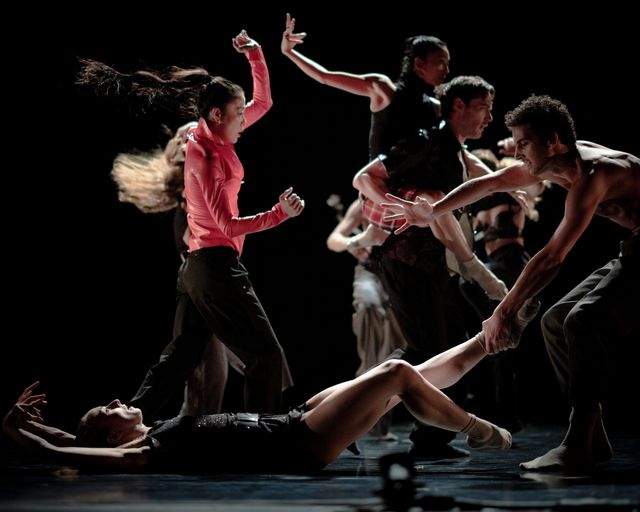
Amanda Selwyn Dance Theatre presents world premiere of Threads at New York Live Arts this week (photo by Maria Baranova)
Who:Amanda Selwyn Dance Theatre What: World premiere of Threads Where:New York Live Arts, 219 West Nineteenth St. between Seventh & Eighth Aves., and online When: April 7-9, $15-$30, 7:30 (livestream $20) Why: Since 2000, Amanda Selwyn Dance Theatre has been staging works that explore what makes us human, the connections between people and nature, performer and audience, and humanity itself. The New York–based company will be presenting the world premiere of its latest evening-length piece, Threads, April 7-9 at New York Live Arts, looking at how we have dealt psychologically, emotionally, and physically with the last two years. “Threads explores what holds us together in isolation and the practice of letting go,” Selwyn said in a statement. “This pandemic has brought into focus where priorities are, the value of our human connections, and the very fleeting nature of it all. We are just a moment away from change. The threads can be fixed, torn, mended, or woven. . . . This is a story of heartbreak, forgiveness, loss, new beginnings, agency, and powerlessness.”
The work features set and costumes by Anna-Alisa Belous, lighting by Dan Ozminkowski, and sound by Joel Wilhelmi; it will be performed by Torrey Harada, Manon Hallay, Misaki Hayama, David Hochberg, Isaac Kerr, Minseon Kim, Ashley McQueen, Michael Miles, Oscar Antonio Rodriguez, Lauren Russo, John Trunfio, and Evita Zacharioglou. If you can’t make it to the Chelsea theater, the shows will also be livestreamed here.
“It starts as a thread of an idea and, from that thread, a fabric of meaning emerges,” Selwyn (Hindsight,Crossroads,Renewal) continues. “One thread at a time. By listening, pulling, teasing, tearing at each piece. Showing up in it. We can only see when our minds, eyes, and hearts are open. We can only see when we are ready. When we aren’t looking. In this pause, we step forward and balance on a thread to discover divine beauty. We measure risk, we acknowledge what is gone, we let go.”
Who: Baba Israel, AMYRA, Drew Drake, Dizzy SenZe, Freakquencee, DJ Reborn, Jade Charon What: Live music, dance, and spoken word performances centered around Aṣẹ Where:BAM Fisher, Fishman Space, 321 Ashland Pl. When: April 7—9, $25, 7:30 Why: BAM’s annual celebration of spoken word and hip-hop features a stellar lineup of performers honoring the power of Aṣẹ, the Yoruba philosophical concept of affirmation, life force, and verbal creation. Artist, producer, educator, and consultant Baba Israel will host “Word. Sound. Power. 2022,” which takes place April 7-9 at BAM Fisher’s intimate Fishman Space. The impressive gathering brings together Bronx-born lyrical assassin Dizzy SenZe, Newark vibe curator Freakquencee, NYC-based poet and actor Drew Drake, and Harlem musician, author, and director AMYRA, with music by Brooklyn-based DJ Reborn and choreography by Brooklyn-based multidisciplinary artist Jade Charon. The seventy-minute showcase, exploring agency, creativity, resilience, and more, also includes student poets from Brooklyn public schools, part of a BAM in-school residency program, and will conclude with a twenty-minute Q&A with the artists.
Martha Graham Dance Company will present world premiere of Hofesh Shechter’s CAVE at inaugural City Center Dance Festival (photo by Brian Pollock)
Who:Martha Graham Dance Company What:City Center Dance Festival Where:New York City Center, 131 West Fifty-Fifth St. between Sixth & Seventh Aves. When: April 6-10, $35-$125 Why: Celebrating the long-awaited return to the stage in front of in-person audiences following two years of lockdown, the inaugural City Center Dance Festival kicked off March 24 with Paul Taylor Dance Company followed by Ballet Hispánico, with Dance Theatre of Harlem coming in April 5-10. DTH will be performing concurrently with Martha Graham Dance Company, which is presenting three programs April 6-10. “It’s staggering to think that we are premiering nine new creations by nine exciting and diverse choreographers at New York City Center in April,” Graham Company artistic director Janet Eilber said in a statement. “Creating new work has never been more challenging than in the past many months, which makes the accomplishments of the choreographers, our dancers, and the entire creative team even more resonant. Each of these dances provides a visceral, ecstatic, and even cathartic response to the restrictions the world has endured.”
Program A (April 6 and 9) consists of the 1936 anti-Fascist classic Chronicle, choreographed by Graham, originally about Hitler’s Germany but now relating to Putin’s Russia, with music by Wallingford Riegger (performed live by the Mannes Orchestra); the New York premiere of the reconceived version of 1952’s Canticle for Innocent Comedians for its seventieth anniversary, with a new score by Jason Moran (who will play live on opening night) and choreography by Sonya Tayeh, Kristina and Sadé Alleyne, Sir Robert Cohan, Jenn Freeman, Juliano Nunes, Micaela Taylor, Yin Yue, and Graham, for the vignettes “Sun,” “Moon,” “Earth,” “Water,” “Fire,” “Stars,” “Wind,” and “Death”; and the world premiere of Hofesh Shechter’s CAVE, with music by Shechter and Âme.
Program B (April 10) begins with Graham’s 1944 masterwork Appalachian Spring, featuring a marvelous score by Aaron Copland for a thirteen-piece chamber orchestra and set design by Isamu Noguchi, and concludes with Canticle for Innocent Comedians. On April 7, MGDC’s gala is highlighted by Ritual to the Sun, the final section of Graham’s 1981 Acts of Light, set to music by nineteenth-century Danish composer Carl Nielsen, in addition to CAVE and excerpts from the new Canticle. The works will be performed by MGDC members So Young An, Alessio Crognale, Laurel Dalley Smith, Natasha M. Diamond Walker, Lloyd Knight, Jacob Larsen, Devin Loh, Lloyd Mayor, Marzia Memoli, Anne O’Donnell, Lorenzo Pagano, Kate Reyes, Anne Souder, Richard Villaverde, Leslie Andrea Williams, and Xin Ying.
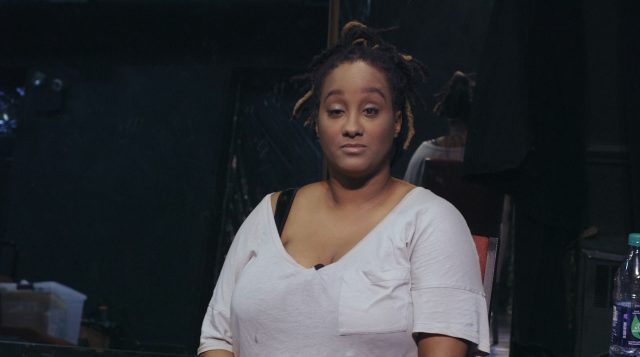
Dancer Kayla Hamilton is not about to let visual impairment get in the way of her career in Vision Portraits (photo by Kjerstin Rossi)
Who:Moving Body — Moving Image What:ScreenDance Film Festival Where: Barnard College Department of Dance Movement Lab, Glicker Milstein Theatre in the Diana Center, 3009 Broadway at 116th St., and online When: Sunday, April 3, free with advance RSVP, noon – 6:00 pm (festival continues through April 11) Why: The Moving Body — Moving Image Biennale Festival was founded in 2018 by choreographer, dancer, teacher, filmmaker, and curator Gabri Christa to “give voice to social and social justice themes,” two years before dance films began reaching new heights of creativity during the pandemic lockdown, with a concerted focus also on social justice. The third iteration, “The Moving Body with Disabilities,” is underway now at Barnard College, with an international collection of six installation films, eight shorts, one feature, and three online-only works. On Sunday, April 3, Barnard’s Glicker Milstein Theatre will host a full in-person afternoon at its Morningside Heights home, with screenings of all films in addition to a panel discussion. “We are stunned by how much demand there was for the festival films among the global audiences,” Christa, whose now-wheelchair-bound mother was a special ed teacher, said in a statement. “Also, I hope that the pandemic isolation brought greater awareness around social inequity and perhaps more understanding of racism, ageism, and ableism.” The themes of the previous festivals were “Moving Brown Body” in 2018 and “Aging & Othering” in 2020.
The festival begins at noon with welcome remarks, followed by two shorts programs, at 12:30 and 2:00. Part I consists of Robert Dekkers’s Flutter (with AXIS Dance Company and others), Stephen Featherstone’s Stopgap in Stop Motion (with Stopgap Dance Company), Katrina MacPherson’s Uath Lochans (with Marc Brew), and Karina Epperlein’s Phoenix Dance (with Homer Avila, Andrea Flores, and choreographer Alonzo King). The second program comprises Ralph Klisiewicz’s Moods in Three Movements (with Kris Lenzo), Pioneer Winter’s Gimp Gait (with Marjorie Burnett and Pioneer Winter), Alison Ferrao’s From Me (with the Dancer Development Course at Magpie Dance), and Katherine Helen Fisher’s One + One Makes Three (with Jerron Herman, Laurel Lawson, Brandon Kazen-Maddox, Catherine Nelson, and choreographer Alice Sheppard). The feature presentation at 3:00 is Rodney Evans’s 2019 documentary, Vision Portraits, about three artists with vision impairment, made by the blind Evans. Admission is free with advance registration. If you can’t make it to Barnard, all of the films and events will be available online through April 11, including Anna-Lena Ponath’s Eudaimonia, Yannis Bletas’s How to Train an Antihero, and Alexandros Chantzis’s Who Is Honorine Platzer?
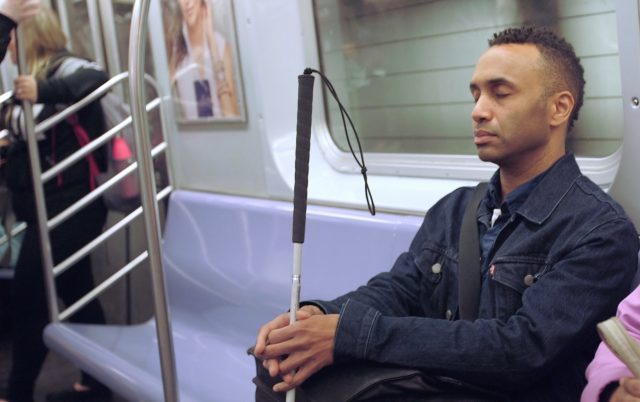
Filmmaker Rodney Evans explores his increasing blindness in Vision Portraits (photo by Kjerstin Rossi)
VISION PORTRAITS (Rodney Evans, 2019)
Barnard College, Glicker Milstein Theatre in the Diana Center, 3009 Broadway at 116th St.
Sunday, April 3, free with advance RSVP, 3:00 www.thefilmcollaborative.org
“In a lot of ways, I feel like I’m just looking for guidance in how to be a blind artist,” filmmaker Rodney Evans says in Vision Portraits, his remarkable documentary. Evans follows three artists as they deal with severe visual impairment but refuse to give up on their dreams as he seeks experimental treatment for his retinitis pigmentosa. Manhattan photographer John Dugdale lost most of his eyesight from CMV retinitis when he was thirty-two but is using his supposed disability to his advantage, taking stunning photos bathed in blue, inspired by the aurora borealis he sees when he closes his eyes. “Proving to myself that I could still function in a way that was not expected of a blind person was really gonna be the thing,” he says. “It’s fun to live in this bliss.” Bronx dancer Kayla Hamilton was born with no vision in one eye and developed iritis and glaucoma in the other, but she is shown working on a new piece called Nearly Sighted that incorporates the audience into her story. “How can I use my art form as a way of sharing what it is that I’m experiencing?” she asks.
Canadian writer Ryan Knighton lost his eyesight on his eighteenth birthday due to retinitis pigmentosa, but he teaches at a college and presents short stories about his condition at literary gatherings. “I had that moment where I had a point of view now, like, I realized blindness is a point of view on the world; it’s not something I should avoid, it’s something I should look from, and I should make it my writerly point of view,” Knighton explains. Meanwhile, Evans heads to the Restore Vision Clinic in Berlin to see if Dr. Anton Fedorov can stop or reverse his visual impairment, which is getting worse.
Vision Portraits is an intimate, honest look at eyesight and art and how people adapt to what could have been devastating situations. Evans, who wrote and directed the narrative features Brother to Brother and The Happy Sad, also includes animated segments that attempt to replicate what the subjects see, from slivers of light to star-laden alternate universes. The Moving Body — Moving Image screening at Barnard will be followed by a discussion with Evans and Hamilton.
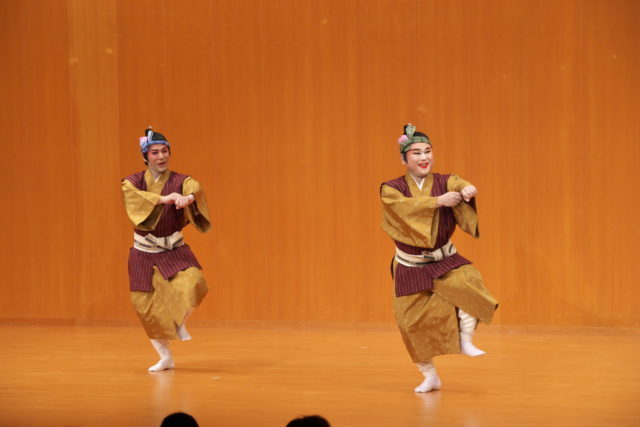
Who: Okinawan dancers and musicians What: Performance honoring the golden anniversary of Okinawa being returned to Japan following US WWII occupation Where:Japan Society, 333 East 47th St. at First Ave. When: Friday, March 18, and Saturday, March 19, $42, 7:30 Why: On June 17, 1971, the last of the Ryukyu Islands was returned to Japanese control. “Waves Across Time: Traditional Dance and Music of Okinawa” is touring the United States, paying tribute to the fiftieth anniversary of that event with an evening of traditional music and dance that comes to Japan Society on March 18 and 19. Michihiko Kakazu, the artistic director of the National Theatre Okinawa, has curated a diverse program that includes several types of traditional storytelling featuring a select group of performers wearing lavish, colorful bingata costumes, created using a unique Okinawan dyeing process.
“Waves Across Time” begins with excerpts from the noh-inspired kumiodori masterpiece Manzai Techiuchi; “Sakamoto-bushi” features two women using castanets called yotsudake, followed by a dance between brothers disguised as buskers, and concluding with “Shinobi no ba,” a secret rendezvous that includes solos for the thirteen-stringed koto and the fue. The program continues with several zo odori works, folk dances that originated in the nineteenth century and grew in popularity in the late 1920s after the Meiji era, consisting of solos, duets, and ensemble pieces about traditional village life (Murasakae), true love, and martial arts. The music will be performed live on the snakeskin-covered three-stringed sanshin and other traditional instruments. Each performance will be preceded by a lecture on Okinawa by ethnomusicologist Dr. James Rhys Edwards at 6:30; Japan Society will also host the workshop “Introduction to Okinawan Dance,” led by Kakazu and members of the troupe, on March 19 at 11:00 ($50) and “Okinawan Dance Workshop for Families” on March 20 at 10:30 ($40 per family).
Armitage Gone! Dance will be at New York Live Arts this week with a program of world premieres that mix live performance with film, fashion, visual art, science, and more that promises to be a grand finale before the company is reimagined for the future. As a special treat, Karole Armitage, who founded AG!D in 1981, will take the stage for the first time since 1989.
“A Pandemic Notebook” begins with the diptych Beautiful Monster and Louis. The first part was inspired by Le streghe bruciata viva (The Witch Burned Alive), Luchino Visconti’s contribution to the 1967 omnibus Le streghe, with Silvana Mangano and Annie Girardot, and Roberto Rossellini’s 1966 television film La prise de pouvoir par Louix XIV (The Taking of Power by Louis XIV), along with references to former president Donald Trump and celebrity culture; the music is by Michael Gordon, Jean-Baptiste Lully, Thomas Adès, and David T. Little.
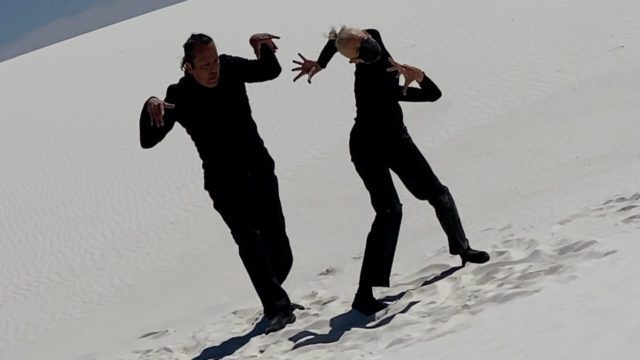
The second part combines two short films from Armitage’s “Under the Dancer” series, Head to Heel and Andy, made during the pandemic, with live performance, followed by Time/Times, an homage to slow cinema in which Armitage, currently an MIT Media Lab Directors Fellow, will dance with former New York City Ballet principal Jock Soto in front of footage taken in White Sand Dunes National Park, Valley of Fires lava fields, and Plaza Blanca in New Mexico and in the snow of Crested Butte, Colorado, set to Bach’s Chaconne.
The next piece, 6 Ft. Apart, debuted online last May in “WOMEN / CREATE! A Virtual Festival of Dance” and will now be performed in person; the work involves Alonso Guzman tracking dancers Sierra French and Cristian Laverde-Koenig using an iPhone attached to his baseball cap that triggers engineer Agnes Fury Cameron’s abstract percussive sounds.
The seventy-five-minute show concludes with Marc Jacobs, adapted from the fall 2021 runway show Armitage choreographed for the designer, who supplies the daring costumes for this performance, set to the Jim Pepper Remembrance Band and Gunther Schuller’s “Goin’ Down to Muskogee.”
The full company consists of Armitage, Guzman, Laverde-Koenig, French, Isaac Kerr, and Kali Marie Oliver, with lighting by Tsubasa Kamei and Clifton Taylor. It should be quite a farewell for the popular, cutting-edge company; it will be fascinating to see what Armitage does next.
SARA MEARNS: PIECE OF WORK
Joyce Theater
175 Eighth Ave. at 19th St.
March 8-13, $10-$71
212-645-2904 www.joyce.org saramearns.com
During the pandemic lockdown, I covered more than a thousand online events created since March 2020. I had many favorite performers over those nearly two years, from actress Kathleen Chalfant and musician Richard Thompson to Arlekin Players Theatre and White Snake Projects to dancer-choreographer Jamar Roberts and Stars in the House hosts Seth Rudetsky and James Wesley. You can check out them and other stalwarts in twi-ny’s three-part Pandemic Awards.
But for me no one stood out like Sara Mearns. The extraordinary New York City Ballet principal dancer expanded her horizons in a series of breathtaking performances, including her Le Cygne (The Swan) variation for Swans for Relief, the Works & Process commission Storm, Lee Mingwei and Bill T. Jones’s durational Our Labyrinth at the Metropolitan Museum of Art, Justin Peck’s Thank You, New York for the New York City Ballet New Works Festival, Christopher Wheeldon’s The Two of Us for Fall for Dance, L.A. Dance Project’s Sonata for Saras (Mearns as her own trio!), Henry Joost and Ariel Schulman’s Another Dance Film shot at the East River Park Amphitheater, and Molissa Fenley’s State of Darkness solo onstage at the Joyce.
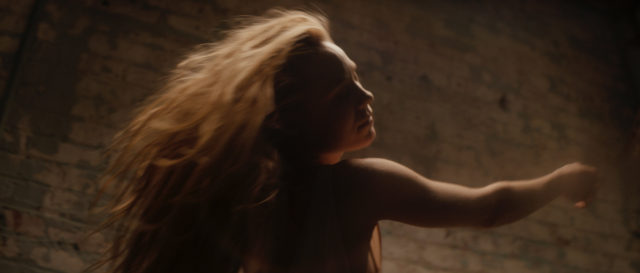
Austin Goodwin’s carefully is part of Sara Mearns program at the Joyce (photo by Drew Dawson)
But in October 2021, Mearns had to take a break to deal with a personal issue she eventually discussed on social media several months later: She was diagnosed with depression and extreme burnout and was getting help from a sports psychologist. “This is never something I saw happening to me,” she wrote on Instagram. “I thought I was invincible, that maybe I was just tired, that maybe it’s just a phase, and to get over it. I’m here to tell you it’s a very real thing,”
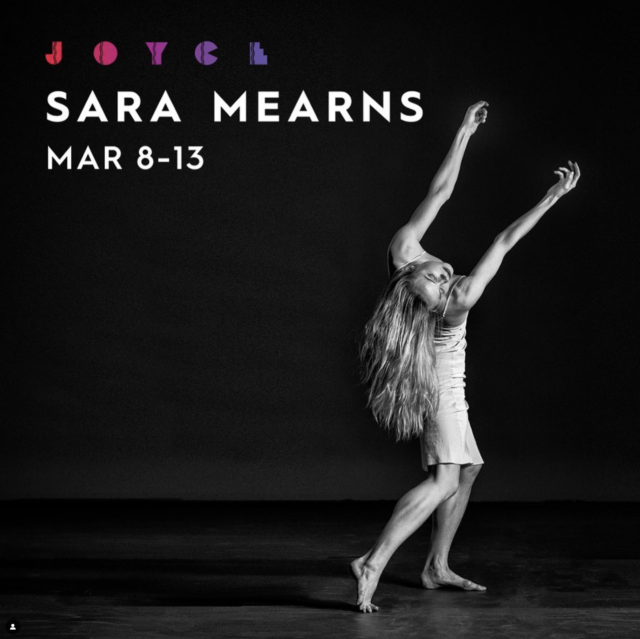
From March 8 to 13, Mearns will return to performing, and to the Joyce, with her own program, “Piece of Work,” a kind of coming-out, coming-back party in which she will perform with eight dancers in works by six choreographers, including five world or NYC premieres created specifically for Mearns. “I have been lucky enough to perform in the biggest houses in the world, doing grand productions, pouring my heart out. It’s what comes naturally to me. It doesn’t feel like a risk,” she explains in a program note. “Three years ago, I decided it was time to go a different route, a route that was vulnerable for me artistically and that would be the biggest challenge for me thus far in my career. . . . I would like to say that I curated this evening, but the truth is, New York did. It will be raw, honest, and at times messy.”
The evening begins with Jodi Melnick’s Opulence, a duet with Melnick commissioned for the 2019 Jacob’s Pillow Dance Festival, with music by drummer Kid Millions and guitarist Zach Lehrhoff. Choreographer and director Austin Goodwin’s film carefully pairs Mearns with Paul Zivkovich inside an empty house. Mearns teams with Vinson Fraley Jr. in Fraley’s On the Margins, set to an original score by Rahm Silverglade for violin, electronics, guitar, and sax.
Following intermission, Mearns will perform with Melnick, Taylor Stanley, Jaquelin Harris, Chalvar Monteiro, and Burr Johnson in a special JoycEvent, excerpts from “Night of 100 Solos: A Centennial Event” and other works by Merce Cunningham, arranged and staged here by Rashaun Mitchell and Silas Riener, featuring live music by John King. Beth Gill’s SSSara is a solo for Mearns with music by Ryan Seaton. The night concludes with Guillaume Côté’s Spir, a duet with the Canadian dancer and choreographer set to German pianist, producer, and composer Nils Frahm’s “Corn” and Woodkid and Frahm’s “Winter Morning I.” In between each piece will be audio interludes directed and edited by Ezra Hurwitz.
Mearns also wrote on Instagram, “This show has been thru so many lives, revisions, faces, versions, and I wouldn’t take any of it back. A big influence was the pandemic; it gave me a clear path of what I wanted this show to be about. I’m not the same person or artist I was before the pandemic, and I wanted the evening to reflect that & acknowledge it. How art, specifically dance, is created in New York; what artists go thru in New York is unlike anywhere else in the world.” Mearns will talk about that and more in a curtain chat at the March 9 show.