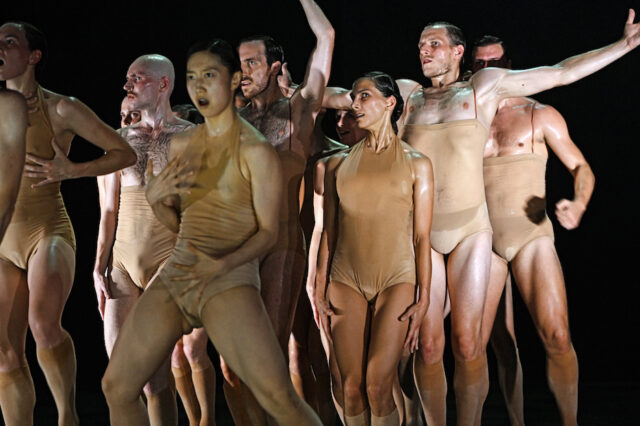
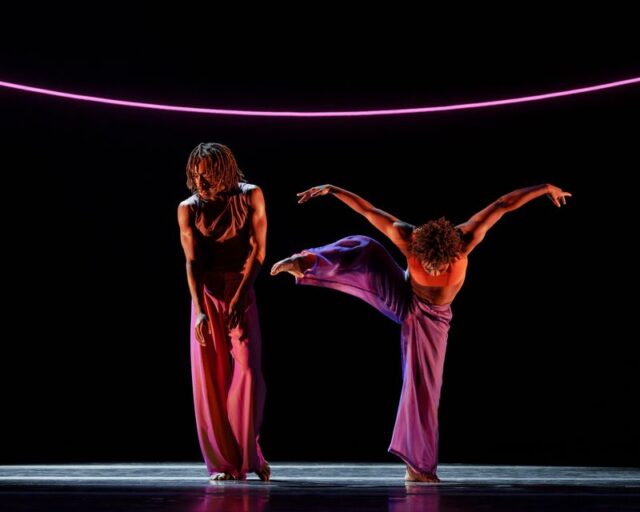
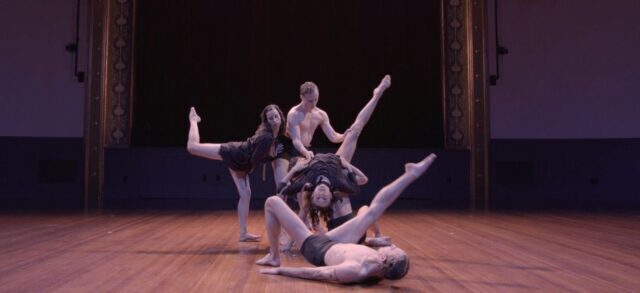
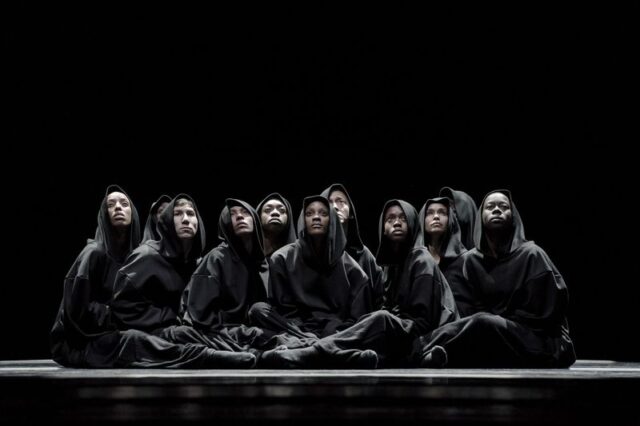
German-based tanzmainz makes its explosive Joyce debut with Sharon Eyal’s Soul Chain, fifty-five minutes of pure exhilaration and intensity, a thumping trance rave executed with a thrilling military-like precision. An international cast of seventeen fearless dancers first enters the empty stage on relevé, one, two, and three at a time, walking on tiptoes and the balls of their feet determinedly in Rebecca Hytting’s tight-fitting beige leotards, which run from shoulder to buttocks, most of the men bare-chested. Soon they are forming a hive or collective, part apian, part Borg, angulating their arms and legs with movements evoking insects; some collective members stand out by keeping an arm raised — or swiveling a head back and forth for a frightening amount of time — while the others dance in unison. (The brave company features Elisabeth Gareis, Daria Hlinkina, Cassandra Martin, Nora Monsecour, Amber Pansters, Maasa Sakano, Marija Slavec-Neeman, Milena Wiese, Zachary Chant, Paul Elie, Finn Lakeberg, Christian Leveque, Jaume Luque Parellada, Cornelius Mickel, Matti Tauru, Alberto Terribile, and Federico Longo.)
Alon Cohen’s stark lighting isolates individuals and cuts the stage in half, furthering the idea of a group and singular entities. Dancers occasionally break free and perform improvised solos that challenge the limits of physical possibility as Israeli composer and DJ Ori Lichtik’s original industrial techno score echoes through the theater, beating into your bones. Lichtik and Jerusalem-born choreographer Eyal of L-E-V, a former longtime Batsheva dancer and house choreographer, worked in conjunction with the dancers as the piece developed, establishing their own creative collective that ultimately links up with the audience. (To get in the mood, check out the accompanying Spotify playlist, consisting of forty songs that inspired the troupe.)
The night I went, the crowd didn’t want to leave at the end, joining together for three boisterous curtain calls, followed by an informative talkback with tanzmainz director Honne Dohrmann, dancers Monsecour and Longo, and Joyce marketing manager Nadia Halim, who shed more light on the process of making Soul Chain, emphasizing collaboration, protecting bodies, and Eyal’s goal of promoting passion and love and celebrating uniqueness amid longing and loneliness.
Ronald K. Brown’s The Equality of Night and Day makes its stunning NYC premiere at the Joyce this week (photo by Rose Eichenbaum)
Ronald K. Brown/EVIDENCE, a Dance Company
The Joyce Theater
175 Eighth Ave. at 19th St.
January 17-22, $51-$71
212-691-9740 www.joyce.org www.evidencedance.com
“When I work, in all situations, people meet me and they say, ‘You create family wherever you go,’ and so I think I have a nurturing side but I demand a lot,” Brooklyn-based choreographer Ronald K. Brown explains in an Alvin Ailey video about the making of Open Door, a piece Brown made for Alvin Ailey American Dance Theater in 2015. “Why do you have to open the door, how do you open the door, this whole thing of easing, pushing through the door . . .”
Brown created a sense of family and community yet again when his troupe, EVIDENCE, a Dance Company, kicked off its home season at the Joyce on January 17. The program started, appropriately enough, with the company premiere of Open Door, which was inspired by Brown’s travels to Cuba. In front of a screen that changes colors (the lighting is by Tsubasa Kamei), Arturo O’Farrill’s eight-piece Afro Latin Jazz Ensemble performs Luis Demetrio’s “La Puerta,” Tito Puente’s “Picadillo,” and O’Farrill’s “All of the Americas” (from his “Afro Latin Jazz Suite”) and “Vaca Frita” as nine dancers move about the stage, led by solos and duets by Shaylin D. Watson and Isaiah K. Harvey. Originally commissioned for AAADT in 2015, it’s an uplifting twenty-six minutes, with the dancers often putting out their palms in gestures of welcome, beckoning not only fellow dancers but immigrants from Cuba and around the globe.
Open Door is just the right aperitif for the world premiere of The Equality of Night and Day (TEND), a sizzling emotional work in which Brown gets more explicit as he tackles his recurrent themes of social injustice and racism. Five men (Demetrius Burns, Austin Coats, Randall Riley, Christopher Salango, Harvey) and five women (Watson, Shayla Caldwell, Joyce Edwards, Stephanie Chronopoulos, Breana Moore), in loose-fitting flowing blue costumes by Omotayo Wunmi Olaiya, gather and separate to a powerful original score by pianist Jason Moran and the rallying words of activist and writer Angela Davis, who declared in a 2017 speech at Brown, “During the coming period, our primary job will be to build community, to create community — in ways that allow us to understand that the work that we do now does matter, even if we cannot see in an immediate sense the consequences of the work we are doing. It will matter eventually.”
Photos of protests from the last half century and more, curated by Debra Wills, are projected on the back screen, instilling a sense of immediacy in the proceedings, which are highlighted by poignant movement by Burns, Caldwell, and Edwards, the men at one point covering their faces and letting out primeval screams. Later the dancers remove their tops and walk around in a kind of memorial prayer for Black bodies, reacting to Davis’s facts about the racial imbalance in crime and punishment.
The evening concludes with Brown’s half-hour classic, Grace, an appropriate finale providing subtle elegance following the exuberance of Open Door and the psychological intensity of TEND. Commissioned for AAADT in 1999, the deeply spiritual piece begins with Edwards standing in a large doorway at the back of the stage; as opposed to the first two works, where the dancers often came onto the stage with a swagger, here they mostly walk on and off calmly, five women and six men in lovely white or red costumes by Olaiya. They strut out their elbows and their hands reach for the sky to songs by Duke Ellington, Roy Davis Jr., and Fela Kuti, spreading the energy to the audience.
Some years back, I saw Grace at the Joyce with Brown himself dancing a major role. The Bed-Stuy native saved one final, exhilarating moment for the curtain call on January 17, cementing the loving community he had built over the course of the program. He came onstage to uproarious applause, walking gently with a four-pronged cane and being helped by his partner and associate artistic director, Arcell Cabuag. Brown suffered a debilitating stroke in April 2021, at the age of fifty-four, shortly after a residency at Jacob’s Pillow to develop TEND, but has vowed to walk again on his own, and he is ahead of his doctors’ prognosis. The smile on his face was infectious, assuring everyone that there is a promising future to look forward to for all of us.
Ronald K. Brown/EVIDENCE presents New York premiere at the Joyce next week (photo by Rose Eichenbaum)
Ronald K. Brown/EVIDENCE, a Dance Company
The Joyce Theater
175 Eighth Ave. at 19th St.
January 17-22, $51-$71
212-691-9740 www.joyce.org www.evidencedance.com
Discussing “the grief and the weight of everything that we feel,” choreographer Ronald K. Brown says, in a Jacob’s Pillow behind-the-scenes video of the making of his latest work, The Equality of Night and Day (TEND), “I want us to find that joy and make sure that everyone understands that this is the destination in the word equality. That it’s the destination of this kind of . . . serenity.”
Since 1985, Bed-Stuy native Brown has been choreographing illuminating works for his Brooklyn-based troupe, EVIDENCE, melding classical ballet and traditional West African movement to create powerful and exhilarating contemporary pieces steeped in social justice, honoring the ancestors, and celebrating community. Through January 15, Brown is curating American Dance Platform at the Joyce, featuring Les Ballet Afrik, B. Moore Dance, and waheedworks. “I remember the first time EVIDENCE, a Dance Company was on the Joyce stage over twenty years ago,” Brown writes in the program. “It was a monumental moment for us and I hope that these three companies will benefit from the exposure that the platform provides.”
Following American Dance Platform, EVIDENCE returns to the Joyce stage for its 2023 home season, presenting three works. Commissioned for Alvin Ailey American Dance Theater in 1999 and added to the EVIDENCE repertory in 2004, Grace is a rapturous tribute to Ailey’s legacy, set to music by Duke Ellington, Roy Davis Jr., and Fela Anikulapo Kuti. Also choreographed for AAADT, 2015’s Open Door will have its company premiere, a twenty-six-minute piece with live music by Arturo O’Farrill’s Afro Latin Jazz Ensemble.
The centerpiece is the New York premiere of TEND, which explores balance, equity, and fairness, with a score by pianist and visual artist Jason Moran, spoken word by Angela Davis, flowing costumes by Omotayo Wunmi Olaiya, set design and lighting by Tsubasa Kamei, and photographs curated by Debra Wills; the company consists of associate artistic director Arcell Cabuag, rehearsal directors Demetrius Burns and Shayla Caldwell, assistant rehearsal director Joyce Edwards, Stephanie Chronopoulos, Austin Coats, Isaiah Harvey, and Breana Moore, with guest artists Randall Riley, Christopher Salango, Shaylin D. Watson, Kirven Douthit-Boyd, Daniel Harder, Hannah Alissa Richardson, Annique S. Roberts, and Keon Thoulouis. There will be a Curtain Chat following the January 18 performance and a family matinee on January 21.
Don’t miss what is sure to be one of the highlights of the dance year. Brown/EVIDENCE knows how to get the crowd going like no other company; every time I see them feels monumental.
A Thousand Ways (Part Three): Assembly brings strangers together at the New York Public Library (photo courtesy 600 Highwaymen)
UNDER THE RADAR FESTIVAL
Public Theater and other venues
January 4-22, free – $60 publictheater.org
The Public Theater’s Under the Radar Festival is back and in person for its eighteenth iteration, running January 4-22 at the Public as well as Chelsea Factory, NYU Skirball, La MaMa, BAM, and the New York Public Library’s Stavros Niarchos Foundation branch. As always, the works come from around the world, a mélange of disciplines that offers unique theatrical experiences. Among this year’s selections are Jasmine Lee-Jones’s seven methods of killing kylie jenner, Annie Saunders and Becca Wolff’s Our Country, Roger Guenveur Smith’s Otto Frank, Rachel Mars’s Your Sexts Are Shit: Older Better Letters, Kaneza Schaal’s KLII, and Timothy White Eagle and the Violet Triangle’s The Indigo Room.
In addition, “Incoming! — Works-in-Process” features early looks at pieces by Mia Rovegno, Miranda Haymon, Nile Harris, Mariana Valencia, Eric Lockley, Savon Bartley, Raelle Myrick-Hodges, and Justin Elizabeth Sayre, while Joe’s Pub will host performances by Eszter Balint, Negin Farsad, Julian Fleisher and his Rather Big Band, Salty Brine, and Migguel Anggelo.
Below is a look at four of the highlights.
600 HIGHWAYMEN: A THOUSAND WAYS (PART THREE): AN ASSEMBLY
The New York Public Library, Stavros Niarchos Foundation Library
455 Fifth Ave. at Fortieth St., seventh floor
January 4-22, free with advance RSVP publictheater.org
At the January 2021 Under the Radar Festival, the Obie-winning 600 Highwaymen presented A Thousand Ways (Part One): A Phone Call, a free hourlong telephone conversation between you and another person, randomly put together and facilitated by an electronic voice that asks both general and intimate questions, from where you are sitting to what smells you are missing, structured around a dangerous and lonely fictional situation that is a metaphor for sheltering in place. The company followed that up with the second part, An Encounter, in which you and a stranger — not the same one — meet in person, sitting across a table, separated from one another by a clear glass panel, with no touching and no sharing of objects. In both sections, I bonded quickly with the other person, making for intimate and poignant moments when we were all keeping our distance from each other.
Now comes the grand finale, Assembly, where sixteen strangers at a time will come together to finish the story at the New York Public Library’s Stavros Niarchos Foundation branch in Midtown. Written and created by Abigail Browde and Michael Silverstone, A Thousand Ways innovatively tracks how the pandemic lockdown influenced the ways we interact with others as well as how critical connection and entertainment are.
Palindromic show makes US premiere at Under the Radar Festival (photo courtesy Ontroerend Goed)
ONTROEREND GOED: Are we not drawn onward to new erA
BAM Fishman Space
321 Ashland Pl.
January 4-8, $45 publictheater.org www.bam.org
What do the following three statements have in common? “Dammit, I’m mad.” “Madam in Eden, I’m Adam.” “A man, a plan, a canal – Panama.” They are all palindromes, reading the same way backward and forward. They also, in their own way, relate to Ontroerend Goed’s Are we not drawn onward to new erA, running January 4-8 at BAM’s Fishman Space. Directed by Alexander Devriendt, the Belgian theater collective’s seventy-minute show features a title and a narrative that work both backward and forward as they explore climate change and the destruction wrought by humanity, which has set the Garden of Eden on the path toward armageddon. But maybe, just maybe, there is still time to save the planet if we come up with just the right plan.
The world is obsessed with Moby-Dick much the way Captain Ahab is obsessed with the great white itself. Now it’s Norwegian theater company Plexus Polaire and artistic director Yngvild Aspeli’s turn to harpoon the story of one of the most grand quests in all of literature. Aspeli (Signaux,Opéra Opaque,Dracula) incorporates seven actors, fifty puppets, video projections, a drowned orchestra, and a giant whale to transform Herman Melville’s 1851 novel into a haunting ninety-minute multimedia production at NYU Skirball for four performances only, so get on board as soon as you can.
Brian Mendes and Jim Fletcher get ready for NYCP’s Field of Mars (photo courtesy New York City Players)
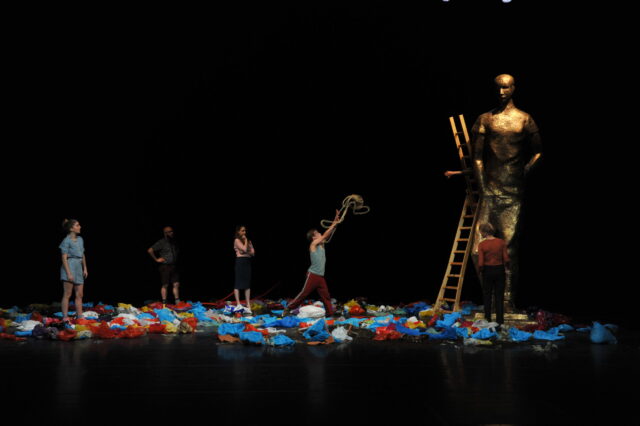
I’ll follow Richard Maxwell and New York City Players anywhere, whether it’s on a boat past the Statue of Liberty (The Vessel), an existential journey inside relationships and theater itself (The Evening,Isolde) and outside time and space (Paradiso,Good Samaritans), or even to the Red Planet and beyond. Actually, his newest piece, Field of Mars, playing at NYU Skirball January 19-29, refers not to the fourth planet from the sun but to the ancient term for a large public space and military parade ground. Maxwell doesn’t like to share too much about upcoming shows, but we do know that this one features Lakpa Bhutia, Nicholas Elliott, Jim Fletcher, Eleanor Hutchins, Paige Martin, Brian Mendes, James Moore, Phil Moore, Steven Thompson, Tory Vazquez, and Gillian Walsh and that the limited audience will be seated on the stage.
Oh, and Maxwell noted in an email blast: “Field of Mars: A chain restaurant in Chapel Hill is used as a way to measure the progress of primates, from hunter/gatherer to fast casual dining experience. Topics covered: Music, Food, Nature, and Spirituality. . . . I also wanted to take this opportunity to tell parents regarding the content of Field of Mars: my kids (aged 11 and 15) will not be seeing this show.”
Ghrai DeVore-Stokes and Chalvar Monteiro explore love in Jamar Roberts’s In a Sentimental Mood (photo by Paul Kolnik)
ALVIN AILEY AMERICAN DANCE THEATER: ALL NEW
New York City Center
131 West 55th St. between Sixth & Seventh Aves.
Through December 24, $39-$169 www.alvinailey.org www.nycitycenter.org
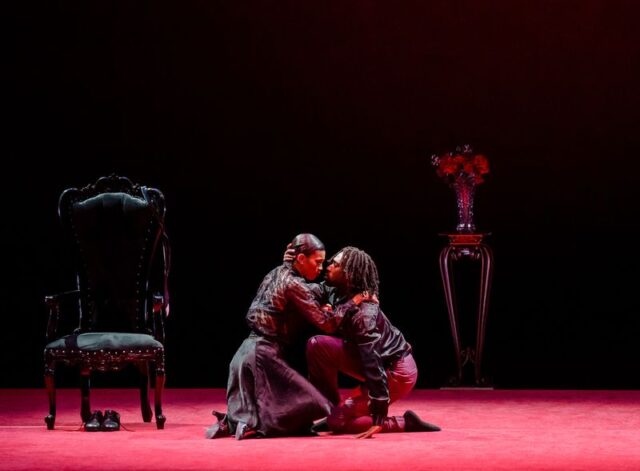
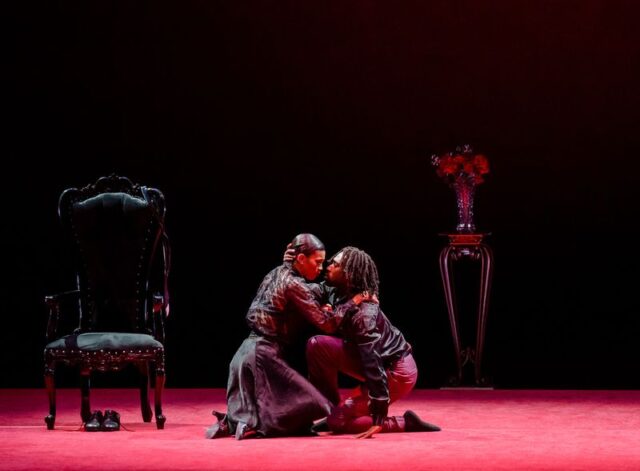
It was all about coupling, uncoupling, and never-coupling at Alvin Ailey American Dance Theater’s all-new program on December 15, part of the annual City Center season that continues through Christmas Eve. The evening began with the world premiere of Jamar Roberts’s poignant and emotional In a Sentimental Mood, in which Courtney Celeste Spears and Christopher R. Wilson follow the trajectory of a relationship in a dark and mysterious red-lit room. Spears appears first, dressed in a long white coat and white hat with red gloves, filled with hope as a scratchy recording of Duke Ellington’s “There’s Something About an Old Love” plays. She rips off her coat and hat to reveal a sexy black outfit underneath as she is joined by Christopher R. Wilson and the two get romantic to Rafiq Bhatia’s version of “The First Time Ever I Saw Your Face,” featuring vocalist Cécile McLorin Salvant, who sings, “The first time ever I kissed your mouth / I felt the earth move in my hand / Like the trembling heart of a captive bird,” holding the last word for a jarring, extended period. As Roberts’s sharp, angular choreography continues, the dancers experience an angry, then melancholic setback and try to reunite to Ornette Coleman’s “Lonely Woman” and Ellington’s “Single Petal of a Rose.” It’s a lovely piece from former longtime Ailey dancer Roberts, who also designed the costumes and set, enhanced with stark lighting by Brandon Stirling Baker.
Belén Indhira Pereyra and Patrick Coker merge as one in Paul Taylor’s DUET (photo by Paul Kolnik)
Following a pause, Jacquelin Harris and Renaldo Maurice become one in the company premiere of Paul Taylor’s 1964 DUET, a classic pas de deux set to Franz Josef Haydn’s “The Seven Last Words of Christ” Sonata VII in E-flat major – Largo. Dressed in George Tacet’s tight-fitting, colorful bodysuits, Harris and Maurice move elegantly with sinewy expertise, their beings merging amid their confident love.
Vernard Gilmore and Ghrai DeVore-Stokes reach for freedom in Alvin Ailey’s Survivors (photo by Paul Kolnik)
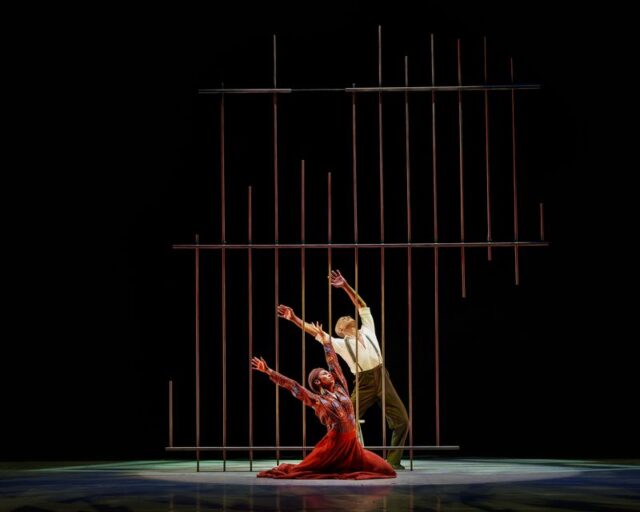
After intermission, a new production of Ailey and Mary Barnett’s 1986 Survivors, restaged by Masazumi Chaya, focuses on the love story between Nelson and Winnie Mandela after his arrest. As jazz drummer Max Roach’s “Survivors” and “Triptych” practically explode (balanced by Peter Phillips’s stings), Harris, in a flowing red skirt and African top, and Yannick Lebrun, in brown pants, a white shirt, and suspenders, are separated by incomplete bars, evoking both the injustice of Apartheid and the possibility of freedom. (The costumes are by Toni-Leslie James, with original décor by Douglas Grekin and lighting by Tim Hunter.) They are accompanied by Wilson, Solomon Dumas, Hannah Alissa Richardson, Caroline T. Dartey, and Yazzmeen Laidler, wearing traditional South African hats and serving as a kind of Greek chorus. It’s a powerful work about a determined couple, all the more affecting since we know that Mandela was freed in 1990 and he and Winnie divorced in 1996.
Chalvar Monteiro and Ashley Green come together and break apart in Kyle Abraham’s Are You in Your Feelings? (photo by Paul Kolnik)
The world premiere of Kyle Abraham’s Are You in Your Feelings? brought the house down, an exhilarating celebration of Black culture. Through spoken dialogue and such songs as the Flamingos’ “I Only Have Eyes for You,” Lauryn Hill’s “Forgive Them Father,” Drake’s “That’s How You Feel,” Erykah Badu’s “I’ll Call U Back,” and Kendrick Lamar’s “LOVE. ft. Zacari,” seven women (Dartey, Ghrai DeVoire-Stokes, Samantha Figgins, Ashley Kaylynn Green, Ashey Mayeux, Miranda Quinn, and Deidre Rogan) and five men (Dumas, Maurice, James Gilmer, Chalvar Monteiro, and Jermaine Terry), flirt, diss, come together, and grow apart in front of a backdrop of a fluorescent semicircle and larger, flatter circle, suggesting the sun and the moon. At the center of it all are Monteiro and Green, who swirl, embrace, push away, and keep an eye on each other as various other couples, including two men, form and dissolve. There’s a little bit of West Side Story here, some Night Creature there, leading to a thrilling finale.
Are You in Your Feelings? bursts with a masterful, infectious energy that is a fitting conclusion to a night of love and separation, joy and sadness, humor and romance, starting and ending with the choreographers who are leading AAADT into the future, Roberts and Abraham.
Stephen Petronio’s New Prayer for Now is part of special program at Danspace (film still courtesy of the Joyce Theater)
Who:Stephen Petronio Company What:Bloodlines/Bloodlines(future) Where:Danspace Project, St. Mark’s Church in-the-Bowery, 131 East Tenth St. at Second Ave. When: December 8-10, $20, 7:30 Why: The indefatigable Stephen Petronio doesn’t know how to stop, which is a boon for dance lovers. The Newark-born choreographer presented innovative virtual work during the pandemic lockdown, followed by the exciting “Petronio’s Punk Picks and Other Delights” at La MaMa last November and a season at the Joyce this past May. Petronio, who celebrates postmodern dance history in his “Bloodlines” project, restaging classic works by Merce Cunningham, Trisha Brown, Lucinda Childs, Anna Halprin, Yvonne Rainer, and others, while collaborating with the next generation of creators, including Johnnie Cruise Mercer, Davalois Fearon, and UFlyMothership (dancer, singer, and songwriter Tendayi Kuumba and sound designer, director, and music producer Greg Purnell), is now returning to Danspace Project, where he presented his first evening-length work forty years ago.
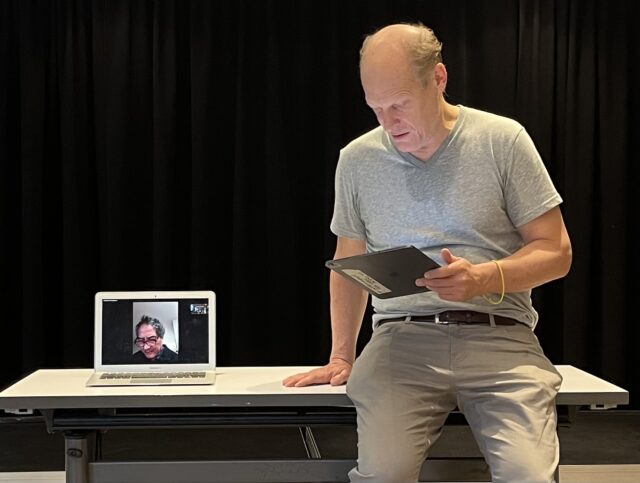
Bloodlines/Bloodlines(future) consists of that 1982 piece, Steve Paxton’s improvisational Jag Vill Gärna Telefonera (I Would Like to Make a Phone Call), which Paxton, interpreting sports photographs, originally performed with Robert Rauschenberg in 1964 (see 2018 SPC MoMA rehearsal clip above); Petronio’s initially virtual New New Prayer for Now, set to original music by Monstah Black and renditions of “Balm in Gilead” and “Bridge Over Troubled Water” recorded with the Young People’s Chorus of New York City (YPC); UFlyMothership’s The Adventures of Mr. Left Brain and Ms. Right, which pits technology against nature; Fearon’s Finding Herstory, a solo set to a compilation of Kumina, Doundounba, Congolese, Ska, Reggae, and Dancehall and music composed by Fearon and clarinetist and sax player Michael McGinnis; and the conclusion of Mercer’s six-year Process memoir 7 (Vol 8): ‘back to love.’
“It’s a thrill to come back to Danspace, the first venue to ever produce my work,” Petronio said in a statement. “And to do so in conversation with a work from history that empowers me, alongside these voices of the future that inspire me, makes this evening a profound one for me.” It should be a profound, and extremely entertaining, evening for the audience as well.
Jamar Roberts’s In a Sentimental Mood will make its work premiere at AAADT season at City Center (photo by Paul Kolnik)
ALVIN AILEY AMERICAN DANCE THEATER
New York City Center
131 West 55th St. between Sixth & Seventh Aves.
November 30 – December 24, $39-$169 www.alvinailey.org www.nycitycenter.org
I don’t know about you, but I’ve had a rough coupla weeks. Thankfully, Alvin Ailey American Dance Theater returns to New York City Center this week just in time to give me just the break I need, something I look forward to every year.
AAADT’s 2022 fall/winter season at City Center runs November 30 to December 24, featuring fifteen works presented in various groupings, beginning with an opening night gala consisting of an excerpt from Mauro Bigonzetti’s Festa Barocca (with Constance Stamatiou and students from the Ailey School), a romantic duet from Twyla Tharp’s Nine Sinatra Songs, and excerpts from Alvin Ailey’s classic Night Creature along with artistic director Robert Battle’s Unfold, with live vocals by soprano Brandie Sutton, before concluding with Ailey’s standard-bearer, Revelations.
If you haven’t been paying attention to former Ailey dancer Jamar Roberts’s growth as a choreographer, you’ve been missing a special progression. The world premiere of his In a Sentimental Mood, the exploration of a young couple’s love and desire, set to music by Duke Ellington and Rafiq Bhatia’s spin on a quartet of jazz standards, is sure to be a highlight at City Center. The other world premiere is Kyle Abraham’s Are You in Your Feelings?, a celebration of Black culture with songs by the Flamingos, Jazmine Sullivan, Lauryn Hill, Erykah Badu, and others. The troupe will present the company premieres of Paul Taylor’s 1964 short, motionless DUET and Tharp’s 1997 Roy’s Joys, a nine-part piece honoring trumpet legend Roy “Little Jazz” Eldridge. There will also be a new production of Ailey and Mary Barnett’s 1986 Survivors, a tribute to Nelson and Winnie Mandela with music by drummer Max Roach and singer Abbey Lincoln, restaged by former AAADT associate artistic director Masazumi Chaya.
Fan favorite BUSK by Aszure Barton is part of AAADT presentation at City Center (photo by Paul Kolnik)
The repertory pieces offer a wide range of consistent delights from throughout the company’s sixty-four-year existence. “All Ailey A” encompasses Night Creature,Reflections in D,Pas de Duke, and The River, “All Ailey B” brings together Memoria,Survivors, and Revelations, “All Ailey C” comprises Blues Suite,Reflections in D,Cry, and Revelations, and “All Ailey D” boasts The River,Blues Suite, and Revelations.
Future of Jazz Orchestra will perform live December 16-18 to Night Creature,Reflections in D,For Four, and Pas de Duke. Two “All New” programs team up In a Sentimental Mood,DUET,Survivors, and Roy’s Joys or Roy’s Joys,Survivors, and Are You in Your Feelings?
I always make sure to see one of the “All New” evenings, a glorious way to say goodbye to one year and welcome the next one, filled with hope and promise and great dancing.