this week in dance

ÁGUA

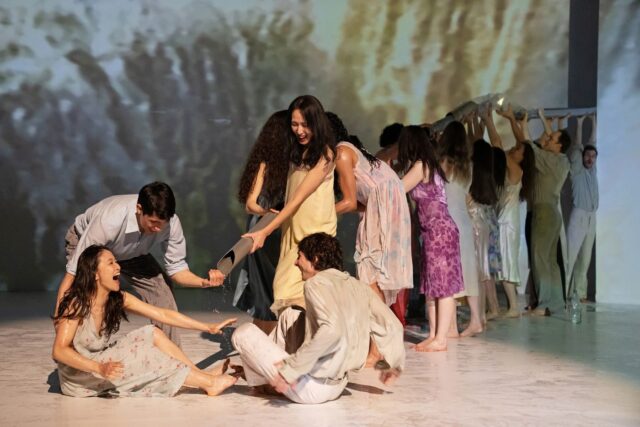
Performers enjoy a drink of water in Pina Bausch’s Água at BAM (photo by Julieta Cervantes)

ÁGUA
BAM Howard Gilman Opera House, Peter Jay Sharp Building
230 Lafayette Ave. between St. Felix St. & Ashland Pl.
March 3-19
www.bam.org
www.pina-bausch.de/en

Dance-theater pioneer Pina Bausch would probably agree with Nobel Prize–winning Hungarian biochemist Dr. Albert Szent-Györgyi, who said “Water is life’s matter and matrix, mother and medium. There is no life without water.”

In such dazzling pieces as Vollmond (Full Moon), Nefés, and “…como el musguito en la piedra, ay si, si, si…” (Like moss on a stone), Bausch repeatedly explored the role of this element, the elixir of life.

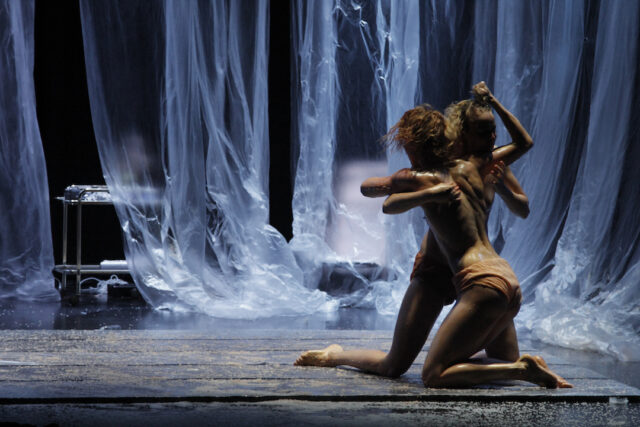
Water again takes center stage in the US premiere of Tanztheater Wuppertal Pina Bausch’s Brazil-inspired Água, which debuted in 2001 in Rio de Janeiro and has at last come to BAM, the company’s exclusive New York home since 1984. Água, which means “water,” is a nearly three-hour masterpiece (with a far too long intermission), combining music, comedy, storytelling, video, props, and, of course, sensational dance. Peter Pabst’s stark white stage features three large curved screens on which he projects footage of palm trees blowing in the wind, a team of drummers playing in the street, and adventures through the rainforest.

Men in everyday clothing and suits and women in gorgeous, colorful gowns — Marion Cito’s costumes are stunning — perform a series of vignettes to songs by a wide range of artists, including Mickey Hart, Tom Waits, the Tiger Lillies, PJ Harvey, Amon Tobin, Susana Baca, Caetano Veloso, David Byrne, Gilberto Gil, Bebel Gilberto, Nana Vasconcelos, and Antonio Carlos Jobim.

Tsai-Wei Tien is lifted off the ground and passed hand to hand by Dean Biosca, Oleg Stepanov, and Denis Klimuk, clad only in bathing suits and platform shoes, Christopher Tandy rows across the stage in a palm leaf, Tsai-Chin Yu asks several people in the first row where they are from and then uses a boot to predict the weather there, and a dancer in a lush red dress falls to the ground and reveals her long legs as men pass by, ignoring her. Performers break out into sudden solos that meld with the projected images that envelop them. The screens rise to reveal a surprise behind them. The women all have long hair that they use inventively as an object of sex and power.

Fire plays a continuing function, as dancers light cigarettes and candles and original Água cast member Julie Shanahan tries to set the place ablaze, explaining, “I wanted to do something really beautiful for you, but I don’t know how. . . . I wanted to go crazy. But it’s not possible.” The cast, which also features Emma Barrowman, Naomi Brito, Maria Giovanna Delle Donne, Taylor Drury, Letizia Galloni, Nayoung Kim, Reginald Lefebvre, Alexander López Guerra, Nicholas Losada, Jan Möllmer, Milan Nowoitnick Kampfer, Franko Schmidt, Ekaterina Shushakova, Julian Stierle, and Sara Valenti, attends a cocktail party, pulls out white couches to take a break, and uses hilariously patterned towels at a beach resort. They bounce off walls. They spray water at each other. They use microphones as if they’re comedians.

A handful of scenes feel extraneous, and Bausch’s highly gendered choreography can be perceived as out of date in 2023, though the company has its first trans dancer (Brito). But Água is still hugely entertaining.

Bausch, who died in June 2009 at the age of sixty-eight, displayed a passion for life and all that it offers in her work, from light to dark, creating a mélange that ranged from Café Müller and The Rite of Spring to Kontakthof and Bamboo Blues. Artistic director Boris Charmatz continues her legacy with this international tour of Água, which is, contrary to what Shanahan said, “something really beautiful.”

ESTROGENIUS FESTIVAL: BAN(NED) TOGETHER

ESTROGENIUS FESTIVAL: BAN(NED) TOGETHER
The Kraine Theater, 85 East Fourth St.
UNDER St. Marks, 94 St. Marks Pl.
Arts on Site, 12 St. Marks Pl.
721 Decatur Street Community Garden, Bushwick
March 15 – April 2, sliding scale $20
www.estrogenius.nyc

Since 2000, the EstroGenius Festival has been celebrating “the artistry of femme, nonbinary, nonconforming, and trans womxn artists.” The 2023 edition, presented by FRIGID New York and Manhattan Theatre Source, launches March 15 with “Funny Women of a Certain Age,” an evening of comedy with Amanda Cohen, Jessie Baade, Laura Patton, and Carole Montgomery. The festival, curated by maura nguyễn donohue, Melissa Riker, and John C. Robinson, kicks into high gear March 18 through April 2 with nearly two dozen productions taking place at the Kraine Theater, UNDER St. Marks, Arts on Site, and the 721 Decatur Street Community Garden in Bushwick, from concerts and plays to discussions and burlesque.

On March 19 at 3:30, Joya Powell and Pele Bauch team up for the open dialogue “Who We Are | Ban(ned) Together,” getting to the heart of this year’s theme: “Ban(ned) Together,” a response to the overturning of Roe v. Wade and the violence being committed against trans and femme bodies.

Claire Ayoub heads down memory lane in her solo show The GynoKid. Marina Celander shares the family-friendly story The Tale of An-Noor, incorporating dance and puppets. In the duet Develop(ing) Together: BEAR, c/s movement projects investigates balance, exhaustion, and tolerance. Molly Kirschner’s BiPolar Brunch brings together four characters seeking connection. Alt-folkers Brokeneck Girls perform songs from The Murder Ballad Musical.

“An Evening with Peterson, Savarino & Wells” features Muriel “Murri-Lynette” Peterson’s Black Enough, Kim Savarino’s Blue Bardo, and Portia Wells’s Inside Flesh Mountain, Part II. Anabella Lenzu examines herself as a woman, a mother, and an immigrant in Solo Voce: The Night You Stopped Acting. Hip-hop takes center stage with Yvonne Chow’s #Unapologetically Asian and an excerpt from Janice Tomlinson’s PRN. There are also works by sj swilley, Emily Fury Daly, Vanessa Goodman, Donna Costello, Kayla Engeman, Leslie Goshko, Soul Dance Co., and Petra Zanki, among many others.

BATSHEVA DANCE COMPANY: HORA

Batsheva Dance Company brings Hora back to New York in two-week Joyce engagement (photo by Steven Pisano)

HORA
The Joyce Theater
175 Eighth Ave. at 19th St.
February 28 – March 12, $10-$75
212-691-9740
www.joyce.org
www.batsheva.co.il

Next year is the one hundredth anniversary of the Jewish circle dance known as the Hora, created by Baruch Agadati in Palestine in 1924, influenced by Romanian and Greek traditions. The dance is a staple of Jewish American weddings and bar and bat mitzvahs, usually accompanied by the folk song “Hava Nagila” and including the lifting of various celebrants on chairs. The Tel Aviv–based Batsheva Dance Company is paying tribute to that centennial by bringing back former artistic director and current house choreographer Ohad Naharin’s sixty-minute Hora, continuing at the Joyce through March 12.

When the 2009 piece came to BAM in 2012, I called it “a mesmerizing experience, a stunning balance of light, color, sound, and movement from one of the world’s most innovative and entertaining choreographers.” It is just as mesmerizing today.

Batsheva and Naharin have dazzled us with such other pieces as Deca Dance, Three, Minus 16, Project 5, Venezuela, and Last Work; this return to Hora is a welcome one, even if the required mask-wearing muffles some of the audience’s exhilarated gasping.

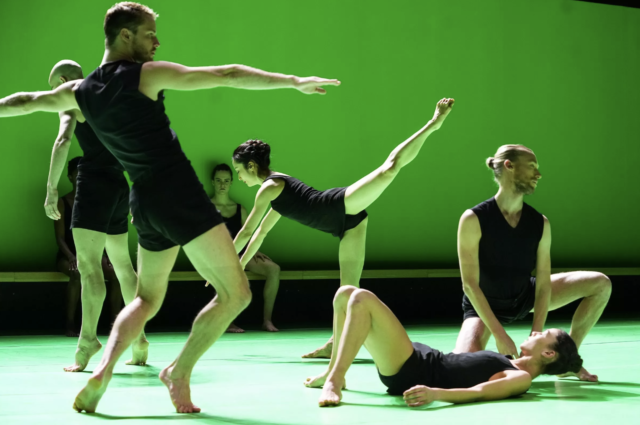
Naharin’s Hora features no chairs and no “Hava Nagila”; it takes place in an empty rectangular space bordered on three sides by a green wall, with a long bench (designed by Amir Raveh) in the back where the eleven dancers sit when not dancing. Isao Tomita’s electronic score incorporates such familiar sounds as Richard Strauss’s “Also Sprach Zarathustra,” Richard Wagner’s “Tannhauser: Overture” and “Die Walküre: Ride of the Valkyries,” Charles Edward Ives’s “The Unanswered Question,” Claude Debussy’s “Prelude to the Afternoon of a Faun,” Modest Mussorgsky’s “Catacombs,” and a whistled version of John Williams’s main theme from Star Wars. (The sound design and editing is by Maxim Waratt.)

The show starts with the eleven dancers rising from the bench and approaching the front of the stage, set and lighting designer Avi Yona Bueno initially casting them in silhouette. It is one of only a few times the performers will move in unison; they break out into solos and other configurations, seldom coming into contact with one another as they proceed in Batsheva’s unique Gaga language, ranging from sharp, angular gestures to nearly impossible formations that resemble animals, insects, and even animated video game characters. I’m still trying to figure out how Ohad Mazor touched his foot to his elbow.

There are also dazzling moments from Eri Nakamura (who designed the black costumes), Billy Barry (undulating on the floor), Sean Howe (repeatedly hitting himself in the head), Londiwe Khoza, Matan Cohen, Chiaki Horita (gyrating her torso) — well, the entire company, which also includes Chen Agron, Yarden Bareket, Yael Ben Ezer, Guy Davidson, Ben Green, Li-En Hsu, Adrienne Lipson, Gianni Notarnicola, Danai Porat, Igor Ptashenchuk, and Yoni (Yonatan) Simon, who all display a thrilling physicality, testing the boundaries of what the human body could, and should, do.

When all eleven dancers are off the bench, it is hard to know where to focus your attention, as they are all doing different things; if you follow a cartwheel, you might miss a trio rolling over the floor or a duo balancing against each other’s buttocks. To watch the entire troupe at once is to get absorbed in a kind of whirlwind of life in all its unpredictability and excitement. But no matter where you look, prepare to be amazed.

twi-ny talk: JODY OBERFELDER / RUBE G. — THE CONSEQUENCE OF ACTION

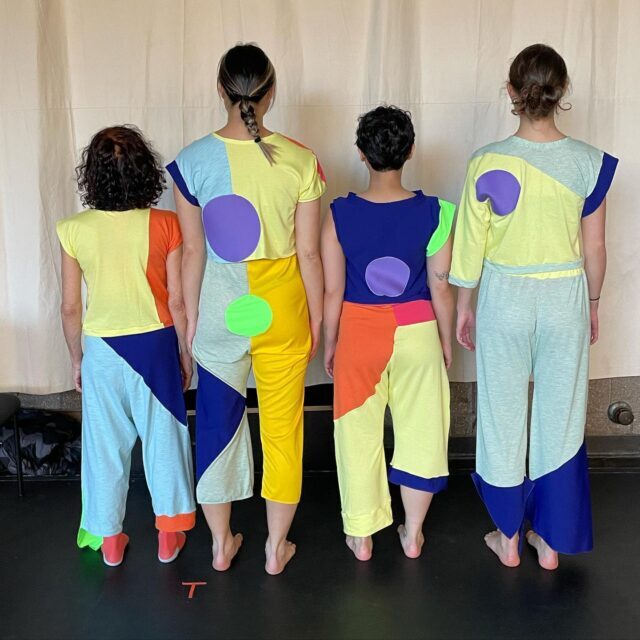
Jody Oberfelder, Grace Yi-Li Tong, Paulina Meneses, and Ashley Merker will perform Rube G. — The Consequence of Action at Gibney this month (costumes by Claire Fleury / photo courtesy Jody Oberfelder Projects)

RUBE G. — THE CONSEQUENCE OF ACTION
Gibney Dance Agnes Varis Performing Arts Center, White Box Studio C
280 Broadway between Chambers & Reade Sts.
Saturday and Sunday, March 4-5, 11-12, 18-19, $15-$25
jodyoberfelder.com
gibneydance.org

New York–based director, dancer, choreographer, and filmmaker Jody Oberfelder is the September 2023 entry in the Modern Women: 21st Century Dance Coloring Book calendar. On that page she says, “Standing on my head I see the world upside down. When I’m right side up, I look again with a different perspective.”

The quote is apropos of her latest piece, Rube G. — The Consequence of Action, making its world premiere March 4-19 at Gibney.

“Many of the younger generation know my name in a vague way and connect it with grotesque inventions but don’t believe that I ever existed as a person,” Rube Goldberg once explained. “They think I am a nonperson, just a name that signifies a tangled web of pipes or wires or strings that suggest machinery. My name to them is like a spiral staircase, veal cutlets, barber’s itch — terms that give you an immediate picture of what they mean.”

Reuben L. Goldberg (1883–1970) was an engineer, sculptor, inventor, author, and cartoonist who won the Pulitzer Prize in 1948 for his political cartoon “Peace Today,” a depiction of an American family and their house perched atop a giant atomic bomb that is tilting precariously at the edge of a cliff. But Goldberg is best known for his drawings of crazy contraptions in which a series of odd items must connect in a chain reaction in order to make something happen, like dominoes but with objects and animals.

In Adam Felber’s 2006 novel Schrödinger’s Ball, a character explains, “You know: a lever is pulled, causing a boot to kick a dog, whose bark motivates a hamster to run on a wheel which winds a pulley that raises a gate that releases a bowling ball and so on? Until, at the end, finally, the machine does something incredibly mundane, like making a piece of toast. Yes? Well, as it turns out, that’s the world.”

A fun, immersive, interactive view of the world and our place in it, Rube G. — The Consequence of Action features Grace Yi-Li Tong, Paulina Meneses, and Ashley Merker, joined by Detroit native Oberfelder, weaving in and around an audience of forty people sitting on stools spaced two feet apart, with music by klezmer trumpeter Frank London. There is light touching as the performers ask audience members to give them small pushes, as if we’re all objects in a Rube Goldberg machine, which the Rube Goldberg Institution for Innovation & Creativity says “solves a simple problem in the most ridiculously inefficient way possible.”

In May 2019, London put together “In Dreams Begin Responsibilities” at the New York Public Library, in which he selected a wide range of artists to pay tribute to such Jewish cultural figures as Hannah Arendt, Benjamin Cardozo, Morton Feldman, Susan Sontag, and Kurt Weill; Oberfelder was assigned Goldberg. She spent the next four years researching him, leading to the short film Rube G., the performance Rube G at Roulette, and Amphitheater in East River Park.

On a recent Monday afternoon, I was a “test guest” at a rehearsal for the new work, experiencing the piece and then talking about it afterward with Oberfelder, Yi-Li Tong, Meneses, Merker, and fellow test guest EmmaGrace Skove as Oberfelder took notes; she was particularly interested in a comment I made about one section reminding me of a pinball machine. Following the discussion, I spoke with Oberfelder — whose oeuvre also includes Madame Ovary, 4Chambers, Throb, The Soldier’s Tale, and The Title Comes Last — about Goldberg, working with new dancers, making connections, and her affinity for site-specific immersive presentations.
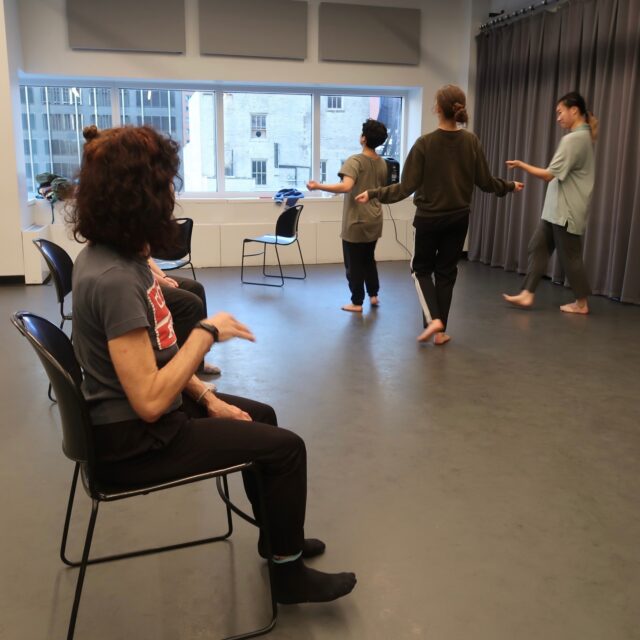
Jody Oberfelder watches team rehearse at Open Jar Studios in Midtown (photo by twi-ny/mdr)

twi-ny: In creating this work, did you have a specific fascination with Rube Goldberg himself or the Rube Goldberg machine?

jody oberfelder: I’m thinking of it in a larger context, like how one thing affects another. Frank London actually gave me the assignment in 2019. He had a thing about Jewish thinkers, philosophers, poets, writers. He had like twenty people on a program at the New York Public Library. And he assigned who got what. So I got Rube Goldberg. I knew about Rube Goldberg because when I was working on The Brain Piece, the neuroscientist who was teaching a class in illusion showed us the the Okay Go video [“This Too Shall Pass”], which is quite amazing. I think everybody knows about Rube Goldberg without knowing they know about Rube Goldberg. But now I’ve been researching who he was as a person and how he was of his time. The humor is very much Jewish humor too, like his comic strip “Foolish Questions.” He asks about how things affect each other and that’s a question that’s been in my choreographic toolbox. What interests me is intersections of people and ideas. And my medium is bodies. So this is really nice for me, instead of doing a purely conceptual piece to just work physically with awesome dancers.

twi-ny: You said Frank approached you in 2019, but I would’ve thought that it came out of the pandemic lockdown, when people couldn’t connect. But it was already in process.

j.o.: But that was different; it was more celebratory.

twi-ny: It has the same name, but it’s not the same?

j.o.: That one I called Amphitheater, because I knew I would do Rube G., and then we did the show at Roulette. It totally was about Rube Goldberg.

twi-ny: And you did the film also.

j.o.: The film was a total pandemic film. People said, Look, can’t we wear masks? I’m like, no. Because one day nobody’s going to want to see masks. I look at that film and it was everybody in their little boxes, they would go outside to dance. And I just strung them together with the same words that catalyzed this piece. Like “bounce lever carousel” is one, “slide slice.” So I just came up with the action words from studying Rube Goldberg machines that were posted online, the ones that people work on for a really long time and they jump up and down at the end. In fact, some of the sound score was ripped from YouTube. You can hear the dominoes falling.

twi-ny: So these are new dancers for you?

j.o.: Yes. And that’s what changed the piece.

twi-ny: In what way? Was it an open call?

j.o.: Yes, they’re from the audition that I had. I just thought start fresh, look around, see who’s out there. Ashley is my Gyrotonics teacher; she’s so beautiful when she teaches. I just said, Look, I’m thinking about adding in some new dancers. Do you want to come to the studio? And in a two-hour span of time, I made up a whole bunch of material with her; that was a no-brainer. And then I picked the other two from the audition I had.

twi-ny: Ashley just seems like a natural human connector.

j.o.: She danced with Doug Varone and she still dances with Jacqulyn Buglisi, but I had no idea. You don’t know until you get in the studio how someone will be with you. Each of them has their own quality. They’re not carbon copies of each other. They’re unique dancers. And they just went with the material. I had to stop inventing. Even Frank said, Jody, you’ve got too much material. Just stop inventing.
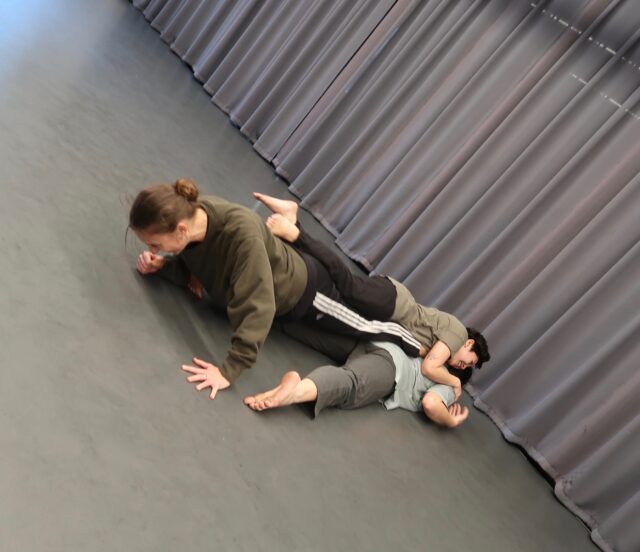
Grace Yi-Li Tong, Paulina Meneses, and Ashley Merker go horizontal mountain climbing in Rube G. — The Consequence of Action (photo by twi-ny/mdr)

twi-ny: You just want to keep watching them do something.

j.o.: Well, yeah. Now I want to do a pinball machine. I think we’ll have to do something as a transition where someone’s trying to get through and they get bounced back. That’s great.

I don’t like to get an idea from seeing someone in someone else’s piece, because they’ll be different. In fact, I did go see Ashley perform with somebody and I just said, She’ll be different with me.

twi-ny: Since the very beginning of your career, you’ve been into immersive, interactive, site-specific pieces, before it was a thing, a genre. What was the impetus?

j.o.: I’m pretty visual. And I like environments. If I look at the music stands in this room, there’s definite space around each one. [Gets up and walks around room] You get an idea from looking at the place that you’re in. [Returns to seat] The immersive stuff that I’ve been doing the last three years is very much like leading the audience on an experience so that they know what this space is, so that they’re going on a journey.

twi-ny: So that’s how you explore the spaces you’re in? Your mind automatically sees that.

j.o.: I applied for an NEA grant and hopefully we’re going to be partnering with Green-Wood Cemetery. That would be the next thing. I came up with a title before, and I have the location. It’s going to be called And then, no.

twi-ny: It’s a great place to see a performance.

j.o.: I’m also doing a piece called Walking to Present, which we’re doing in Munich, right on the site of a Trümmerberg, which is a trauma mountain. It’s at Olympiaberg in Olympic Park. What they did after World War II is they made these huge piles of rubble and just covered it with turf. And then they got the great idea to turn it into a park. And when, when the Olympics came in 1972, they made a beautifully scaled park. And that’s where the performance will take place.

So working on all this primed me to get back to Rube G. in a different way, so that it wouldn’t just be on the stage, there wouldn’t be a separation. It’s an experiment to see if I can be immersive inside, if I can make the room come alive as if it were an installation of people.

twi-ny: Right. As a test guest, that’s exactly what I felt.

j.o.: We’re all in this period where we need to lighten up and not be so hard on ourselves. And we’re in this period where a little goodwill, a little lightheartedness is important. There’s all this heavy stuff we have to think about daily. Walking to Present is a little more deep. But I hope I can find after this piece more lightness, even though the subject matter of walking through history and walking over history is heavy. Cemeteries are heavy, but, on the flip side, you can’t experience heaviness unless you have lightness.

twi-ny: You’re Jewish. Does that have anything to do with your choice of doing it in Munich [where eleven Israeli coaches and athletes were killed in a terrorist attack in the Olympic Village in 1972]?
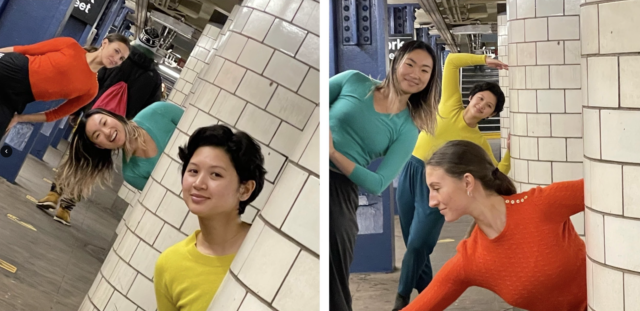
Jody Oberfelder Projects will become a dancing Rube Goldberg machine in world premiere at Gibney (photo courtesy Jody Oberfelder Projects)

j.o.: Definitely. I’m married to a German guy, so I’ve been going to Germany a lot, and I performed there in 1983, a solo concert in a club, three pieces. And this curator saw me and we’ve been in touch all these years. I was doing my piece Life Traveler with the suitcases, where it’s a one-on-one piece. And she got the gist of that and just said, We’d love you to be part of the [2023 Dance München] festival. So I feel really lucky to have that be in such good company. But Rube G. is its own piece. And it’s not an identity piece. It’s just what it is. It’s not a political statement, but it is kind of, because what would be political about it is what happens when people gather together. Either you resist and you’re destructive or you’re constructive.

twi-ny: Do you see Rube G. as a natural progression of your career or more of an outlier?

j.o.: Oh, well, I see this piece as both. It’s a return to the really athletic physical stuff I did for most of the first twenty years. I mean, I was very athletic. I didn’t dance until I was nineteen and I did gymnastics and water ballet. I was a cheerleader. You couldn’t get me to sit in a chair for over forty minutes.

So it’s a continuation of my exploration of physical possibilities. And it’s fed by the idea that the fourth wall has to come down. It’s just not interesting to me to dance on a stage unless it’s something with bells and whistles, visual opera. I heard a piano concert, Yuja Wang, and that was on a stage and I was riveted, I was part of it. There’s a way to put things on a stage and have the audience be part of it. But I like intimacy.

twi-ny: As an audience member at so many of your shows, I can say that’s one of the draws; you’re not going to just be sitting in the audience as an observer. You’re going to be involved. You might be physically touched, but you’ll certainly be emotionally and psychologically touched.

j.o.: Well, with these pieces that only forty people can attend, it’s hard to make a living. I have to do a benefit and hope people will come to that [on March 19]. Apply for grants . . . but I’m not complaining. I don’t stop working. I feel like dancers and artists, we work so hard, and our brilliance is something the world needs. The climate is making the world smaller. We’re all going to be suffering the same things. I hope I’m putting something really great in the world for people to experience.
tanzmainz: SHARON EYAL’S SOUL CHAIN

Soul Chain is an explosive Joyce debut for tanzmainz (photo by Andreas Etter/tanzmainz)

SOUL CHAIN
The Joyce Theater
175 Eighth Ave. at Nineteenth St.
January 24-28
212-691-9740
www.joyce.org
www.staatstheater-mainz.com

German-based tanzmainz makes its explosive Joyce debut with Sharon Eyal’s Soul Chain, fifty-five minutes of pure exhilaration and intensity, a thumping trance rave executed with a thrilling military-like precision. An international cast of seventeen fearless dancers first enters the empty stage on relevé, one, two, and three at a time, walking on tiptoes and the balls of their feet determinedly in Rebecca Hytting’s tight-fitting beige leotards, which run from shoulder to buttocks, most of the men bare-chested. Soon they are forming a hive or collective, part apian, part Borg, angulating their arms and legs with movements evoking insects; some collective members stand out by keeping an arm raised — or swiveling a head back and forth for a frightening amount of time — while the others dance in unison. (The brave company features Elisabeth Gareis, Daria Hlinkina, Cassandra Martin, Nora Monsecour, Amber Pansters, Maasa Sakano, Marija Slavec-Neeman, Milena Wiese, Zachary Chant, Paul Elie, Finn Lakeberg, Christian Leveque, Jaume Luque Parellada, Cornelius Mickel, Matti Tauru, Alberto Terribile, and Federico Longo.)

Alon Cohen’s stark lighting isolates individuals and cuts the stage in half, furthering the idea of a group and singular entities. Dancers occasionally break free and perform improvised solos that challenge the limits of physical possibility as Israeli composer and DJ Ori Lichtik’s original industrial techno score echoes through the theater, beating into your bones. Lichtik and Jerusalem-born choreographer Eyal of L-E-V, a former longtime Batsheva dancer and house choreographer, worked in conjunction with the dancers as the piece developed, establishing their own creative collective that ultimately links up with the audience. (To get in the mood, check out the accompanying Spotify playlist, consisting of forty songs that inspired the troupe.)

The night I went, the crowd didn’t want to leave at the end, joining together for three boisterous curtain calls, followed by an informative talkback with tanzmainz director Honne Dohrmann, dancers Monsecour and Longo, and Joyce marketing manager Nadia Halim, who shed more light on the process of making Soul Chain, emphasizing collaboration, protecting bodies, and Eyal’s goal of promoting passion and love and celebrating uniqueness amid longing and loneliness.

RONALD K. BROWN/EVIDENCE: OPEN DOOR/THE EQUALITY OF NIGHT AND DAY/GRACE

Ronald K. Brown’s The Equality of Night and Day makes its stunning NYC premiere at the Joyce this week (photo by Rose Eichenbaum)

Ronald K. Brown/EVIDENCE, a Dance Company
The Joyce Theater
175 Eighth Ave. at 19th St.
January 17-22, $51-$71
212-691-9740
www.joyce.org
www.evidencedance.com

“When I work, in all situations, people meet me and they say, ‘You create family wherever you go,’ and so I think I have a nurturing side but I demand a lot,” Brooklyn-based choreographer Ronald K. Brown explains in an Alvin Ailey video about the making of Open Door, a piece Brown made for Alvin Ailey American Dance Theater in 2015. “Why do you have to open the door, how do you open the door, this whole thing of easing, pushing through the door . . .”

Brown created a sense of family and community yet again when his troupe, EVIDENCE, a Dance Company, kicked off its home season at the Joyce on January 17. The program started, appropriately enough, with the company premiere of Open Door, which was inspired by Brown’s travels to Cuba. In front of a screen that changes colors (the lighting is by Tsubasa Kamei), Arturo O’Farrill’s eight-piece Afro Latin Jazz Ensemble performs Luis Demetrio’s “La Puerta,” Tito Puente’s “Picadillo,” and O’Farrill’s “All of the Americas” (from his “Afro Latin Jazz Suite”) and “Vaca Frita” as nine dancers move about the stage, led by solos and duets by Shaylin D. Watson and Isaiah K. Harvey. Originally commissioned for AAADT in 2015, it’s an uplifting twenty-six minutes, with the dancers often putting out their palms in gestures of welcome, beckoning not only fellow dancers but immigrants from Cuba and around the globe.

Open Door is just the right aperitif for the world premiere of The Equality of Night and Day (TEND), a sizzling emotional work in which Brown gets more explicit as he tackles his recurrent themes of social injustice and racism. Five men (Demetrius Burns, Austin Coats, Randall Riley, Christopher Salango, Harvey) and five women (Watson, Shayla Caldwell, Joyce Edwards, Stephanie Chronopoulos, Breana Moore), in loose-fitting flowing blue costumes by Omotayo Wunmi Olaiya, gather and separate to a powerful original score by pianist Jason Moran and the rallying words of activist and writer Angela Davis, who declared in a 2017 speech at Brown, “During the coming period, our primary job will be to build community, to create community — in ways that allow us to understand that the work that we do now does matter, even if we cannot see in an immediate sense the consequences of the work we are doing. It will matter eventually.”

Photos of protests from the last half century and more, curated by Debra Wills, are projected on the back screen, instilling a sense of immediacy in the proceedings, which are highlighted by poignant movement by Burns, Caldwell, and Edwards, the men at one point covering their faces and letting out primeval screams. Later the dancers remove their tops and walk around in a kind of memorial prayer for Black bodies, reacting to Davis’s facts about the racial imbalance in crime and punishment.

The evening concludes with Brown’s half-hour classic, Grace, an appropriate finale providing subtle elegance following the exuberance of Open Door and the psychological intensity of TEND. Commissioned for AAADT in 1999, the deeply spiritual piece begins with Edwards standing in a large doorway at the back of the stage; as opposed to the first two works, where the dancers often came onto the stage with a swagger, here they mostly walk on and off calmly, five women and six men in lovely white or red costumes by Olaiya. They strut out their elbows and their hands reach for the sky to songs by Duke Ellington, Roy Davis Jr., and Fela Kuti, spreading the energy to the audience.

Some years back, I saw Grace at the Joyce with Brown himself dancing a major role. The Bed-Stuy native saved one final, exhilarating moment for the curtain call on January 17, cementing the loving community he had built over the course of the program. He came onstage to uproarious applause, walking gently with a four-pronged cane and being helped by his partner and associate artistic director, Arcell Cabuag. Brown suffered a debilitating stroke in April 2021, at the age of fifty-four, shortly after a residency at Jacob’s Pillow to develop TEND, but has vowed to walk again on his own, and he is ahead of his doctors’ prognosis. The smile on his face was infectious, assuring everyone that there is a promising future to look forward to for all of us.

RONALD K. BROWN/EVIDENCE AT THE JOYCE

Ronald K. Brown/EVIDENCE presents New York premiere at the Joyce next week (photo by Rose Eichenbaum)

Ronald K. Brown/EVIDENCE, a Dance Company
The Joyce Theater
175 Eighth Ave. at 19th St.
January 17-22, $51-$71
212-691-9740
www.joyce.org
www.evidencedance.com

Discussing “the grief and the weight of everything that we feel,” choreographer Ronald K. Brown says, in a Jacob’s Pillow behind-the-scenes video of the making of his latest work, The Equality of Night and Day (TEND), “I want us to find that joy and make sure that everyone understands that this is the destination in the word equality. That it’s the destination of this kind of . . . serenity.”

Since 1985, Bed-Stuy native Brown has been choreographing illuminating works for his Brooklyn-based troupe, EVIDENCE, melding classical ballet and traditional West African movement to create powerful and exhilarating contemporary pieces steeped in social justice, honoring the ancestors, and celebrating community. Through January 15, Brown is curating American Dance Platform at the Joyce, featuring Les Ballet Afrik, B. Moore Dance, and waheedworks. “I remember the first time EVIDENCE, a Dance Company was on the Joyce stage over twenty years ago,” Brown writes in the program. “It was a monumental moment for us and I hope that these three companies will benefit from the exposure that the platform provides.”

Following American Dance Platform, EVIDENCE returns to the Joyce stage for its 2023 home season, presenting three works. Commissioned for Alvin Ailey American Dance Theater in 1999 and added to the EVIDENCE repertory in 2004, Grace is a rapturous tribute to Ailey’s legacy, set to music by Duke Ellington, Roy Davis Jr., and Fela Anikulapo Kuti. Also choreographed for AAADT, 2015’s Open Door will have its company premiere, a twenty-six-minute piece with live music by Arturo O’Farrill’s Afro Latin Jazz Ensemble.

The centerpiece is the New York premiere of TEND, which explores balance, equity, and fairness, with a score by pianist and visual artist Jason Moran, spoken word by Angela Davis, flowing costumes by Omotayo Wunmi Olaiya, set design and lighting by Tsubasa Kamei, and photographs curated by Debra Wills; the company consists of associate artistic director Arcell Cabuag, rehearsal directors Demetrius Burns and Shayla Caldwell, assistant rehearsal director Joyce Edwards, Stephanie Chronopoulos, Austin Coats, Isaiah Harvey, and Breana Moore, with guest artists Randall Riley, Christopher Salango, Shaylin D. Watson, Kirven Douthit-Boyd, Daniel Harder, Hannah Alissa Richardson, Annique S. Roberts, and Keon Thoulouis. There will be a Curtain Chat following the January 18 performance and a family matinee on January 21.

Don’t miss what is sure to be one of the highlights of the dance year. Brown/EVIDENCE knows how to get the crowd going like no other company; every time I see them feels monumental.