this week in dance

EMILY JOHNSON/CATALYST: THE THANK-YOU BAR

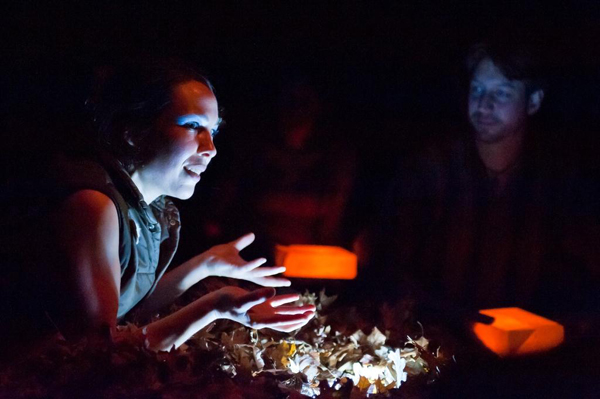
Emily Johnson offers the audience glowing surprises in THE THANK-YOU BAR (photo by Ian Douglas)

New York Live Arts
Bessie Schönberg Theater
219 West 19th St. between Seventh & Eighth Aves.
Through November 12, $15-$20
212-691-6500
www.newyorklivearts.org
www.catalystdance.com

Every once in a while, something comes along that’s so delightfully fresh and invigorating, so new, that you want to shout about it from the rooftop and out windows so everyone can know about it. (Well, at least in the old days. Now you can just write about it on your blog.) Emily Johnson’s The Thank-you Bar is just such an experience. To say too much about it would be giving it away, but for about an hour, Johnson and composers James Everest and Joel Pickard of BLACKFISH put on a dazzlingly original display of dance, video, live music, storytelling, and performance art, filled with surprises that at times engage the audience in the offbeat goings-on. Johnson is a charming performer and ringleader with a sly sense of humor, beaming with a contagious smile as she comments directly and indirectly on the very serious concepts of home and individual identity. A native Alaskan of Yup’ik descent, the Minneapolis-based Johnson has reconfigured the piece specifically for New York Live Arts, where it continues through Saturday night. We won’t say any more about it, but you can read Johnson discuss it in our twi-ny talk here.

TWI-NY TALK: EMILY JOHNSON

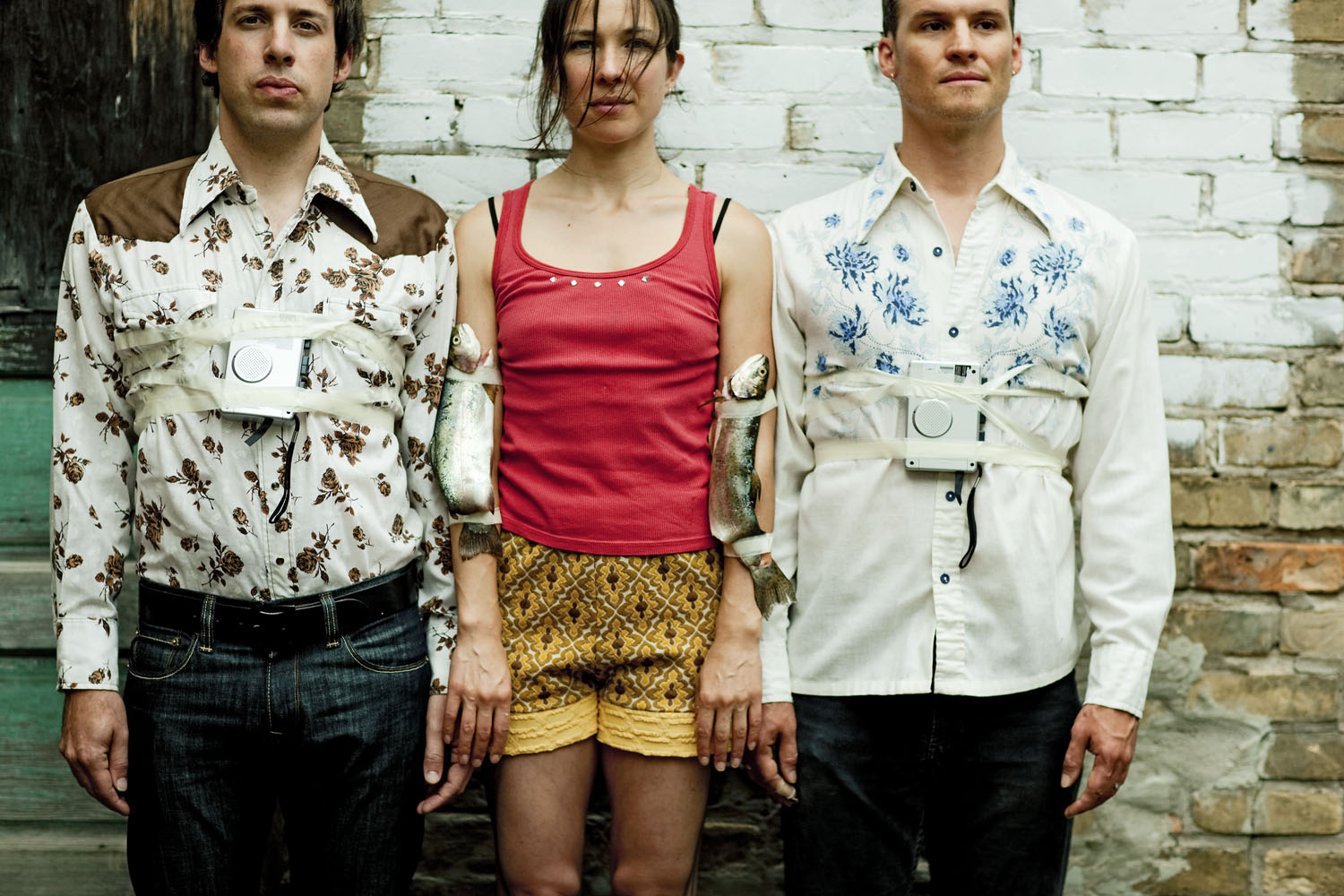
Emily Johnson explores home and heritage in THE THANK-YOU BAR (photo by Cameron Wittig)

THE THANK-YOU BAR
New York Live Arts
Bessie Schönberg Theater
219 West 19th St. between Seventh & Eighth Aves.
November 9-12, $15-$20
212-691-6500
www.newyorklivearts.org
www.catalystdance.com

“I want to make work that looks at identity and cultural responsibility — that is beautiful and powerful — full of myth and truth at the same time,” choreographer Emily Johnson explains in her mission statement. “I want to be grounded in my heritage, supported by my community, and giving back — always.” Born in Alaska of Yup’ik descent and based in Minneapolis, Johnson has been creating site-specific dance installations in collaboration with visual artists and musicians since 1998, exploring ideas of home, identity, and the natural world through different modes of storytelling. Her latest multimedia performance piece is The Thank-you Bar, running at New York Live Arts from November 9 to 12. A collaboration with musicians James Everest and Joel Pickard of BLACKFISH, who will play a special set on the final night, the performance installation also includes beadwork by Karen Beaver and paper sculptures by Krista Kelley Walsh. The extremely eloquent and thoughtful Johnson carefully considered our questions for our latest twi-ny talk; she will also participate in a preshow chat on November 9 with NYLA artistic director Carla Peterson as well as a discussion on November 11 with dancer-choreographer Reggie Wilson following the 9:30 show.

twi-ny: In her Context Notes about The Thank-you Bar on the New York Live Arts blog, Biba Bell is taken by your voiceover “What is becoming more clear to me is what I’m missing,” asking the questions “How many moments are passed, paused or pregnant with the sense of what is missed — something, someone, someplace? What do they sound like, smell like, and how do they feel?” What are some of the things you are missing, and how do they drive your artistic creation?

Emily Johnson: I said that — about the missing — because I am feeling years accumulate. What is absent is becoming an acute pain and it makes me feel old, most simply because of what has already gone by. I have missed my niece and nephew growing up because I was in Minneapolis, making dance, while they were in Alaska. I miss many, many mornings with my grandma — casual mornings of coffee, where we sit around, she doing crosswords until a story comes out. If I’m not around, I simply miss the story and I miss the time. And this creates the yearning — or heightens it, at the very least. I long for these stories. I long for the time with my elders, the time with my niece and nephew and rest of my family. And it points to what might not be: How much longer can I wait to learn the Yup’ik language, helped along by my grandma — the only one in my family who speaks it? How much longer can my body make do without feeling the ground of Alaska beneath my feet on a regular, day in and day out basis? What disservice do I do my life when I let these things pass me by?

Eventually, time runs out. Every summer I go home for the salmon run and I am trying to imprint the process of putting the salmon up (cleaning, smoking, kippuring, freezing . . .) into my brain so that when it comes my time to take charge of making it happen I will be able to do so. These are some of the things I am missing, and the absence and the longing are so real that it creates a new version of life. Biba’s questions about sounds, smell, feel — this is exactly what drives me. As I created The Thank-you Bar, a work very much about missing home/land, I thought about how our bodies miss, how our minds remember — not a scientific how, but a how related to our own perceptions of our experiences. When a thread of a Crystal Gayle song comes on, I am brought back to the jukebox at my grandma’s bar; when I think about the mountains near my Alaskan home, my chest aches and for some reason it also feels like I am diving into a very cold lake, exhilarating my being. And the thoughts about where and when also make me think of the future.

When I make dances, I try to imagine the future. I get curious about what images, reactions, or stories the audience might remember four days after seeing a performance. This leads me to structure dances with a focused attention on the smallest of details: what the audience might walk on as they enter the space, what they might smell during a particular story. . . . It makes me consider what I can leave out of the equation so as to let conjecture and interpretation have a role in the room.

Emily Johnson has teamed up with James Everest and Joel Pickard of BLACKFISH and others in THE THANK-YOU BAR (photo by Cameron Wittig)

twi-ny: The Thank-you Bar and its companion exhibit, “This Is Displacement,” explore the idea of home. You were born in Alaska, you’re based in Minneapolis, and you’re now presenting the New York premiere of a work that has previously been performed in Oklahoma, Houston, and other locations. Where is home for you?

Emily Johnson: The most specific, locating answer is that I have two homes: one in Minneapolis, the other in Alaska. I love both places, and the home in Minneapolis is actually more concrete: it has my stuff in it. The home in Alaska feels expansive and like it goes on for thousands of years, probably because it doesn’t actually have any walls. I don’t have a living space in Alaska, but it’s where I come from and where I continually return to.

To be honest, I try to build another home for myself and audiences in The Thank-you Bar. Does this mean I am searching? Does this mean I believe we can adapt to any longing, and dislocation? I build the home by trying to bring attention to the building we are in and the people who are gathered in the room. I try to imagine the walls gone; I try to imagine what was here before the current incarnation. I want the feeling of “home” to lead to a kind of intimacy so that people feel comfortable, responsible even, for it. I think we tend to look at things as static when, in reality, our bodies and places house past, present, and future, at once. It’s anything but static and it’s kind of exciting to tap into.

twi-ny: You collaborated with James Everest and Joel Pickard of BLACKFISH on The Thank-you Bar, and the duo will be playing a special concert on November 12. What is it about their music that draws you to them and made you want to work with them?

Emily Johnson: BLACKFISH music is dramatically mind altering for me. When James [Everest], Joel [Pickard], and I started work, part of our process was to improvise together in a room, daily. We’ve continued that process, as much as we can when we tour, and out of it James and Joel created their project, BLACKFISH. As BLACKFISH, they perform improvised concerts in conjunction with our tours. I love their concerts — and I love that they’ve developed this entire project out of The Thank-you Bar. On the twelfth, they’re releasing a gorgeous limited edition, letter-pressed, eight-CD collection of some of the concerts they’ve recorded over the past two years. John Scott heard their concert in Vermont this summer and has since worked with them for music for his new work. He very endearingly asked my permission first.

In The Thank-you Bar, they don’t play as BLACKFISH; they play as James and Joel. What I most appreciate about them is their specificity and dedication to improvisation. The music they composed for The Thank-you Bar is set; it came from improvisations, from bouts of memory and discussions of the jukebox I mentioned (that at my grandma’s was filled with classic country). The sound of dislocation and rerouting to find home is what they built for The Thank-you Bar. It makes me want to work with them again and again.

One day, early in the process, I was rehearsing in a separate studio. I came down and they told me to sit on the floor. They proceeded to play music that layered inch by inch and sound by sound, as they appeared and disappeared, until a reverberating chorus echoed off the walls. I remember slapping the floor and exclaiming/laughing at the genius of it. Them: missing. Music: building. We’ve kept it. They basically choreographed the beginning of the dance.

TWI-NY TALK: LAURA PETERSON

Laura Peterson goes environmental with WOODEN (photo by Steven Schreiber)

HERE
145 Sixth Ave. at Dominick St.
November 4-12, $20
212-647-0202
www.here.org
www.lpchoreography.com

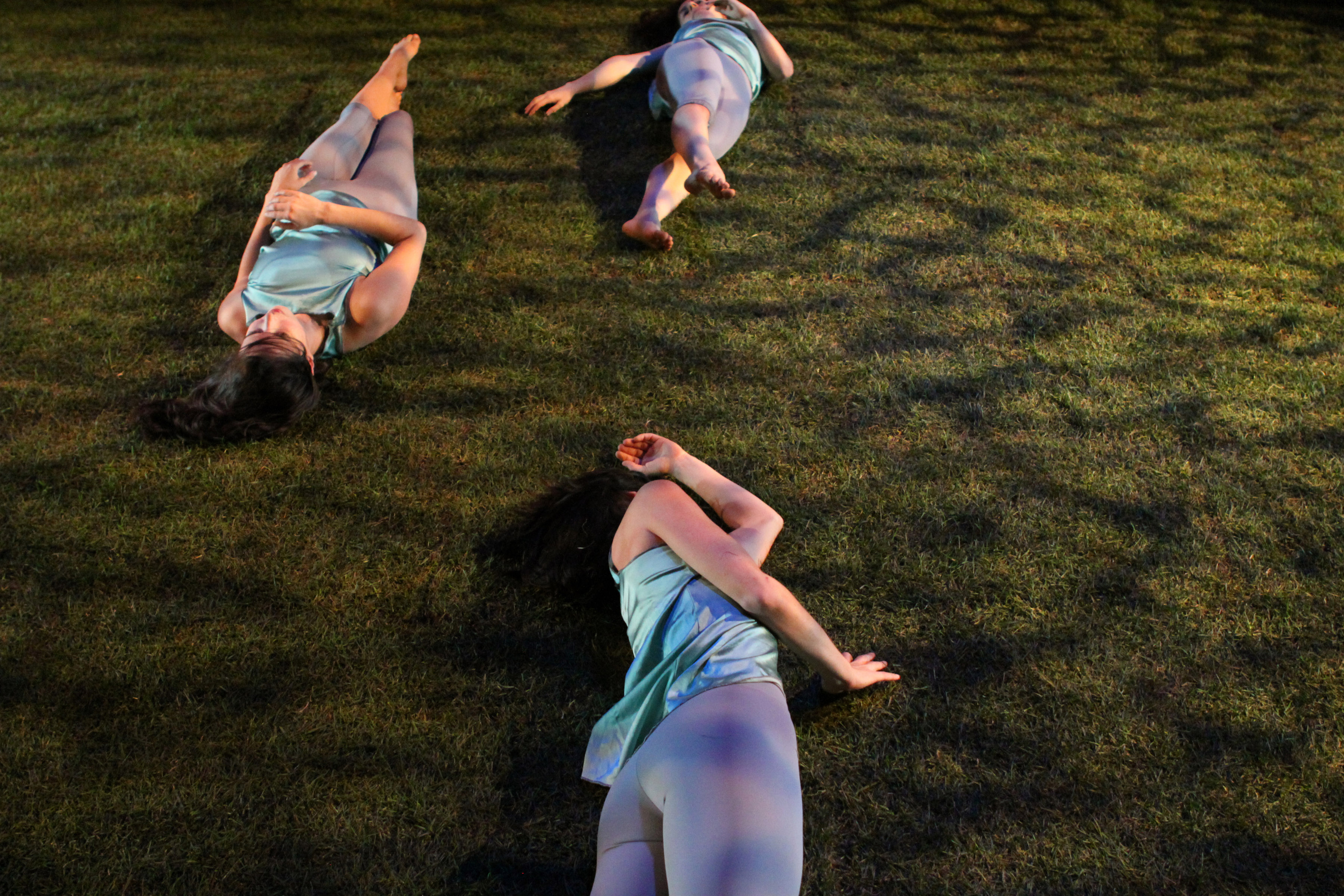
Last January, Laura Peterson Choreography presented Wooden as part of HERE’s annual Culturemart festival. The work-in-progress, which uses real grass and trees in creating living environments in which a quartet of dancers — Peterson, Kate Martel, Edward Rice, and Janna Diamond — perform, officially opened this past Friday, beginning an eight-show run that continues at HERE through November 12. Consisting of three parts, “Ground,” “Trees,” and “Corridor,” Wooden examines time and nature, inspired by earthworks and taking place on a biodegradable set. There will be a special panel discussion, “Dance, Installation, and Repurposing,” following the November 9 performance, in which Peterson will talk about her creative process. Just as she prepared for opening night, Peterson, who teaches classes at Dance New Amsterdam, answered some questions for twi-ny as curtain time beckoned.

Edward Rice, Laura Peterson, and Janna Diamond in WOODEN (photo by Steven Schreiber)

twi-ny: When we first met back in January, you were extremely nervous, putting together Wooden for Culturemart. How are the nerves as the piece is ready for its first official performances this week at HERE?

Laura Peterson: I am so happy with Wooden. When we performed the dance on the grass at Culturemart in January, I had no idea how it would behave, what it would be like to install a living lawn or what it would feel like for our bodies to dance on. We learned that it lives and grows and needs water every night. Dancing on the grass is so much more difficult that dancing on a normal floor. Sliding doesn’t really happen, turning is very precarious, and the effort of moving on an uneven terrain is very intense. We figured all of these things out through Culturemart and everyone is much calmer.

twi-ny: How has Wooden changed since then?

Laura Peterson: Most of the choreography that we performed in January 2011 has been reworked. Because HERE provides the opportunity of the Culturemart festival to workshop the pieces by members of the HERE Artist Residency Program, we are able to see the problems in a piece before full production and address them. The sound score is very different, the costumes are a little different, and we are also performing part of the dance we developed in 2010. This section is performed in a barren landscape with hanging driftwood trees while the audience is sitting on the lawn in the second half of Wooden. There is an installation and a soloist as the audience enters, which is brand new as well. It’s called “Corridor,” and it is performed by several different dancers throughout the performance run.

twi-ny: You incorporate environmentally friendly earthwork into Wooden. How did you go about selecting the material? Did you have any primary influences when designing the installation itself?

Laura Peterson: I was first inspired to create this dance in 2009 when I was looking at outdoor installation work and natural architecture. I am often influenced by visual art, and I started seriously looking at earthwork and pieces made from natural materials. I found myself thinking that those pieces are meant to change, as they are subject to time and weather. This was around the time that my dance called Forever was being performed on a large set consisting of a white circular platform made from forty-eight triangles. After the performances of Forever ended and we were loading out, I thought about how much I was throwing away after a show closes and it really bothered me. Luckily, some of those triangles became tables in our friend’s restaurant, but only using something for a week and letting it go into a Dumpster stuck with me. I decided that using biodegradable materials was going to be part of my concept in Wooden. I wonder if the audience will consciously realize they are sitting on and among natural and ecologically sensitive materials. We are going to find out.

FIRST SATURDAY — SANFORD BIGGERS: SWEET FUNK—AN INTROSPECTIVE

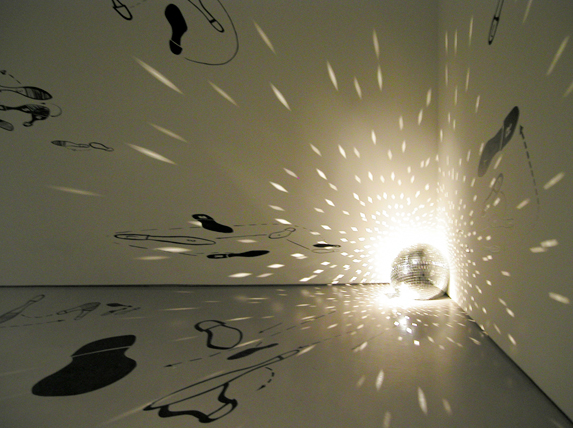
Sanford Biggers, “Calenda (Big Ass Bang!),” pure pigment, mirrored disco ball, 2004 (courtesy of the artist and Michael Klein Arts, New York)

Brooklyn Museum
200 Eastern Parkway
Saturday, November 5, free, 5:00 – 11:00 (some events require free tickets distributed in advance at the Visitor Center)
212-864-5400
www.brooklynmuseum.org

The exhibition “Sanford Biggers: Sweet Funk—An Introspective” is at the center of the Brooklyn Museum’s free First Saturday program for November, focusing on the sociocultural, history-laden work of the L.A.-born, New York-based multidisciplinary artist, who will be on hand to give an artist talk at 8:00. The evening also includes live performances by Navegante, Ninjasonik, Kanene Holder (400 Years of GRRRRRR), and Imani Uzuri, a screening of Charles Burnett’s To Sleep with Anger, an artist talk with Matthew Buckingham about his installation “The Spirit and the Letter,” a curator talk with Teresa Carbone on “Youth and Beauty: Art of the American Twenties,” a book club talk and signing with Paul Beatty (The White Boy Shuffle), and a dance party hosted by DJ Rich Medina with Jump N Funk paying tribute to Fela Kuti, Afrobeat, and world music. Among the other exhibitions on view are “Raw/Cooked: Kristof Wickman,” “Lee Mingwei: ’The Moving Garden,’” “Eva Hesse Spectres 1960,” “Timothy Greenfield-Sanders: The Latino List,” “reOrder: An Architectural Environment by Situ Studio,” and “Split Second: Indian Paintings.”

MARIA HASSABI: SHOW

The Kitchen
512 West 19th St. between Tenth & Eleventh Aves.
November 3-5, $15, 8:00
212-255-5793
www.thekitchen.org
www.mariahassabi.com

One might think that Maria Hassabi’s latest piece, SHOW, is the final part of a trilogy that began at the fall 2000 Crossing the Line Festival with SOLO, in which she performed with a rolled-up carpet, and continued that November at Performa 09 with SoloShow, in which she performed on a black rectangular platform. But in fact, the first two were part of a dance diptych that have nothing to do with her newest work, SHOW, an installation-based collaboration performed by Hassabi and Hristoula Harakas, with lighting by Joe Levasseur, sound design by cellist Alex Waterman (of Either/Or and the Plus-Minus Ensemble), set design by Hassabi and Canadian visual artist Scott Lyall, and dramaturgy by Lyall and experimental Waco-born Brooklyn artist Marcos Rosales. The Cyprus-born Hassabi also serves as director and choreographer, with Meghan Finn the production manager. Both Hassabi and Harakas display remarkable dexterity, which is likely to be on view throughout the sixty-minute SHOW, which runs November 3-5 at the Kitchen. As Hassabi told us in our recent twi-ny talk, “I was born flexible! Then I slept all the way until I went onstage! You know, muscle atrophy helps!”

Update: Maria Hassabi’s SHOW, which opened at the Kitchen on November 3 for a too-brief three-day run, has the welcome feel of those experimental performance-art happenings staged at such venues as the Kitchen some forty or so years ago. Incorporating elements from her three most recent works, Solo, SoloShow, and Robert and Maria,, Hassabi has again teamed with Hristoula Harakas to create a deeply intimate and extremely entertaining evening of dance theater. SHOW’s audience enters an empty black-box space where the Kitchen’s multileveled seating usually is; instead, the floor is sparse, save for about sixty Klieg lights gathered to one side, with another forty or so on the ceiling, casting brightness into the space. People can sit or stand anywhere they want.

For more than an hour, Hassabi and Harakas slowly maneuver through the crowd, their gaze locked on one another, sometimes appearing to be mirror images of each other, moving with excruciating precision and slowness. The two perform a dramatic duet that fills the space with magnetic energy. SHOW develops as an in inquiry between audience and performer, performance space and emotional space. The audience members, who have become unwitting participants in the event, can barely take their eyes off the dancers — except when looking at each other. SHOW is a brilliant, often erotically charged evening-length piece performed by two dynamic, brave dancers unafraid to take risks, involving the audience in unique and, at times, demanding ways.

Although we were told to turn off our electronic devices, many audience members took pictures or video; on opening night, one woman took video on her iPhone of the entire performance, moving about the room, occasionally blocking people’s site lines and getting them in the shots. We later learned that Hassabi herself had asked some friends (including the woman on the iPhone) to take pictures, hoping it would spur others to do so as well. Although we can understand why Hassabi would want to document the show in that way, the many cell phones proved extremely distracting. In addition, Alex Waterman’s sound design of the chatter, which is continually rerecorded over itself to make it muddier and more abstract, is too short; every time it starts again from the beginning, there is a hiccup that is slightly jarring. Nonetheless, SHOW is a captivating experience that is best seen with complete focus; check your coat and bag (it gets very hot inside with all of the lights, and bags can get in the dancers’ way), and don’t pull out your cell phone to snap a photo or two. Instead, just immerse yourself in this very beautiful happening.

CHUNKY MOVE: CONNECTED

Chunky Move collaborates with sculptor Reuben Margolin in CONNECTED (photo by Jeff Busby)

The Joyce Theater
175 Eighth Ave. at 19th St.
November 2-6, $10-$49
212-691-9740
www.joyce.org
www.chunkymove.com

One of the most inventive and innovative contemporary dance companies in the world, Australia’s Chunky Move will be staging the New York premiere of the hour-long Connected November 2-6 at the Joyce. A collaboration between company artistic director Gideon Obarzanek and California sculptor Reuben Margolin, Connected eschews Chunky Move’s usual fascination with digital technology, kinetic motion tracking, and brilliant light displays in favor of a more hands-on approach to building a work of art with dancers and physical, graspable objects. We can’t get enough of this company, having seen the decidedly low-tech I Like This in April at Joyce SoHo, Mortal Engine at BAM in 2009, and Glow at the Kitchen in 2008. Connected is performed by five dancers — Sara Black, Ross McCormack, Marnie Palomares, Joseph Simons, and Harriet Ritchie — with music by Oren Ambarchi and Robin Fox, lighting by Benjamin Cisterne, and costumes by Anna Cordingley. “I was fortunate to meet Reuben Margolin in October, 2009 in Maine USA, where we were both invited to speak at PopTech, a conference focusing on social change through current innovations in science, art and economics,” explains choreographer Obarzanek in a program note. “There, I witnessed Reuben’s various sculpture machines made of wood, recycled plastic and steel transcend their concrete forms once they were set into motion and appear as waveforms in nature — a weightless kinetic flow. This was not dissimilar to the changeability of a dancer from a person to a moving figure when performing on stage. We were immediately drawn to each other’s work and began discussing possibilities for future collaboration.” Connected is the initial result of that partnership.

Dancers move in, under, and around Reuben Margolin’s sculpture in CONNECTED (photo by Jeff Busby)

Update: Chunky Move founder and artistic director Gideon Obarzanek and his Australian company regularly employ gadgetry in their works. Glow consisted of a single dancer performing on a motion-sensor floor that emitted a dazzling LED display, Mortal Engine let loose with a spectacular flurry of smoke and lasers and other special effects, and I Like This was built around a group of individuals toying with old-fashioned handheld lights. For his latest work to come to New York, Connected, Obarzanek has collaborated with California sculptor Reuben Margolin, who has designed a large-scale loomlike object, complete with spinning wheel, that lies at the heart of the evening-length piece. Four dancers dressed in black (Ross McCormack, Harriet Ritchie, Joseph Simons, and Sara Black) and one in white (Marnie Palomares) move about the dominant kinetic installation, with McCormack, soon joined by Palomares, adding white pieces of recycled plastic to the bottom of a cubelike structure composed of hundreds of wires hanging from above while the other dancers whirl their arms and writhe on the floor to Oren Ambarchi and Robin Fox’s electronic score, which at times seems to include homemade DIY percussion sounds. When several of the dancers are attached to the wires coming out of the wheel so that every surge backward or forward, every arm lift and twist, alters the shape of the cube, Palomares moves beneath it, as if she is creating the resulting waves and forms herself. It’s an unusual and exciting sight, but the narrative shifts about halfway through as the dancers change outfits and become museum security guards protecting a work of art, talking about their jobs and saying things like, “Oh, I could do that” and “I’m never bored because I’ll always find something to do.” Unfortunately, this second half of Connected is far less interesting than the first section, as if Obarzanek wasn’t quite sure what else to do with Margolin’s sculpture, deciding to call attention to its artiness instead of creating more dances around and within it. Still, there’s much to admire about Connected, which also requires the audience to remain connected; there is no intermission during the sixty-minute piece, and the audience is told beforehand that if they leave the theater at any time during the performance, they will not be allowed back in.

PERFORMA 11: NEW VISUAL ART PERFORMANCE BIENNIAL

Elmgreen & Dragset’s HAPPY DAYS IN THE ART WORLD kicks off the fourth edition of the Performa biennial, which runs November 1-21 all over the city

Multiple venues in all five boroughs
November 1-21, free – $75
www.11.performa-arts.org

More than a hundred venues will be hosting cutting-edge experimental productions at Performa 11, the fourth edition of the biennial multidisciplinary arts festival being held all over the city November 1-21. Featuring art, music, dance, theater, film, architecture, and more in exciting combinations, the three-week festival consists of long-term exhibitions, special one-night stands, and other limited engagements that push the envelope of contemporary performance. Elmgreen & Dragset revisit Beckett in Happy Days in the Art World at the Skirball Center, with Joseph Fiennes and Charles Edwards. L’Encyclopédie de la parole’s Chorale turns political speeches, text messages, and movie quotes into choral works at the Performa Hub on Mott St. Rashaad Newsome holds a medieval rap joust Tournament in conjunction with his new exhibit at Marlborough Chelsea. Anthology Film Archives screens rare footage of one of Lenny Bruce’s last performances, as well as routines by Richard Pryor, Albert Brooks, and Andy Kaufman. Innovative installation artists Mika Rottenberg and Jon Kessler team up to create the chakra sauna Seven at Nicole Klagsbrun Project Space. Matthew Stone journeys into shamanism at the Hole. Mai-Thu Perret’s Love Letters in Ancient Brick at the Joyce SoHo reimagines Krazy Kat as a love-triangle dance. Dripping paint drives Jonathan VanDyke’s storefront drama With One Hand Between Us at Scaramouche. Israeli collective Public Movement choreographs public demonstrations in various parks for Positions. Daido Moriyama restages his thirty-year-old Printing Show—TKY at the Aperture Foundation. Deaf artist Christine Sun Kim will go from audio to visual with Lukas Geronimas in Feedback at Recess. Liz Glynn’s Utopia or Oblivion: Parts I and II will take place in several outdoor venues, using Buckminster Fuller’s geodesic dome as inspiration. Raphael Zarka mixes skateboarding and sculpture in Free Ride at the Performa Hub. Gerard Byrne turns the Abrons Arts Center into an interactive theater for In Repertory. Varispeed’s Perfect Lives Manhattan is an all-day performance of Robert Ashley’s opera. Performa Ha! gathers comedians and musicians at the HA! comedy club. And that’s only the first week of this outstanding collection of diverse talent and unique performances, with many of the events free.