Pavel Zuštiak + Palissimo Company complete the Painted Bird trilogy with Strange Cargo, taking place Thursday through Sunday, May 3-13, at the Cathedral Church of St. John the Divine. Presented by PS 122 in the cathedral’s Synod Hall, Strange Cargo, the follow-up to Bastard (La MaMa, November 2010) and Amidst (Baryshnikov Arts Center, June 2011), concludes the multimedia production inspired by Jerzy Kosinski’s 1965 novel about a boy wandering around European towns during WWII and ultimately searching for home. The piece is once again directed and choreographed by Zuštiak, with live music composed and performed by Christian Frederickson and Ryan Rumery, lighting by Joe Levasseur, set by Peter Ksander, costumes by Asta Hostetter, and video design by Keith Skretch and Manny Pallad. The company consists of Giulia Carotenuto, Lindsey Dietz-Marchant, Luke Murphy, Denisa Musilova, and Jeremy Xido. On May 5 at 5:30, there will be a free, experimental public forum, “A Long Table on Migration & Displacement,” led by Masha Pyshkina, with sweets from the Hungarian Pastry Shop; advance reservations are strongly recommended.
this week in dance
IVY BALDWIN: AMBIENT COWBOY

Ivy Baldwin’s AMBIENT COWBOY premieres this week at New York Live Arts
New York Live Arts
219 West 19th St. between Seventh & Eighth Aves.
May 2-5, $15-$20, 7:30
212-691-6500
www.newyorklivearts.org
www.ivybaldwindance.org
In such works as Here Rests Peggy and Bear Crown, Brooklyn-based dancer and choreographer Ivy Baldwin has combined a unique sense of space with sonic and architectural elements to create highly emotional and physical pieces. Her latest evening-length work, Ambient Cowboy, which is having its world premiere May 2-5 at New York Live Arts, was inspired by master architect Philip Johnson’s Glass House in New Canaan, Connecticut, a National Historic Site with structures that have no interior walls, only glass exteriors. Ambient Cowboy will be performed by Baldwin, Molly Poerstel, Lawrence Cassella, and Eleanor Smith, with sound design by Justin Jones, lighting by Chloë Z Brown, and a live, evolving set by painter and installation artist Anna Schuleit that changes every night. The May 2 show will be preceded by a talk with Ryan Tracy, while the May 4 performance will be followed by a discussion with Brian Brooks.
CHUNKY MOVE: FAKER
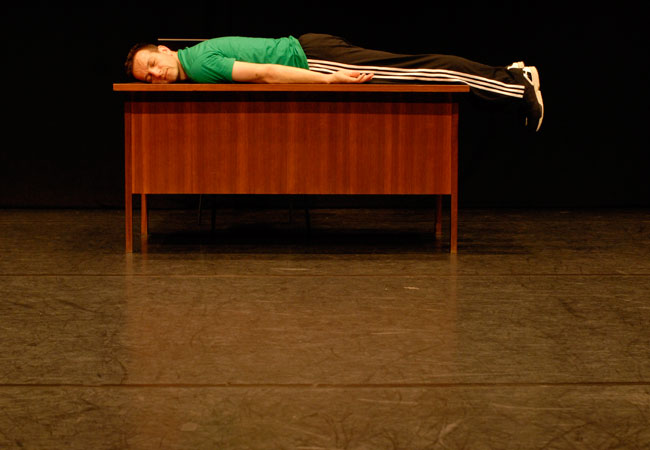
Chunky Move founder Gideon Obarzanek wonders what it’s all been about in FAKER (photo by Heidrun Lohr)
Joyce SoHo
155 Mercer St. between Houston & Prince Sts.
April 25-29, May 2-6, $22
212-242-0800
www.joyce.org
www.chunkymove.com
Since 1995, when he founded the Australian company Chunky Move, artistic director Gideon Obarzanek has been creating unique and unusual pieces that range from the extremely high-tech (Mortal Engine) to the charmingly low budget (I Like This) to the technologically cutting edge (Glow.) As he prepares to hand over the reins of the company to new artistic director Anouk van Dijk this July, he is saying farewell by starring in a production for the first time in ten years, the deeply personal solo show Faker. Beginning with Obarzanek sitting at a desk reading an e-mail he received from a young dancer, he roams about the stage, questions his abilities, looks back at his successes and failures, and wonders what it has all been about. Faker runs Wednesday through Sunday the next two weeks; you can find out even more about Obarzanek when he participates in a Q&A following the April 27 performance.
BAC FLICKS: CARMEN & GEOFFREY
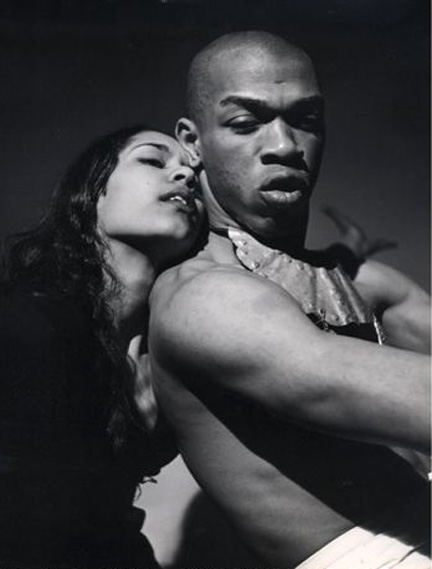
The life of Carmen de Lavallade and Geoffrey Holder is examined in low-budget documentary
CARMEN & GEOFFREY (Linda Atkinson & Nick Doob, 2006)
Baryshnikov Arts Center, Jerome Robbins Theater
450 West 37th St. between Ninth & Tenth Aves.
Tuesday, April 24, $15, 7:00
866-811-4111
www.bacnyc.org
firstrunfeatures.com
 Carmen & Geoffrey is an endearing look at Carmen de Lavallade and Geoffrey Holder’s lifelong love affair with dance — and each other. The New Orleans-born de Lavallade studied with Lester Horton and went to high school with Alvin Ailey, whom she brought to his first dance class. Trinidadian Holder is a larger-than-life gentle giant who is a dancer, choreographer, composer, costume designer, actor director, writer, photographer, painter, and just about anything else he wants to be. The two met when they both were cast in Truman Capote and Harold Arlen’s Broadway show House of Flowers in 1954, with Holder instantly falling in love with de Lavallade; they’ve been together ever since. Directors Linda Atkinson and Nick Doob combine amazing archival footage — of Eartha Kitt, Josephine Baker, Ulysses Dove, de Lavallade dancing with Ailey, and other splendid moments — with contemporary rehearsal scenes, dance performances, and interviews with such stalwarts as dance critic Jennifer Dunning, former Alvin Ailey artistic director Judith Jamison, and choreographer Joe Layton (watch out for his eyebrows), along with family members and Gus Solomons jr and Dudley Williams, who still work with de Lavallade. The film was made on an extremely low budget, and it shows, but it is filled with such glorious footage that you’ll get over that quickly. Carmen & Geoffrey is screening April 24 at 7:00 at the Baryshnikov Arts Center, with a panel discussion to follow, as part of the “BAC Flicks” series, which continues May 30 with Matt Wolf’s 2008 documentary, Wild Combination: A Portrait of Arthur Russell.
ANNUALS, BIENNIALS, TRIENNIALS
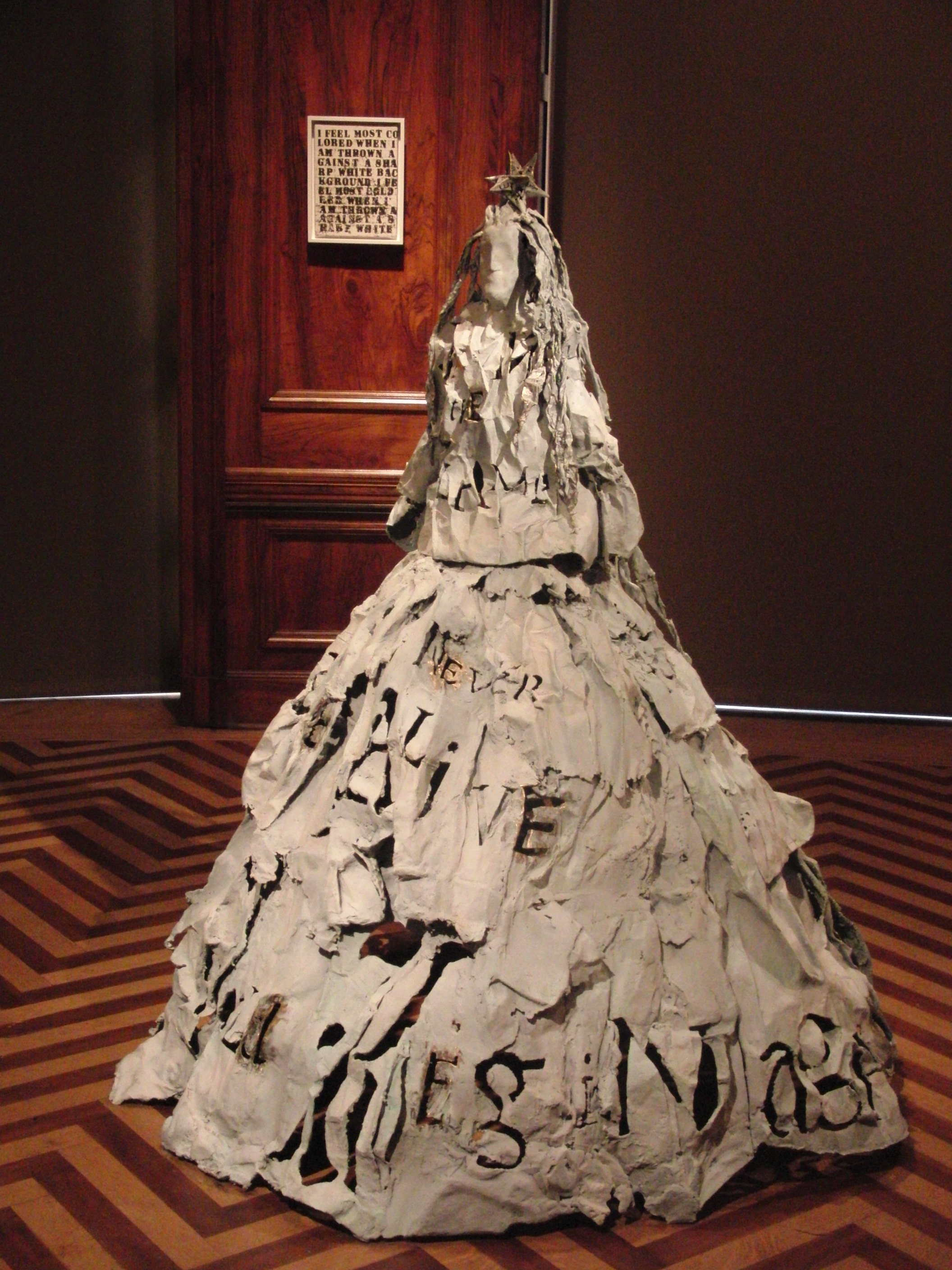
Lesley Dill’s “Woman in Dress with Star” and Glenn Ligon’s untitled oil painting are cleverly juxtaposed at 2012 Annual (photo by twi-ny/mdr)
THE ANNUAL: 2012
National Academy Museum
1083 Fifth Ave. at 89th St.
Wednesday – Sunday through April 29, $12, 11:00 am – 6:00 pm
212-369-4880
www.nationalacademy.org
In an artistic convergence that occurs only once every six years, the National Academy’s annual, the Whitney’s biennial, and the New Museum’s triennial are all on view at the same time. And in a perhaps unexpected convergence, all three reveal that less is more with shows that avoid jam-packing galleries with brand-name artists and instead concentrate on fewer works with a focus on installation. At the National Academy, a mix of cross-generational academicians and invited non-academicians makes for an effective examination of contemporary American art, albeit through a more traditional lens than at the biennial and the triennial, using juxtaposition as a means to an end. Figurative paintings by Burton Silverman, Daniel Bennett Schwartz, Gillian Pederson-Krag, and Philip Pearlstein are seen alongside abstract works by Dorothea Rockburne, Richard Mayhew, David Driskell, and Eric Aho. Sculptures by Barbara Chase-Riboud, Jeffrey Schiff, and Arlene Shechet line the center of a hallway of paintings. Lesley Dill’s “Woman in Dress with Star” stands in front of Glenn Ligon’s untitled oil painting, each incorporating text. The annual also includes a trio of video installations: Joan Jonas’s “Lines in the Sand,” Kate Gilmore’s “Break of Day,” and Carrie Mae Weems’s three-channel “Afro-Chic,” which keeps the funk pumping on the second floor. The 2012 Annual is the best the National Academy has put on in several years.
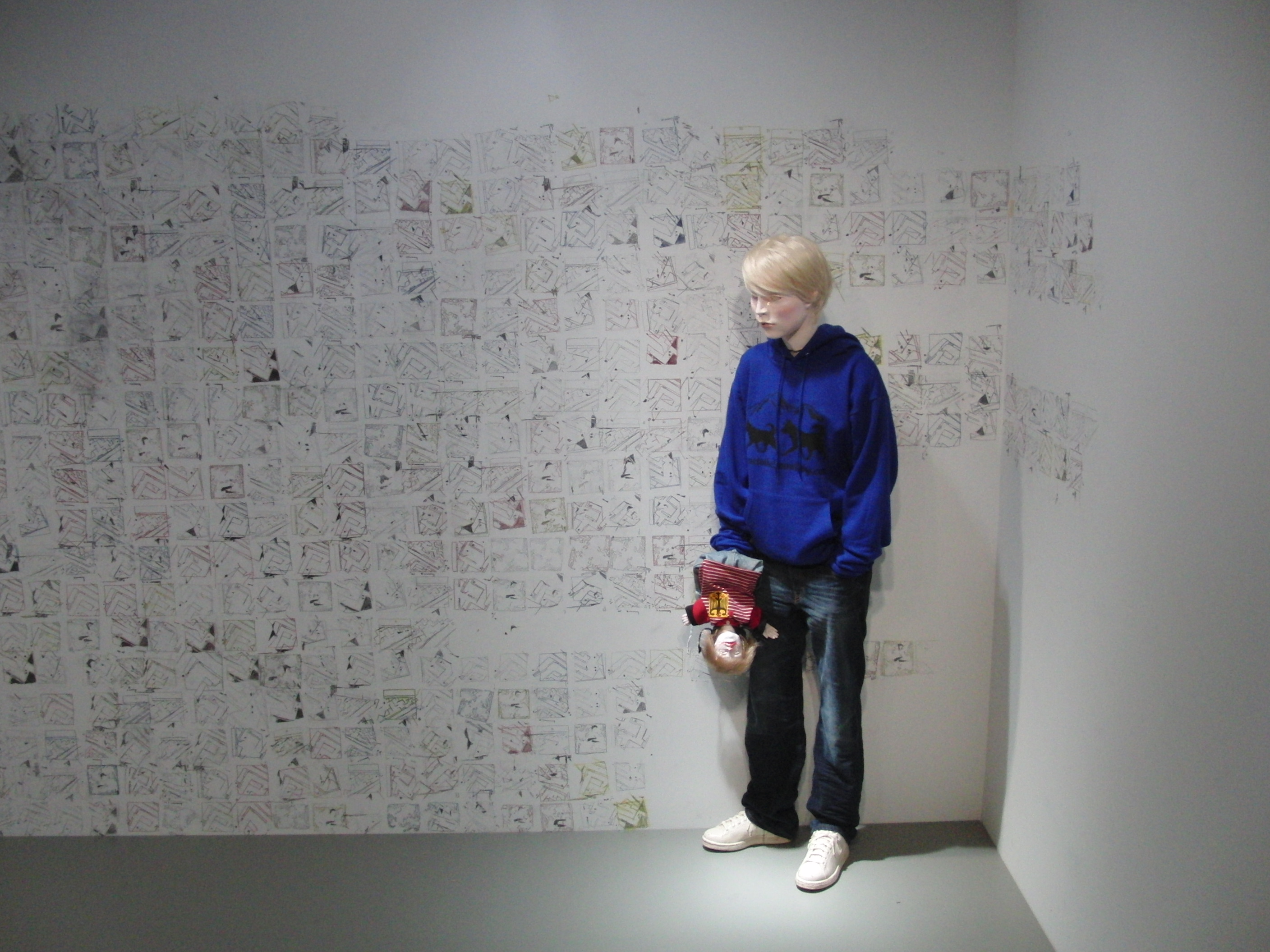
Gisèle Vienne with Dennis Cooper, Stephen O’Malley, and Peter Rehberg, “Last Spring: A Prequel,” mixed-media installation, 2011 (photo by twi-ny/mdr)
WHITNEY BIENNIAL 2012
Whitney Museum of American Art
945 Fifth Ave. at 75th St.
Wednesday – Sunday through May 27, $12, 11:00 am – 6:00 pm (pay what you wish Fridays 6:00 -9:00)
212-570-3600
www.whitney.org
“Art discourse serves to maintain links among artistic subfields and to create a continuum between practices that may be completely incommensurable in terms of their economic conditions and social as well as artistic values,” Andrea Fraser writes in “There’s no place like home,” an essay that serves as her contribution to the 2012 Whitney Biennial. “This may make art discourse one of the most consequential—and problematic—institutions in the art world today, along with mega-museums that aim to be all things to all people and survey exhibitions (like the Whitney Biennial) that offer up incomparable practices for comparison.” As it turns out, curators Elisabeth Sussman and Jay Sanders have not turned the biennial into all things for all people, instead putting together a manageable collection of contemporary American art that leans heavily toward performance and installation, showing off the space of the Marcel Breuer building instead of cluttering every nook and cranny with anything and everything. Visitors can walk through Oscar Tuazon’s “For Hire,” Georgia Sagri’s “Working the No Work,” and Wu Tsang’s “Green Room” and watch the New York City Players get ready for Richard Maxwell’s new site-specific play in an open dressing room. Gisèle Vienne’s “Last Spring: A Prequel” features a young animatronic teen standing in a corner, mumbling text by Dennis Cooper. More traditional art forms like painting and photography tend to get lost in these kinds of shows, but the disciplines are well represented by Nicole Eisenman’s uneasy figures, Andrew Masullo’s eye-catching small canvases filled with bright colors and geometric patterns, and Latoya Ruby Frazier’s photographic examination of her hometown of Braddock, Pennsylvania. If you’re thirsting for some music, there’s Lutz Bacher’s “Pipe Organ,” Lucy Raven’s “What Manchester Does Today, the Rest of the World Does Tomorrow” player piano, and Werner Herzog’s “Hearsay of the Soul,” a four-channel video installation that brings together Hercules Segers’s etchings with music by Ernst Reijseger. And then there’s Robert Gober’s exploration of the career of Forrest Bess, which has to be seen to be believed. For a closer look at the myriad live performances, talks, and workshops, visit here.
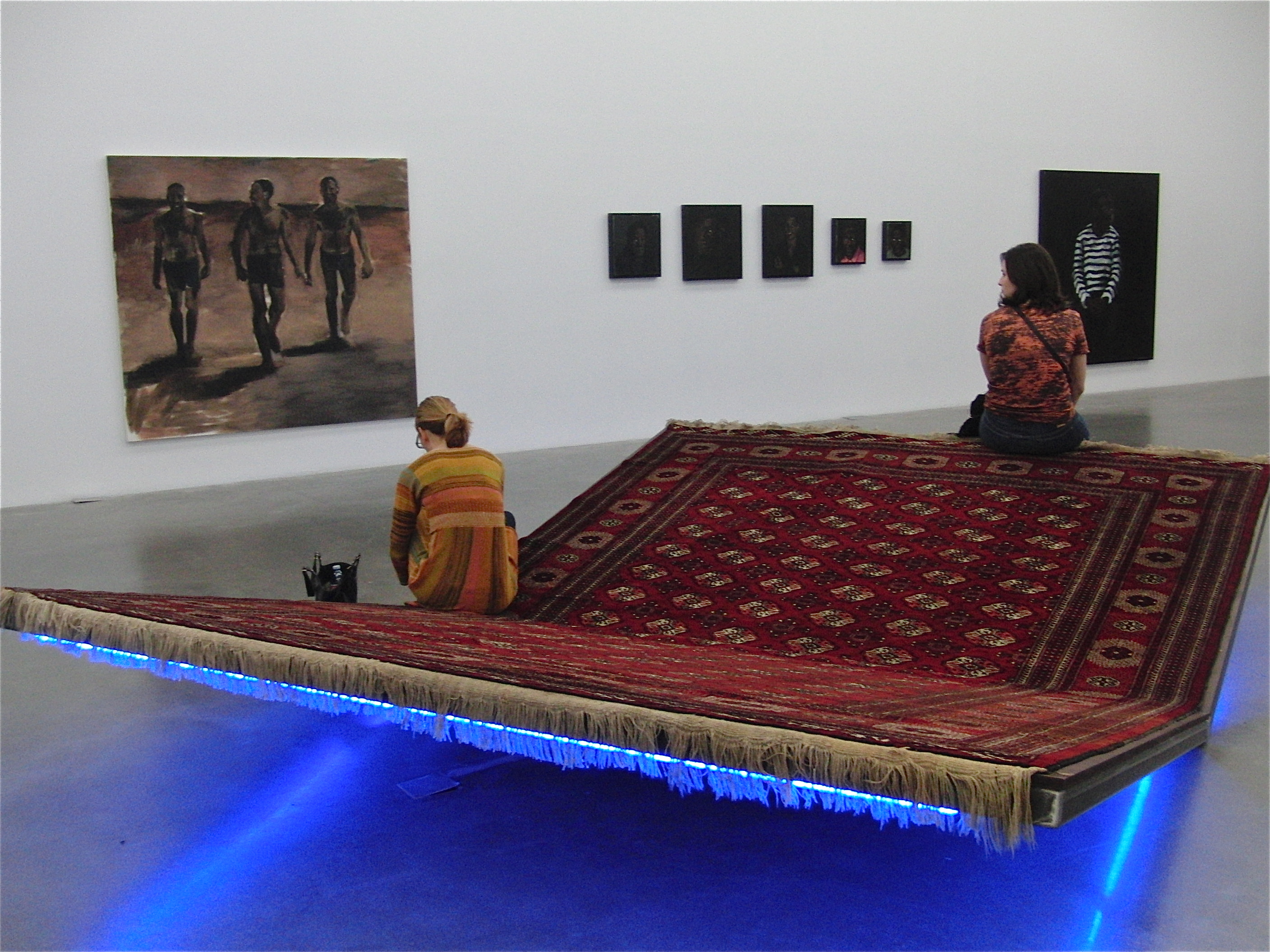
Triennial visitors can take a seat on Slavs and Tatars’ “PrayWay” while contemplating Lynette Yiadom-Boakye’s oil paintings (photo by twi-ny/mdr)
THE UNGOVERNABLES: 2012 NEW MUSEUM TRIENNIAL
New Museum
235 Bowery at Prince St.
Wednesday – Sunday through April 22, $12, 11:00 am – 6:00 pm (free Thursdays 7:00 -9:00)
212-219-1222
www.newmuseum.org
Three years ago, the New Museum’s inaugural triennial featured international artists who were all younger than Jesus was at his death at age thirty-three. The 2012 edition, “The Ungovernables,” comprises sculpture, painting, video, and installation that challenge the status quo often in subtle ways, commenting on world economics, corporatization, and politics through creative methods. In Amalia Pica’s “Eavesdropping,” a group of drinking glasses stick out from a wall, referencing both the surveillance and the digital age. Danh Vo’s “We the People” consists of sheets of pounded copper that are actually re-creations of the skin of the Statue of Liberty, a different way to look at freedom. Pratchaya Phinthong’s “What I learned I no longer know; the little I still know, I guessed” is a square collection of Zimbabwean paper money whose specific value continually decreases. Cinthia Marcelle and Tiago Mata Machado’s O Século (The Century) shows debris being thrown from a building, resulting in a visual and aural cacophony of chaos. The Propeller Group’s multichannel “TVC Communism” details the creation of a modern advertising campaign selling communism. Slavs and Tatars’ “PrayWay” is a folded prayer carpet on which visitors are invited to sit and get lost in contemplation that need not be religious. Lynette Yiadom-Boakye’s oil paintings examine race and gender. Hassan Khan’s short video, Jewel, depicts two men dancing using signifiers set to a propulsive Cairene song. José Antonio Vega Macotela’s “Time Exchange” details a four-year collaboration with Mexican prisoners in which tasks are exchanged instead of money. Pilvi Takala’s riotous “The Trainee” follows the Finnish-born artist’s intervention as she pretends to be working in a Deloitte office. And Gabriel Sierra’s interventions involve placing such objects as a ladder and a level, which he refers to as devils, directly into the walls of the museum. As with the National Academy’s Annual and the Whitney Biennial, “The Ungovernables” avoids clutter and overt political statements, steering clear of the obvious and instead offering a varied and intriguing look at the contemporary art world
E-MOVES
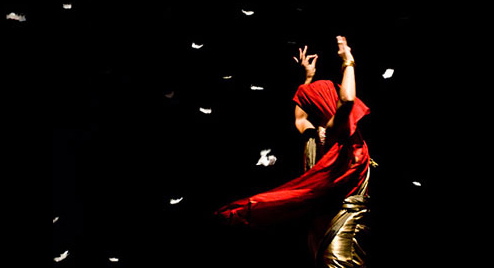
Evolving artist Sheetal Gandhi will collaborate with mentor David Rousseve on contemporary dance as part of “E-Moves” series (photo by Cedar Bough T. Saeji)
Harlem Stage Gatehouse
150 Convent Ave. at West 135th St.
April 20-21, 27-28, $15, 7:30
www.harlemstage.org
The thirteenth season of the “E-Moves” dance series will take place at Harlem Stage over the next two weekends, pairing emerging and evolving choreographers with well-established mentors, creating works in a variety of styles. On April 20 and 27, the emerging artist section joins Nikki Hefko with Nia Love (ballet), Daisuke Omiya with Patricia Hoffbauer (contemporary/tap), Simone Sobers with Kevin Wynn (contemporary), and Jaamil Olawale Kosoko with Tania Isaac (postmodern), followed by evolving artist Sheetal Gandhi with David Rousseve (contemporary). The April 21 and 28 sessions feature emerging artist Jenni Hong with Francesca Harper (contemporary), Leslie Parker with Edisa Weeks (contemporary), Franklin Diaz with Ronald K. Brown (contemporary flamenco), and Marjani Forté with Earl Mosley (contemporary), followed by evolving artist Souleymane Badolo with Reggie Wilson (contemporary). The program also includes screenings of Joan Frosch’s Movement (R)Evolution Africa: A Story of an Art Form in Four Acts and Rousseve’s Two Seconds After Laughter. All of the emerging artists are local choreographers from Brooklyn, the Bronx, and Manhattan (including two from Harlem), while Badolo is a native of Burkina Faso who is currently based in Bennington, Vermont, and Gandhi arrives from Los Angeles. “E-Moves” offers a fabulous opportunity to experience what is coming next in the world of dance.
FAYE DRISCOLL: YOU’RE ME
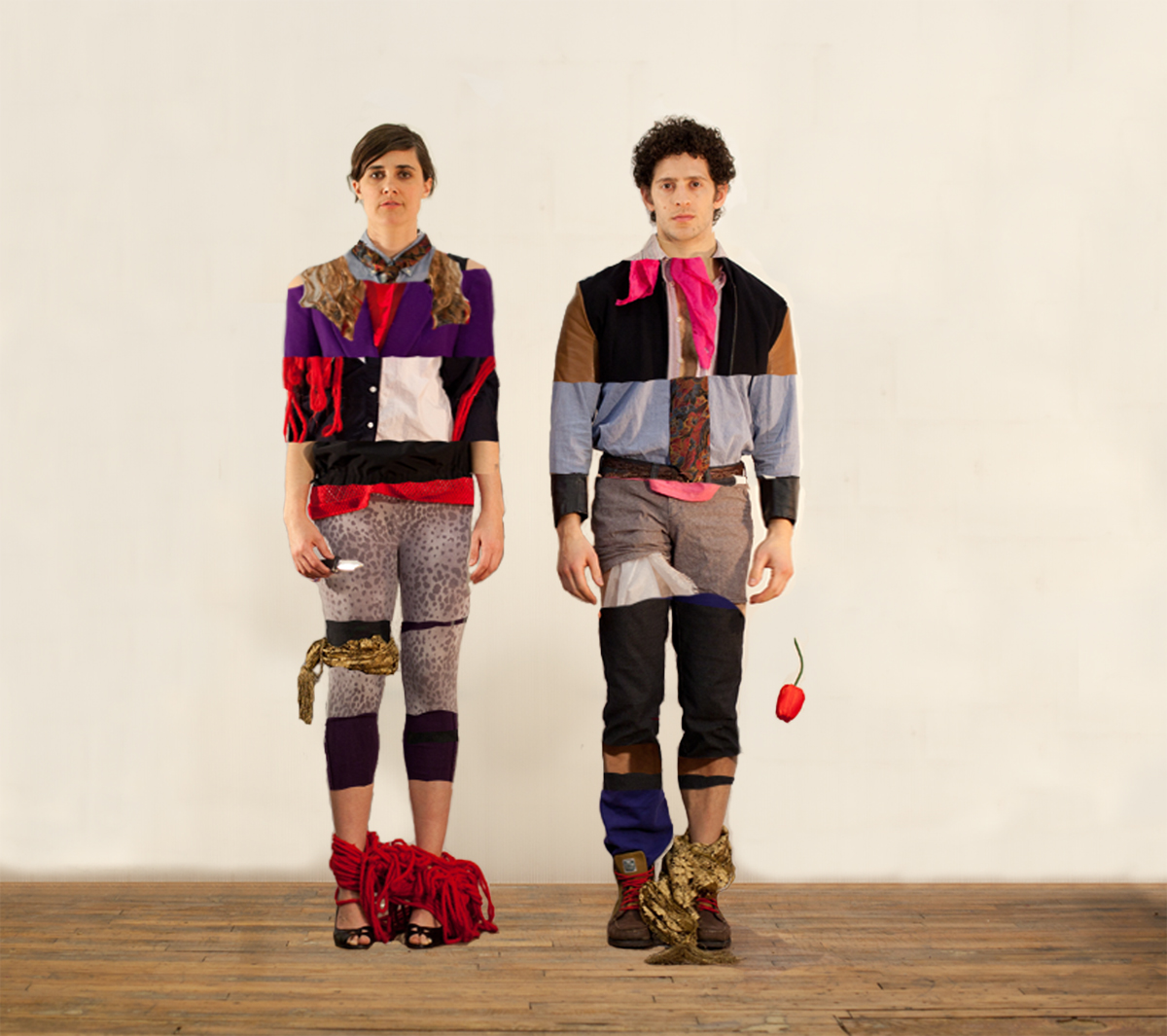
Faye Driscoll and Jesse Zaritt explore each other’s ― and their own ― identity in YOU’RE ME (photo by Christy Pessagno)
The Kitchen
512 West 19th St. between Tenth & Eleventh Aves.
Thursday – Sunday through April 21, $15, 8:00
212-255-5793 ext11
www.thekitchen.org
fayedriscoll.com
New York-based choreographer Faye Driscoll examines the complicated, ever-changing nature of interpersonal relationships in her latest evening-length work, You’re Me. As the audience enters the space at the Kitchen, Driscoll and dancer Jesse Zaritt are standing still and ridiculously tall at the back of the stage, wearing a bevy of costumes that reference Lewis Carroll’s Red and White Queens as well as Winnie from Samuel Beckett’s Happy Days, combining humor with absurdity. Pieces of their outfits start to fall off until the performers are reduced to their basic selves and begin exploring each other through a series of awkward movements as if on a first date, feeling out the possibilities as they touch, squirm, hug, eat, and experiment with their bodies, learning about themselves and their partner. This first section, which is performed with little or no background music and evokes silent films at times, goes on slightly too long but eventually morphs into a middle piece in which the duo goes crazy with spray paint before ending with an exhilarating display of props and costumes (courtesy of Emily Roysdon) changing at a furious pace. You’re Me, part of which was presented as not…not (part 1) at last June’s Gotham Dance Festival at the Joyce, is another strong, intricately conceived work from Driscoll (There is so much mad in me, 837 Venice Blvd), a talented choreographer who is not afraid to take chances and challenge both her audience and her dancers. Here she delves into the very essence of art and creativity as she and Zaritt keep going for ninety breathless minutes that allow plenty of room for improvisation, so you never can guess quite what is going to happen next.