this week in broadway

TINA: THE TINA TURNER MUSICAL

(photo by Manuel Harlan)

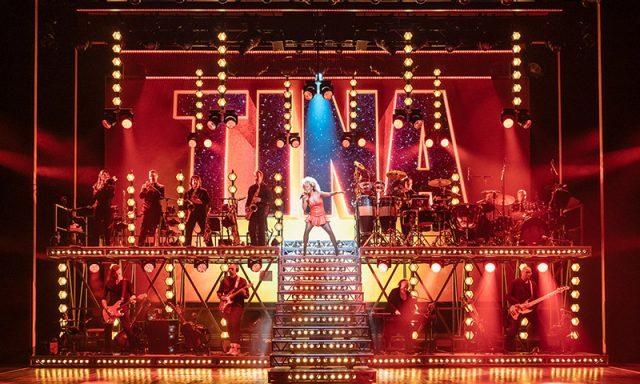
Adrienne Warren dazzles as rock ‘n’ roll queen Tina Turner in jukebox musical (photo by Manuel Harlan)

Lunt-Fontanne Theatre
205 West 46th St. between Seventh & Eighth Aves.
Tuesday – Sunday through September 20, $79-$229
tinaonbroadway.com

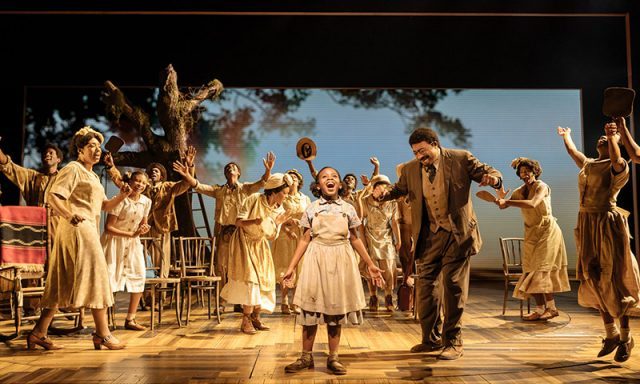
Queen of Rock ‘n’ Roll Tina Turner turns eighty today, a major milestone in a complicated, difficult life that is currently under the microscope on Broadway in Tina: The Tina Turner Musical, continuing through next September at the Lunt-Fontanne Theatre. Adrienne Warren is explosive in the title role, giving a dazzling performance as Tina transforms herself from little Anna Mae Bullock (Skye Dakota Turner) singing in church to joining Ike Turner’s (Daniel J. Watts) band to ultimately carving out a memorable second-half-of-life career after being physically and psychologically abused and supposedly being washed up at the age of forty. Presented in “association with Tina Turner,” it’s an inspiring rags-to-riches-to-rags-to-riches story that is a step above the recent spate of mediocre (or worse) biographical jukebox musicals that includes Summer: The Donna Summer Musical, The Cher Show, Beautiful: The Carole King Musical, and Aint Too Proud to Beg: The Life and Times of the Temptations.
(photo by Manuel Harlan)

Little Anna Mae Bullock (Skye Dakota Turner) prepares for a remarkable career in Tina on Broadway (photo by Manuel Harlan)

The book is by rising African American playwright Katori Hall (Our Lady of Kibeho, Hurt Village) with Frank Ketelaar and Kees Prins (Hij Gelooft in Mij), and the show is directed by Phyllida Lloyd, who has helmed Mamma Mia! and The Iron Lady as well as a well-received all-female Shakespeare trilogy. Tina is paced like a concert, with a strong, fast beginning, some slower moments in the middle, and a grand finale. Not all of it works, particularly as the second act drips into Hallmark territory as Tina’s mother, Zelma (Dawnn Lewis), gets sick. Another problem is that instead of the songs appearing more or less in chronological order as the story unfolds, they are squeezed into scenes because of their content, not when they were recorded, so, for example, her 1983 version of Al Green’s “Let’s Stay Together” is followed, in succession, by 1984’s “Better Be Good to Me,” 1970’s “I Want to Take You Higher,” 1966’s “River Deep — Mountain High,” 1989’s “Be Tender with Me, Baby,” 1971’s “Proud Mary,” and 1993’s “I Don’t Wanna Fight No More.” Tina didn’t write any of these songs, so they don’t relate to her state of mind at the time, and, even more important, the narrative is by then only up to the early 1980s, several years before she meets manager Roger Davies (Charlie Franklin) and starts her comeback with some of the very tunes we’ve now already heard. It might be a great concert setlist but it muddies the waters of a chronological tale. And don’t even get me started on the prominence of “We Don’t Need Another Hero”; did anyone listen to the end of the chorus and wonder where the line “All we want is life beyond Thunderdome” fits into Tina’s life (particularly without mentioning the Mad Max film it’s from)?
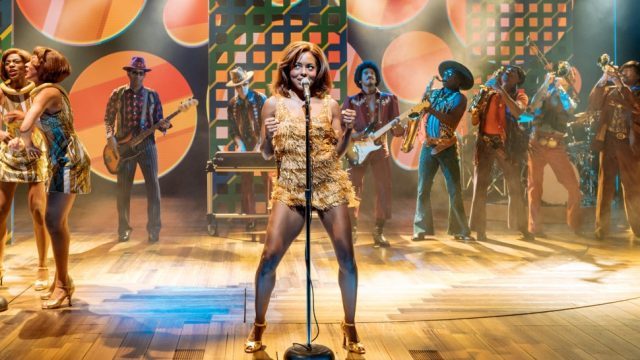
(photo by Manuel Harlan)

Tina Turner (Adrienne Warren) takes center stage with Ike and the Ikettes in Tina (photo by Manuel Harlan)

That said, Mark Thompson’s sets and costumes shine, Anthony van Laast’s choreography glints and glimmers, and Nicholas Skilbeck’s arrangements and Ethan Popp’s orchestrations, performed by an eleven-piece rock band, do justice to the originals. In addition to Warren’s star turn as Tina — prepare to be awed at how she makes her way up and down the staircase in heels during the encores — Myra Lucretia Taylor is heartwarming as Tina’s grandmother, Gran Georgeanna; Holli’ Conway, Kayla Davion, Destinee Rea, and Mars Rucker have fun as the Ikettes; Dakota Turner reveals quite a strong voice as the young Anna Mae; and Watts does not make Ike pure evil, though you still might consider hissing at him at the curtain call. But the show is really all about Warren (Shuffle Along, Bring It On: The Musical), who commands the stage with a magnetic presence and instantly wins over the audience with her unceasing energy, flashy movement, and magical voice, just like the woman she is portraying has done for decades. Happy birthday, Tina!
THE ROSE TATTOO

(photo by Joan Marcus)

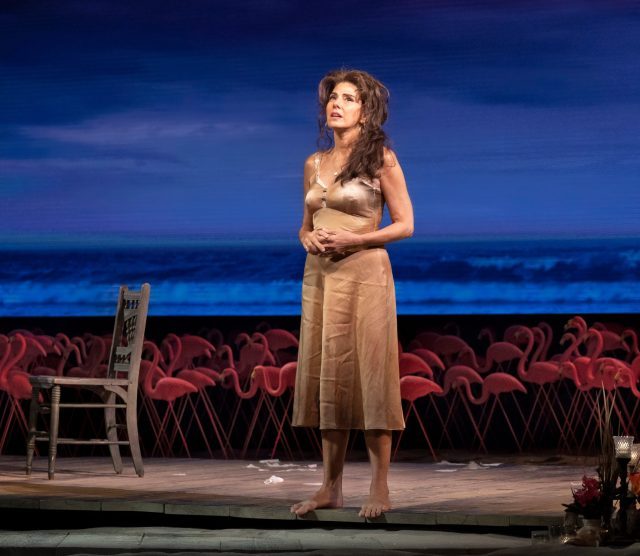
Marisa Tomei is fiery and passionate as Serafina in Roundabout revival of Tennessee Williams’s The Rose Tattoo (photo by Joan Marcus)

American Airlines Theatre
227 West 42nd St. between Broadway & Eighth Ave.
Tuesday – Sunday through December 8, $59-$299
212-719-1300
www.roundabouttheatre.org

Following the disappointing reaction to his third major play, Summer and Smoke, a Broadway failure in 1948 after the runaway successes of 1944’s The Glass Menagerie and 1947’s A Streetcar Named Desire, Mississippi-born playwright Tennessee Williams headed to Sicily with the love of his life, Frank Merlo. The trip reenergized Williams and inspired him to write The Rose Tattoo, which won four Tonys in 1951, including Best Play, Best Supporting Actor (Eli Wallach), and Best Supporting Actress (Maureen Stapleton). “The Rose Tattoo was my love-play to the world,” he wrote in Memoirs. “It was permeated with the happy young love for Frankie and I dedicated the book to him, saying: ‘To Frankie in return for Sicily.’” Roundabout’s revival of the play at the American Airlines Theatre, its ninth Williams show since 1975, is a fiery, passionate affair imbued with broad comedy, along with muddling confusion.

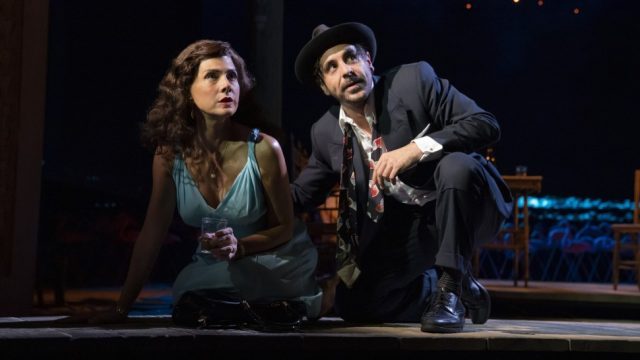
The play is set in 1950 in a Gulf Coast village populated by Sicilian immigrants. Serafina Delle Rose (Marisa Tomei) is eagerly awaiting the return of her truck-driver husband, who she calls the Baron. “The clock is a fool. I don’t listen to it. My clock is my heart and my heart don’t say tick-tick, it says love-love!” she tells Assunta (Carolyn Mignini), an elderly fattuchiere. But the Baron never makes it home, leaving Serafina a young widow raising a daughter, Rosa (Ella Rubin), by herself. Regularly surrounded by a Greek chorus of women in black (Andréa Burns as Peppina, Susan Cella as Giuseppina, Jennifer Sánchez as Mariella, and Ellyn Marie Marsh as Violetta) and with the Strega (Constance Shulman) ever lurking about, the young widow mourns intensely for three years, praying to her very special statue of the Virgin Mary at a shrine at stage front and to the urn that holds her husband’s ashes. Serafina, a seamstress having trouble sewing her life back together, swears to be faithful to the Baron’s memory while she tries to protect Rosa’s virginity as Rosa strenuously tries to lose it to Jack (Burke Swanson), an eighteen-year-old sailor in the throes of young love. But when she overhears Bessie (Paige Gilbert) and Flora (Portia) gossiping about how the Baron cheated on her with the fancy Estelle Hoehengarten (Tina Benko), Rose has to rethink her life, especially when she meets another truck driver, Alvaro Mangiacavallo (Emun Elliott), as he’s being harassed by a racist traveling salesman (Greg Hildreth). Alvaro reminds her of the Baron, lighting a fire inside her she hasn’t felt for a long time.

(photo by Joan Marcus)

Serafina Delle Rose (Marisa Tomei) and Alvaro Mangiacavallo (Emun Elliott) find common ground in The Rose Tattoo at the American Airlines Theatre (photo by Joan Marcus)

Obie-wining director Trip Cullman zeroes in on the comic aspects of Williams’s story; if you’ve seen the 1955 movie starring Anna Magnani, who won an Oscar as Serafina, a role Williams wrote for her, you might be surprised at just how funny it is, including a bizarre moment with condoms that led to an arrest in a 1957 Irish production. Meanwhile, a scene involving Bessie and Portia coming to Serafina to pick up clothing she made for them is so racist it’s hard not to wonder why it’s done in that style in this day and age. Many of Cullman’s plays have unique and unusual sets that offer complex ways to look at the work, from Lobby Hero and Significant Other to Moscow Moscow Moscow Moscow Moscow Moscow and The Pain of My Belligerence. But Mark Wendland’s stage for The Rose Tattoo is confounding. It’s a combination of indoor and outdoor spaces, with a wooden walkway over sand, a living room, a window, a flock of pink flamingos at the back, and Lucy Mackinnon’s projections of the tide rolling in on the shore on three sides. Characters enter and exit inconsistently in too many different ways so it’s hard to tell where everything leads to and from. Tomei (The Realistic Joneses, How to Transcend a Happy Marriage), whose maternal grandmother was Sicilian, is steamy and, appropriately, ardent — Serafina means “ardent” in Italian — as the zealous widow, imbuing her with a fierce sexuality, leaving Elliott (Black Watch, Red Velvet), in his Broadway debut, to play catch-up. (The pair was played by Stapleton and Wallach in the 1951 original, Magnani and Burt Lancaster in the 1955 film, Stapleton and Harry Guardino in the 1966 Broadway revival, and Mercedes Ruehl and Anthony LaPaglia in the 1995 Broadway adaptation.) Rubin is a force as Rosa, representing the next generation of Italian Americans who are not about to do things the way their parents did. Jonathan Linden contributes country-folk blues off stage right, enhancing the period setting.

“During the past two years I have been, for the first time in my life, happy and at home with someone and I think of this play as a monument to that happiness, a house built of images and words for that happiness to live in,” Williams wrote to Elia Kazan in June 1950 when asking him to direct the show. “But in that happiness there is the long, inescapable heritage of the painful and the perplexed like the dark corners of a big room.” Williams even threw in a nod to Merlo, the man responsible for his happiness and whom he called the Little Horse, by giving Alvaro the last name Mangiacavallo, which means “eat a horse.” This latest Broadway revival of The Rose Tattoo also manages to find happiness amid the painful and the perplexed.

SLAVE PLAY

(photo by Matthew Murphy)

Jeremy O. Harris’s Slave Play has moved from New York Theatre Workshop to Broadway (photo by Matthew Murphy)

Golden Theatre
252 West 45th St. between Broadway & Eighth Ave.
Tuesday – Sunday through January 19, $39-$159
slaveplaybroadway.com

Over the last several years, I’ve had the privilege of seeing four terrific shows first off Broadway and then on, then on the Great White Way. In each case, nothing was lost in the transition to the bigger stage; in fact, three of them received Tony nominations for Best Play — Indecent, Pulitzer Prize recipient Sweat, and The Humans — with The Humans winning the award. (Unfortunately, the sadly overlooked Significant Other had only a short stint on Broadway.)

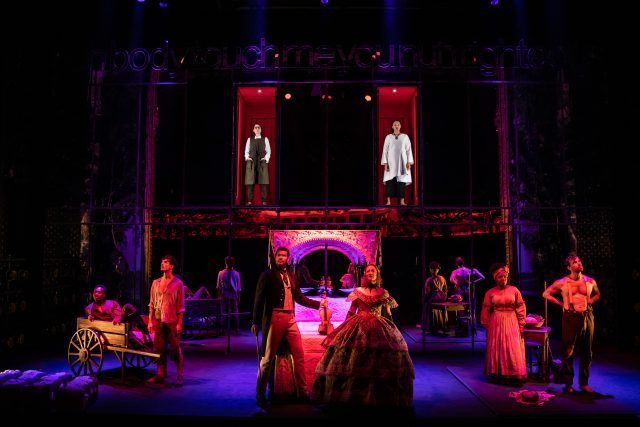
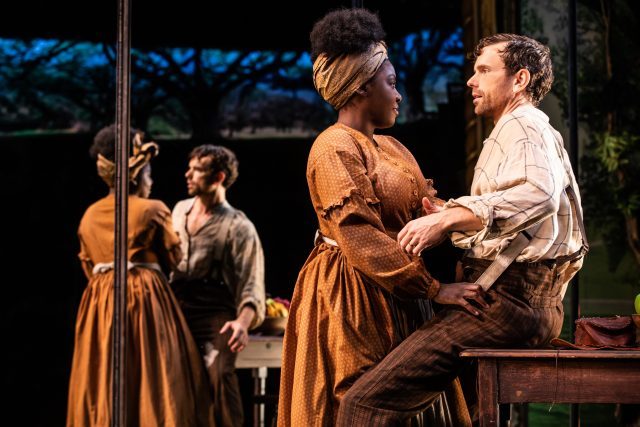
So at first I was surprised to hear that Jeremy O. Harris’s Slave Play, which initially ran at New York Theatre Workshop last season, was heading to the Golden Theatre for a Broadway engagement, not least because of its graphic sexual content as well as its central subject matter involving a trio of dangerous sexual interactions defined by race, gender, and power on a plantation in the Antebellum South as well as today: black slave Kaneisha (Joaquina Kalukango) and her white overseer, Jim (Paul Alexander Nolan); Alana MacGregor (Annie McNamara), the plantation owner’s wife, and her “mulatto” house servant, Phillip (Sullivan Jones); and Dustin (James Cusati-Moyer), a white indentured servant, and Gary (Ato Blankson-Wood), his black boss. Clint Ramos’s set has been expanded, with two levels of mirrored doors that open up to reveal characters and bring on and off various pieces of furniture; the MacGregor plantation is represented by a long horizontal image of the main house on the mezzanine facade that is reflected in the mirrors across the back of the stage so the audience can see itself. At NYTW, the mirrors made it feel like we were all on the plantation, making us complicit in America’s original sin of slavery.

(photo by Matthew Murphy)

Kaneisha (Joaquina Kalukango) and Jim (Paul Alexander Nolan) face issues of race, gender, and power in Slave Play (photo by Matthew Murphy)

But at the Golden, the mirrors feel more gimmicky, less insightful and condemnatory. The two-hour intermissionless play is divided into three sections, each of which now struck me as being too long and repetitive, continuing well past their expiration date. And the shock value of the brutal sex scenes and, especially, the second-act twist seemed much more tame. The cast, which is the same except for Kalukango replacing Parris — Irene Sofia Lucio and Chalia La Tour are also back as politically correct comic facilitators Patricia and Teá, respectively — is again uniformly strong, with Cusati-Moyer standing out as a white man claiming he’s not white. So what happened? Only small tweaks were made to the script and direction. Perhaps it’s the spate of works by black playwrights about the black experience in America; since Slave Play debuted at NYTW, I’ve seen Jackie Sibblies Drury’s Pulitzer-winning Fairview, Thomas Bradshaw’s Southern Promises, Jordan E. Cooper’s 2019 Ain’t No Mo’, Suzan-Lori Parks’s White Noise, Tori Sampson’s If Pretty Hurts Ugly Must Be a Muhfucka Lynn Nottage’s By the Way, Meet Vera Stark, and Harris’s own “Daddy.”

There’s no denying that it’s a boon to the artform that so many diverse voices are now being heard onstage, both on and off Broadway, dealing with issues that must be faced in a society still teeming with institutional and systemic racism; what used to be the exception (August Wilson, Lorraine Hansberry, Ntozake Shange, Adrienne Kennedy) is quickly becoming the norm (see also Lydia R. Diamond, Dominique Morriseau, Danai Gurira, Dael Orlandersmith, and Katori Hall, among others). But maybe the shock I experienced when I first saw Slave Play has worn off a bit as the subject matter becomes more commonplace in American theater. Maybe the Golden is too large a venue for the intimacy Harris is exploring in the show. Maybe the flaws in Slave Play are more evident in this bigger production, particularly when seen for the second time. Or maybe the novelty of the play has just dissipated as more nuanced ones come along. I’m not sure any of that matters from a critical standpoint, as the producers just announced that it’s off to a solid financial start, even extending the run two weeks.

THE HEIGHT OF THE STORM

(photo by Joan Marcus)

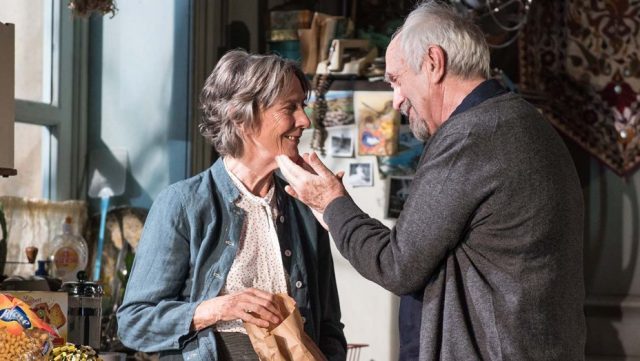
Eileen Atkins and Jonathan Pryce play a happy couple dealing with death in The Height of the Storm (photo by Joan Marcus)

Manhattan Theatre Club at the Samuel J. Friedman Theatre
261 West 47th St. between Broadway & Eighth Aves.
Tuesday – Sunday through November 24, $79-$169
heightofthestorm.com
www.manhattantheatreclub.com

Eileen Atkins and Jonathan Pryce are more than reason enough to see Florian Zeller’s latest intricate family drama, The Height of the Storm, although the play doesn’t quite live up to its lofty ambitions. The follow-up to Zeller’s trilogy of The Father, The Mother, and The Son, this new work shares themes with its predecessors, particularly The Father; as in that story, an elderly man named André (Pryce) with two daughters, Anne (Amanda Drew) and Élise (Lisa O’Hare), is having trouble with his memory. But in this case, there has been a death, but it’s not clear whether it’s André, an extremely successful writer, or his wife, Madeleine (Atkins). References to a recent bereavement are many, yet the two elderly married characters appear in scenes together that do not seem to be flashbacks. “There’s nothing to understand. People who try to understand things are morons,” an ornery André says, which is good advice to the audience as well, who shouldn’t try to think too hard to figure out what’s happening, whether we’re watching the present, the past, or the meanderings of a man suffering from dementia.

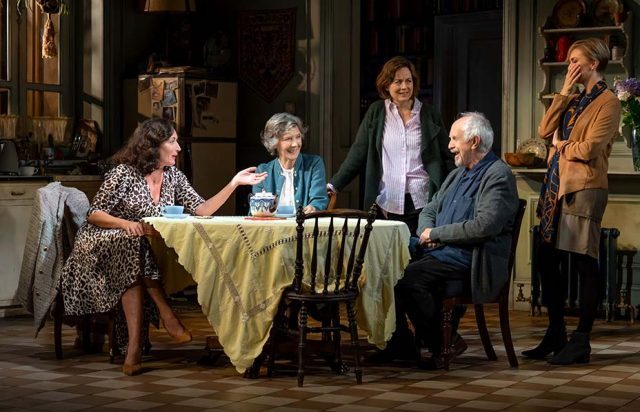
Anne is going through her father’s papers at the request of his editor to find more material to publish. Élise and her latest boyfriend, real estate agent Paul (James Hiller), are in from Paris, about to rush back for an important meeting. Madeleine is much calmer, walking through their vegetable garden and making her husband’s favorite mushroom dish. (The play takes place in Anthony Ward’s cozy, high-ceilinged kitchen set.) But when a woman (Lucy Coho) arrives claiming to be an old friend of André’s, his memory is tested yet again. “I had a life. I don’t deny it. But in the end, what’s left?” André opines. “A few faces? A few names lost in the fog? Here and there . . . Not much more. May as well forget everything.”

(photo by Joan Marcus)

A family gathering is interrupted by an unexpected guest in Florian Zeller’s The Height of the Storm (photo by Joan Marcus)

Pryce (Comedians, Miss Saigon), who has won two Tonys and two Olivier Awards, and three-time Olivier Award winner Atkins (Honour, A Room of One’s Own) are impeccable, delivering meticulous performances anchored by the fear that after fifty years of marriage, either André or Madeleine must go first, leaving the other one alone. Drew (Three Days in the Country, Enron), who played Anne in James Macdonald’s production of The Father at the Duke of York’s Theatre in 2016, is staunchly resolute as the daughter trying to keep everything from falling apart. The ninety-minute play features profound lighting by Hugh Vanstone, particularly as it relates to Pryce, who is sometimes cast in darkness while the others remain lit and talking. But director Jonathan Kent (Plenty, Naked) and translator Christopher Hampton (who did the same for the previous three related works) don’t always maneuver fluidly through the narrative; part of the intent is to set the viewer off balance, but too much manipulative confusion is not ideal, especially when accompanied by a clichéd twist. “What is my position? What is my position here? What is my position? My position! What is my position here? My position. Here. What is it? My position . . . what is it?” André frantically demands at one point. The audience is often not sure, which can be both hypnotic and aggravating.

BETRAYAL

(photo by Marc Brenner)

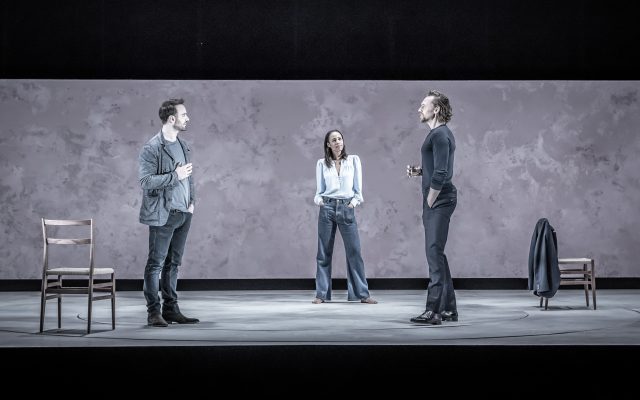
Jerry (Charlie Cox), Emma (Zawe Ashton), and Robert (Tom Hiddleston) are caught up in a circular love triangle in Betrayal (photo by Marc Brenner)

Bernard B. Jacobs Theatre
242 West 45th St. between Broadway & Eighth Ave.
Tuesday – Sunday through December 8, $25 – $189
betrayalonbroadway.com

Jamie Lloyd’s minimalist reimagining of Harold Pinter’s Betrayal, which opened tonight at the Jacobs, is not just a great revival; it’s a wholly new, brilliant work of art that is so fresh and alive that I feel like I’ve never seen the play before, although I have twice. Inspired by Pinter’s real-life affair with Joan Bakewell, Betrayal goes backward in time as it details a circuitous love triangle involving gallery owner Emma (Zawe Ashton), her husband, book publisher Robert (Tom Hiddleston), and his best friend, literary agent Jerry (Charlie Cox). The story begins in 1977, as Jerry and Emma meet two years after their long affair ended, and concludes in 1968, when they first became attracted to each other. It’s like a mystery where you know who the killer and victim are but now have to find out what led to that outcome. Except in Betrayal there are no victims; all three protagonists are complicit in the lies and deceit that are deconstructed over the course of ninety tense minutes. (Perhaps the only victim is Jerry’s unseen wife, Judith.)

The suspense starts at the rise of the curtain, which reveals Soutra Gilmour’s stark set, featuring three chairs and the three characters standing in front of a long, L-shaped marble wall. Jerry and Emma each grab a chair and move to the tip of the stage, where they sit down and share intimate details of their relationship. It’s uncomfortable in an exciting yet unsettling way, getting right in the face of the audience; meanwhile, Robert stands in the back, as if a ghost listening in, the cuckold all alone. Throughout the play, as it travels in reverse chronology, the three characters are onstage nearly the entire time, moving the chairs around as they go from a bar to a restaurant to a furnished room, from England to Italy. In most of the scenes, two of them are speaking while the other hovers cryptically, although all three appear together a few times, amplifying the dynamic among them. They wear the same clothes through most of the play — Gilmour designed the costumes as well — as if they are trapped by time. The set also includes two rotating sections, slowly spinning the characters in circles, mimicking their relationships, especially at one dazzling moment when one circle goes clockwise, the other counterclockwise, leaving the audience awed and nearly dizzy. Jon Clark’s lighting amplifies the suspense, creating eerie shadows as the wall moves up and back.

(photo by Marc Brenner)

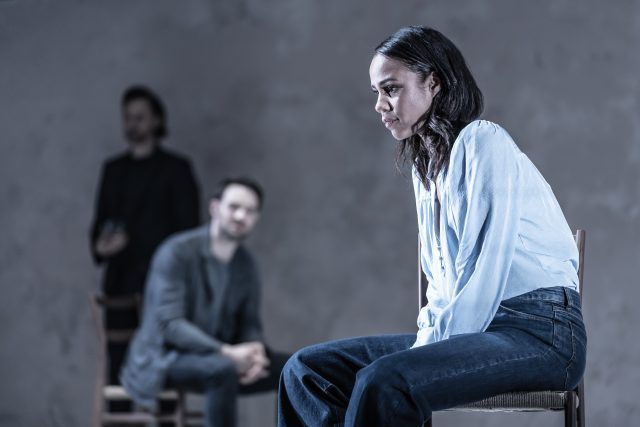
Emma (Zawe Ashton) considers her predicament in Pinter revival (photo by Marc Brenner)

All three characters lie, emitting falsehoods that are so intertwined with who they are that it’s impossible to take anything they say at face value. Their memories are untrustworthy too; for example, Jerry keeps forgetting whose kitchen he was in when he threw Charlotte, Emma and Robert’s daughter, up in the air, a seemingly insignificant fact that he just can’t get right, if we are to believe Emma. Lloyd (Assassins, Pinter’s The Caretaker) makes the most of Pinter’s trademark pauses and silences, incorporating specialized movement and incidental sound and music by Ben and Max Ringham; he even slyly includes a snippet of Susan Boyle’s haunting version of Depeche Mode’s “Enjoy the Silence.”

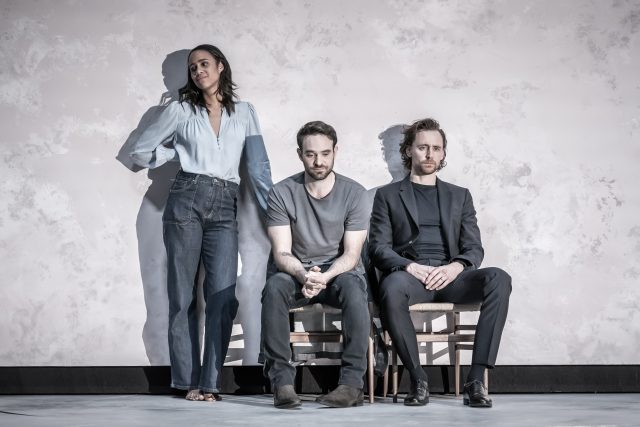
The three leads are phenomenal in a play that has always been a big-name vehicle. Raul Julia, Blythe Danner, and Roy Scheider teamed up in the Broadway debut in 1980, Liev Schreiber, Juliette Binoche, and John Slattery joined together for the 2000 revival, and Daniel Craig, Rachel Weisz, and Rafe Spall starred in Mike Nichols’s 2013 iteration; the 1983 film boasted Jeremy Irons, Patricia Hodge, and Ben Kingsley. The tall, lithe, classically trained Hiddleston (The Avengers, Othello) is elegant and graceful as Robert, a potent counterpart to Cox’s (Daredevil, Incognito) more earthy and straightforward Jerry; their longtime bromance adds an extra dimension to their individual relationships with Emma, who is stunningly portrayed by novelist, playwright, film director, and actress Ashton (Velvet Buzzsaw, Gone Too Far!); it is easy to see why both men fall in love with her. Emma is smart, beautiful, and ambitious, enticingly barefoot throughout, a woman who knows what she wants and is not afraid to go after it, but she doesn’t necessarily fully contemplate the potential consequences of her decisions. Eddie Arnold is humorous as the waiter in an Italian restaurant, but this Betrayal is not a dark tale in need of comic relief. I had never thought of it as a comedy, but it is surprisingly laugh-out-loud funny, particularly in Hiddleston’s often satirical delivery.

(photo by Marc Brenner)

Zawe Ashton, Charlie Cox, and Tom Hiddleston excel in Jamie Lloyd revival of Betrayal at the Jacobs (photo by Marc Brenner)

Theater is different from books and movies in that you can see plays multiple times in unique adaptations, each making their own mark on the story, for good or bad. You can read a book or see a film more than once, but it doesn’t change, although you do. With Betrayal, Lloyd has breathed new, vital life into Pinter’s nearly forty-year-old Olivier Award winner. In the opening scene, Emma tells Jerry, “It’s nice, sometimes, to think back. Isn’t it?” He replies, “Absolutely.” It’s also more than nice to think forward. Don’t miss this opportunity to see this profound, organic interpretation that captures the heart and soul of Pinter’s bold original.

NYC BROADWAY WEEK SUMMER 2019

(photo by Matthew Murphy)

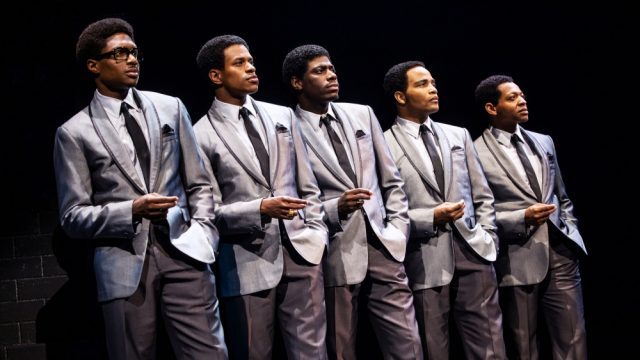
Ain’t Too Proud – The Life and Times of the Temptations is one of twenty-four shows participating in Broadway Week (photo by Matthew Murphy)

BROADWAY WEEK: 2-for-1 Tickets
September 3-16, buy one ticket, get one free
www.nycgo.com/broadwayweek

Tickets are on sale for the end-of-summer edition of Broadway Week, which runs September 3-16 and offers theater lovers a chance to get two-for-one tickets in advance to see new and long-running productions on the Great White Way. Two dozen shows are participating, but one is already sold out — The Lion King — so you need to act fast. You can still grab seats, either half-price or a $30 upgrade, for Ain’t Too Proud – The Life and Times of the Temptations, Aladdin, Beautiful: The Carole King Musical, Beetlejuice, Betrayal, The Book of Mormon, Chicago, Come from Away, Dear Evan Hansen, Derren Brown: Secret, Frozen, The Great Society, Harry Potter and the Cursed Child, The Height of the Storm, Mean Girls, Oklahoma!, The Phantom of the Opera, Sea Wall / A Life, Slave Play, The Sound Inside, Tootsie, Waitress, and Wicked.

SEA WALL / A LIFE

(photo by Richard Hubert Smith)

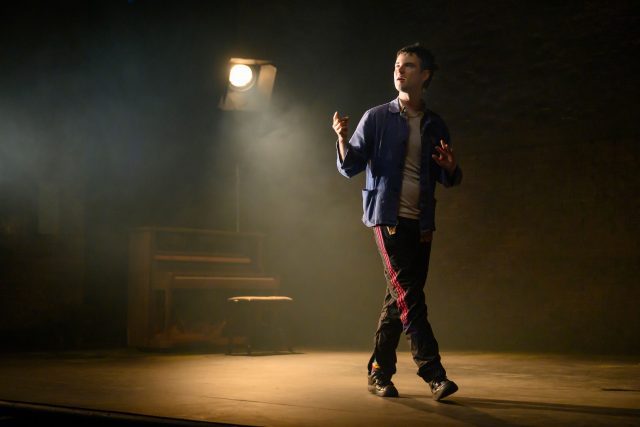
Alex (Tom Sturridge) deals with tragedy in Simon Stephens one-act at the Hudson Theatre (photo by Richard Hubert Smith)

Hudson Theatre
139-141 West 44th St. between Sixth & Seventh Aves.
Tuesday – Sunday through September 29, $59 – $315
855-801-5876
seawallalife.com
www.thehudsonbroadway.com

When I first saw Sea Wall / A Life at the Public’s Newman Theater this past March, I was profoundly moved by the deeply affecting show, a pair of thematically related monologues by two superstar writers, performed by two superstar actors. Seeing it again on Broadway, where it opened tonight at the Hudson Theatre, was a surprisingly different experience. There are some minor tweaks, particularly a beautiful coda along with new lighting choices by Guy Hoare and subtle sound design by Daniel Kluger, but it’s essentially the same presentation, still utterly involving and captivating, delicately directed by Carrie Cracknell on Laura Jellinek’s austere set, which features a piano on one side and a ladder leading to a large brick landing in the back on the other. But this time around I was sitting fourth row center, much closer than I did at the Public, and I was mesmerized by the eyes of the two men onstage. I usually do get great seats, but sitting so near the stage, I was awestruck by the way Tom Sturridge and Jake Gyllenhaal modulated their performances with just their eyes.

Be sure to arrive early, because as the crowd enters, Gyllenhaal sits at the piano, black-framed glasses on, looking out at the audience, making direct eye contact with as many people as he can. Shortly after he leaves, Sturridge wanders onto the stage, grabs a beer and a box of Polaroids, and takes a seat at the top of the ladder. The actors are making a clear, powerful connection that sets up what is to follow.

First is Simon Stephens’s Sea Wall, in which Tony-nominated British actor Sturridge is Alex, a photographer who shares a riveting story about his wife, Helen; their daughter, Lucy; and Helen’s father, Arthur, building up to an incident that occurred three weeks earlier. Much of the tale takes place in the south of France, where Arthur has a house. As Alex talks about how much he loves his family, his penchant for crying, his difficulty putting on a wetsuit, and the hole in the center of his stomach, Sturridge’s eyes move slowly, stopping and pondering, remembering, afraid to forget. Sharp humor is laced with a melancholia that hovers in the tense air as he walks across the stage and atop the landing, as if the brick wall is the sea wall itself, which is supposed to provide protection to humans and ocean life.

(photo by Richard Hubert Smith)

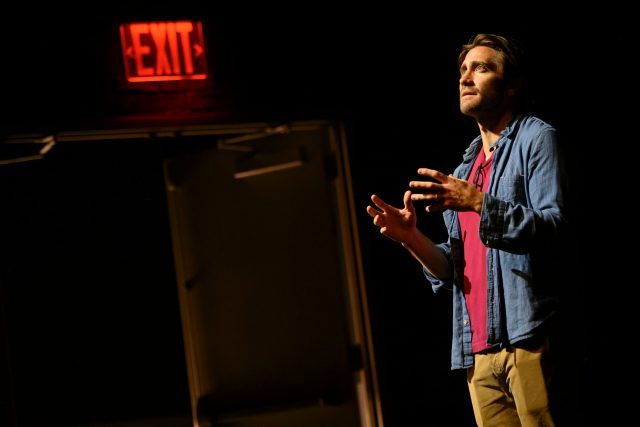
Abe (Jake Gyllenhaal) faces crises as a father and a son in Nick Payne’s A Life on Broadway (photo by Richard Hubert Smith)

Intermission is followed by Nick Payne’s A Life, in which Oscar-nominated American actor Gyllenhaal is Abe, a music producer whose father is ailing and wife is pregnant. He so seamlessly shifts between the two stories, one of impending death, the other of upcoming birth, that it’s sometimes hard to tell which one he is referring to. As each reaches its conclusion, the back-and-forth becomes rapid fire, life and death overlapping as Abe considers his existence as a father and as a son. Gyllenhaal spends nearly the entire fifty-five minutes in a large spotlight, so we are drawn to his expressive face and his eyes, which dart around faster and faster, seeking acknowledgment, encouragement, and understanding from the audience. It’s a bravura performance that I appreciated in a whole new way by sitting so close. That is not at all to say that you won’t be blown away if you are significantly farther away; it is just different, a theatrical experience that is well worth it no matter where you sit.

Gyllenhaal (Sunday in the Park with George, Brokeback Mountain), who was previously in Payne’s If There Is I Haven’t Found It Yet and Constellations, and Sturridge (Orphans, 1984), who was in Stephens’s Punk Rock and Wastwater, wanted to work together, and this is the project they decided on. Even though they do not act side-by-side, they form an intimately linked duo, developing a unique relationship with each other and the audience, as if the plays were written as a set piece, which they were not. Getting to the heart of both shows, Abe says, “I remember reading somewhere or maybe someone telling me about this idea that there are three kinds of deaths. . . . The first is when the body ceases to function. The second is when we bury the body, or I guess set it on fire. And the third is the moment, sometime way in the future, when our names are said, spoken aloud, for the very last time. I’m thinking to myself but I don’t say it, I wonder who’s gonna say our child’s name for the last time?” Alex and Abe are filled with the joy of life, but it’s the fear of death that can be overwhelming, to the characters as well as the audience as we consider that prophetic pronouncement.