this week in broadway

TAKE ME OUT

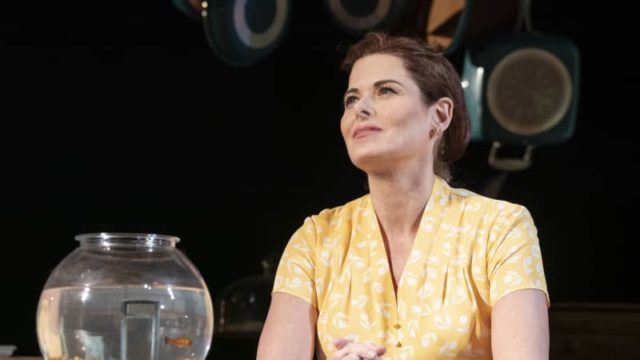
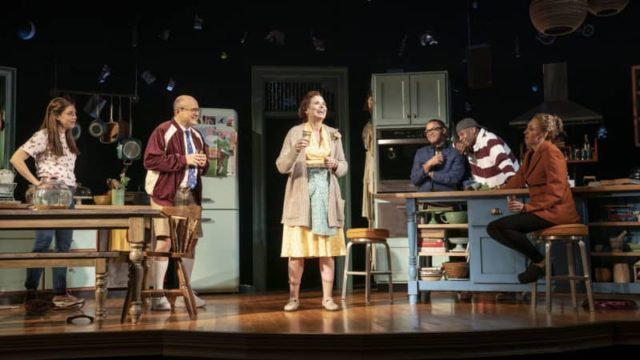
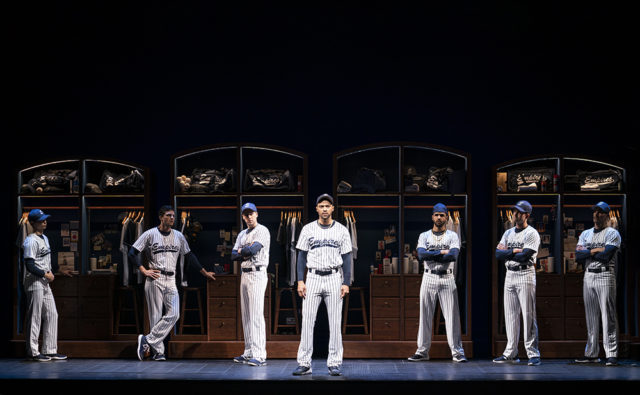
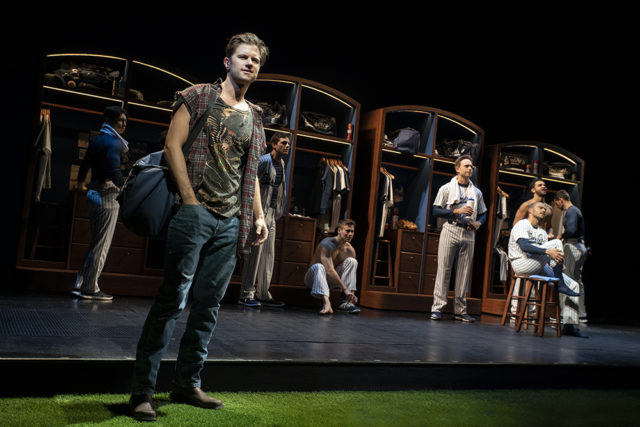
Much of Take Me Out happens in the locker room — with and without uniforms (photo by Joan Marcus)

TAKE ME OUT
Helen Hayes Theater
240 West 44th St.
Tuesday – Sunday through June 11, $79-$199
2st.com/shows

Scott Ellis’s hit Broadway revival of Richard Greenberg’s Tony-winning Take Me Out is well on its way to the playoffs (Tony nominations) and the World Series (Tony wins), but you don’t have to know anything about baseball to root for this compelling tale of ego, homophobia, and winning and losing.

It all starts with the brilliant title itself, which refers to: the traditional 1908 tune “Take Me Out to the Ball Game,” sung by fans during the seventh-inning stretch of every contest; a reverse riff on the chorus of John Fogerty’s 1985 hit, “Centerfield,” in which the former CCR leader declares, “Put me in, coach / I’m ready to play, today”; going out on a date; the public revelation that someone is gay; and the slang for a mob hit, as in “take him out.”

It’s 2002, and the world champion Empires, a stand-in for the Yankees — one backdrop features a silhouette of the Yankee Stadium wooden facade — are off to another good season. The story is narrated in flashback by shortstop Kippy Sunderstrom (Patrick J. Adams), a good friend of superstar Darren Lemming (Jesse Williams), a five-tool centerfielder who comes out of the closet with a sudden, unexpected announcement that he is gay. Darren did not do it to become a role model, to fight for gay rights, or to make a sociocultural statement; throughout the play, Darren’s motivations are private, driven primarily by ego and self-importance.

“Now, I’m not a personal sort of guy, really, and that’s not gonna be any different,” Darren, a handsome mixed-race player reminiscent of Bronx Bomber legend Derek Jeter, tells his teammates. “I mean, don’t expect the free flow of information. Don’t expect the daily update. I’m just here to play ball. I’m just here to have a good time. That’s no different. . . . And if, incidentally, there’s any kid out there who’s struggling with his identity, I hope this sends a message that it’s okay. They can follow their dream, no matter what. Any young man, creed, whatever, can go out there and become a ballplayer. Or an interior decorator.”

But he also tells Kippy, “You think you know me? You think you know my secret? Shit, that wasn’t a secret — that was an omission. I’ve got a secret — but that’s not it.” Even his last name, Lemming, is a warning for others not to follow him.

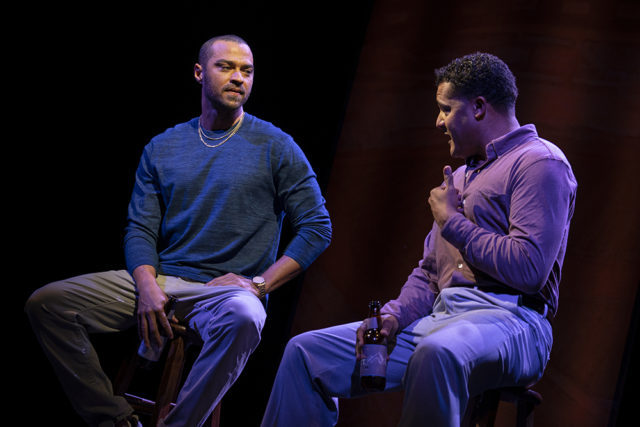
Friends and rivals Darren Lemming (Jesse Williams) and Davey Battle (Brandon J. Dirden) sit down for a chat in Take Me Out (photo by Joan Marcus)

As one would expect, his declaration creates significant problems in the locker room. Emerging from the shower to find a naked Darren, Toddy Koovitz (Carl Lundstedt) complains, “So now I gotta go around worrying that every time I’m naked or dressed or whatever you’re checking out my ass.” Because, of course, every gay man immediately wants to sleep with every male he sees. But Darren always gives better than he gets, telling Toddy, “Why’re ya lookin’ at it’s the question.” As the quippy Kippy noted earlier, after Darren confirmed, “I don’t want to fuck any of you,” he responded, “It’s not about that, Darren. It’s about us wanting to fuck you.”

When their ace pitcher, Takeshi Kawabata (Julian Cihi), slumps, they call up hard-throwing closer Shane Mungitt (Michael Oberholtzer) from Double A, who leads them back on track until he opens his mouth one day and spews forth bigoted remarks that would make even former Braves reliever John Rocker wince.

The tension in the locker room grows to epic proportions as no one can have a civil conversation, exacerbated by Kawabata’s, Martinez’s (Hiram Delgado), and Rodriguez’s (Eduardo Ramos) inability to speak English, a sports trope that enrages more conservative fans who believe that if you play ball in America, you need to speak the language — and the same fans are likely to have problems with a gay player.

“We were Men,” Kippy slyly philosophizes to his teammates. “This meant we could be girlish. We could pat fannies, snap towels; hug. Now . . . What do we do with our stray homosexual impulses?” After not-too-bright new catcher Jason Chenier (Tyler Lansing Weaks) asks if he was talking specifically to him and then turns red out of embarrassment because of the topic, Kippy adds, “We’ve lost a kind of paradise. We see that we are naked.” It’s as if they have taken a bite out of that apple and are being cast out of the garden.

Meanwhile, Darren keeps meeting with his new business manager, Mason Marzac (Jesse Tyler Ferguson), a gay accountant who at first knows nothing about baseball except that Darren is also gay, which makes him fall in love with the sport and worship his client. “A couple of weeks earlier I would have barely recognized the name! Then the announcement — that incredible act of elective heroism — and it was as if I’d known him my whole life — as if he’d been something latent in my subconscious.”

As the Empires prepare for a big game against the club that Darren’s best friend, Davey Battle (Brandon J. Dirden), is on, the world around Darren and the Empires turns into a lot more than just “the mess” Kippy alluded to at the start of the show.

Shane Mungitt (Michael Oberholtzer) has a rude awakening in store in Broadway revival of Richard Greenberg play (photo by Joan Marcus)

Take Me Out is an exceptional drama that uses baseball as an apt analogy for the state of the country. “I have come (with no little excitement) to understand that baseball is a perfect metaphor for hope in a Democratic society,” Mason says. “It has to do with the rules of play. It has to do with the mode of enforcement of these rules. It has to do with certain nuances and grace notes of the game. . . . Everyone is given exactly the same chance. . . . And baseball is better than Democracy — or at least than Democracy as it’s practiced in this country — because unlike Democracy, baseball acknowledges loss.”

In the history of the four major sports leagues, only one NBA player and one NFL player have revealed they were gay and kept playing: Brooklyn Nets center Jason Paul Collins in 2013 and current LA Raiders defensive end Carl Nassib in 2021. The revelation that a baseball superstar in his prime is gay would be a major deal today, but in the twenty years since Take Me Out premiered at the Public, no MLB player and only one umpire, Dale Scott, has come out and stayed on the diamond. Greenberg’s (The Assembled Parties, Three Days of Rain, The Perplexed) play feels fresh and alive in 2022, like it could have been written yesterday, save for the lack of cellphones onstage (and, thanks to strict rules, in the audience as well).

The two-hour play (plus intermission) moves much faster and more smoothly than baseball games. Ellis (On the 20th Century, The Elephant Man) is a superb manager, guiding the actors through David Rockwell’s splendid sets, which range from the ballpark and the locker room to a lounge and actual showers. Linda Cho’s costumes, primarily baseball uniforms, spend nearly as much time off the actors as on. (The nudity is the reason audience members must have their phones sealed in a Yondr pouch that the staff will open for you during intermission and then upon exiting.)

In their Broadway debuts, Adams (Suits, Equivocation) displays an easygoing, likable charm as Kippy, earning the audience’s devoted attention from his very first words, while Williams (Grey’s Anatomy, The Sandbox) shows off his numerous tools as the secretive hotshot Darren. (He will reprise the role in an upcoming television series, according to Deadline.) Dirden (Skeleton Crew, Jitney) excels in his supporting role, like a solid, dependable DH who always gets good wood on the ball and comes through in the clutch.

But the MVP might just be Ferguson (Modern Family, The 25th Annual Putnam County Spelling Bee), who knocks it out of the park every chance he gets. Mason is the glue that holds it all together, the only one who seems to really understand Darren as both a wealthy athlete and a gay man. Ferguson’s growing enthusiasm is infectious, spreading throughout the theater; he’s just the kind of person every locker room needs.

THE MUSIC MAN

Hugh Jackman and Sutton Foster turn up the glitz in Music Man revival (photo by Joan Marcus)

THE MUSIC MAN
Winter Garden Theatre
1634 Broadway between 50th & 51st Sts.
Tuesday – Sunday through January 15, $99-$599
musicmanonbroadway.com

In my decidedly unfavorable review of the 2017 revival of Hello, Dolly! starring Bette Midler, I wrote, “The new production of Hello, Dolly!, which is breaking house records at the Shubert Theatre, is everything that is wrong with Broadway. . . . Through it all, there’s Bette, who never really inhabits the role but plays herself playing the character while basking in the unending attention, the love bursting forth from the audience at her every knowing smirk; the Shubert practically explodes when she emerges in her glittering red dress for the title song, but it’s Bette who’s being celebrated, not Dolly.”

Unfortunately, the same can be said about the third Broadway revival of Meredith Willson’s 1957 smash The Music Man, continuing through November 6 at the Winter Garden. The star attraction is the beloved Hugh Jackman, but he is trapped as Hugh Jackman playing Professor Harold Hill, a con artist who has arrived in River City, Iowa, to sell the townspeople costumes and instruments for a band that will never be. The Grammy-, Emmy-, and Tony-winning Jackman, who follows such previous Hills as Robert Preston, Eddie Albert, Forrest Tucker, Bert Parks, Van Johnson, Dick Van Dyke, Craig Bierko, and Matthew Broderick, is as charming as ever, but he never fully embodies the character, and the fault lies in part with the audience, who won’t allow him to, and four-time Tony-winning director Jerry Zaks and Tony-winning choreographer Warren Carlyle, the duo who performed the same tasks on Midler’s Hello, Dolly! As with that production, which won four Tonys, many of the scenes don’t move the narrative along but instead are excuses to meander off track with showy, too long set pieces that are only fun for a while before we need to get back to the story.

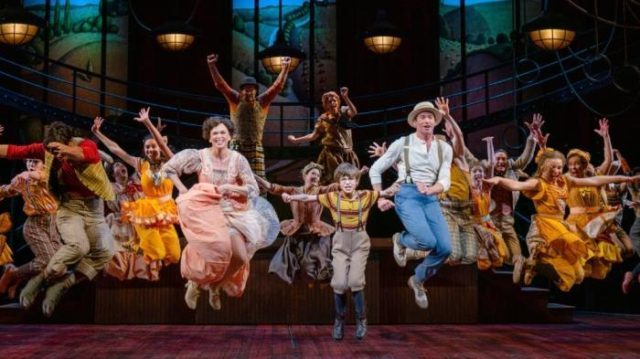
The cast of The Music Man jumps for joy in Broadway revival at the Winter Garden (photo by Joan Marcus)

Tony winner Sutton Foster fares better as Marian Paroo, whose previous portrayers range from Barbara Cook and Shirley Jones to Rebecca Luker and Meg Bussert, but since we all know what is going to happen between Hill the snake oil salesman and Marian the adorable librarian, Zaks and Carlyle don’t focus properly on the chemistry between them that is necessary to propel the plot, even as basic as it is. Meanwhile, the cast features a slew of Tony winners in small roles, including Shuler Hensley as Marcellus Washburn, Jefferson Mays as Mayor Shinn, Jayne Houdyshell as Mrs. Shinn, and Marie Mullen as Mrs. Paroo, but it’s yet more window dressing; for example, Mays, one of New York City’s most consistently entertaining actors, can’t rise above the more dated material, as nearly all of the mayor’s jokes fall flatter than an out-of-tune trombone.

All the songs are here — “Rock Island,” “(Ya Got) Trouble,” “Seventy-Six Trombones,” “Pickalittle (Talk-a-Little),” “Marian the Librarian,” “Shipoopi,” “Till There Was You” — but the only one you’re likely to be humming on your way out is “Seventy-Six Trombones,” and only because it seems that it never ends. Santo Loquasto’s ever-changing set and colorful costumes get lost in the razzle-dazzle.

Born and raised in Iowa, Willson also wrote the musicals The Unsinkable Molly Brown, Here’s Love, and 1491, the holiday classic “It’s Beginning to Look a Lot Like Christmas,” several symphonies, and three memoirs. If he were alive to write a fourth book, maybe even he would agree that there’s big-time trouble in River City.

PLAZA SUITE

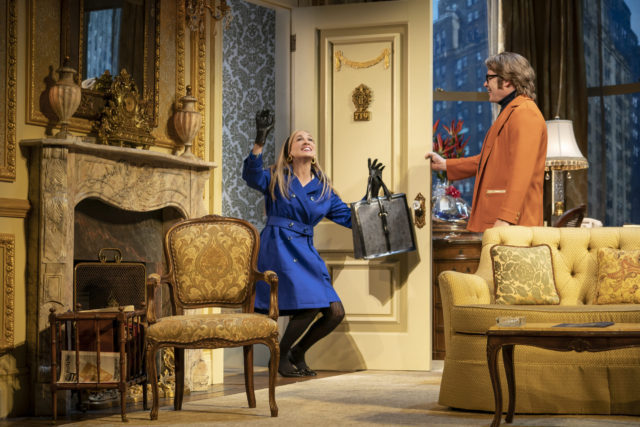
The Nashes (Sarah Jessica Parker and Matthew Broderick) try to celebrate their anniversary in Neil Simon’s Plaza Suite (photo by Joan Marcus)

PLAZA SUITE
Hudson Theatre
141 West Forty-Fourth St. between Sixth & Seventh Aves.
Tuesday – Sunday through June 26, $99-$559
plazasuitebroadway.com

Some playwrights age better than others. It’s been more than ten years since the last Neil Simon revival on Broadway, and if the current production of Plaza Suite at the Hudson Theatre is any indication, at least part of the reason why is evident.

The three-act play, which opened on Broadway on Valentine’s Day, 1968, is a slapstick love letter to marriage written with a poison pen. In each act, a couple, portrayed by the same actors, flirt and argue as they evaluate their relationships and their lot in life as they flit about in room 719 at the Plaza Hotel in midtown Manhattan. The original featured George C. Scott and Tony nominee Maureen Stapleton and was directed by Tony winner Mike Nichols; the current revival stars Matthew Broderick and Sarah Jessica Parker, who are married in real life, with John Benjamin Hickey directing the fusty festivities. The play might be set in 1968–69, but it feels a whole lot older than that, especially in its Neanderthal portrayal of women.

“Visitor from Mamaroneck” takes place on a late winter afternoon at the Plaza, where Karen Nash (Parker) has planned a romantic getaway with her workaholic husband, Sam (Broderick), to celebrate their anniversary in the same room where they spent their wedding night more than twenty years earlier. Karen orders Champagne and hors d’oeuvres, but when Sam arrives, he is overwhelmed with business issues.

While he is a wiz with figures, she has trouble with any kind of number, which slides right into gender stereotypes. After she claims that it’s their twenty-fourth anniversary, Sam responds, “Tomorrow is our anniversary and we’re married twenty-three years.” She asks, “Are you sure?” Sam: “I go through this with you every year. When it comes to money or dates or ages, you are absolutely unbelievable. We were married December fifteenth, nineteen forty-five.” Karen: “Then I’m right. Twenty-four years.” Sam: “Forty-five from sixty-eight is twenty-three!” Karen: “Then I’m wrong. Math isn’t one of my best subjects.”

When Sam’s devoted, and devilishly sexy, secretary, Jean McCormack (Molly Ranson), shows up, things take a turn for the worse, although not at all unexpectedly. In fact, we can see what’s coming from the proverbial mile away as occasionally funny banter transforms into a terrible, unfair weight on Karen (and Sarah).

A New Jersey housewife (Sarah Jessica Parker) and a Hollywood producer (Matthew Broderick) have a clandestine meeting in Neil Simon revival (photo by Joan Marcus)

“Visitor from Hollywood” is set the following spring, with hotshot Hollywood producer Jesse Kiplinger (Broderick) meeting his high school flame, Muriel Tate (Parker), in room 719. She’s an uptight New Jersey suburban housewife and mother obsessed with his success; she dreams of the glamorous life he’s leading, but he just wants to get into her pants. As he plies her with vodka stingers, she grows friendlier and friendlier even as she protests that she has to get home and take care of her family, although she’s pretty shifty about the details. It’s evident her “I never do things like this!” housewife shtick is . . . just shtick. She knows what she wants: proximity to fame. He wants proximity to her. Close proximity.

The play reveals its age in this act with its outdated references, from Bonwit and Lee Marvin to Elke Sommer and Marge and Gower Champion, which will leave younger audiences scratching their heads (or desperately wanting to Google the names right there and then). “Will you stop with the celebrity routine. Aside from a couple of extra pounds, I’m still the same boy who ran anchor on the Tenafly track team,” Jesse says. Muriel replies, “And is living in the old Humphrey Bogart house in Beverly Hills.” In 2022 — if not in 1968 — it’s tremendously uncomfortable watching a single male Hollywood producer trying to take advantage of a woman in a hotel room, regardless of how happy or not she is.

The play concludes in June 1969 with “Visitor from Forest Hills,” in which Roy and Norma Hubley (Broderick and Parker) are in room 719 at the Plaza, preparing for the wedding of their daughter, Mimsey (Ranson); the only problem is that Mimsey has locked herself in the bathroom and refuses to come out and marry Borden Eisler (Eric Wiegand). Roy and Norma try just about everything to get Mimsey to open the door, as Roy trots out jokes so old they have cobwebs about fathers and wedding costs.

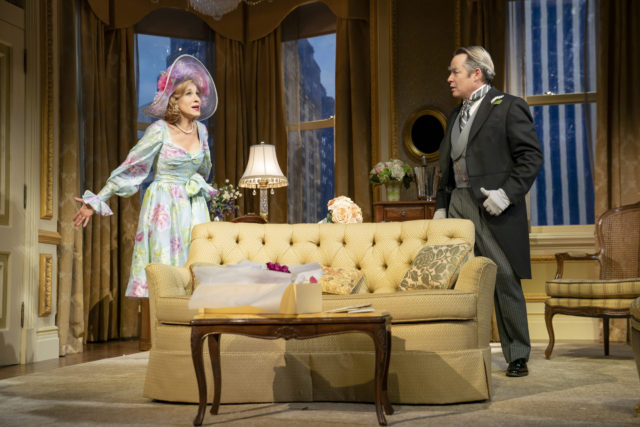
Norma (Sarah Jessica Parker) and Roy (Matthew Broderick) are facing a wedding crisis in Plaza Suite at the Hudson (photo by Joan Marcus)

“All right, what did you say to her?” Roy demands to know. Muriel answers, “I knew it! I knew you’d blame me. You took an oath. God’ll punish you.” Roy explains, “I’m not blaming you. I just want to know what stupid thing you said to her that made her do this.” As they attempt to lure their daughter out of the bathroom, Roy ratchets up the blaming of the women while Norma keeps the truth from the ever-more-worried Eislers downstairs.

The best parts of this Plaza Suite, which runs slightly more than two and a half hours with an intermission and a brief pause, are John Lee Beatty’s gorgeous set, which gets its own well-deserved round of applause; Jane Greenwood’s costumes, especially the glorious outfits worn by Parker; and the stars’ undeniable chemistry and gift for physical comedy. There is some potent slapstick from Broderick (Evening at the Talk House, Shining City), who has appeared in three previous Simon plays, and Parker (The Commons of Pensacola, The Substance of Fire), who last worked with Broderick onstage in the 1995 Broadway revival of How to Succeed in Business without Really Trying; at one point in the second act, after Parker pulled off a hilarious move, both actors tried unsuccessfully to suppress their own laughter. The third act is highlighted by an outrageously funny stunt by a nearly unrecognizable Broderick, in gray wig and mustache and elegant tux. [Note: Both Broderick and Parker have contracted Covid-19 so the show has been temporarily shut down as of April 7.]

But standout moments here and there do not make up for the misogyny that is on view in all three acts, filling the theater with a dense cloud of midcentury woman hating. It’s also hard to get too excited about watching the foibles of wealthy white people in a fancy schmancy hotel room. The first of a trilogy that was followed by California Suite in 1976 and London Suite in 1995, Plaza Suite feels old, crusty, and unnecessary today, unless they’re going to redefine some of the characters or experiment more with the staging. Playing it straight in 2022 is just not viable, and it has nothing to do with political correctness.

Simon — who was nominated for four Oscars and four Emmys, won four Tonys and a Pulitzer Prize (for 1991’s Lost in Yonkers), and had a Broadway theater named after him in 1983 — was ultimately married five times to four women (three actresses and a dancer); this is the first revival of one of his plays since his death in 2018 at the age of ninety-one. Hopefully the next one will do more to burnish his legacy.

COMPANY: KATRINA LENK, PATTI LuPONE & CHRIS HARPER

Who: Katrina Lenk, Patti LuPone, Chris Harper, Jessica Shaw
What: Virtual discussion about current Broadway revival of Company
Where: The Temple Emanu-El Streicker Center online
When: Thursday, February 10, free with advance RSVP, 12:30
Why: In my review of the current, controversial revival of Stephen Sondheim and George Furth’s beloved Company, I wrote, “Two-time Tony winner Marianne Elliott has reconceptualized Company in ways that go beyond mere gender switching and diverse casting; this Company emphasizes individuality, confinement, isolation, and fear through magnificent staging.” You can hear what some of the key participants have to say about the show when the Temple Emanu-El Streicker Center hosts a live, virtual discussion with Tony and Grammy winner Katrina Lenk (The Band’s Visit, Indecent), who plays Bobby, previously always portrayed as a man; two-time Tony and two-time Grammy winner Patti LuPone (Evita, Gypsy), who delivers the classic “Ladies Who Lunch”; and Olivier-winning producer Chris Harper (Elliott’s War Horse and The Curious Incident of the Dog in the Night-Time). SiriusXM’s Jessica Shaw will moderate the free talk.

SKELETON CREW

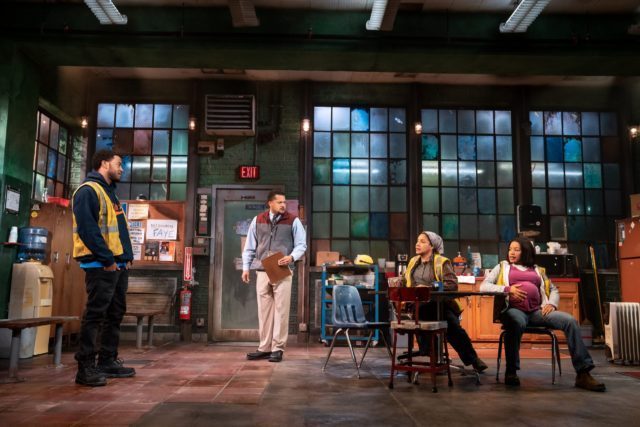
Dominique Morisseau’s Skeleton Crew takes place in an auto stamping plant on the brink in 2008 (photo by Matthew Murphy)

SKELETON CREW
Samuel J. Friedman Theatre
261 West Forty-Seventh St. between Broadway & Eighth Ave.
Tuesday – Sunday through February 20, $59-$159 ($49-$99 with code FAFCREW)
www.manhattantheatreclub.com

When the audience enters MTC’s Samuel J. Friedman Theatre for the Broadway premiere of Dominique Morisseau’s Skeleton Crew, a sizzling tale of socioeconomic ills in 2008 Detroit, they see Michael Carnahan’s set, the dingy, dirty breakroom of an auto stamping plant, filled with handwritten and preprinted signs detailing various rules and regulations, advising employees that there is no smoking, when the next union meeting is, what their OSHA rights are, what they can and can’t do with the refrigerator, coffeemaker, and microwave. However, there are also multiple reminders, on paper and yellow caution floor signs, to wear a mask and turn off cellphones; those warnings are for the audience in 2022, of course, but the effect is an immediate feeling of equality between the performers and the characters they portray. We are them, and they are us, especially as we all continue to deal with a global pandemic.

The cast then heads onstage and removes all the contemporary signs with a resolute vigilance that, we soon find out, applies to the company admonitions that still remain. “I don’t abide by no rules but necessity. I do what I do til’ I figure out another thing and do that. And that’s all I got to say about it,” Faye (Phylicia Rashad) declares.

Rumors are swirling that the plant might be on the chopping block, which would wreak havoc in a city that we know is about to pay dearly during the coming subprime mortgage crisis. Faye, a divorced single mother, is the union leader with twenty-nine years on the job, intent on making it to thirty to receive more substantial retirement benefits. Despite having survived breast cancer, she smokes constantly; she also has a penchant for gambling with her much younger colleagues: Dez (Joshua Boone), a loose cannon hoping to start his own repair garage, and Shanita (Chanté Adams), a pregnant woman who is one of the line’s best workers. Both in their mid-to-late twenties, Dez ceaselessly flirts with Shanita, whose baby daddy is absent.

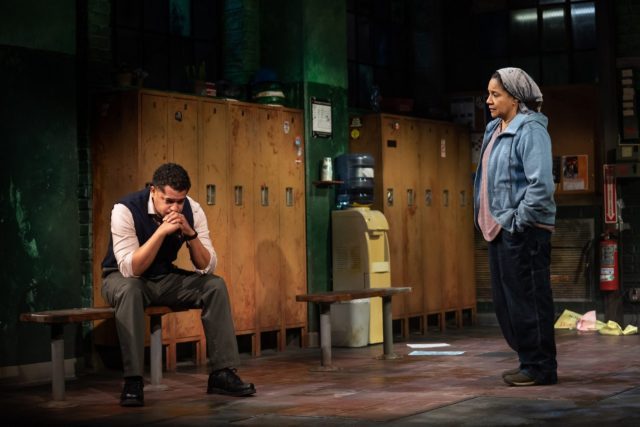
Their foreman, Reggie (Brandon J. Dirden), a close family friend of Faye’s since he was a child, used to be one of them before being promoted. He often finds himself in the middle, caught between the employees and his bosses upstairs, walking a tightrope that becomes even more tenuous when he admits to Faye that the plant will indeed be shutting down within a year.

Reggie (Brandon J. Dirden) and Faye (Phylicia Rashad) face a crisis in Broadway premiere of Skeleton Crew (photo by Matthew Murphy)

He tries to convince her to stay quiet about it, which she is hesitant to do. “It’s my job to protect these folks,” Faye says. Reggie responds, “Faye, I’m confiding in you. I’m putting myself on the line for you cuz I’m on your side. But I need you on mine. I need your guidance. Help me figure this out without sounding the alarm.” She agrees but feels guilty keeping the news from Dez and Shanita, who have their own issues with management.

“You youngins don’t have no respect for the blood been spilled so yo’ ass have some benefits,” Faye says to Dez, who she regularly calls “stupid.” Dez shoots back, “What benefits? I don’t hardly see no benefits.”

When materials start disappearing from the plant, Dez, who brings a gun to work and has been acting suspiciously, is a prime suspect. Meanwhile, Faye has hit some hard times and hides a secret from her colleagues. And Shanita shares her complex dreams with the others and plans on working as long as she can, piling on the overtime, before she gives birth. The tension is so thick that something has to eventually give, and when it does, everybody better stand back.

Skeleton Crew premiered at the Atlantic’s Stage 2 in January 2016, then moved to the bigger Linda Gross Theater in May of that year. It’s the first play of Morisseau’s to be produced on Broadway; she also wrote the book for Ain’t Too Proud to Beg: The Life and Times of the Temptations. The play completes her Detroit Projects trilogy, three works set in her hometown in the twentieth century, beginning with 2013’s Detroit ’67 and continuing with 2015’s Paradise Blue. Seen as a whole, the plays explore the Black experience in America in a way that evokes both August Wilson and Lynn Nottage; specific plays that immediately come to mind are Wilson’s Jitney and Nottage’s Sweat and Clyde’s as well as Erika Dickerson-Despenza’s recent Cullud Wattah, about the Flint water crisis.

Director Ruben Santiago-Hudson shows a firm confidence in Morisseau’s language and themes; he previously directed the world premiere of Paradise Blue at the Signature. He also was a close friend of Wilson’s and starred in and/or directed many of his plays, including Jitney and The Piano Lesson, both of which featured Dirden. In addition, Santiago-Hudson knows the Samuel J. Friedman well; his one-man show, Lackawanna Blues, was the previous production at the theater, completing its run in November.

Adesola Osakalumi dances between scenes in Dominique Morisseau’s Skeleton Crew (photo by Matthew Murphy)

Morisseau (Pipeline, Blood Rot) masterfully avoids any specific discussion about race, instead letting the story play out with that subtext hovering over everything like an ominous cloud. The audience knows that Detroit has had a history of race riots — from 1833 and 1849 to 1943 and 1967 — and in 2007-8, nearly twenty thousand Black men and women lost their jobs in car factories. “African Americans earn much higher wages in auto industry jobs than in other parts of the economy, and the loss of these solid, middle-class jobs would be a devastating blow,” the Economic Policy Institute reported at the time.

Tony winner and six-time Emmy nominee Rashad (A Raisin in the Sun, August: Osage County), who has directed three Wilson plays, is a powerhouse as Faye, a tired but strong-willed woman who is determined to not let a system she’s been fighting against her entire life beat her down. Rashad delivers her quips with an uncanny assuredness, her eyes revealing the wear and tear of years of battle, both personal and professional. Boone (Actually, All the Natalie Portmans) is a fireball as Dez, ready to explode at any moment but with a soft side underneath. Adams (Roxanne, Roxanne, Wilson’s Ma Rainey’s Black Bottom, directed by Santiago-Hudson) is charming as Shanita, who is wise beyond her years. And Dirden, who played Sly in the original New York production of Detroit ’67, gives a rousing performance as Reggie, a kindhearted man who has to make hard decisions that rip him up inside.

In between scenes, choreographer Adesola Osakalumi (Cullud Wattah, Fela!) dances at the front of the stage or behind the breakroom windows, moving robotically to hip-hop music that mimics the motion of the machines in the plant, which are seen almost abstractly in projections by Nicholas Hussong lit by Rui Rita. (The sound and music is by Robert Klapowitz, with original songs by J. Keys.) It equates humans with automation, as if people are interchangeable with machines. It might not be a new idea, but it is beautifully laid bare in Morisseau’s searing, intimate drama.

(MTC is currently hosting Detroit Week on Broadway, beginning February 4 at 8:00 with “Detroit Comes to Broadway,” celebrating the people and culture of the Motor City. On February 6 at 5:00, Morisseau, Dr. Michael Eric Dyson, and Michael Dinwiddie will take part in the free virtual discussion “Black Theatre: Radical Longevity.” And on February 7 at 6:00, “Morisseau Moment” fêtes the playwright with proclamations and presentations from her three latest shows, Skeleton Crew, Ain’t Too Proud to Beg, and Confederates, livestreaming from the Harlem School of the Arts.)

COMPANY

Bobbie (Katrina Lenk) is not exactly thrilled about turning thirty-five in Company (photo by Matthew Murphy)

COMPANY
Bernard B. Jacobs Theatre
242 West 45th St. between Broadway & Eighth Ave.
Tuesday – Sunday through July 31, $59 – $299
companymusical.com

Originally slated to open on Broadway on March 22, 2020 — Stephen Sondheim’s ninetieth birthday — Marianne Elliott’s reimagining of composer and lyricist Sondheim and book writer George Furth’s beloved Company finally arrives at the Bernard B. Jacobs Theatre, two weeks after Sondheim’s sad, sudden passing just as we all could use, er, a little company. Having never seen the iconic musical before — it debuted on Broadway in 1970 and was revived in 1995 and 2006 — I cannot compare it to any of those editions or focus on the well-publicized changes to this new version, primarily involving several gender switches, most importantly to the main character, who has gone from Bobby the man to Bobbie the woman. But what I can report is that Elliott’s inventive adaptation has a fine first act and an utterly spectacular second.

Bobbie, played with a nagging trepidation by Katrina Lenk, is turning thirty-five and none too happy about it. After receiving a flurry of birthday messages, she says, “How many times do you get to be thirty-five? Eleven? Okay, come on. Say it and get it over with. It’s embarrassing. Quick. I can’t stand it.”

Harry (Christopher Sieber) and Sarah (Jennifer Simard) battle as Bobbie (Katrina Lenk) and Joanne (Patti LuPone) look on in Sondheim-Furth revival (photo by Matthew Murphy)

Bobbie is tired of being the third wheel. She puts a mylar “35” balloon on her wall and it ticks like a biological clock. Her married and engaged friends, some with kids, attempt to entertain her but they have their own lives away from her. She is spending more and more time with bottles of Maker’s Mark to try to make her forget her loneliness. She’s attracted to a dimwitted flight attendant, Andy (Claybourne Elder), who doesn’t exactly fulfill her needs.

She visits with Sarah (Jennifer Simard) and Harry (Christopher Sieber), who get into a riotous jiu-jitsu battle; Susan (Rashidra Scott) and Peter (Greg Hildreth), who, on their terrace, announce they’re getting divorced; Jenny (Nikki Renée Daniels) and David (Christopher Fitzgerald), who get high and discuss Bobbie’s possible fear of being hitched (“It’s not like I’m avoiding marriage. It’s avoiding me, if anything. I’m ready,” she insists); Jamie (Matt Doyle) and Paul (Etai Benson), who are getting married but Jamie is suddenly having doubts; her former lover Theo (Manu Narayan), who has made the kind of important decision Bobbie is unable to; her friend P.J. (Bobby Conte Thornton), who is in love with New York itself; and the older Joanne (Patti LuPone) and her third husband, Larry (Terence Archie), who party at a nightclub. “The phone is a phenomenon. Really. The best way for two people to be connected and detached at the same time,” Bobbie says. Joanne responds, “Second only to marriage.”

The story goes back and forth in time — the script explains, “The narrative is conveyed in a stream of consciousness technique and time moves both backwards and forwards, encompassing the past, present and future” — as Bobbie contemplates the state of her existence as she turns thirty-five, alone in the big city. “One’s impossible, two is dreary, / Three is company, safe and cheery,” she tries to convince herself. “Here is the church, / Here is the steeple, / Open the doors and / See all the crazy, married people!”

Friends gather to celebrate Bobbie’s (Katrina Lenk) birthday in Company (photo by Matthew Murphy)

Two-time Tony winner Elliott (The Curious Incident of the Dog in the Night-Time, Angels in America) has reconceptualized Company in ways that go beyond mere gender switching and diverse casting; this Company emphasizes individuality, confinement, isolation, and fear through magnificent staging constructed around Bunny Christie’s ingenious set; much of the action takes place in and around claustrophobic rectangular spaces framed by fluorescent lights. (The lighting is by Neil Austin.) Bobbie, wearing a sensational sexy red pantsuit (Christie also designed the costumes), is trapped physically and psychologically in each scenario, from a tiny room in her apartment to the club to a street where every door is numbered “35.” Turning thirty-five and still being single is a nightmare that follows her wherever she goes.

Bobbie’s friends represent parts of herself as well as a potential companion. “Someone is waiting, / Sweet as David, / Funny and charming as Peter. Larry . . . / Someone is waiting, / Cute as Jamie, / Sassy as Harry / And tender as Paul,” she sings in “Being Alive,” adding, “Did I know him? Have I waited too long? / Maybe so, but maybe so has he.”

As portrayed by Tony winner Lenk (The Band’s Visit, Indecent), Bobbie is not after our sympathy or even our compassionate understanding; no mere old maid, she serves as a reminder of the uncertainty and isolation we all experience, whether coupled or not, regardless of how happy we might be. The scene in which Bobbie, in bed with Andy, sees one possible outcome of her life unfold before her is horrifyingly funny, whether you live alone or are married with kids; it’s a tour de force for both Elliott and the ensemble.

Joanne (Patti LuPone) has a bit of important advice for Bobbie (Katrina Lenk) in Broadway revival (photo by Matthew Murphy)

Two-time Tony winner LuPone (Evita, Gypsy) brings the house down just by saying, “I’d like to propose a toast,” prior to singing “The Ladies Who Lunch.” The signature role of Joanne has previously been performed by Elaine Stritch, Debra Monk, Sheila Gish, Lynn Redgrave, and Barbara Walsh, while the roll call of male Bobbys includes Dean Jones, George Chakiris, Larry Kert, Boyd Gaines, Adrian Lester, Raúl Esparza, and Neil Patrick Harris.) The rest of the cast is exemplary as well, with shout-outs to Simard’s brownie-desiring Sarah, two-time Tony nominee Fitzgerald’s puppy-dog-eyed David, and Doyle’s breathlessly fast-paced rendition of “Getting Married Today.”

Liam Steel’s choreography is fun, as are illusions by Chris Fisher. One oddity is that characters often enter and exit the stage through the aisles, which are also frequented by theater staffers holding signs telling the audience to keep their masks on, momentarily diverting our attention while also reminding us of the situation we’re still in.

David Cullen’s orchestrations honor Sondheim’s complex melodies, performed by a fourteen-piece band conducted by Joel Fram that hovers above the stage. The second act explodes with an electrifying “Side by Side by Side” and never lets up through Bobbie’s closing soliloquy, “Being Alive,” an able metaphor for what we all need right now. Winner of three Olivier Awards — for Set Design (Christie), Supporting Actress in a Musical (LuPone), and Musical Revival — Company is more than just grand company in these troubled times, when we can all benefit from being together once again.

MRS. DOUBTFIRE

Daniel Hillard (Rob McClure) goes to extreme measures to see his kids in Mrs. Doubtfire (photo by Joan Marcus)

MRS. DOUBTFIRE
Stephen Sondheim Theatre
124 West 43rd St. between Sixth & Seventh Aves.
Tuesday – Sunday through May 8, $79 – $229
mrsdoubtfirebroadway.com

Robin Williams and Stephen Sondheim must be turning over in their graves — or urns. The musical adaptation of Chris Columbus’s overrated hit 1993 movie, Mrs. Doubtfire, in which Williams plays the title character, a divorced actor who dresses up as an older Scottish nanny in order to spend more time with his children, opened earlier this month at the Stephen Sondheim Theatre on West Forty-Third St., less than two weeks after the musical genius passed away at the age of ninety-one. Williams died in 2014 at the age of sixty-three.

Mrs. Doubtfire the musical is a labored, inorganic embarrassment, a jaw-droppingly inauthentic mess that is scheduled to run for at least six months on the Great White Way. Tony nominee Rob McClure, the talented star of such duds as Chaplin and Honeymoon in Vegas, dives into the shtick headfirst, but four-time Tony-winning director Jerry Zaks is trapped by Karey Kirkpatrick and John O’Farrell’s leaden book and Karey and Wayne Kirkpatrick’s trite music and lyrics. Williams was able to make the film somewhat palatable, but McClure never has a chance with the Broadway version.

Just as the movie felt like a retread of Sydney Pollack’s 1982 romantic comedy, Tootsie, in which Dustin Hoffman plays an unemployed actor who dresses up as an unfashionable older woman in order to get a part on a soap opera, Mrs. Doubtfire the musical offers little we haven’t already seen in the 2019 musical adaptation of Tootsie, which earned ten Tony nominations, winning two awards.

Andre (J. Harrison Ghee) and Frank (Brad Oscar) preen for Wanda Sellner (Charity Angél Dawson) as Daniel (Rob McClure) looks on in Mrs. Doubtfire (photo by Joan Marcus)

Nearly every musical number feels forced and unnatural, as if Zaks (La Cage aux Folles, Hello, Dolly!), choreographer Lorin Lotarro (Waitress, Merrily We Roll Along), and the Kirkpatricks (Something Rotten!) looked around David Korins’s set to find random objects to incorporate into the dancing. When Daniel and the kids start playing air guitar with brooms, well, I considered jumping onstage and sweeping them all away, for the benefit of the audience as well as the performers. Meanwhile, the Spanish restaurant where a critical late scene occurs should be shut down for improper use and storage of musical theater.

The show is primarily set in the Hillard home, where father Daniel (McClure) has plenty of time to hang around with his three kids, Lydia (Analise Scarpaci), Christopher (Jake Ryan Flynn), and Natalie (Avery Sell). While his wife, Miranda (Jenn Gambates), is working hard, putting together a fashion line with her hunk of a partner, Stuart Dunmire (Mark Evans), Daniel is like a fourth child, running around the house with the three of them and breaking things. Lydia finally has had enough and throws him out; when the judge awards full custody to Lydia, Daniel is distraught, ready to do whatever he can to spend time with them again. He is watched closely by court liaison officer Wanda Sellner (Charity Angél Dawson), who will ultimately report back to the judge whether Daniel has an acceptable place to live and a regular job and, therefore, should be allowed to have shared custody.

But it all gets turned upside down and inside out when Daniel hatches the plan to pretend he’s Mrs. Euphegenia Doubtfire — and gets the job as his children’s nanny, taking care of them every weekday afternoon. He has to keep his secret from Lydia as well as the kids, but Wanda is on the prowl, suspicious that something nefarious is going on.

A game cast never has a chance in Mrs. Doubtfire (photo by Joan Marcus)

Brad Oscar and J. Harrison Ghee, as Daniel’s brother, Frank, and Frank’s partner, Andre, respectively, are supposed to provide comic relief (it’s already a comedy, right?) as the designers behind Daniel’s transformation into Mrs. D, but their jokes quickly become repetitive (for example, how Frank has to speak extra loudly every time he tells a lie), and laughing at flamboyant gay minor characters is not as much fun as it was once upon a time. And the scenes with Peter Bartlett as hapless kids’ show host Mr. Jolly (accompanied by Jodi Kimura as humorless channel president Janet Lundy) are not very jolly, unless you find laughing at doddering elderly men hysterical.

“What’s wrong with this picture?” the opening number prophetically asks. The show had to shut down for more than a week because of positive Covid cases; for those of you who had tickets during that time, consider yourselves lucky. [Ed. note: The musical is going on hiatus from January 10 to March 14 “out of concern for the potential long-term employment of everyone who works on Mrs. Doubtfire, and the extended run of the show.”]