this week in art

WHITNEY BIENNIAL 2019

(photo by twi-ny/mdr)

Nicole Eisenman’s aptly named Procession nearly proceeded out of the Whitney Biennial (photo by twi-ny/mdr)

Whitney Museum of American Art
99 Gansevoort St.
Wednesday – Monday through September 22, $18-$25 (eighteen and under free; pay-what-you-wish Fridays 7:00 – 9:30)
Some programs require advance registration and/or tickets
212-570-3600
whitney.org

The most viscerally entertaining work at the 2019 Whitney Biennial is Nicole Eisenman’s aptly named Procession, which first proceeded onto the sixth floor terrace, then nearly proceeded out of the building. The France-born, Brooklyn-based artist was part of a protest against the Whitney’s vice chairman, Warren Kanders, whose Safariland company makes tear-gas canisters, among other items used by security forces on civilians around the world. Eight artists — Eisenman, Michael Rakowitz, Korakrit Arunanondchai, Meriem Bennani, Nicholas Galanin, Eddie Arroyo, Agustina Woodgate, and Christine Sun Kim — demanded their work be removed from the biennial as long as Kanders remained on the board; they were responding to an original call for a boycott made by Hannah Black, Ciarán Finlayson, and Tobi Haslett. Two years ago, artist and writer Black argued that Dana Schutz’s painting Open Casket, depicting Emmett Till in his coffin, “must go,” claiming it was cultural appropriation. The Whitney decided to add signage to Schutz’s canvas, explaining the controversy and letting viewers decide for themselves. But this time around, the Whitney agreed to pull the contributions from the eight artists — only to stop when Kanders resigned from the board, not admitting any guilt but not wanting the story to “undermine the important work of the Whitney.”

(photo by twi-ny/mdr)

Agustina Woodgate’s National Times erases “master/slave” time (photo by twi-ny/mdr)

The site-specific Procession is an oddball collection of near-mythical bronze and plaster figures trudging along, a mix of classical and contemporary styles. Visitors are allowed to walk on the platform and get up close to the individual elements, which contain plenty of humor; watch out for the gaseous release. If you’d like to comment on the piece, Eisenman has a message for you: “How’s my sculpting? Call 1-800-EAT-SHIT.” Meanwhile, after much consternation, Marcus Fischer opted to keep his audio installation, Ascent/Dissent, in the Allison and Warren Kanders Stairway as a tribute to Felix Gonzalez Torres’s Untitled (America) string of lightbulbs that hang down the center of the stairwell. For more on the Kanders situation, Forensic Architecture’s eye-opening Triple-Chaser digs deep into the making and distribution of tear-gas canisters using an AI algorithm.

(photo by twi-ny/mdr)

Joe Minter’s ’63 Foot Soldiers is composed of found objects (photo by twi-ny/mdr)

The rest of the survey of twenty-first-century American art is, as always, a hit-or-miss affair, with many works dealing with international sociopolitical issues. Alexandra Bell’s Friday, April 21, 1989 — Front Page looks at how the New York Daily News reported the Central Park Five case. Bennani’s Mission Teens invites viewers to sit in a tropical “video viewing garden” to experience her films on colonialism. Robert Bittenbender uses garbage he collected in Long Island City to create wall sculptures that comment on gentrification. Kota Ezawa’s large-scale animation National Anthem was made from smaller watercolors of football players taking a knee during “The Star-Spangled Banner.” Sofía Gallisá Muriente explores the fraught relationship between mainland America and Puerto Rico in Lluvia con Nieve (Rain with Snow), as does Daniel Lind-Ramos in his found-object sculptures Sentinels and Maria-Maria; the latter reimagines the Virgin Mary through Hurricane Maria, which devastated his homeland.

Calvin Marcus (1988-), Los Angeles Painting, 2018. Watercolor and vinyl paint on linen, 79 x 101 5/8 in. (200 x 258 cm). Image courtesy the artist; Clearing, New York and Brussels; and David Kordansky Gallery, Los Angeles

Calvin Marcus, Los Angeles Painting, watercolor and vinyl paint on linen, 2018 (image courtesy the artist; Clearing, New York and Brussels; and David Kordansky Gallery, Los Angeles)

Three videos by Ilana Harris-Babou take on such issues as reparations and redlining. Joe Minter’s ’63 Foot Soldiers uses found materials, including license plates, signs, helmets, sneakers, and a small flag, to reference the civil rights movement and the current state of wealth and class inequality. Woodgate’s National Times consists of clocks keeping “master/slave” time, the minute hand equipped with sandpaper that slowly erases the numbers. In My Soul Remainer, ballet star Jock Soto dances to Laura Ortman’s violin, playing a combination of musical notes and environmental sounds amid a mountain landscape. On select Fridays, Saturdays, and Sundays, five dancers (Hector Cerna, Tiffany Mangulabnan, Charles Gowin, Violetta Komyshan, Josep Maria Monreal Vidal, Amy Saunder, Mauricio Vera, Allison Walsh, Jennifer Whalen, Tyler Zydel) move within Brendan Fernandes’s The Master and Form scaffold-like installation, in which the performers get ready at individual spots where they interact with ash wood and leather works on black carpets, their bodies mimicking the shape of the sculpture, then inhabit a central scaffold-like installation that looks like it belongs in a children’s playground before grabbing on to floor-to-ceiling ropes lined up in front of full-length windows.

(photo by twi-ny/mdr)

Brendan Fernandes’s The Master and Form is performed Fridays, Saturdays, and Sundays (photo by twi-ny/mdr)

Two of the most striking images in the show are Curran Hatleberg’s Untitled (Camaro), a photograph of a red Camaro stuck on top of two dumpsters in a junkyard, and Calvin Marcus’s gorgeous Los Angeles Painting, a fiery red future visible through a car windshield; both can be seen as harbingers of doom, a theme that hovers over this biennial, though the exhibit, curated by Jane Panetta and Rujeko Hockley, is not without hope. Also keep an eye out for impressive works by Simone Leigh, Brian Belott, Todd Gray, Maia Ruth Lee, and the late Barbara Hammer. Below are the remaining special screenings and live performances; some require advance tickets or RSVP.

Thursday, September 5
and
Saturday, September 7

Autumn Knight: Sanity TV, third floor, Susan and John Hess Family Theater, $10, 7:30

Saturday, September 7
Whitney Block Walk, free with advance RSVP, 4:30, 5:00, 5:30, 6:00

Friday, September 13
Steffani Jemison with Garrett Gray: On Similitude, third floor, Susan and John Hess Family Theater, $10, 7:30

Saturday, September 14
Whitney Block Walk, free with advance RSVP, 4:30, 5:30

Sunday, September 15
From Seneca Village to Brooklyn: A Conversation with Tomashi Jackson, with Tourmaline, Tsubasa Berg, Diana diZerega, Jonathan Kuhn, Meredith B. Linn, Kelly Mena, K-Sue Park, Nan Rothschild, Marie Warsh, and Stephen Witt, third floor, Susan and John Hess Family Theater, free with advance RSVP, 7:30

Thursday, September 19
Madeline Hollander — Ouroboros: Gs, Pamella and Daniel DeVos Family Outdoor Largo, free with museum admission, 5:00 – 9:00

Friday, September 20, 7:00
and
Saturday, September 21, 4:00

What Was Always Yours and Never Lost, short films followed by a Q&A with curator Sky Hopinka and some of the filmmakers, Susan and John Hess Family Theater, $10

LEONARD COHEN: A CRACK IN EVERYTHING

George Fok, "Passing Through," 2017. Courtesy of the artist. Photo: Frederick Charles

George Fok’s Passing Through is centerpiece of Leonard Cohen show at Jewish Museum (courtesy of the artist / photo by Frederick Charles)

The Jewish Museum
1109 Fifth Ave. at 92nd St.
Through September 8, $8-$18, pay-what-you-wish Thursday from 5:00 – 8:00, free Saturday
212-423-3200
thejewishmuseum.org

In an October 2016 Q&A at the Canadian Consulate in LA, Leonard Cohen explained, “Uh, I said I was ready to die recently. And I think I was exaggerating. I’ve always been into self-dramatization. I intend to live forever.” Leonard Norman Cohen died the next month at the age of eighty-two, leaving behind a legacy that might just live forever, as evidenced by the sensational exhibition “Leonard Cohen: A Crack in Everything” that continues at the Jewish Museum through September 8. Curated by John Zeppetelli and Victor Shiffman for the Musée d’art contemporain de Montréal in Cohen’s beloved hometown, the show is an ingenious exploration of the life and career of the singer-songwriter, poet, novelist, visual artist, Buddhist monk, father, grandfather, Sabbath-observant Jew, and elegant raconteur.

Named after a quote from his song “Anthem” from the 1992 album The Future — “Ring the bells that still can ring / Forget your perfect offering / There is a crack, a crack in everything / That’s how the light gets in” — the three-floor multimedia exhibit consists of thirteen installations by artists repurposing and recontextualizing Cohen’s words and images. The centerpiece is George Fok’s nearly hourlong Passing Through, a nine-channel video across three walls of a large room in which visitors can sit on benches or beanbag chairs; the piece features concert and backstage footage ranging from Cohen’s early days to his final tour in 2013, merging together performances of the same songs through the years, including “Hallelujah,” “Tower of Song,” “Suzanne,” “I’m Your Man,” “Chelsea Hotel #2,” and “First We Take Manhattan,” revealing how he adapted his unique trademark vocal phrasings as he got older. Kara Blake’s The Offerings is a five-channel video that compiles thirty-five minutes of interviews in which Cohen discusses his writing process and some of his life choices, from moving to Greece to becoming a monk. In Ari Folman’s Depression Chamber, the director of such films as Waltz with Bashir and The Congress invites people one at a time to spend five minutes in a dark room, lying on a bed as Cohen’s “Famous Blue Raincoat” plays, the lyrics coming alive in mesmerizing, meaningful ways. At the other end of the hall, more than two hundred of Cohen’s self-portrait drawings from 2003 to 2016 are projected on a loop, edited together by Alexandre Perreault.

Candice Breitz, "I'm Your Man (A Portrait of Leonard Cohen)," 2017. Courtesy of the artist. Photo: Frederick Charles

Candice Breitz’s I’m Your Man (A Portrait of Leonard Cohen) consists of eighteen fans singing all of 1988 Cohen comeback album (courtesy of the artist / photo by Frederick Charles)

Candice Breitz’s two-part I’m Your Man (A Portrait of Leonard Cohen) begins with a video of the all-male Shaar Hashomayim Synagogue Choir, from Cohen’s longtime shul, singing only the background vocals to every tune on Cohen’s extraordinary 1988 comeback album, I’m Your Man (“First We Take Manhattan,” “Ain’t No Cure for Love,” “Everybody Knows,” “Take This Waltz,” “Tower of Song,” the title track, et al.); down a narrow path blanketed by red curtains, eighteen Cohen fans sing the main lyrics to the songs, each on their own screen and speaker. For the best effect, walk around the room and then into the hall to find the exact spot where the lead vocals and harmonies merge. Audiences can participate in Janet Cardiff and George Bures Miller’s The Poetry Machine, a vintage Wurlitzer organ with an array of speakers and gramophone horns; guests can take a seat and press down the keys, each of which connects to Cohen’s voice reading poems from his 2006 Book of Longing. You can also sit or lie down on a bench and hum “Hallelujah” into any of several dangling microphones in Daily tous les jours’ Heard There Was a Secret Chord, joining a chorus of live hummers online.

Janet Cardiff and George Bures Miller, "The Poetry Machine," 2017. Courtesy of the artists; Luhring Augustine, New York; Fraenkel Gallery, San Francisco; and Gallery Koyanagi, Tokyo. Photo: Frederick Charles

Janet Cardiff and George Bures Miller’s The Poetry Machine invites visitors to take a seat (courtesy of the artists; Luhring Augustine, New York; Fraenkel Gallery, San Francisco; and Gallery Koyanagi, Tokyo / photo by Frederick Charles)

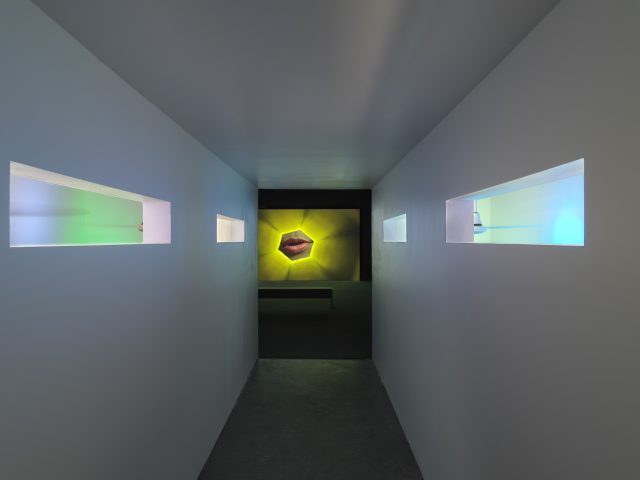
On the third floor is a listening room where you can relax and hear specially commissioned Cohen cover songs while immersed in a James Turrell–like display of changing colors and shapes; the setlist includes Feist’s “Hey, That’s No Way to Say Goodbye,” Dear Criminals’ “Anthem,” Ariane Moffatt and the Orchestre Symphonique de Montréal’s “Famous Blue Raincoat,” Moby’s “Suzanne,” Chilly Gonzales, Jarvis Cocker, and Kaiser Quartett’s “Paper Thin Hotel,” and the National, Sufjan Stevens, Ragnar Kjartansson, and Richard Reed Parry’s “Memories.” There are also contributions from Christophe Chassol, Kota Ezawa, Jon Rafman, Taryn Simon (linking Cohen’s death with the election of Donald Trump), and Tacita Dean (a sweet tribute to “Bird on the Wire”) along with extensive biographical text in one area. It all comes together to paint a magnificent portrait of an exceptional artist who continually challenged himself and his audience, a highly intelligent storyteller and performer who seemed to exist on his own plane. “I never had the sense that there was an end. That there was a retirement or that there was a jackpot, Cohen told Paul Zollo in an 1990s interview. With “Leonard Cohen: A Crack in Everything,” fans hit the jackpot with a potpourri of phenomenal proportion. (On August 29, the Jewish Museum and Russ & Daughters are hosting the final “Cocktails with Cohen,” in which, from 5:30 to 7:30, visitors can partake of the Red Needle, a drink invented by Cohen in 1975 consisting of tequila, cranberry juice, lemon, and ice. Beer, wine, and other drinks will also be available for purchase.)

RAGNAR KJARTANSSON: DEATH IS ELSEWHERE

Ragnar

Two sets of twins perform in the round in Ragnar Kjartansson’s Death Is Elsewhere (photo courtesy Metropolitan Museum of Art)

Metropolitan Museum of Art, Met Fifth Ave.
Gallery 963, Robert Lehman Wing court
1000 Fifth Ave. at 82nd St.
Through September 2, $25 suggested admission
212-535-7710
www.metmuseum.org

Multimedia Icelandic artist Ragnar Kjartansson has an affinity for durational installations that push the boundaries for both the audience and the performers. In A Lot of Sorrow, the Ohio band the National played their song “Sorrow” repeatedly for six hours at one of MoMA PS1’s Sunday Sessions. For his immersive New Museum show My, My Mother, My Father, and I, a group of musicians played the song “Take Me Here by the Dishwasher: Memorial for a Marriage” for two months, alongside personal videos involving Kjartansson’s parents. And for his contribution to “Drifting in Daylight” in Central Park, the SS Hangover wooden fishing boat sailed on the Harlem Meer, carrying a brass sextet performing a dirgelike composition by Kjartan Sveinsson. Kjartansson’s latest work, Death Is Elsewhere, premiering at the Met through September 2, combines elements of those pieces in a beautiful presentation in the Robert Lehman Wing court.

A stone fountain sits in the middle of a circular tiled floor, around which seven large screens depict two sets of twins singing the title song, which Kjartansson wrote on a summer solstice with brothers Aaron and Bryce Dessner of the National and sisters Gyða and Kristín Anna Valtýsdóttir from múm. The lyrics take words and phrases from such books as Alexander Dumbadze’s Bas Jan Ader: Death Is Elsewhere, about the late Dutch performance artist, Anne Carson’s If Not Winter: Fragments of Sappho, and poetry by Robert Lax and uses them to explore poetic ideas of love and the rebirth of spring. The siblings form two couples, each man playing an acoustic guitar, as they walk across a grass-covered landscape surrounded by lava fields near the volcano Laki — which wreaked havoc when it erupted in 1783-84 — singing “Death Is Elsewhere” for seventy-seven consecutive minutes, as if an endless rehearsal of a movie scene. The ballad includes such lines as “In the dark, in the dark, my love, my love” and “By the stream, by the stream, my love, my love.”

death is elsewhere 2

Inspired by cycloramas and a theater production staged by his father, Kjartansson shot the video in real time with seven cameras arranged in a circle, “like a high-tech Stonehenge,” he says in a Met blog post; the film is directed by Kate Ferrell, with cinematography by Rick Siegel. There is empty space between each screen, so sometimes the couples disappear from view, only to appear again on the next screen as if nothing happened. The screens are like paintings come to life, but Kjartansson leaves it up to visitors to flesh out the details. “I’ve never wanted to make a narrative film,” he explains. “I make films that have no stories, but there’s the idea of a story around it. They’re these open, poetic things that you can relate to in an ironic or sentimental way. The audience can create their own narrative around my works. There’s no wrong way to understand the piece.”

Watching Death Is Elsewhere, which Kjartansson dedicates to Carolee Schneemann, the groundbreaking performance artist who passed away in March at the age of seventy-nine, is a lovely, beguiling experience, filled with the beauty of nature, the love of family, the pain of loss, and the innate power of music to invade our soul, all tinged with nihilism. Spend as much time as you possibly can in the installation’s lush yet simple and evocative grandeur; there is no beginning and no end. It just is.

A POSSIBILITY THAT EXISTS ALONGSIDE: MELANIE CREAN AND JESS SALDAÑA GALLERY TOUR AND POETRY READING

Cover Image: Left: Melanie Crean. Photo: Jordan Parnass; right: Jess Saldaña. Photo: Jess Saldaña

Melanie Crean and Jess Saldaña will team up for the latest “A Possibility that Exists Alongside” at the New Museum (photos by Jordan Parnass, Jess Saldaña)

Who: Melanie Crean, Jess Saldaña
What: Free gallery tour and poetry reading
Where: New Museum of Contemporary Art, 235 Bowery at Prince St., 212-219-1222
When: Thursday, August 22, free with advance RSVP, 6:00
Why: On August 22, artist, educator and filmmaker Melanie Crean will lead a special tour of the New Museum exhibition “Mirror/Echo/Tilt,” a multichannel video installation by Crean, Shaun Leonardo, and Sable Elyse Smith that examines arrest and incarceration, made in conjunction with participants with firsthand experience. The tour will be followed by a poetry reading by Chicanx muralist, poet, performer, and analogue film photographer Jess Saldaña, the founder and curator of the Brooklyn performance space Affections. The event, free with advance RSVP, is part of the New Museum program “A Possibility that Exists Alongside,” which last month featured a gallery tour by Leonardo and a poetry reading by Nicole Sealey and continues September 12 with a tour and reading by Smith; the exhibit runs through October 6.

BEYOND THE STREETS

(photo by twi-ny/mdr)

Tim Conlon’s freight train is a highlight of “Beyond the Streets” (photo by twi-ny/mdr)

25 Kent Ave., Brooklyn
Thursday – Sunday through September 29, $25
beyondthestreets.com

“Beyond the Streets” is an aptly titled exhibition, a wide-ranging show, continuing in a multilevel space in Williamsburg through September 29 that features more than 150 artists who made their names tagging and writing on trains, buildings, water towers, and the like. Displaying rebellious art that originally arose from a disaffected community — pieces meant to be freely viewed outdoors by all — in a gallery setup can be problematic. Curator Roger Gastman includes ample documentation of earlier spray-can art and graffiti but mainly concentrates on artists’ more recent work, including paintings on canvas, sculptures, and installations. The centerpiece is “Facing the Giant: 3 Decades of Dissent,” Shepard Fairey’s thirtieth anniversary show, consisting of more than thirty framed pieces that follow his transition from a street artist posting stickers of Andre the Giant to making larger murals and posters that have entered the political zeitgeist, taking on such issues as racism, gender inequality, and the military industrial complex. “Beyond the Streets” began in Los Angeles, and the New York iteration is significantly different, focusing on a more local appeal, though the LA artists get their due as well.

(photo by twi-ny/mdr)

Graffiti goes off the streets and onto gallery walls in “Beyond the Streets” (photo by twi-ny/mdr)

Among the artists represented are Barry McGee, BAST, BLADE, Charlie Ahearn, CRASH, Dash Snow, DAZE, Dennis Hopper, Fab 5 Freddy, Gordon Matta-Clark, Guerrilla Girls, INVADER, Keith Haring, Kenny Scharf, LADY PINK, Mark Mothersbaugh, Ron English, SWOON, TAKI 183, and TATS CRU, the first major graffiti collective to create commercial work. Street art is, by nature, temporary, so photographs by Martha Cooper, Glen E. Friedman, Maripol, Henry Chalfant, and Jane Dickson depict classic tags. LEE Quiñones re-creates his “Soul-Train” wall piece, adding such quotes on a pizza box as “Running out of paint just as I did back in ’75.” Takashi Murakami and MADSAKI collaborate with snipe1 and TENGAone on a room that includes a text-laden, colorful sculpture that declares, “Hollow.” Craig Costello takes over a corner with two canvases and a pair of mailboxes dripping in white paint.

Takashi Murakami makes a hollow declaration in Brooklyn (photo by twi-ny/mdr)

Takashi Murakami makes a “hollow” declaration in Brooklyn (photo by twi-ny/mdr)

C. R. Stecyk III repurposes old, rusted spray cans. Bill Barminski invites visitors into an interactive world made out of paper. DABSMYLA offers a respite with a panorama bouquet. A special section is dedicated to the Beastie Boys’ street sense. Tim Conlon paints a large-scale model freight train. John Ahearn’s “Smith vs. the Vandal Squad” depicts an incognito graffiti artist giving the finger. Jenny Holzer’s “Truisms” posters are filled with thousands of statements, such as “Any surplus is immoral” and “Awful punishment awaits really bad people.” The visual theme of the presentation is Kilroy Was Here’s half-hidden man peeking out from various places. Overall, it’s a celebration of a revolutionary art form and its immense cultural influence, showing how so many of these artists continue to create today.

TOO FAST TO LIVE, TOO YOUNG TO DIE: PUNK GRAPHICS, 1976-1986

(photo by twi-ny/mdr)

“Too Fast to Live, Too Young to Die: Punk Graphics, 1976-1986” includes a listening room where visitors can play their favorite old vinyl (photo by twi-ny/mdr)

Museum of Arts & Design
2 Columbus Circle at 58th St. & Eighth Ave.
Tuesday- Sunday through August 18, $12-$16 (eighteen and under free)
212-299-7777
madmuseum.org

The whole punk aesthetic is a tough one to capture in a museum setting. The Met’s 2013 Costume Institute exhibit “Punk: Chaos to Couture” was roundly booed — despite huge crowds — for its haute approach to punk culture, the antithesis of DIY. Currently, the Museum of Sex’s “Punk Lust: Raw Provocation 1971-1985” immerses attendees in the in-your-face sexuality and desire of punk music, language, and clothing, but it’s the Museum of Sex, which instantly scares away many art lovers. The Museum of Arts & Design gets things right with the superb “Too Fast to Live, Too Young to Die: Punk Graphics, 1976-1986,” which continues at the Columbus Circle institution through August 18 (although some sections close August 11). Spread across two floors, the exhibit focuses on the DIY look and style of punk promotion, through album covers, advertisements, posters, zines, pins, flyers, and other ephemera. The show is divided into eight thematic sections, looking at typography, specific artists (such as Mark Mothersbaugh, Barney Bubbles, Neville Brody, Vaughan Oliver, Malcolm Garrett, and Peter Saville), political statements, sexual orientation, the influence of comic books and science fiction, and the New York scene.

(photo by twi-ny/mdr)

The unique graphic-design approach of the Sex Pistols is a highlight of MAD museum show (photo by twi-ny/mdr)

Beginning with punk and extending into protopunk and New Wave, “Too Fast to Live, Too Young to Die” highlights the graphic presentation and messaging of such seminal figures as the Sex Pistols, the Clash, Elvis Costello, Black Flag, Blondie, Buzzcocks, the Smiths, Kraftwerk, Devo, Patti Smith, the Cramps, Siouxsie and the Banshees, Talking Heads, Joy Division, the Slits, and the Dead Kennedys. Rare archival photographs by Fred W. McDarrah, Danny Fields, Bob Gruen, David Godlis, and others accompany Legs McNeil and Gillian McCain’s audiovisual installation Please Kill Me: Voices from the Archive, featuring fab interviews with and/or about Iggy Pop and the Stooges, Nico and the Velvet Underground, the Ramones, the New York Dolls, Debbie Harry, Jim Carroll, and many others; in an adjoining room, a black-and-white film boasts live performances (with dubbed-in audio). Jamie Reid’s brash work with the Sex Pistols stands out, challenging the status quo and resulting in lawsuits for its appropriation of corporate logos. You can also create your own private playlist the old-fashioned way, picking through a few boxes of vinyl records and spinning them on one of two turntables, listening on bulky headphones. The majority of objects are on loan from collector and archivist Andrew Krivine; the exhibition, originally presented at the Cranbrook Art Museum in Michigan, is lovingly curated by Andrew Blauvelt and has been tweaked for the New York iteration. On August 8, MAD is hosting a pair of workshops, “Button Design with MAD Fellow Tamara Santibañez” (pay-what-you-wish, 6:00) and “Let’s Draw with Mark Mothersbaugh!” ($15, 6:30).

FIRST SATURDAYS: BIG UH YUHSELF

Josephine, Peckham, 1995

Liz Johnson Artur, Josephine, Peckham, chromogenic photograph, 1995 (courtesy of the artist / © Liz Johnson Artur)

Brooklyn Museum
200 Eastern Parkway at Washington St.
Saturday, August 3, free (some events require advance tickets), 5:00 – 11:00
212-864-5400
www.brooklynmuseum.org

The Brooklyn Museum gets ready for the West Indian American Day Carnival on Labor Day in the August edition of its free First Saturday program. There will be live performances by Los Habaneros, DJ I.M., DJ TYGAPAW, and Noise Cans; a hands-on workshop in which participants can make Caribbean carnival masks; a Flag Fête workshop and performance with Haitian choreographer and dance instructor Charnice Charmant and Afrobeat dancers; teen pop-up gallery talks on “Liz Johnson Artur: Dusha”; a screening of Khalik Allah’s Black Mother, followed by a talkback with Allah and curator Drew Sawyer; Likkle Bites with food from Caribbean-owned Brooklyn businesses Greedi Vegan and Island Pops; an artist talk with Liz Johnson Artur; and the discussion “Yoruba in Pop Culture” with Grammy winner Chief Ayanda Clarke, presented by the Fadara Group. In addition, the galleries will be open late so you can check out “Garry Winogrand: Color,” “Nobody Promised You Tomorrow: Art 50 Years After Stonewall,” “Eric N. Mack: Lemme walk across the room,” “Liz Johnson Artur: Dusha,” “One: Egúngún,” “Pierre Cardin: Future Fashion,” “Infinite Blue,” “Rembrandt to Picasso: Five Centuries of European Works on Paper,” and more.