this week in art

THE ROOF GARDEN COMMISSION — ALICJA KWADE: PARAPIVOT

(photo by twi-ny/mdr)

Alicja Kwade has created a unique solar system on the Met roof with Parapivot (photo by twi-ny/mdr)

Metropolitan Museum of Art, Met Fifth Avenue
The Iris and B. Gerald Cantor Roof Garden
1000 Fifth Ave. at 82nd St.
Daily through October 27 (weather permitting)
Recommended admission: $25 adults, children under twelve free
212-535-7710
www.metmuseum.org
parapivot slideshow

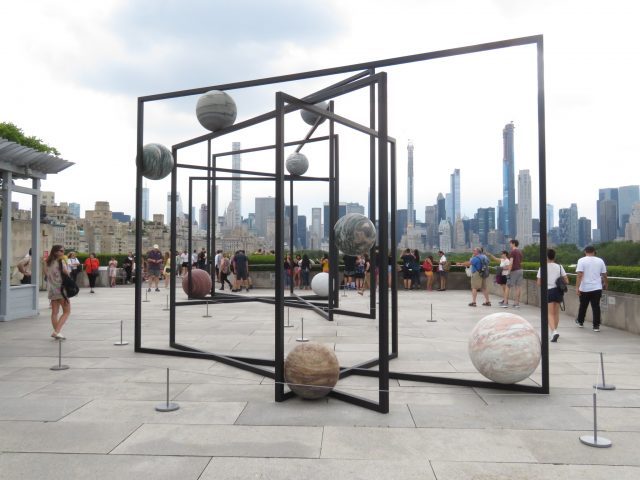
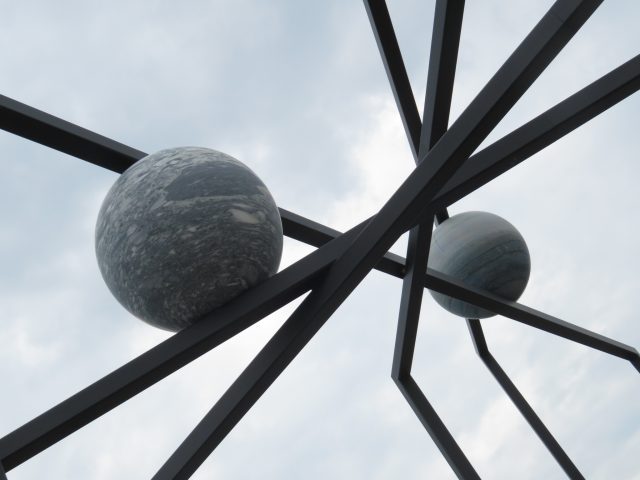
In 2015-16, Berlin-based Polish artist Alicja Kwade turned time upside down and backward in Against the Run, a reconfigured nineteenth-century-style city street clock that stood at the Scholars’ Gate entrance to Central Park. She now focuses her attention on space in her first solo US museum exhibition, Parapivot, continuing on the Met’s roof through October 27. Kwade’s construction consists of nine round, polished stones, evoking planets, precipitously balanced in interlocking steel frames. The daughter of a cultural scientist mother and an art historian father, Kwade’s works often involve scientific inquiry. Overlooking Central Park, Parapivot recalls such earlier pieces by Kwade as Ousia, Changed, Abakus, and But the Same, exploring issues of art, perception, and the natural world.

(photo by twi-ny/mdr)

Polished spheres are like planets in steel-framed construction by Alicja Kwade (photo by twi-ny/mdr)

“The work is not an illustration of something we invented; it’s more like an illustration of us inventing,” Kwade says in a catalog interview with Met chief curator Sheena Wagstaff. “In other words, it’s more like a reflection of ourselves than of something we already did, a sense of what could be a system, what we do, and how we read things.” Thus, Kwade’s solar system will call up different things for different people as they walk around and through it. “I never want to have an answer,” she says in the catalog. “I want to have more questions, but not answers.”

THE NEW MoMA

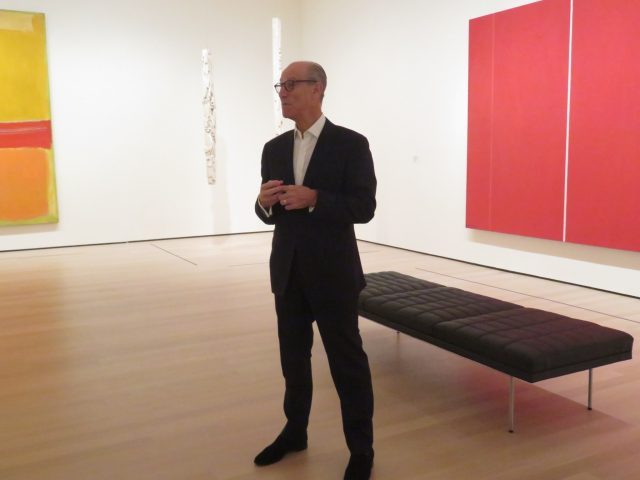
MoMA director Glenn D. Lowry shows off the new museums curatorial (photo by twi-ny/mdr)

MoMA director Glenn D. Lowry shows off museum’s ambitious new approach (photo by twi-ny/mdr)

MoMA, Museum of Modern Art
11 West 53rd St. between Fifth & Sixth Aves.
Opens Monday, October 21, $14-$25 (sixteen and under free)
212-708-9400
www.moma.org

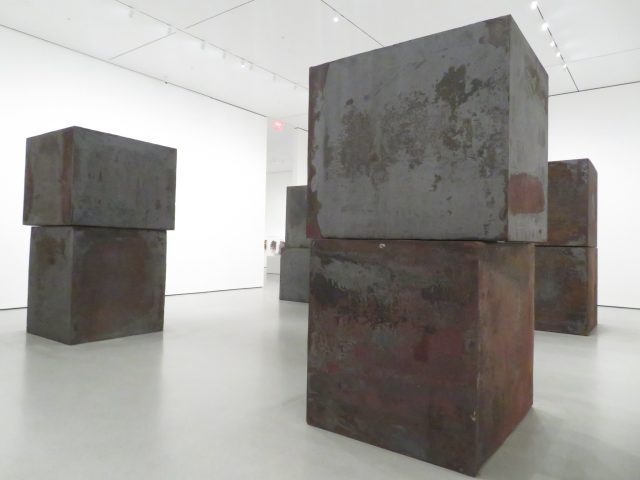
Perhaps no single work of art encapsulates the newly renovated, revamped, and expanded Museum of Modern Art as much as Richard Serra’s 2015 Equal, which gets its own room on the fourth floor. Eight forged weatherproof steel blocks are stacked in pairs, four on four. Despite their title, they are not the same: the random patterns on their sides are not consistent, the light that gleams through gaps in the stacks reveals the blocks are not exact replicas of each other, and they are positioned on different sides. It announces a new MoMA, reopening today with much fanfare after closing on June 16 for four months of reinstallation, a reimagination and reevaluation of how to display items from its ever-growing collection of more than two hundred thousand works. At an intimate press preview, museum director Glenn D. Lowry used all the right words and phrases to bring MoMA into 2019 and beyond, including “a more global perspective,” “pluralism,” “dialogues,” and “diversity.”

He was standing in gallery 404, “Planes of Color,” carefully chosen as representative of the institution’s updated curatorial approach. Instead of being essentially chronological, the room combines painting and sculpture in a more complex way, creating what Lowry said is a “conversation through time and space.” Thus, brought together are an obvious grouping of Russian-born American artist Mark Rothko’s No. 10 and No. 5/No. 22, American artist Ad Reinhardt’s Number 107, and American artist Barnett Newman’s Abraham and Vir Heroicus Sublimis, along with the less-expected choices of Ukraine-born American artist Louise Nevelson’s Hanging Column from Dawn’s Wedding Feast and Indian artist Vasudeo S. Gaitonde’s exquisite Painting, 4. “I hope that my painting has the impact of giving someone, as it did me, the feeling of his own totality, of his own separateness, of his own individuality, and at the same time of his connection to others,” Newman said in a 1965 interview with David Sylvester. “If a meeting of people is meaningful, it affects both their lives.” The same goes for this meeting of artworks.
(photo by twi-ny/mdr)

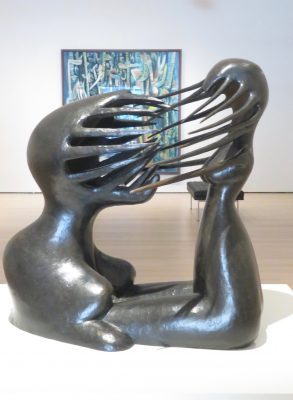
Maria Martins’s The Impossible, III tears apart conventional ideas of curation (photo by twi-ny/mdr)

In gallery 503, “Around Les Demoiselles d’Avignon,” thirteen works by Pablo Picasso from 1905 to 1912 are joined by Louise Bourgeois’s 1947-53 Quarantania, I sculpture and Faith Ringgold’s 1967 painting American People Series #20: Die 1967, a Guernica-inspired canvas about race, class, and violence. One of the museum’s greatest hits, Les Demoiselles d’Avignon, hangs in a corner, given no special prominence. Similarly, Vincent van Gogh’s The Starry Night and Henri Rousseau’s The Sleeping Gypsy, two other perennial favorites, are side by side on a far wall in gallery 501, along with turn-of-the-twentieth-century earthenware by George Ohr. The works on display will rotate every six months, although the classics will most likely always be on view, but not necessarily in the same place. “My ambition is to get past worrying about the canon,” Lowry said. “We’re shaking it up.”

The Worlds to Come gallery on the second floor was inspired by Jack Whitten’s Atopolis: For Édouard Glissant, an eight-panel acrylic canvas depicting a tattered America as if seen from space; it is accompanied by Trisha Donnelly’s Untitled video, Kara Walker’s ink and pencil on paper Christ’s Entry into Journalism, Michaela Eichwald’s Duns Scotus on artificial leather, Deana Lawson’s pigmented inkjet print Thai, and Nairy Baghramian’s styrofoam, aluminum, and cork Maintainers A, a wide range of disciplines and artists that the wall text puts in context of MoMA’s new curatorial decision-making: “Employing a range of forms and materials, some of these works address historical traumas and their present-day echoes, while others imagine a more hopeful future rooted in multiplicity and diversity. Purposefully open-ended, this grouping of works refuses a tidy summation of the art of our time.”
(photo by twi-ny/mdr)

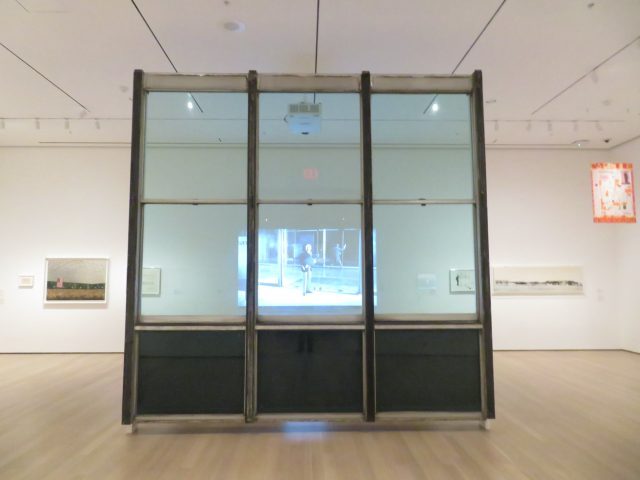
MoMA mixes artistic disciplines in revamped galleries (photo by twi-ny/mdr)

You can find the unexpected everywhere. An excerpt from Jacques Tati’s 1967 comedy Playtime can be viewed in gallery 417 through a piece of the facade from the 1952 UN Secretariat Building in a space dedicated to architecture. Alma Woodsey Thomas’s Fiery Sunset is in a gallery otherwise filled with paintings and sculptures by Henri Matisse. (Matisse’s The Swimming Pool gets its own room, as do Rosemarie Trockel’s Book Drafts and Joan Jonas’s Mirage.) The “Picturing America” gallery includes photographs by Dorothea Lange, Aaron Siskind, Rudy Burckhardt, Edward Weston, Walker Evans, and others alongside paintings by Edward Hopper, another example of the cross disciplines MoMA is now emphasizing.

Visitors to the second-floor contemporary galleries are greeted by Dara Birnbaum’s Technology/Transformation: Wonder Woman video, complete with explosion; to the right are two dozen of Cindy Sherman’s Untitled Film Stills, while to the left is Louise Lawler’s Does Andy Warhol Make You Cry?, a photo of Andy Warhol’s Gold Marilyn Monroe from a 1988 Christie’s auction. It’s a bold, if cheeky, way for MoMA to exclaim its dedication to women artists, blowing up the past.
(photo by twi-ny/mdr)

Richard Serra’s 2015 Equal gets its own room in new MoMA (photo by twi-ny/mdr)

Among what’s new are the Paula and James Crown Creativity Lab, where adults can learn about process and create their own art (kids can still drop in at the Samuel and Ronnie Heyman Family Art Lab in the Education and Research Building), and the fourth-floor Marie-Josée and Henry Kravis Studio, which will host live and experimental programming beginning with David Tudor’s immersive audio installation Rainforest V (variation 1); Tudor’s Forest Speech will be performed in the space October 24, 26, and 27 ($10-$15, 8:00) by Phil Edelstein, Marina Rosenfeld, Stefan Tcherepnin, Spencer Topel, and Jeremy Toussaint-Baptiste as well as three days each in November and December by different sets of musicians.

The museum’s initial exhibitions are all culled from the collection, furthering MoMA’s goal of making more of it available to the public: “Taking a Thread for a Walk,” “The Shape of Shape Artist’s Choice: Amy Sillman,” “Energy,” “Projects 110: Michael Armitage,” “Haegue Yang: Handles” (which will be activated daily at 4:00), “Private Lives Public Spaces” (home movies from dozens of artists and filmmakers), “Surrounds 11: Installations,” “Sur moderno: Journeys of Abstraction ― The Patricia Phelps de Cisneros Gift,” “member: Pope.L, 1978–2001,” and “Betye Saar: The Legends of Black Girl’s Window.” Philippe Parreno’s immersive, site-specific Echo provides sound, light, and movement in the entries on both West Fifty-Third and Fifty-Fourth St., yet more evidence that art is everywhere, in this case putting the visitor at the very center. “It is nearly impossible to make people understand each other,” explained Maria Martins, whose spiky 1946 bronze sculpture The Impossible, III greets people in gallery 401, the theme of which is “Out of War.” With its focus on diversity, juxtapositional dialogues, rotating works, and reconsidered approach to curation, MoMA is trying to get people to understand art, and each other, a whole lot better, in ways that make sense in our current era.
SARA SZE

(photo by twi-ny/mdr)

Sarah Sze’s Crescent (Timekeeper) immerses visitors at Tanya Bonakdar (photo by twi-ny/mdr)

Tanya Bonakdar Gallery
521 West 21st St. between Tenth & Eleventh Aves.
Through October 19, free, 10:00 am – 6:00 pm
212-414-4144
www.tanyabonakdargallery.com
www.sarahsze.com
sarah sze slideshow

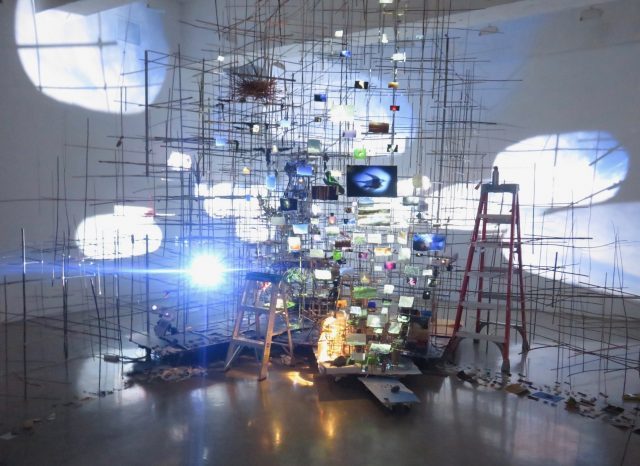
Sarah Sze has long been creating intricate, fragile ecosystems that feel like a complex construction made of giant toothpicks (and just about anything else she can find) that could come tumbling down with a mere touch. These installations have grown more detailed over time, incorporating high-tech electronic elements while expanding the breadth of its range. Her latest immersive exhibition at Tanya Bonakdar in Chelsea begins outside the gallery and continues in the hallways, large main space, back room, and upstairs, on the walls and the floors and the ceilings. There’s something everywhere, transforming parts of the gallery into her studio, revealing her extraordinary process. Originally a painter who now considers herself a sculptor, the Boston-born, New York-based artist centers the show with Crescent (Timekeeper), an exquisite work consisting of dozens of objects, from ladders, boxes, and rocks to plants, lamps, and bottles. Videos are projected onto torn pieces of paper, including a flying eagle, prowling wolves, the swirling ocean, and a burning fire, enhanced by sound as well, each open in its own internet browser, leaving it up to the viewer to make a narrative.

(photo by twi-ny/mdr)

Sarah Sze reveals some of her methodology in Tanya Bonakdar back room (photo by twi-ny/mdr)

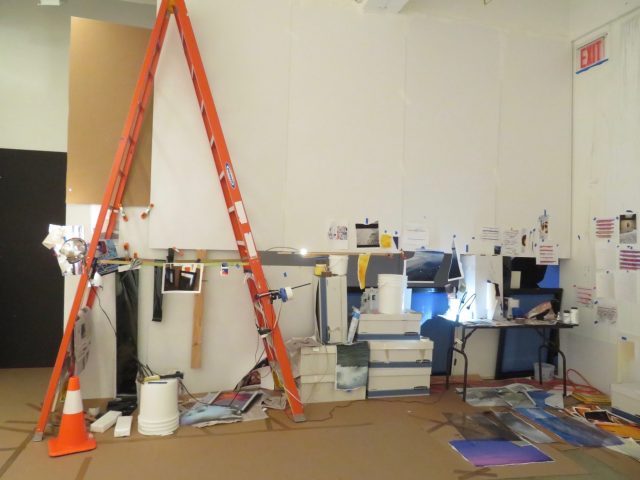
There are no barriers to prevent you from getting too close to the delicate piece; there’s a guard situated on the other side of the room, but Sze trusts us to not wreak havoc. She also shows us what she’s doing; the hallway is filled with her notes, some of the materials she uses (tape, paint, push pins, photographs, videos), while behind Crescent (Timekeeper) is a stack of slowly turning projectors, casting light and shadows everywhere. The back room is a cluttered studio setting with boxes, painted canvases with images stuck on, water bottles, paper towels, and other general detritus — the process has become the work.

(photo by twi-ny/mdr)

A studio space offers viewers a look at Sarah Sze’s creative process (photo by twi-ny/mdr)

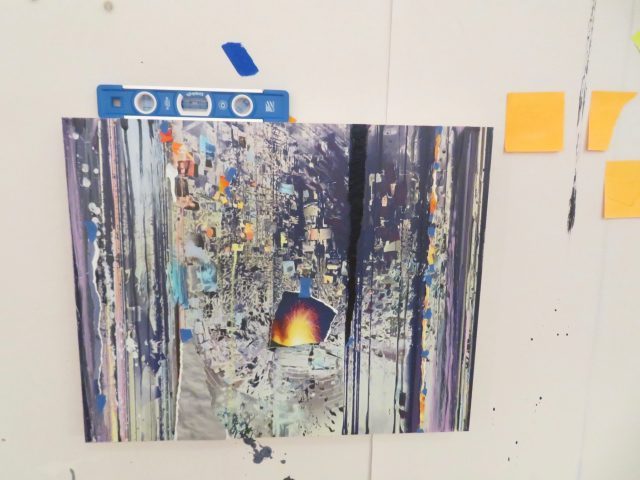
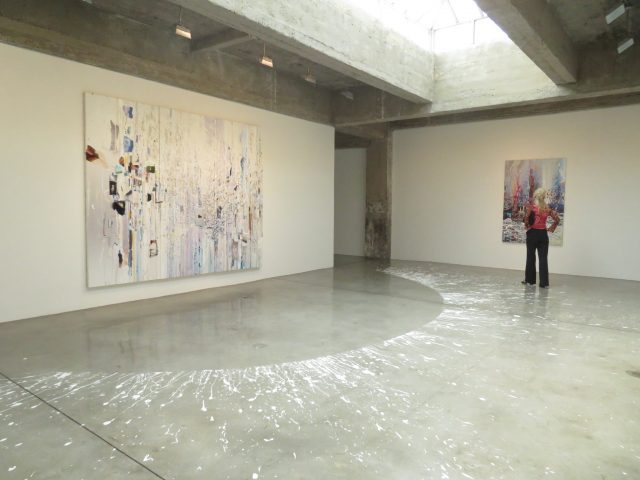
Upstairs is a room of four gorgeous painting collages, streaks of white paint on the floor forming a half-moon around one, as if beaming in through the skylight. Be sure to get close to the works to experience their startling depth. In the smaller, dark room, Sze lays bare her process of projecting tiny images onto a wall, revealing how she first designs them on a computer, then projects them through a sculptural form and onto the far wall. It’s utterly ingenious and wholly captivating.

Sze’s works are particularly suited to our image-saturated urban life, and especially here in New York City: Her Triple Point (Pendulum) is part of MoMA’s “Surrounds: 11 Installations” exhibition opening next week, her Blueprint for a Landscape can be seen all over the 96th St. stop on the Second Ave. subway, and her birdhouse Still Life with Landscape (Model for a Habitat) was on the High Line in 2012. And in 2006, her partially submersive Corner Plot welcomed people to the Scholars’ Gate entrance to Central Park.

(photo by twi-ny/mdr)

Paint forms a kind of floor sculpture in Sarah Sze show in Chelsea (photo by twi-ny/mdr)

In her 2018 essay “The Tattered Ruins of the Map: On Sarah Sze’s Centrifuge,” Sze’s friend, award-winning writer Zadie Smith, writes, “Like so much of Sarah Sze’s work, Centrifuge is a complex constellation of elements, in which all constituents present themselves simultaneously. . . . After the rupture, after the apocalypse, amid the ruin of cables and wires, someone might ask: what was the purpose of all of those images within and through which we lived?” This is true of her current Chelsea show, as Sze merges disparate components and artistic disciplines, both analog and digital, to forge a deep dive into the nature of time, space, and memory in a chaotic age.

PAUL CHAN: THE BATHER’S DILEMMA

(photo by twi-ny/mdr)

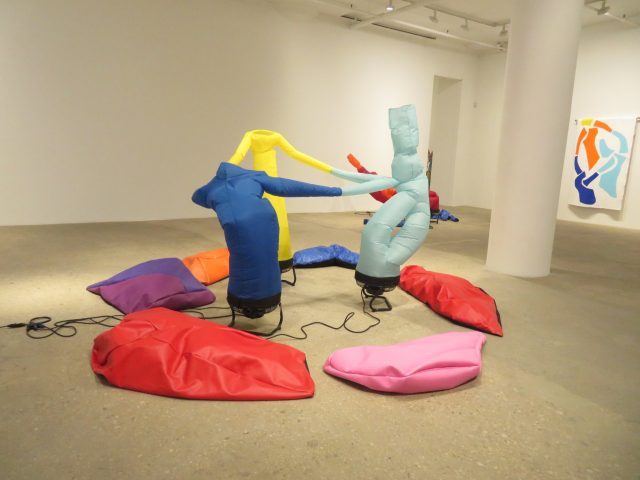
Paul Chan, Khara En Tria (Joyer in 3), nylon, fans, vinyl, polyfil, 2019 (photo by twi-ny/mdr)

Greene Naftali Gallery
508 West 26th St. between Tenth & Eleventh Aves.
Through October 19, free
www.greenenaftaligallery.com

Hong Kong-born, Nebraska-raised artist Paul Chan uses inflatable air dancers to reference art-historical themes and offer his take on the sorry state of the world in “The Bather’s Dilemma,” continuing at Greene Naftali through October 19. Chan, whose video installations include The 7 Lights, in which animated versions of people and debris fall from above, has created a series of beach tableaux in which the air dancers, generally seen as happy synthetic beings flailing about playfully, are weighed down, stuck, facing the problems tearing us apart despite their often bright color schemes. “At every age, overwhelming structural iniquities bring meaningless and arbitrary suffering and pain,” Chan writes in his “Sex, Water, Salvation, or What Is a Bather?” essay for the “Artistic License: Six Takes on the Guggenheim Collection” show on view at the Museum Mile institution through January 12. “And at every age, people organize to resist the best they can to try to stop the calamities from claiming more lives. Progress here means the collective power to stop ourselves from what we are most in danger of becoming. But progress takes a toll, especially on those who want it most. Resistance wears down the spirit, and makes a mess of the body and mind. It is a shame that it feels natural to expect suffering in oneself for the sake of ending it in others, and commonplace to accept this terrible symmetry as the price one pays for progress.”

(photo by twi-ny/mdr)

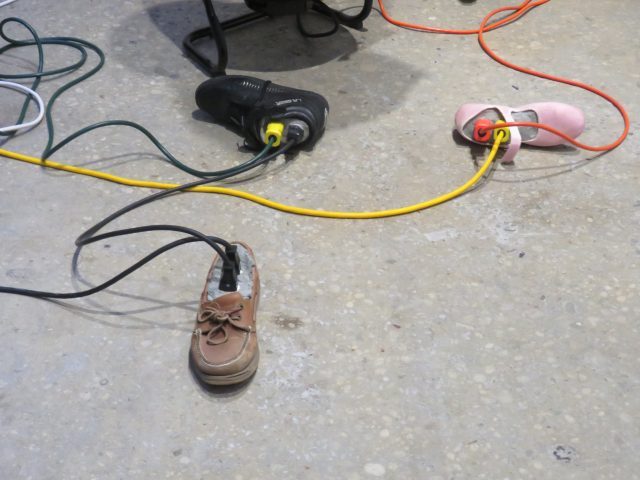
Paul Chan, detail, La Baigneur 7 (Teenyelemachus), nylon, fan, dye paint on nylon, shoes, concrete, suicide cords, 2018 (photo by twi-ny/mdr)

At Greene Naftali, works such as Khara En Tria (Joyer in 3), 2chained or Genesia and Nemesia, Phenus 1, and La Baigneur 7 (Teenyelemachus) employ specially placed fans to make the figures move in specific patterns with one another, rather than randomly as air dancers usually do. Towels serve as counterweights and also are hung on the walls like canvases. The works recall paintings by Cézanne, Munch, and Renoir but are not celebrations in the sand. Chan continues, “The bather in art breaks with this terrible symmetry by offering an image of another way forward. Works that take up this motif invite us to reflect on how pleasure renews us. They are reminders that pleasing and being pleased – without aggression or guilt – expands our capacity for fellow feeling. Genuine pleasure is rejuvenating. And like that perfect night of sleep, it has a clarifying quality, as if one has emerged from a kind of cleansing. This sense of being cleansed is stimulating and healing, insofar as it helps renew us to more ably face what the day demands.” However, he makes clear: “Progress without pleasure at heart is not progress at all. But pleasure without progress in mind is destructive, deadening, or a bore.”

(photo by twi-ny/mdr)

Paul Chan, Untitled (Katabasis with suspensions), muslin, nylon, polyfil, wire, wood, rope, inkjet on cotton, 2019 (photo by twi-ny/mdr)

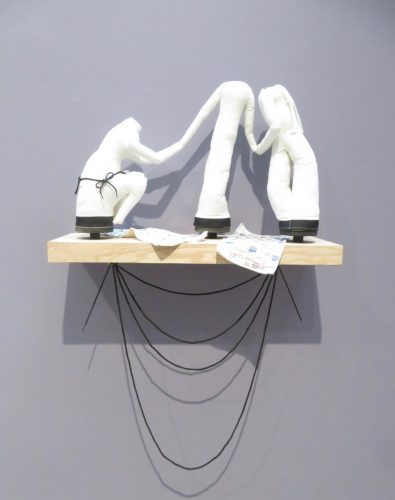
Poordysseus is an upside-down bather trapped in a vitrine. The hunched-over, black La Baigneur 7 (Teenyelemachus) includes what Chan calls “suicide cords,” electrical wiring plugged into shoes. The blue Bropheus wears a shirt that says, “Iche Hab Diche Lieb, Mann” (“I love you, man”), and he is situated on a beach towel made of opioid labels and an American flag color scheme. In the back room, smaller models stand on wooden platforms on the wall, studio detritus hanging below. The beach is supposed to be a place of beauty, a respite from the intense pressure of daily life, an opportunity to commune with nature, and one’s fellow human beings, in a carefree manner, despite the possibility of jellyfish and sharks in the water. But Chan also sees at least some hope in “The Bather’s Dilemma”; in the abovementioned essay, he is writing about the Guggenheim show but it also relates to his Greene Naftali exhibit: “Consider the following artworks as spirited invitations that encourage us to recall how enlivening it is to be near or in a river, some lake, or the open sea — and maybe a figure or two, naked or clothed, alone or no, to remember all that has been lost, how close it all is to disappearing, and what it takes to go on.”

WHITE LIGHT FESTIVAL 2019

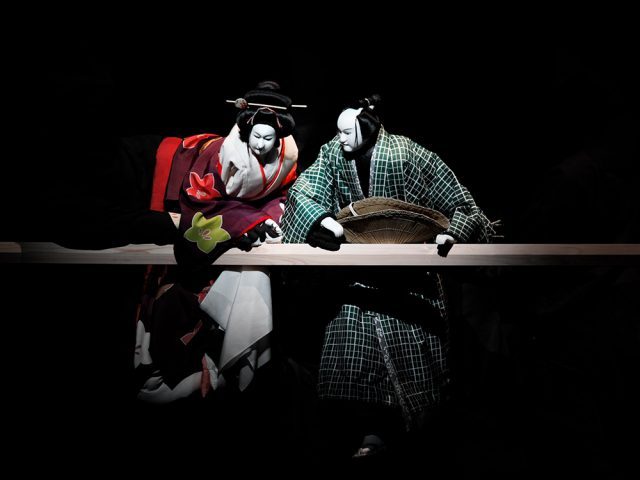
(photo copyright Hiroshi Sugimoto / courtesy Odawara Art Foundation)

Sugimoto Bunraku Sonezaki Shinju’s The Love Suicides at Sonezaki kicks off Lincoln Center’s tenth annual White Light Festival (photo copyright Hiroshi Sugimoto / courtesy Odawara Art Foundation)

Multiple venues at Lincoln Center
October 19 – November 24, free – $165
212-721-6500
www.lincolncenter.org

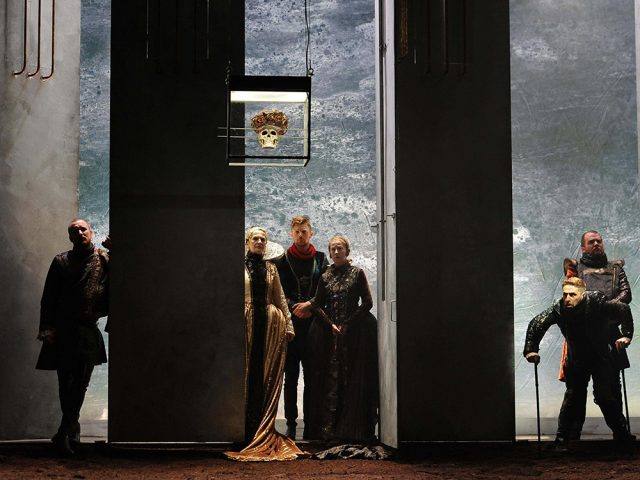
Lincoln Center’s multidisciplinary White Light Festival turns ten this year, and it is celebrating with another wide-ranging program of dance, theater, music, and more, running October 19 through November 24 at such venues as the Rose Theater, the Gerald W. Lynch Theater at John Jay College, Alice Tully Hall, and the Church of St. Mary the Virgin. “The resonance of the White Light Festival has only deepened during its first decade, as we have moved into far more challenging times here and around the world,” Lincoln Center artistic director Jane Moss said in a statement. “The Festival’s central theme, namely the singular capacity of artistic expression to illuminate what is inside ourselves and connect us to others, is more relevant than ever. This tenth anniversary edition spanning disparate countries, cultures, disciplines, and genres emphasizes that the elevation of the spirit the arts inspires uniquely unites us and expands who we are.” Things get under way October 19-22 (Rose Theater, $35-$100) with Sugimoto Bunraku Sonezaki Shinju’s The Love Suicides at Sonezaki, a retelling of a long-banned tale by Chikamatsu Monzaemon using puppets, composed and directed by Seiji Tsurusawa, with choreography by Tomogoro Yamamura and video by Tabaimo and artistic director Hiroshi Sugimoto. That is followed October 23-25 by Australia ensemble Circa’s boundary-pushing En Masse (Gerald W. Lynch Theater, $25-$65), directed and designed by Yaron Lifschitz, combining acrobatics and contemporary dance with music by Klara Lewis along with Franz Schubert and Igor Stravinsky.

In Zauberland (Magic Land) (October 29-30, Gerald W. Lynch, $35-$95), soprano Julia Bullock performs Schumann’s Romantic song cycle Dichterliebe while facing haunting memories; the text is by Heinrich Heine and Martin Crimp, with Cédric Tiberghien on piano. The set for Roysten Abel’s The Manganiyar Seduction (November 6–9, Rose Theater, $55-$110) is mind-blowing, consisting of more than two dozen Manganiyar musicians in their own lighted rectangular spaces in a giant red box. Last year, Irish company Druid and cofounder Garry Hynes brought a comic Waiting for Godot to the White Light Festival; this year they’re back with a dark take on Richard III (November 7-23, Gerald W. Lynch, $35-$110) starring Aaron Monaghan, who played Estragon in 2018. Wynton Marsalis will lead The Abyssinian Mass (November 21-23, Rose Theater, $45-$165) with Chorale Le Chateau, featuring a sermon by Rev. Dr. Calvin O. Butts III. In addition to the above, there are also several one-time-only events, listed below.

(photo by Robbie Jack)

DruidShakespeare will present Richard III at the White Light Festival November 7-23 (photo by Robbie Jack)

Thursday, October 24
Jordi Savall: Journey to the East, Alice Tully Hall, $35-$110, 7:30

Tuesday, October 29
Mahler Songs, recital by German baritone Christian Gerhahe with pianist Gerold Huber, Alice Tully Hall, $45-$90, 7:30

Thursday, November 7
Stabat Mater by James MacMillan, with Britten Sinfonia and the Sixteen, conducted by Harry Christophers, Alice Tully Hall, $50-$85, 7:30

Saturday, November 9
White Light Conversation: Let’s Talk About Religion, panel discussion with Kelly Brown Douglas, Marcelo Gleiser, James MacMillan, and Stephen Prothero, moderated by John Schaefer, Daniel and Joanna S. Rose Studio, free, 3:00

Sunday, November 10
Goldberg Variations, with pianist Kit Armstrong, Walter Reade Theater, $25, 11:00 am

Wednesday, November 13
Ensemble Basiani: Unifying Voices, Church of St. Mary the Virgin, $55, 7:30

Thursday, November 14
Attacca Quartet with Caroline Shaw: Words and Music, David Rubenstein Atrium, free, 7:30

Sunday, November 17
Tristan and Isolde, Act II, with the National Symphony Orchestra, conducted by Gianandrea Noseda, featuring Stephen Gould as Tristan and Christine Goerke as Isolde, David Geffen Hall, $35-$105, 3:00

Thursday, November 21
Gloria, with the Orchestra of the Age of Enlightenment and its Choir, conducted by harpsichordist Jonathan Cohen, featuring soprano Katherine Watson, countertenor Iestyn Davies, and soprano Rowan Pierce, Alice Tully Hall, $100, 7:30

Sunday, November 24
Los Angeles Philharmonic: Cathedral of Sound, Bruckner’s “Romantic” Symphony, conducted by Gustavo Dudamel, David Geffen Hall, $35-$105, 3:00

KARA WALKER’S KATASTWÓF KARAVAN WITH JASON MORAN

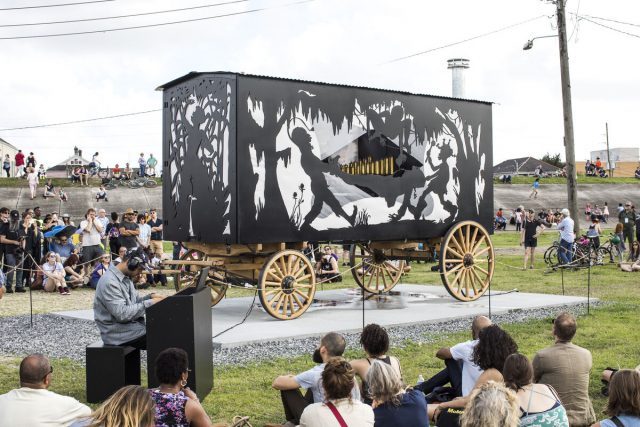
Kara Walker, The Katastwóf Karavan, 2017 (Installation view, Prospect.4: The Lotus in Spite of the Swamp, Prospect New Orleans, New Orleans, Louisiana, 2018). Steel frame mounted to lumber running gear, aluminum, red oak and muslin wall panels, propane fired boiler, water tank, gas generator, brass and steel 38-note steam calliope, calliope controller panel with MIDI interface, iPad controller with QRS PNO software; 152 × 216 × 100 inches (386.1 × 548.6 × 254 cm). © Kara Walker. Image courtesy Sikkema Jenkins & Co., New York. Photograph by Alex Marks

Kara Walker, The Katastwóf Karavan, steel frame mounted to lumber running gear, aluminum, red oak and muslin wall panels, propane fired boiler, water tank, gas generator, brass and steel 38-note steam calliope, calliope controller panel with MIDI interface, iPad controller with QRS PNO software, 2017 (© Kara Walker. Image courtesy Sikkema Jenkins & Co., New York. Photograph by Alex Marks)

Whitney Museum of American Art
Pamella and Daniel DeVos Family Largo
99 Gansevoort St.
Saturday, October 12, free, 1:00 – 6:30
whitney.org
www.karawalkerstudio.com

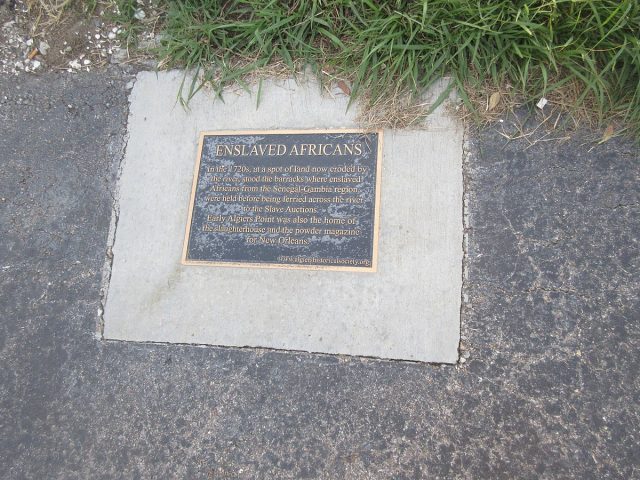
Two years ago, Kara Walker’s site-specific Katastwóf Karavan nearly didn’t make it to New Orleans’ Prospect.4 Triennial: The Lotus in Spite of the Swamp because of disagreements over shipping costs. But it ultimately took its place on Algiers Point, and now the completely fabricated wagon will be pulling into the Pamella and Daniel DeVos Family Largo outside the Whitney, where it will perform for free from 1:00 to 6:30 on Saturday. The California-born, New York-based artist was inspired to construct the wagon after reading an insufficient, small historical plaque (see below) at Algiers Point identifying the location where enslaved Africans were “held before being ferried across the river to the Slave Auctions” as well as after hearing calliope music coming from the Natchez riverboat, a steamboat reminiscent of the kind used to transport the slaves. The four-wheeled, four-ton circus-style wagon features Walker’s trademark silhouette figures of slaves being abused by masters on all four sides in water-cut steel, with a loud, thirty-eight-note steam-powered calliope inside, custom made by Kenneth Griffard. The presentation is taking place in conjunction with jazz musician Jason Moran’s solo show at the Whitney, which continues through January 5; Texas native Moran will play the calliope at 6:00 on Saturday.

In the Prospect.4 performance handout, Walker, whose My Complement, My Enemy, My Oppressor, My Love ran at the Whitney in 2007-8, explained, “I was thinking a lot about music as the bearer of our emotional history, and about the way Jazz and gospel and African American Music are testaments to survival of our culture in the face of unrelenting, nihilistic ‘Progress’ and how it’s regarded as a monument in American History etc. But also thinking about how the Industrial Revolution, the Steam Engine and Cotton Gin were pivotal in usurping and grinding up the bodies of laborers and how much of that action, John Henry style, occurs today, with Humans fighting uphill battles to prove themselves against the latest technology. Steam engines are quaint things of the past, but industry presses on without us. The Machines have changed, but the action stays the same. How would it be if the old steam engines that ate us, swallowed too, our songs and pain, and what if, when its time was done, and slated for the scrapheap, the Steam Engine sang out in solidarity?”

algiers point

Incorporating the Haitian Creole word for “catastrophe” in its name, Katastwóf Karavan — “We simply say ‘Slavery’ as if that were a legitimate job instead of what it was, a Catastrophe for millions,” Walker explains — will also play such civil-rights-era, celebratory, and protest songs as “We Shall Overcome,” Aretha Franklin’s “Respect,” Prince’s “When Doves Cry,” and Marvin Gaye’s “What’s Going On?” Walker, whose Fons Americanus is currently wowing visitors at the Tate Modern and whose Domino Sugar Factory installation A Subtlety caused a sensation in New York five years ago, holds nothing back in her work, confronting racial prejudice and inadequate histories head-on. “Forgetting is preferable to remembering, as remembering stirs action,” she writes in the handout.

JENNY HOLZER: VIGIL

mail

Rockefeller Center
30 Rockefeller Plaza
October 10-12, free, 8:00 – 10:00 pm
creativetime.org
projects.jennyholzer.com

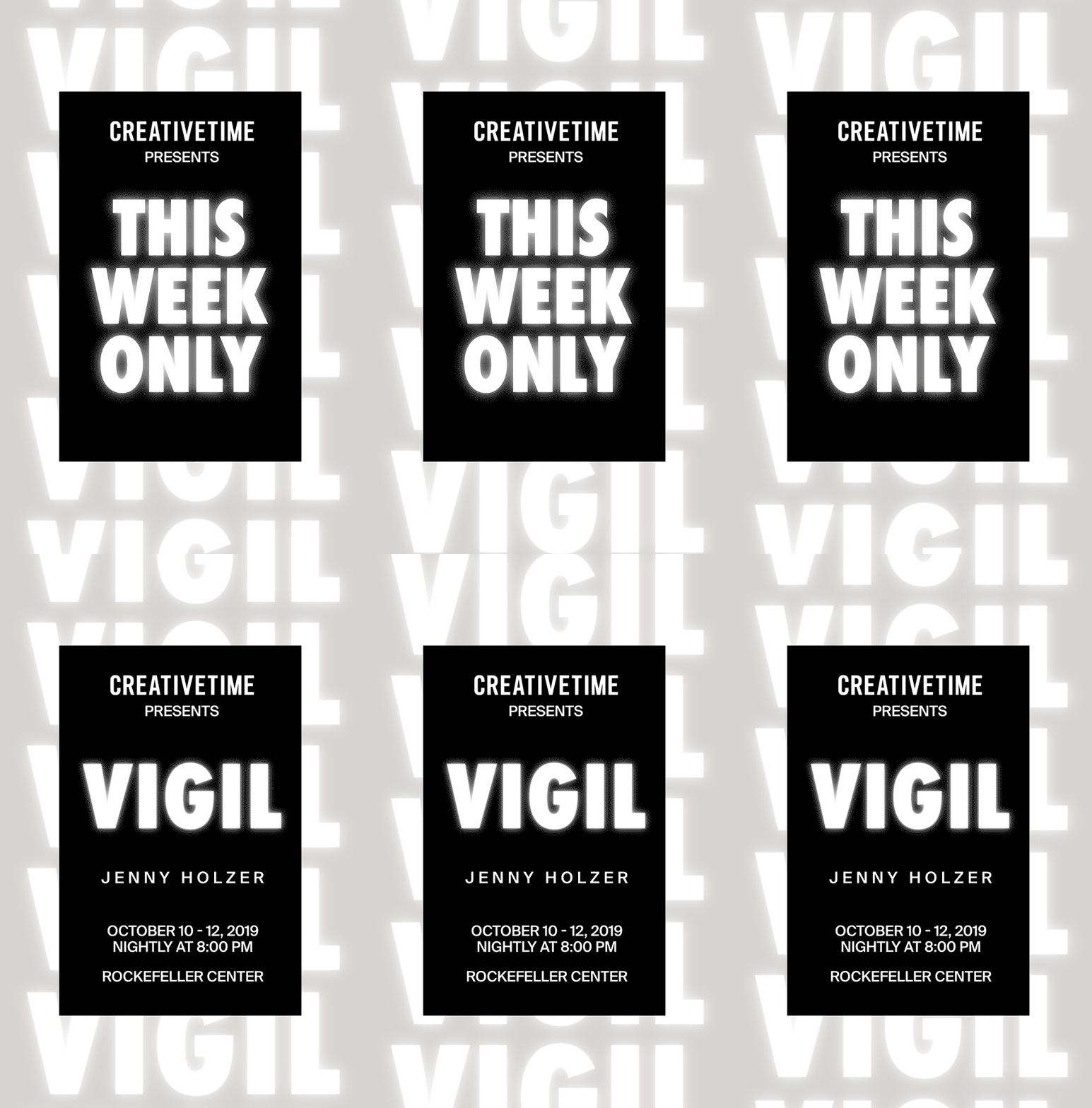
For more than forty years, Jenny Holzer has been producing text-based art, carving words into marble, projecting them on walls and buildings, running them digitally across sculptural signs, compiling them in lists, and even stitching them onto a dress Lorde wore to the Grammys. Her work has been seen on Singapore’s city hall, Silo No 5. in Montreal, the Potomac River, NYU’s Bobst Library, the New York Public Library, the Guggenheim, and Rockefeller Center. Her latest project takes her back to Rock Center with “Vigil,” a commission from the public arts organization Creative Time, which will be holding its tenth annual summit next month, asking the question “Can speaking truth to power unravel the age of disillusion we find ourselves in?”

From 8:00 to 10:00 on the evenings of October 10-12, the Ohio-born, New York-based Holzer will zero in on the rise of gun violence in the US, projecting excerpts from the 2017 book Bullets into Bells: Poets & Citizens Respond to Gun Violence, which combines poetry from established writers with responses from gun control activists, politicians, survivors of mass shootings, and family members of victims; stories from the award-winning activist website Moments that Survive, collected by Everytown for Gun Safety, which is dedicated to ending gun violence; and poems by teenagers who refuse to be silent. Holzer previously collaborated with Creative Time on “For New York City: Planes and Projections” and “For the City” in 2004-5, and her ongoing “It Is Guns” series, featuring such statements as “Scream Again,” “The President Backs Away,” and “Too Late Now” on trucks, has traveled to Chicago, Miami, Atlanta, Tallahassee, New York, and other American cities.