John Wilson talks with David Byrne about his latest Pace show and new book on February 7
Who:David Byrne,John Wilson What: Live virtual discussion Where:Pace Gallery, 540 West Twenty-Fifth St., Pace Gallery YouTube When: Monday, February 7, free (online), 7:00 Why: In his endlessly creative and fun HBO docuseries How To with John Wilson, Astoria native John Wilson uses footage shot all around New York City to delve into such issues as small talk, scaffolding, memory improvement, finding a parking spot, and making the perfect risotto. In his endlessly creative and fun career, British-born musician, singer, playwright, and visual artist David Byrne has made albums (solo and with Talking Heads), given concerts, directed films, and had gallery shows; currently, his brilliant American Utopia continues on Broadway at the St. James Theatre through April 3, and his latest exhibition, “How I Learned About Non-Rational Logic,” is running at Pace’s Twenty-Fifth St. space through March 19. The show consists of several series of drawings Byrne has done over the last twenty years, including his unusual depictions of dingbats sketched during the pandemic. (He describes his fascination with dingbats here.)
Byrne and Wilson have previously collaborated on the 2015 true crime concert documentary Temporary Color; they now will sit down together for a discussion at Pace in conjunction with the publication of Byrne’s new book, A History of the World (in Dingbats) (Phaidon, March 9, $39.95). “How We Learned About Non-Rational Logic: A Conversation on Humor and Bookmaking” takes place in person at Pace, where attendees will receive a signed copy of the book; the event will also be streamed for free over YouTube. “This idea of non-rational logic was not something I made up, but I realized that it kind of resonated with both the fact that I make music and the fact that these drawings follow a kind of logic that isn’t kind of based on logical or rational thinking,” Byrne notes in the above behind-the-scenes video. There should be plenty of such non-rational logic in what promises to be a very funny and illuminating talk.
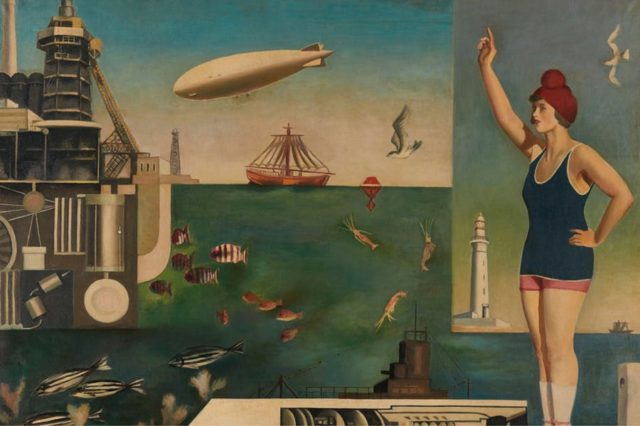
Koga Harue, Umi (The Sea), oil on canvas, 1929 (The National Museum of Modern Art, Tokyo / photo courtesy MOMAT/DNPartcom)
Who:MetSpeaks What: Two-day virtual symposium on Met exhibition “Surrealism Beyond Borders” Where:Metropolitan Museum of Art Zoom When: Thursday, January 20, 1:00–5:30; Friday, January 21, 10:00 am – 1:00 pm, free with advance RSVP Why: While walking through the Met’s must-see “Surrealism Beyond Borders” exhibit, which continues through January 30, I bumped into an old friend of mine who was not impressed by the show, disappointed that it was lacking in big-name familiar works. However, that’s part of the point. While the exhibition does feature works by Max Ernst, Giorgio de Chirico, René Magritte, Salvador Dalí, Leonora Carrington, Wifredo Lam, Dorothea Tanning, and Joan Miró, it explores the development of surrealism around the world, from Belgrade, Mexico City, the Netherlands, Haiti, South Korea, and Portugal to Egypt, England, Colombia, South America, Cuba, and Canada, where surrealism was often part of sociocultural movements toward freedom and justice.
Divided into such sections as “Collective Identities,” “The Work of Dreams,” “Beyond Reason,” “Thoughts in Transition,” “The Fantasy and Phallacy of Elsewhere,” “Bodies of Desire,” and “Automatism,” the show finds commonalities in different cultures in painting and sculpture and broadens the idea of what qualifies as surreal. Marcel Jean’s oil on wood Armoire surréaliste (Surrealist Wardrobe), made while the French artist was living in exile with his wife in Budapest, welcomes visitors with open doors. Koga Harue’s Umi (The Sea) prefigures Thomas Hart Benton. Ramses Younan’s 1939 untitled painting of a twisted Nut, the goddess of the sky, was a direct response to Magritte and Dalí. Ithell Colquhoun called her double-phallic Scylla “a pictorial pun.” There’s also an experimental film by Maya Deren, Cage by Alberto Giacometti, a copy of the 1941 Martinique arts journal Tropiques, Pierre Alechinsky’s depiction of Central Park, and a corner dedicated to surrealism in Chicago in the 1960s, with protest posters, manifestos, and blues music by Elmore James, Buddy Guy, and others. “Surrealism fights for the TOTAL LIBERATION OF MAN!” the Chicago Surrealist Group declared in 1971. The show indeed goes well beyond borders.
In conjunction with the final days of the show, MetSpeaks is hosting a two-day free virtual symposium consisting of four panel discussions with professors, publishers, artists, and art historians exploring various aspects of surrealism, focusing on time and place. Admission is free with RSVP; below is the schedule.
Thursday, January 20 Surrealism and Place, with Lori Cole, Krzysztof Fijalkowski, Talinn Grigor, fahima ife, and Mark Polizzotti, moderated by Joan Kee, 1:00 – 3:00
On Black, Brown, & Beige, with Robin D. G. Kelley and Fred Moten, moderated by Zita Cristina Nunes, 4:00 – 5:30
Friday, January 21 Surrealism and Time, with Sam Durant, Marie Mauzé, Partha Mitter, and Michael Stone-Richards, moderated by Dawn Adès, 10:00 am – 12:00 pm
Closing Discussion, with Dawn Adès, Joan Kee, and Zita Cristina Nunes, 12:00 – 12:45 pm
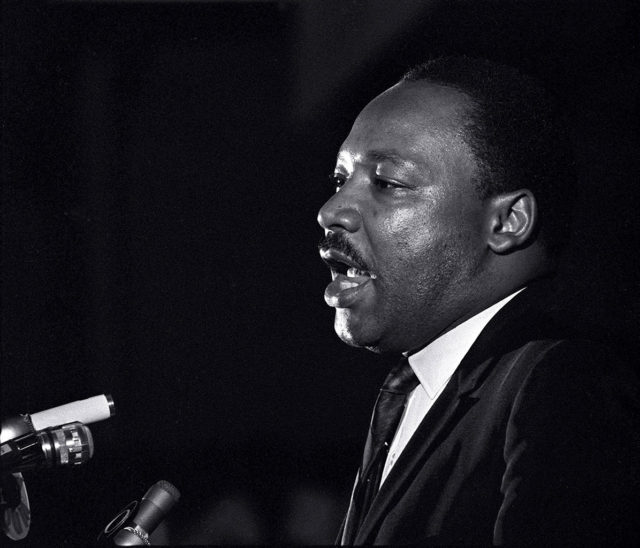
The life and legacy of Dr. Martin Luther King Jr. will be celebrated at BAM on MLK Day (photo courtesy SuperStock)
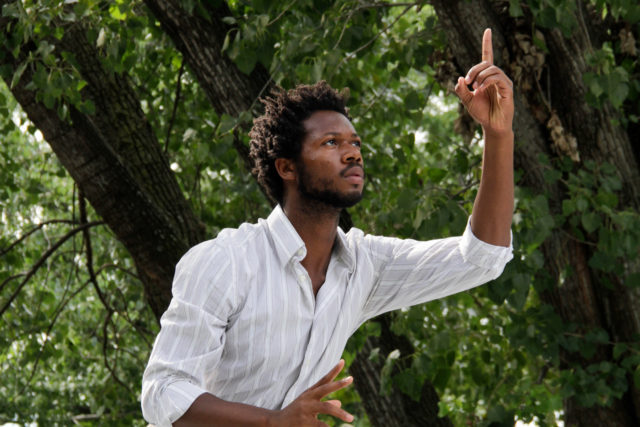
Who: Dr. Imani Perry, Nona Hendryx, Craig Harris & Tailgaters Tales, Sing Harlem, Kyle Marshall, Reggie Wilson, others What: Thirty-Sixth Annual Brooklyn Tribute to Dr. Martin Luther King Jr. Where:BAM Howard Gilman Opera House, Harvey Theater at BAM Strong, BAM Rose Cinemas, and online When: Monday, January 17, free with RSVP, 10:30 am Why: No one pays tribute every year to the life and legacy of the Reverend Dr. Martin Luther King Jr. quite the way BAM does on MLK Day. On January 17, the Brooklyn institution will be hosting another impressive gathering, both in person and online, featuring a keynote address by Dr. Imani Perry, author and professor of African American studies at Princeton, entitled “Where Do We Go from Here: Chaos or Community”; live performances by Nona Hendryx with Craig Harris & Tailgaters Tales and Sing Harlem; and the eight-minute video King, a recording of a solo by dancer and choreographer Kyle Marshall that incorporates text from Dr. King’s “I’ve Been to the Mountaintop” speech, delivered on April 3, 1968, the day before his assassination.
Kyle Marshall’s King is part of BAM MLK tribute (photo by Steven Speliotis)
“We’re thrilled to welcome the community back as we uplift one another and unite in celebration of Dr. King’s enduring legacy and its relevance today,” BAM co-interim resident Coco Killingsworth said in a statement. ”Brooklyn’s beloved tradition was established a year after Dr. King’s birthday was recognized as a national holiday, and thirty-six years later, his convictions remain an indelible force for equality, dignity, and justice. This year we are expanding our celebration to include more programs and events at a moment when we so deeply need to channel Dr. King’s legacy, leadership, and lessons.”
The day also includes a 1:00 screening in BAM Rose Cinemas of Stanley Nelson and Traci A. Curry’s 2021 documentary Attica, about the 1971 uprising at the prison; a 3:00 community presentation at the Harvey Theater at BAM Strong of Reggie Wilson’s Power, a dance that explores the world of the Black Shakers; the BAMkids workshop “Heroes of Color HQ” for children five to eleven, focusing on underrepresented historical figures; and a digital billboard showing “Salvation: A State of Being,” with contributions by seven Black visual artists (Adama Delphine Fawundu, Genevieve Gaignard, Jamel Shabazz, Frank Stewart, Roscoè B. Thické III, Deborah Willis, and Joshua Woods) honoring author and activist bell hooks, who passed away on December 15 at the age of sixty-nine.
As Dr. King said on April 3, 1968: “Something is happening in our world. The masses of people are rising up. And wherever they are assembled today, whether they are in Johannesburg, South Africa; Nairobi, Kenya; Accra, Ghana; New York City; Atlanta, Georgia; Jackson, Mississippi; or Memphis, Tennessee — the cry is always the same: ‘We want to be free.’ And another reason that I’m happy to live in this period is that we have been forced to a point where we are going to have to grapple with the problems that men have been trying to grapple with through history, but the demands didn’t force them to do it. Survival demands that we grapple with them. Men, for years now, have been talking about war and peace. But now, no longer can they just talk about it. It is no longer a choice between violence and nonviolence in this world; it’s nonviolence or nonexistence. That is where we are today.”
WHO IS QUEEN? READING GROUP
January 12, 19, 25, free with advance RSVP, 6:00
Exhibition continues through February 21 at MoMA
11 West 53rd St. between Fifth & Sixth Aves.
Donald and Catherine Marron Family Atrium www.moma.org
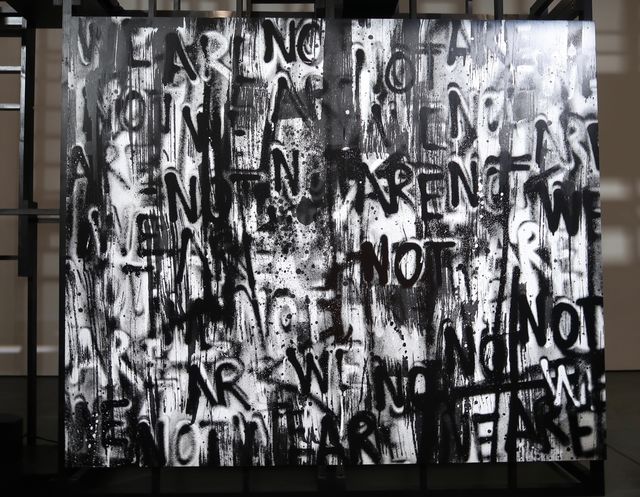
“It has been said that the master’s tools will never dismantle the master’s house, but what about the people the master treated as tools?” Adam Pendleton writes in his 2017 Black Dada Reader. “That is, the ‘tools’ that were themselves capable of practicing abstraction, those three-fifths? Before the question about tools can be asked, there must already be an understanding about what a tool is and what it is not. . . . One day there are masters and tools, and the next, only people.”
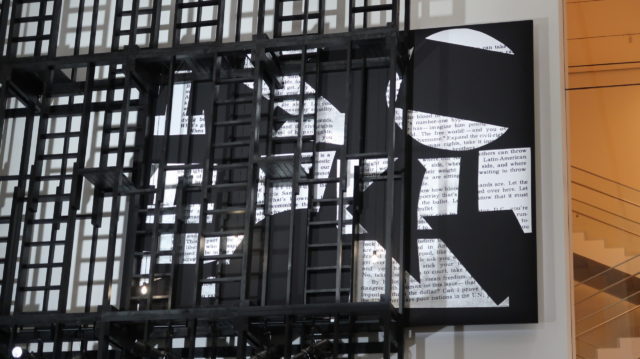
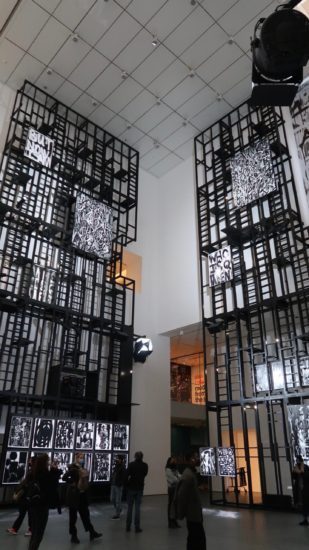
Pendleton’s multimedia installation, Who Is Queen?, on view in MoMA’s Donald and Catherine Marron Family Atrium through February 21, is a unique neighborhood built of various tools, where visitors walk in the middle of three five-story black scaffold towers made of timber, laden with paintings, drawings, text, graffiti-style screenprints, speakers, and a large screen that shows new and archival footage involving the Robert E. Lee statue in Richmond, Virginia (the city where Pendleton was born in 1984); Resurrection City, a forty-two-day encampment protest on the National Mall in 1968 that was part of the Poor People’s Campaign for civil rights; and So We Moved: A Portrait of Jack Halberstam, a film about author, professor, and gender theorist Jack Halberstam, the latest in a series by Pendleton that follows works about Kyle Abraham, Ishmael Houston-Jones, Lorraine O’Grady, and Yvonne Rainer. Among the text that can be made out on the canvases are such phrases as “But now I am,” “We are not,” “Everything,” and “They will love us all,” accompanied by a sound collage that includes American violinist Hahn Rowe’s “Yellow Smile,” a poem read by Amiri Baraka, excerpts from the 2014 Ferguson solidarity protest in New York City, and music by Jace Clayton, Julius Eastman, Laura Rivers, Frederic Rzewski, Linda and Sonny Sharrock, and Hildegard Westerkamp.
Adam Pendleton’s Who Is Queen? includes sculpture, painting, film, drawing, sound, and text (photo by twi-ny/mdr)
The scaffolding resembles fire escape ladders with platforms, but the public is not permitted to walk up and get closer to some of the pieces, which can reach sixty feet high. You might also have trouble making out all the words on the lower works as a parade of museumgoers pose in front of them foor pictures without even reading what they say about politics, race, inequality, gender, and the social contract. Pendleton has previously explored those concepts in such exhibitions as “what a day was this” at Lever House, detailing his manifesto, and his lobby piece As Heavy as Sculpture welcoming visitors to the New Museum’s instantly seminal “Grief and Grievance: Art and Mourning in America” show.
Adam Pendleton uses black-and-white text and imagery in multimedia MoMA installation (photo by twi-ny/mdr)
“Who Is Queen? is undergirded by a kind of Afro-optimism balanced by an abiding Afro-pessimism,” Pendleton explained in a statement. “It is optimistic in a deeply American sense of the word, and pessimistic along those same lines. That is to say, it is not black or white, and locates each within the other. It articulates the ways in which we simultaneously possess and are possessed by contradictory ideals and ideas.” The articulation of the Gesamtkunstwerk, which has been ten years in the making, expands with a series of livestreamed Zoom reading groups and recorded podcast dialogues that are all free; snippets of the conversations will be added to the overall sound collage in the atrium.
Wednesday, January 12, 6:00 Reading Group with Harmony Holiday and Jasmine Sanders, inspired by Adam Pendleton’s idea of “poetic research” and focusing on Amiri Baraka’s poem “Black Dada Nihilismus” and an interview between Ornette Coleman and Jacques Derrida, “The Other’s Language”
Wednesday, January 19, 6:00 Reading Group with Che Gossett and Jules Gill-Peterson, focusing on a 2011 interview between cultural theorist Lauren Berlant and political philosopher Michael Hardt, “No One Is Sovereign in Love”
Tuesday, January 25, 6:00 Reading Group with Jace Clayton and Sharifa Rhodes-Pitts, focusing on “Repetition as a Figure of Black Culture” by James A. Snead
Adam Pendleton installation reaches sixty feet high in MoMA atrium (photo by twi-ny/mdr)
Special FIAF program looks at new book and exhibition about Christian Dior
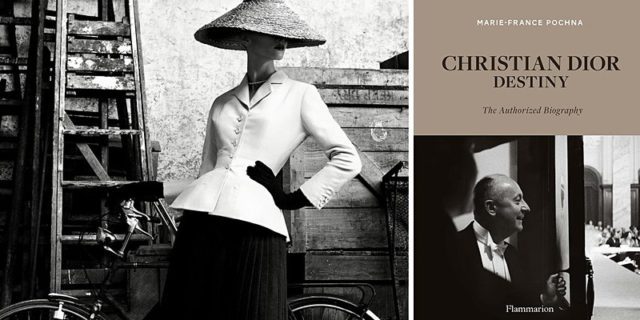
Who: Marie-France Pochna, Matthew Yokobosky What: Discussion about new book and art exhibition on Christian Dior Where:FIAF Skyroom and online, 22 East 60th St. between Park & Madison Aves. When: Thursday, January 13, online or in person, $25, 7:00 Why: “Women have instinctively understood that I dream of making them not only more beautiful but also happier,” fashion revolutionary Christian Dior once said. If you didn’t get tickets for the special scent tour the Brooklyn Museum is hosting on January 19 in conjunction with its exhibition “Christian Dior: Designer of Dreams,” you can still get a behind-the-scenes taste of the popular show with the January 13 FIAF Talk between Marie-France Pochna and Matthew Yokobosky, “Dreaming of Dior,” taking place in person at the French Institute Alliance Française’s Skyroom and online. Pochna is the author of the new book Christian Dior: Destiny: The Authorized Biography (Rizzoli, October 2021, $35), which includes the above quote, while Yokobosky, the senior curator of Fashion and Material Culture at the museum, collaborated with Denver Art Museum curator Florence Müller on the exhibit, which continues in Brooklyn through February 20. Depending on the nature of the omicron variant, the discussion will be followed by a Q&A and book signing.
Berlin-based composer and sound artist Dorit Chrysler ingeniously activates MoMA’s “Alexander Calder: Modern from the Start” exhibition with “Calder Plays Theremin,” a gorgeous eight-minute suite, “Written for Theremin Orchestra in Four Movements.” Invented by Russian-Soviet Leon Theremin around 1920, the theremin is an electronic instrument that creates music without touch, from being in close proximity to a moving object, usually a human hand. Chrysler, cofounder of the NY Theremin Society, set up four theremins (Moog, Hobbs, Moog Etherwave, and Claravox Centennial) to interact with two of Calder’s kinetic mobiles, the gentle 1948 Snow Flurry, I, which hangs from the ceiling in the corner of the third floor surrounded by three large-scale black sheet steel works, including 1959’s Black Widow, and the significantly heavier 1945 Man-Eater with Pennants, which sits in the Abby Aldrich Rockefeller Sculpture Garden, across the street from Theremin’s 1930s studio. Chrysler also incorporates a Moog Model 15 analog synthesizer to pay tribute to the first concert to use that instrument, performed in 1969 by Robert Moog in the sculpture garden.
Working with effects producer Rachael Guma, sonic consultant Joe McGinty, filming director Michael Tyburski, cinematographer Eric Teti, and sound recordist Daniel Neumann, Chrysler collected audio from the movement of the sculptures, whether from the blowing of the wind outdoors or a hair dryer inside. The final composition consists of four sections, “Embrace,” “Fractals,” “Brute,” and “Mesmerism,” that form a narrative as the sculptures and the theremins meet each other, engage in a dialogue, and face conflict, leading to a finale in which the other Calder sculptures become spectators.
“Alexander Calder himself really spawned the idea,” Chrysler tells associate curator Cara Manes in a MoMA interview. “When I was first invited by the Calder Foundation to visit their New York offices, I found myself surrounded by many of the artist’s large-scale works. Calder’s mobiles have strong character and personality and I envisioned them instantly as active performers. The technology of theremins allows for sound production through moving objects, so it made sense to me having a moving mobile play a theremin. The potential of the intricate movements of some of Calder’s sculptures translated into microtonal sounds seemed very exciting. Placing a theremin instrument within its calibrated range close enough to moving elements of Calder’s sculpture should make this possible. What would happen? What would it sound like? It felt like this exploration of a musical dialogue between two modernist masters of sculpture and music, through their creations, demanded to be heard.”
“Alexander Calder: Modern from the Start” continues through January 15, featuring approximately seventy works from throughout the career of MoMA’s unofficial “house artist,” from wire sculptures and drawings to painted sculptural reliefs and jewelry, supplemented with photographs and other archival material.
Who: Works by and/or featuring Moko Fukuyama, Joshua William Gelb, Gabrielle Hamilton, Jace, Elmore James, Jamal Josef, Katie Rose McLaughlin, Sara Mearns, Zaire Michel, Zalman Mlotek, Alicia Hall Moran, Patrick Page, Barbara Pollack, Seth David Radwell, Jamar Roberts, Tracy Sallows, Xavier F. Salomon, Janae Snyder-Stewart, Mfoniso Udofia, Anne Verhallen What:This Week in New York twentieth anniversary celebration Where:This Week in New York YouTube When: Original air date: Saturday, May 22, free with RSVP, 7:00 (now available on demand) Why: In April 2001, I found myself suddenly jobless when a relatively new Silicon Alley company that had made big promises took an unexpected hit. I took my meager two weeks’ severance pay and spent fourteen days wandering through New York City, going to museums, film festivals, parks, and tourist attractions. I compiled my experiences into an email I sent to about fifty friends, rating each of the things I had done. My sister’s husband enthusiastically demanded that I keep doing this, and This Week in New York was born.
Affectionately known as twi-ny (twhy-nee), it became a website in 2005 and soon was being read by tens of thousands of people around the globe. I covered a vast array of events – some fifteen thousand over the years – that required people to leave their homes and apartments and take advantage of everything the greatest city in the world had to offer. From the very start, I ventured into nooks and crannies to find the real New York, not just frequenting well-known venues but seeking out the weird and wild, the unusual and the strange.
For my tenth anniversary, we packed Fontana’s, a now-defunct club on the Lower East Side, and had live music, book readings, and a comics presentation. I had been considering something bigger for twenty when the pandemic lockdown hit and lasted longer than we all thought possible.
At first, I didn’t know what twi-ny’s future would be, with nowhere for anyone to go. But the arts community reacted quickly, as incredible dance, music, art, theater, opera, film, and hybrid offerings began appearing on numerous platforms; the innovation and ingenuity blew me away. The winners of twi-ny’s Pandemic Awards give you a good idea of the wide range of things I covered; you can check out part one here and part two here. (Part III is now up as well.)
I devoured everything I could, from experimental dance-theater in a closet and interactive shows over the phone and through the mail to all-star Zoom reunion readings and an immersive, multisensory play that arrived at my door in a box. Many of them dealt with the fear, isolation, and loneliness that have been so pervasive during the Covid-19 crisis while also celebrating hope, beauty, and resilience. I’ve watched, reviewed, and previewed more than a thousand events created since March 2020, viewing them from the same computer where I work at my full-time job in children’s publishing.
Just as companies are deciding the future hybrid nature of employment, the arts community is wrestling with in-person and online presentations. As the lockdown ends and performance venues open their doors, some online productions will go away, but others are likely to continue, benefiting from a reach that now goes beyond their local area and stretches across the continents.
On May 22 at 7:00, “twi-ny at twenty,” produced and edited by Michael D. Drucker of Delusions International and coproduced by Ellen Scordato, twi-ny’s business manager and muse, honors some of the best events of the past fourteen months, including dance, theater, opera, art, music, and literature, all of which can be enjoyed for free from the friendly confines of your couch. There is no registration fee, and the party will be available online for several weeks. You can find more information here.
Please let me know what you think in the live chat, which I will be hosting throughout the premiere, and be sure to say hello to other twi-ny fans and share your own favorite virtual shows.
Thanks for coming along on this unpredictable twenty-year adventure; I can’t wait to see you all online and, soon, in real life. Here’s to the next twenty!