Anat Litwin, “Sweet Epiphanies #4: The Leap,” paper cutout, 2009
SWEET EPIPHANIES
Colson Patisserie
374 Ninth St. at Sixth Ave., Brooklyn
Through February 10
Admission: free
718-965-6400
www.anatlitwin.com
www.colsonpastries.com
The Epiphany might be held on different days in January depending on where you live in the world and what part of Christianity you follow, but the holiday is continuing into February in a popular Brooklyn pastry shop. “Sweet Epiphanies” is a site-specific display at Colson Patisserie by Brooklyn-based Israeli-American artist and curator Anat Litwin, the founder and artistic director of the HomeBase Project and a senior fellow at LABA at the 14th St. Y. Litwin addresses the word “epiphany” in both its religious and literary contexts, incorporating the January celebration of the manifestation of Christ with Joseph Campbell’s theory of the heroic monomyth, which he borrowed from James Joyce. The exhibit, which features a series of colorful paper cutouts displaying silhouetted figures and crowns and evoking self-realization, is joined by the patisserie’s La Galette des Rois, the Cake of Kings, a traditional puff pastry that involves children becoming a king or queen for a day and receiving a lucky charm baked into the filling. Run by French pastry chef Yonatan Israel, who opened the patisserie in 2006, the eatery is the brainchild of Belgian pastry chef, psychotherapist, and cookbook author Hubert Colson. The engaging, enthusiastic Litwin participated in an exclusive twi-ny talk, discussing her work as well as her own epiphanies, one of which is hanging out at the shop and gauging people’s reactions to the show. “Since it’s been up,” she notes, “I’ve become addicted to sitting in the café and hearing how people from the neighborhood and guests respond to the artwork and reflect on it over cake and coffee. I would never had such lively, meaningful conversations in a gallery.”
twi-ny: How did you and Colson come together for this show?
AL: Yonatan Israel, the owner of Colson, and Ronit, his wife, are close friends. We’ve collaborated together in the past on several art projects, including a benefit for the HomeBase Project. I am familiar with the creative spirit and talent and professional approach and deep dedication that goes into the baking at Colson and was intrigued to create an art series for the patisserie that somehow responds to the place and to the world of French baking. When Yonatan and Hubert Colson, the main chef, told me about the Galette de Rois celebrating the Epiphany and about the traditional French game of becoming a king for the day, I was inspired. I loved the idea of the fantastic childlike immediate empowerment as king or queen and decided to give that an artistic interpretation and explore what kingly-hood really means in folklore and myth.

Anat Litwin, “Sweet Epiphanies #1: Red Royal Path Calling,” paper cutout, 2009
Would you mind sharing one of your own personal or professional epiphanies?
Professional epiphanies and personal epiphanies are somehow connected in the studio. But the nice thing in being an artist is that often an idea or inspiration comes to mind before you realize what it really means — the creative process is somehow a few steps before you, and on good days of inspiration you spend time chasing after your own muse / ideas, trying to discover and understand your inspiration through realizing it in form. One recent epiphany came to me after finishing the “Sweet Epiphanies” series. It became clear to me that as an artist and person I am totally interested in the fantastic transgression from the everyday to the sublime and back again. I believe in the possibility of the human to undergo salvation, and I pursue that through creating images and actions. I am a believer that way. This registered through the work on the series that uses the monomyth of Joseph Campbell as a key model.
What’s your favorite treat that Colson Patisserie makes?
I’m completely addicted now to the Galette de Rois and find myself with cravings for that almond-based butter dough at different times of the day. I am fearful that it soon will be out of season, then the coffee cake (which is remarkable) will have to replace it.



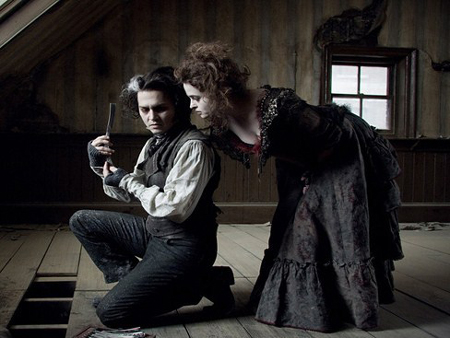
 Oh yes, there will be blood. Tim Burton’s adaptation of the hit Broadway musical SWEENEY TODD is bloody good fun. After being sent to prison for fifteen years by Judge Turpin (Alan Rickman), who had designs on his wife (Laura Michelle Kelly), innocent barber Benjamin Barker (Johnny Depp) returns to nineteenth-century London, reborn as Sweeney Todd, now a dark, ominous figure dead set on gaining his dastardly revenge. He gets back his coveted silver razors, which he considers an extension of his arm, and sets up shop in his old place, above the store where Mrs. Lovett (Helena Bonham Carter) sells meat pies crawling with cockroaches. When Todd begins slicing throats with expert precision, Lovett has a novel way of doing away with the bodies — while increasing business. Burton and screenwriter John Logan (THE AVIATOR, THE LAST SAMURAI) have done a terrific job translating the show onto the big screen, as Depp, Bonham Carter, and the rest of the cast — including Sacha Baron Cohen as a magical elixir salesman, Timothy Spall as the judge’s wingman, and Jayne Wisener as Todd’s daughter, who is doomed to marry the judge — do a wonderful job with such Stephen Sondheim songs as “No Place Like London,” “Poor Thing,” “My Friends,” “Pretty Women,” and “Not While I’m Around.” Depp is marvelous as the demon barber of Fleet Street, wearing a fright wig with a shocking streak of white, singing most of his dialogue with a gentle devilishness, enhanced by his haunting, penetrating eyes. The goth opera not only sounds good but looks even better, courtesy of cinematographer Dariusz Wolski, production designer Dante Ferretti, and costume designer Colleen Atwood. Burton and Depp, who have previously collaborated on EDWARD SCISSORHANDS, ED WOOD, SLEEPY HOLLOW, CHARLIE AND THE CHOCOLATE FACTORY, and CORPSE BRIDE, have another winner on their hands.