this week in art

TIM BURTON: SWEENEY TODD

Johnny Depp and Helena Bonham Carter hide a dark secret in SWEENEY TODD

Johnny Depp and Helena Bonham Carter hide a dark secret in SWEENEY TODD

SWEENEY TODD: THE DEMON BARBER OF FLEET STREET (Tim Burton, 2007)
MoMA Film, Museum of Modern Art
11 West 53rd St. between Fifth & Sixth Aves.
Wednesday, January 27, 8:00
Tickets: $10, in person only, may be applied to museum admission within thirty days, same-day screenings free with museum admission, available at Film and Media Desk
212-708-9400
www.moma.org

www.sweeneytoddmovie.com

Oh yes, there will be blood. Tim Burton’s adaptation of the hit Broadway musical SWEENEY TODD is bloody good fun. After being sent to prison for fifteen years by Judge Turpin (Alan Rickman), who had designs on his wife (Laura Michelle Kelly), innocent barber Benjamin Barker (Johnny Depp) returns to nineteenth-century London, reborn as Sweeney Todd, now a dark, ominous figure dead set on gaining his dastardly revenge. He gets back his coveted silver razors, which he considers an extension of his arm, and sets up shop in his old place, above the store where Mrs. Lovett (Helena Bonham Carter) sells meat pies crawling with cockroaches. When Todd begins slicing throats with expert precision, Lovett has a novel way of doing away with the bodies — while increasing business. Burton and screenwriter John Logan (THE AVIATOR, THE LAST SAMURAI) have done a terrific job translating the show onto the big screen, as Depp, Bonham Carter, and the rest of the cast — including Sacha Baron Cohen as a magical elixir salesman, Timothy Spall as the judge’s wingman, and Jayne Wisener as Todd’s daughter, who is doomed to marry the judge — do a wonderful job with such Stephen Sondheim songs as “No Place Like London,” “Poor Thing,” “My Friends,” “Pretty Women,” and “Not While I’m Around.” Depp is marvelous as the demon barber of Fleet Street, wearing a fright wig with a shocking streak of white, singing most of his dialogue with a gentle devilishness, enhanced by his haunting, penetrating eyes. The goth opera not only sounds good but looks even better, courtesy of cinematographer Dariusz Wolski, production designer Dante Ferretti, and costume designer Colleen Atwood. Burton and Depp, who have previously collaborated on EDWARD SCISSORHANDS, ED WOOD, SLEEPY HOLLOW, CHARLIE AND THE CHOCOLATE FACTORY, and CORPSE BRIDE, have another winner on their hands.

German Expressionist classic is part of Tim Burton influences film fest

German Expressionist classic is part of Tim Burton influences film fest

The film is screening at MoMA in conjunction with the wonderful, expansive Tim Burton retrospective, which runs through April 26; also on the schedule are CHARLIE AND THE CHOCOLATE FACTORY (January 27 & February 1), BATMAN RETURNS (January 28), BEETLEJUICE (January 31), BATMAN (February 3), VINCENT and ED WOOD (February 4), EDWARD SCISSORHANDS (February 5), FRANKENWEENIE and THE NIGHTMARE BEFORE CHRISTMAS (February 7), and PLANET OF THE APES (February 7). In addition, “Tim Burton and the Lurid Beauty of Monsters” features works that influenced Burton; coming up are Harold Young’s THE MUMMY’S TOMB (January 28 & February 6), Lew Landers’s THE RAVEN (January 29), Roger Corman’s PIT AND THE PENDULUM (January 29), Jack Arnold’s THE CREATURE FROM THE BLACK LAGOON (January 30), Arnold’s REVENGE OF THE CREATURE (January 30 & February 5), Val Guest’s WHEN DINOSAURS RULED THE EARTH (January 30 & February 1), Robert Wiene’s THE CABINET OF DR. CALIGARI (February 4), and  Christy Cabanne’s THEMUMMY’S HAND (February 6).

GEORGIA O’KEEFFE / RONI HORN / ALICE GUY BLACHÉ / OMER FAST

Roni Horn, “Becoming a Landscape,” detail, twenty chromogenic prints, 1999–2001 / © Roni Horn

Roni Horn, “Becoming a Landscape,” detail, twenty chromogenic prints, 1999–2001 / © Roni Horn

Whitney Museum of American Art
945 Madison Ave. at 75th St.
Wednesday – Sunday 11:00 am – 6:00 pm
Admission: $18 (Pay-what-you-wish Fridays 6:00 – 9:00)
212-570-3600
www.whitney.org

This might be the last weekend to catch “Georgia O’Keeffe: Abstraction,” an examination of the painter’s development from dark abstract works to her more familiar, repetitive flowery canvases that often feature a palette tailor-made for warm-weather living rooms (however, be sure not to miss the room of intimate photographs of O’Keeffe taken by her longtime lover, Alfred Stieglitz), but there’s a little more time to see the far more interesting and rewarding “Roni Horn AKA Roni Horn,” which runs through January 24. In this wide-ranging midcareer retrospective, Horn searches for the nature of identity in photography, sculpture, drawing, and installation, incorporating images of landscape and language while playing with perception and duality. Horn forces the viewer to question their own place in an ever-changing world in such works as “You are the weather,” comprising one hundred photos of the same woman in Iceland gazing into the camera, her mood shifting based on how hot or cold she is; “Becoming a Landscape,” in which Horn places side by side pairs of photographs taken an instant apart, with only the barest hint of difference evident; “This Is me, This is you,” two large grids of multiple pictures taken of her niece over a few years, consisting of pairs of shots that seem like duplicates but are not; and “Dead Owl,” two pictures of the title subject that are indeed the same. Spread over two floors, “Roni Horn AKA Roni Horn” offers a unique and fascinating perspective on both art and reality.

Alice Guy Blaché, A HOUSE DIVIDED, 1913 (courtesy of the Library of Congress MBRS Division / photograph by George Willeman)

Alice Guy Blaché, A HOUSE DIVIDED, 1913 (courtesy of the Library of Congress MBRS Division / photograph by George Willeman)

Also continuing through January 24 is “Alice Guy Blaché: Cinema Pioneer,” screenings of the little-seen films of the first woman director and studio owner, a series of shorts and longer works that are worth sitting down and spending time with in the Kaufman Astoria Studios Film & Video & Video Galleries, while “Omer Fast: Nostalgia,” in the first-floor Anne & Joel Ehrenkranz Gallery through February 14, displays Fast’s three-part film that investigates fact vs. fiction, reality vs. invention. (Fast fans can also check out his new exhibit at Postmasters in Chelsea, which includes the videos TAKE A DEEP BREATH and DE GROTE BOODSCHAP.)

PATHS LESS TRAVELED

Jing Wei, “Yaks Cont’d — #8,” woodcut and ink

Jing Wei, “Yaks Cont’d — #8,” woodcut and ink

Giant Robot New York
437 East Ninth St. between First Ave. & Ave. A
Through January 13, free, 11:30 – 8:00
212-674-4769
www.grny.net
There are only two days left to see Giant Robot’s current group show, Paths Less Traveled, which features fun, playful work by four young artists: Allison Cole, who uses cut paper in creating teary lovebirds, a sad acorn, a sleepy owl, and a flying girl; Julia Rothman, who brings back the 1950s with her colorful gouache and ink drawings; Daria Tessler, whose characters include ghosts, cosmic cloud killers, and aeronautic tree relocators; and Jing Wei, whose charming, whimsical line drawings of yaks, giant chipmunks, and happy, smiley bones riding bikes lure viewers in with pastel-sweet cuteness before adding a twist. Giant Robot is not only a cool store and gallery but a great place to start an art collection, as the pieces in this show range from $30 to $500, most $150 and below.

KANDINSKY

Vasily Kandinsky, “Impression III (Concert) (Impression III [Konzert]),” oil and tempera on canvas, January 1911 (Courtesy Städtische Galerie im Lenbachhaus, Munich)

Vasily Kandinsky, “Impression III (Concert) (Impression III) (Konzert ),” oil and tempera on canvas, January 1911 (Courtesy Städtische Galerie im Lenbachhaus, Munich)

Solomon R. Guggenheim Museum
1071 Fifth Ave. at 89th St.
Through January 13 (closed Thursday)
Admission: $18 adults, children under twelve free
(pay-what-you-wish Saturdays 5:45-7:45)
212-423-3500
www.guggenheim.org

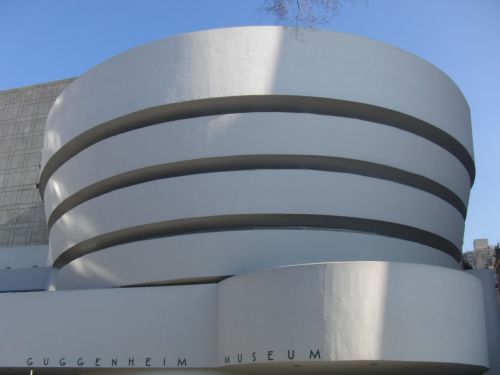
Vasily Kandinsky and the Guggenheim seem made for each other; in fact, it was Kandinsky’s work that directly inspired Frank Lloyd Wright’s spiraling architecture. Curators Tracey Bashkoff and Karole Vail have lovingly laid out nearly one hundred paintings by the Russian-born artist chronologically, winding around the museum’s ramp in a triumph of light and color, with Kandinsky’s reds, blues, yellows, and blacks glistening against the white walls of the bays, never crowded into any individual space. Kandinsky (1866-1944) was an abstract painter who believed in transporting the inner nature of being and spirituality onto the canvas, resulting in surreal, dreamlike images with their own visual vocabulary, incorporating repeated elements such as horses and mountains into enticing landscapes. The exhibit reaches deep into Kandinsky’s process, from his fascinating interaction with composer Arnold Schoenberg to real-life tragedies that found their way into his work. The show begins with Kandinsky’s highly figurative 1907 tempera “Colorful Life (Motley Life)” and reunites his breathtaking four-panel 1914 series commissioned by Edwin R. Campbell, thought by many to be of the four seasons. His Improvisation, Impression, and Composition series follow, including the Schoenberg-inspired “Impression III (Concert)”; be sure to pick up the audio guide, which links the two artists and features music played at the concert Kandinsky attended that influenced the work. In the 1920s, Kandinsky started using sharper lines and geometric patterns as he came into contact with Suprematists, Constructivists, and the Bauhaus, culminating in his love of the circle. The final works on display are somewhat of a surprise, often given short shrift in his oeuvre but proving here to be innovative and powerful, particularly the black-and-white grid “Thirty” and the playful “Sky Blue.”

Vasily Kandinsky, “Sky Blue (Bleu de ciel), oil on canvas, March 1940 (Photo: Philippe Migeat, courtesy Collection Centre Pompidou, Paris, diffusion RMN)

Vasily Kandinsky, “Sky Blue (Bleu de ciel),” oil on canvas, March 1940 (Photo: Philippe Migeat, courtesy Collection Centre Pompidou, Paris)

The exhibit is complemented by a side-gallery collection of wonderful drawings and watercolors, and as an added bonus, “Gabriele Münter and Vasily Kandinsky, 1902-14: A Life in Photographs,” in the downstairs Sackler Center for Arts Education, offers a look at the couple’s life together. The shows close out their run January 12-13 with a two-day forum and symposium. On January 12 at the Sackler Center ($10, 2:00), “The Universe Resounds: Kandinsky, Synesthesia, and Art” consists of lectures, discussions, and performances (Magdalena Dabrowski’s “Kandinsky’s Synesthetic Vision: Color/Sound/Word/Image,” Kerry Brougher’s “Kandinsky’s Legacy in Film and Popular Culture,” Matthew Ritchie’s “Hypermusic Prologue”), followed by an all-day Eyetracking Forum on January 13 that begins at the Martin Segal Theatre at the CUNY Graduate Center at 365 Fifth Ave. and continues after lunch at the Guggenheim (9:00 am, free but RSVP required at publicprograms@guggenheim.org).

WEEKEND CLASSICS: LA CRÈME DU CRIME

Ferdinand and Marianne have little time to hang around in Godard classic

Ferdinand and Marianne have little time to hang around in Godard classic

PIERROT LE FOU (Jean-Luc Godard, 1965)
IFC Center
323 Sixth Ave. at Third St.
January 15-16, 11:00 pm
212-924-7771
www.ifccenter.com/series/weekend-classics/la-creme-du-crime
Art, American consumerism, the Vietnam and Algerian wars, Hollywood, and the cinema itself get skewered in Jean-Luc Godard’s fab feaux gangster flick / road comedy / romance epic / musical PIERROT LE FOU. Based on Lionel White’s novel OBSESSION, the film follows the chaotic exploits of Ferdinand Griffon (Jean-Paul Belmondo) and Marianne Renoir (Anna Karina, Godard’s then-wife), former lovers who meet up again quite by accident. The bored Ferdinand immediately decides to leave his wife and family for the flirtatious, unpredictable Marianne, who insists on calling him Pierrot despite his protestations. Soon Ferdinand is caught in the middle of a freewheeling journey involving gun running, stolen cars, dead bodies, and half-truths, all the while not quite sure how much he can trust Marianne. Filmed in reverse-scene order without much of a script, the mostly improvised PIERROT LE FOU was shot in stunning color by Raoul Coutard. Many of Godard’s recurring themes and style appear in the movie, including jump cuts, confusing dialogue, written protests on walls, and characters speaking directly at the audience, which is more or less along for the same ride as Ferdinand. And as with many Godard films, the ending is a doozy. The screening is part of the IFC Center’s twelve-film series of classic French crime thrillers, which continues on weekend nights at 11:00 through April 4; the upcoming lineup includes Henri-Georges Clouzot’s QUAI DES ORFEVRES and Jules Dassin’s RIFIFI, and that’s just January. Keep watching this space for more select reviews.

detail

Godard film inspired Bernardi Roig exhibit at Claire Oliver Gallery

BERNARDI ROIG: PIERROT LE FOU IS (NOT) DEAD
Claire Oliver Gallery
513 West 26th St. between Tenth & Eleventh Aves.
Through January 23 (closed Sunday & Monday)
Admission: free
212-929-5949
www.claireoliver.com

PIERROT LE FOU fans might want to squeeze in a visit to the Claire Oliver Gallery in Chelsea to check out this exhibit by Bernardi Roig inspired by the Godard film. Roig uses cast polyester resin, wood, and fluorescent lights in this multimedia installation to tell the story of the Man of the Fire Eyes, examining communication, desire, memory, and obsession as well as the nature of art itself.

ONE-NIGHT-of the same thing-ONLY

The new year and palindromes promise a strange evening at Ludlow 38

The new year and palindromes promise a strange evening at Ludlow 38

Ludlow 38
European Kunsthalle Cologne / Goethe Institut New York
38 Ludlow St. between Grand & Hester Sts.
Monday, January 11, free, 7:00
212-2228-6848
www.ludlow38.org

Ludlow 38, the Lower East Side satellite outpost of the Goethe Institut, is hosting a special program January 11 at 7:00 dedicated to the palindrome and celebrating the new year, coordinated by Jeanne Dreskin and Snowden Snowden. Participating artists include Colby Chamberlain, Common Room, John Fare Estate, Abou Farman, Chris Fitzpatrick, Heather Guertin and Neil Donnelly, Ken Jacobs, Molly Kiser, and Sam McCune, promising visitors “a short evening on terminal delay, windbag tautology!!, and objects making feedback make objects…. This then might be an evening of nothing, but nothing you’ve already heard.” Ludlow 38’s first year was curated by Kunstverein München; this year, that honor goes to European Kunsthalle Cologne. We have no idea what to expect in this small, unique space designed by Ethan Breckenridge and Liam Gillick, but it’s sure to be very different.

SERIZAWA

Serizawa Keisuke, "Seabream," kimono, stencil-dyed tsumugi-weave silk, 1964 (Courtesy Tōhoku Fukushi University Serizawa Keisuke Art and Craft Museum)

Serizawa Keisuke, "Seabream," kimono, stencil-dyed tsumugi-weave silk, 1964 (Courtesy Tōhoku Fukushi University Serizawa Keisuke Art and Craft Museum)

SERIZAWA: MASTER OF JAPANESE TEXTILE DESIGN
Japan Society
333 East 47th St. at First Ave.
Through January 17 (closed Mondays)
Admission: $10 (free Fridays from 6:00 to 9:00)
212-832-1155
www.japansociety.org

The Japan Society has teamed up with the Tōhoku Fukushi University Serizawa Keisuke Art and Craft Museum to present the dazzling exhibit “Serizawa: Master of Japanese Textile Design.” Don’t let the rather mundane title fool you; this is a superb collection of some one hundred pieces by Serizawa Keisuke (1895-1984), including beautifully designed hanging scrolls, kimonos, screens, magazine and book covers, calendars, boxes, entrance curtains, and other useful objects. Named a Living National Treasure in Japan in 1956 — more closely translated from the Japanese as Holder of an Important Intangible Cultural Property — Serizawa came out of Yanagi Muneyoshi’s mingei (people’s crafts) movement but developed a style all his own, redefining the process of stencil dyeing that came to be known as kataezome. “Dyeing with paper stencils is a demanding process, requiring the artist to make the best use of an intractable and restrictive medium,” writes Shakuko Hamada in the excellent exhibition catalog. “The results can look awkward and mannered, but Serizawa managed to overcome these technical constraints to produce a large body of work that is relaxed, spontaneous, and lively, its appealing warmth and cheerfulness making us want to have it around us and use it in our daily lives.”

Serizawa Keisuke, "Portrait of Hōnen Shōnin," hanging scroll, stencil-dyed silk, 1942 (Courtesy Tōhoku Fukushi University Serizawa Keisuke Art and Craft Museum)

Serizawa Keisuke, "Portrait of Hōnen Shōnin," hanging scroll, stencil-dyed silk, 1942 (Courtesy Tōhoku Fukushi University Serizawa Keisuke Art and Craft Museum)

Indeed, there are many pieces in this large body of work on display — the first such large-scale career museum retrospective of Serizawa ever held in the United States — that visitors will want to take home with them. A master of technique, he mixed Japanese, Chinese, and Korean cultural elements and patterns into his work. Serizawa’s impressive subject matter ranged from the amazingly detailed “Fallen Leaves” and “Papermaking Village in Ogawa” kimonos to the calm and soothing “Wazome egatari (The Illustrated Story of Japanese Dyeing),” from a series of colorful Chinese characters on norens (entrance curtains) to screens containing Japanese syllables, from “Abstract Designs” to “Portrait of the Bodhisattva Jizō.” Other favorites include fish, bamboo and plum blossoms, thatched huts, banana leaves, seashells, seasonal mandalas, waterfalls, markets, and twisted rope. “Serizawa” is more than just a collection of cool craft designs; it’s pure art that will embrace you.

Friday, January 8
and
Saturday, January 9                   Contemporary Dance Showcase: Japan + East Asia, with Company Derashinera, KIKIKIKIKIKI’s OMEDETO, Masako Yasumoto’s SLAP, PAT SUCK, LDP’s NO COMMENT, and WCdance’s SMALL SONGS, $22, 7:30