![Vasily Kandinsky, “Impression III (Concert) (Impression III [Konzert]),” oil and tempera on canvas, January 1911 (Courtesy Städtische Galerie im Lenbachhaus, Munich)](https://twi-ny.com/wp-content/uploads/2009/12/vassily-kandinsky-1.jpg "vassily kandinsky 1")
Vasily Kandinsky, “Impression III (Concert) (Impression III) (Konzert ),” oil and tempera on canvas, January 1911 (Courtesy Städtische Galerie im Lenbachhaus, Munich)
1071 Fifth Ave. at 89th St.
Through January 13 (closed Thursday)
Admission: $18 adults, children under twelve free
(pay-what-you-wish Saturdays 5:45-7:45)
212-423-3500
www.guggenheim.org
Vasily Kandinsky and the Guggenheim seem made for each other; in fact, it was Kandinsky’s work that directly inspired Frank Lloyd Wright’s spiraling architecture. Curators Tracey Bashkoff and Karole Vail have lovingly laid out nearly one hundred paintings by the Russian-born artist chronologically, winding around the museum’s ramp in a triumph of light and color, with Kandinsky’s reds, blues, yellows, and blacks glistening against the white walls of the bays, never crowded into any individual space. Kandinsky (1866-1944) was an abstract painter who believed in transporting the inner nature of being and spirituality onto the canvas, resulting in surreal, dreamlike images with their own visual vocabulary, incorporating repeated elements such as horses and mountains into enticing landscapes. The exhibit reaches deep into Kandinsky’s process, from his fascinating interaction with composer Arnold Schoenberg to real-life tragedies that found their way into his work. The show begins with Kandinsky’s highly figurative 1907 tempera “Colorful Life (Motley Life)” and reunites his breathtaking four-panel 1914 series commissioned by Edwin R. Campbell, thought by many to be of the four seasons. His Improvisation, Impression, and Composition series follow, including the Schoenberg-inspired “Impression III (Concert)”; be sure to pick up the audio guide, which links the two artists and features music played at the concert Kandinsky attended that influenced the work. In the 1920s, Kandinsky started using sharper lines and geometric patterns as he came into contact with Suprematists, Constructivists, and the Bauhaus, culminating in his love of the circle. The final works on display are somewhat of a surprise, often given short shrift in his oeuvre but proving here to be innovative and powerful, particularly the black-and-white grid “Thirty” and the playful “Sky Blue.”
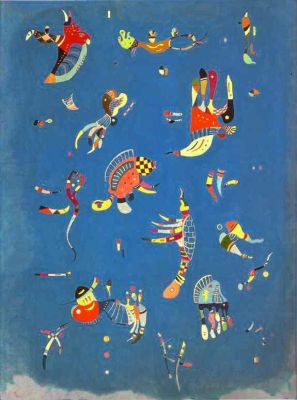
Vasily Kandinsky, “Sky Blue (Bleu de ciel),” oil on canvas, March 1940 (Photo: Philippe Migeat, courtesy Collection Centre Pompidou, Paris)
The exhibit is complemented by a side-gallery collection of wonderful drawings and watercolors, and as an added bonus, “Gabriele Münter and Vasily Kandinsky, 1902-14: A Life in Photographs,” in the downstairs Sackler Center for Arts Education, offers a look at the couple’s life together. The shows close out their run January 12-13 with a two-day forum and symposium. On January 12 at the Sackler Center ($10, 2:00), “The Universe Resounds: Kandinsky, Synesthesia, and Art” consists of lectures, discussions, and performances (Magdalena Dabrowski’s “Kandinsky’s Synesthetic Vision: Color/Sound/Word/Image,” Kerry Brougher’s “Kandinsky’s Legacy in Film and Popular Culture,” Matthew Ritchie’s “Hypermusic Prologue”), followed by an all-day Eyetracking Forum on January 13 that begins at the Martin Segal Theatre at the CUNY Graduate Center at 365 Fifth Ave. and continues after lunch at the Guggenheim (9:00 am, free but RSVP required at publicprograms@guggenheim.org).