this week in art

EARTH DAY NY 2010


Grand Central Terminal
42nd St. between Lexington & Vanderbilt Aves.
April 19-25
Admission: free
www.grandcentralterminal.com
www.earthdayny.ning.com

Grand Central Terminal is celebrating the fortieth anniversary of Earth Day with a week of special events, beginning April 19 with its annual projection of Earth Day Images in the main concourse, featuring quotes and images from such artists as Keith Haring, Roy Lichtenstein, Andy Warhol, and others. In addition, the GreenShows EcoLux boutique will fill Vanderbilt Hall with ecofriendly clothing and accessories from such designers as Bahar Shahpar, Joanne Berman, Nixxi, Samantha Pleet, and House of Organic, with free food and drink provided by Divine Chocolate and Sambazon. And the EarthFair Outdoors festival will take place April 23-24 on Vanderbilt Ave., with interactive displays, booths of environnmentally friendly businesses and organizations, live performances from such groups as Metrosonics, BuzzUniverse, Devi Lim, Judah Tribe, the London Souls, and Grace Potter & the Nocturnals.

EXIT THROUGH THE GIFT SHOP

Banksy reveals only so much of himself in new documentary

Banksy reveals only so much of himself in new documentary

EXIT THROUGH THE GIFT SHOP (A Banksy Movie, 2010)
Landmark Sunshine Cinema, 143 East Houston St.
Lincoln Plaza Cinema, 1886 Broadway
Opens Friday, April 16
www.banksyfilm.com
www.landmarktheatres.com
www.lincolnplazacinema.com

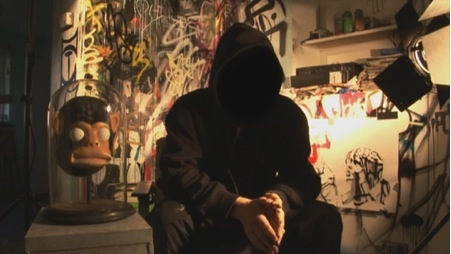
In 1999, L.A.-based French shopkeeper and amateur videographer Thierry Guetta discovered that he was related to street artist Invader and began filming his cousin putting up his tile works. Guetta, who did not know much about art, soon found himself immersed in the underground graffiti scene. On adventures with such famed street artists as Shepard Fairey, Swoon, Ron English, and Borf, Guetta took thousands of hours of much-sought-after video. The amateur videographer was determined to meet Banksy, the anarchic satirist who has been confounding authorities around the world with his striking, politically sensitive works perpetrated right under their noses, from England to New Orleans to the West Bank. Guetta finally gets his wish and begins filming the seemingly unfilmable as Banksy, whose identity has been a source of controversy for more than a decade, allows Guetta to follow him on the streets and invites him into his studio. But as he states at the beginning of his brilliant documentary, EXIT THROUGH THE GIFT SHOP, Banksy—who hides his face from the camera in new interviews and blurs it in older footage—turns the tables on Guetta, making him the subject of this wildly entertaining film.

Guetta is a hysterical character, a hairy man with a thick accent who plays the jester in Banksy’s insightful comedy of errors. Billed as “the world’s first Street Art disaster movie,” EXIT, which is narrated by Welsh actor Rhys Ifans (DANNY DECKCHAIR) and features a soundtrack by Portishead’s Geoff Barrow sandwiched in between Richard Hawley’s declaratory “Tonight the Streets Are Ours,” is all the more exciting and intriguing because the audience doesn’t know what is actually true and what might be staged; although the film could be one hundred percent real and utterly authentic, significant parts of it could also be completely made up. Who’s to say that’s even Banksy underneath the black hood, talking about Guetta, who absurdly rechristens himself Mr. Brainwash? It could very well be Banksy’s F FOR FAKE, Orson Welles’s marvelous 1974 pseudo-documentary about art forger Elmyr de Hory, or it could be on the straight and narrow from start to finish. No matter. EXIT THROUGH THE GIFT SHOP is riotously funny, regardless of how you feel about street art, Banksy, and especially the art market itself (as the title so wryly implies).

For information on Banksy’s sole New York City exhibition, held in fall 2008, visit here.

MR. BRAINWASH: ICONS

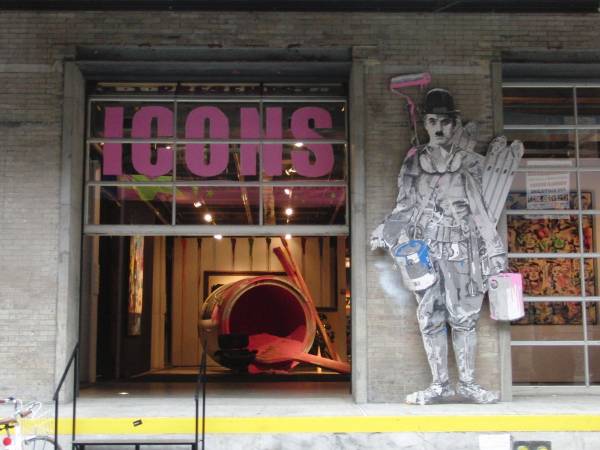
Banksy protege Mr. Brainwash invites art lovers -- and collectors -- to his show in the Meatpacking District (photo by twi-my/mdr)

Banksy protégé Mr. Brainwash invites art lovers — and especially collectors — to his show in the Meatpacking District (photo by twi-ny/mdr)

415 West 13th St. at Washington St.
Through April 30
Monday – Thursday 12 noon – 9:00 pm, Friday – Saturday 12 noon – 12 midnight, Sunday 12 noon – 7:00 pm
www.mrbrainwash.com
icons slideshow

SPOILER ALERT: DO NOT READ ANY FURTHER IF YOU ARE PLANNING ON SEEING THE NEW BANKSY MOVIE, EXIT THROUGH THE GIFT SHOP, WHICH OPENS APRIL 16

In EXIT THROUGH THE GIFT SHOP, the British street artist known as Banksy challenges amateur French videographer Thierry Guetta to become an artist instead of just taping others putting up their pieces. As depicted in the brilliant documentary, Thierry turns himself into Mr. Brainwash, staging a huge show in Los Angeles called “Life Is Beautiful.” In February he opened his first East Coast exhibit, “Icons,” covering some fifteen thousand square feet in a vast space in the Meatpacking District. Whereas Banksy has great skill, a vast imagination, and a unique sense of humor, Mr. Brainwash has, well, Banksy. There is not one shred of an original idea in the two-floor “Icons”; Mr. Brainwash blatantly borrows and steals from such giants as Jeff Koons, Damien Hirst, Jean-Michel Basquiat, Claes Oldenburg, and, of course, Andy Warhol (and Banksy as well), some of whom show up in places of honor on silk-screened canvases. At least his art is environmentally friendly, recycling used tires, paint cans, and vinyl records (even if he did break the black discs himself). Like Warhol, Mr. Brainwash has his own factory of workers repurpose pop culture images, from Michael Jackson and Madonna to John Lennon and Charlie Chaplin, from enormous Campbell’s Soup cans to a giant Starbucks cup, from the Statue of Liberty and Albert Einstein to Bruce Springsteen and Warhol himself. With prices ranging from the tens of thousands to the hundreds of thousands, Guetta is making out quite well for himself. There are all sorts of debates over whether any of this is really art, whether Guetta is in fact Banksy, and whether it’s just one big practical joke by one of the world’s great practical jokers. We guess that the unanswered questions, the whole mystery surrounding Banksy, “Icons,” and Mr. Brainwash, are what makes it all so much fun, regardless of what it is or if it means anything. We’d like to think that it’s all a stunt perpetrated beautifully by Banksy, pulling the wool over everyone’s eyes, including Mr. Brainwash’s, commenting yet again on the absurd state of the art market.

TWO BY KUROSAWA: DERSU UZALA

Maxim Munzuk stars as the remarkable title character in Kurosawa classic (courtesy Kino International)

Maxim Munzuk stars as the remarkable title character in Kurosawa classic (courtesy Kino International)

DERSU UZALA (Akira Kurosawa, 1975)
Film Forum
209 West Houston St.
April 14-22
212-727-8110
www.filmforum.org

In this stunning film, director-cowriter Akira Kurosawa has fashioned one of cinema’s greatest characters, a worldly wise, deceptively simple charming man who understands life, nature, responsibility, and helping others. Maksim Munzuk gives a marvelously understated performance as the title character, who is suddenly taken out of his quiet life of solitude when a Russian army troop comes to Siberia. Film Forum is screening the film as part of its continuing celebration of the centennial of Kurosawa’s birth; it will be followed April 23-29 by his 1970 epic DODES’KA-DEN, in a new 35mm print.

WILLIAM KENTRIDGE: FIVE THEMES

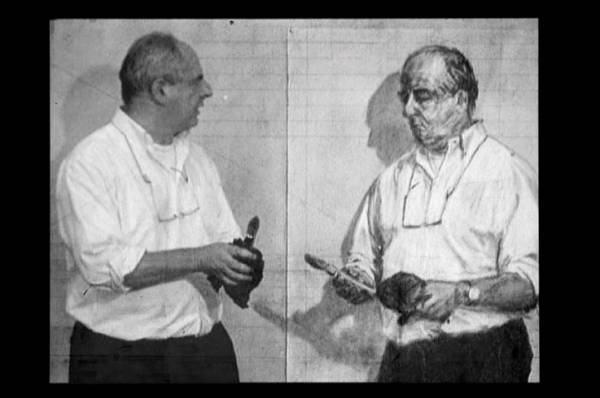
William Kentridge, from “7 Fragments for Georges Méliès,” 35mm and 16 mm animated film transferred to video, 2003 (courtesy of the artist and Marian Goodman Gallery)

William Kentridge, from “7 Fragments for Georges Méliès,” 35mm and 16 mm animated film transferred to video, 2003 (courtesy of the artist and Marian Goodman Gallery)

Museum of Modern Art
West 54th St. between Fifth & Sixth Aves.
Through May 17 (closed Tuesdays; Fridays free from 4:00 to 8:00)
Admission: $20 (includes same-day film screening)
212-708-9400
www.moma.org

In 2001, William Kentridge burst onto the New York art scene with an awe-inspiring show at the New Museum of Contemporary Art in SoHo, introducing to many the unique style employed by this South African artist who creates remarkable films made from charcoal drawings. Nearly ten years later, Kentridge is back with a bang, as multiple exhibits and special events have displayed the breadth of his work and his ingenuity, from his production of Shostakovich’s THE NOSE at the Met and his book of watermarks at Dieu Donné to screenings of his films with live music at the World Financial Center to a quartet of his “Drawings for Projection” series opening at the Jewish Museum on May 2. The centerpiece is the sensational display at MoMA, which continues through May 17. Arranged in a beautifully “generous layout,” as curator Klaus Biesenbach noted at the opening, “William Kentridge: Five Themes” features a bevy of rooms dedicated to the many worlds the artist has created via drawing, film, and a pair of model theaters. Kentridge himself is evident in much of his work, either as a character in his films or through the smudges, erasures, and new markings visible in his animation as he moves from page to page, revealing his unique and fascinating methods, laying himself—Jewish, white, a descendant of a well-known legal family in Johannesburg—bare. “The studio is an enclosed space, not just physically but also psychically, like an enlarged head; the pacing in the studio is the equivalent of ideas spinning around in one’s head, as if the brain is a muscle and can be exercised into fitness, into clarity,” he writes in the exhibition catalog, to which he has contributed several essays alongside a major examination by Mark Rosenthal, who organized the show at its first stop, SFMoMA.
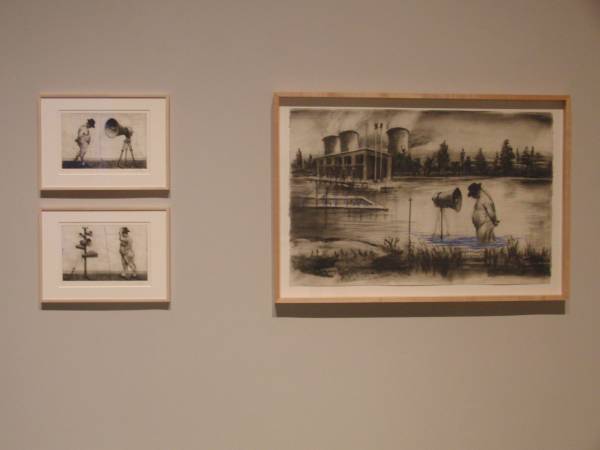
William Kentridge, “Man with Megaphone Cluster,” “Untitled (Man with Megaphone),” etching, aquatint, drypoint, and engraving with roulette and crayon additions, 1998, and “Drawing for the film ‘Stereoscope,’” charcoal and pastel on paper, 1998-99 (photo by twi-ny/mdr)

William Kentridge, “Untitled (Man with Megaphone),” “Man with Megaphone Cluster,” etching, aquatint, drypoint, and engraving with roulette and crayon additions, 1998, and “Drawing for the film ‘Stereoscope,’” charcoal and pastel on paper, 1998-99 (photo by twi-ny/mdr)

At the heart of Kentridge’s oeuvre is his series of films depicting wealthy industrialist Soho Eckstein, naked dreamer Felix Teitlebaum, and the woman caught in between, Mrs. Eckstein. In such short films as “Stereoscope,” “Monument,” “History of the Main Complaint,” and “Mine,” all made without a script or a storyboard, Kentridge relates their continuing tale in an abstract narrative bursting with emotion, incorporating greed and loneliness, love and loss, and the division of the self. (It is not a coincidence that both Soho and Felix resemble the artist himself.) But “Thick Time: Soho and Felix” is only one of the themes that runs through the exhibit. “Ubu and the Procession” includes two films that harken back to Alfred Jarry’s Ubu character, reimagining him in South Africa; “The Magic Flute” and “The Nose” take visitors behind the scenes of Kentridge’s recent productions of the two operas, the first held at BAM in 2007, the latter at the Met in March. “Artist in the Studio” consists of “7 Fragments for Georges Méliès,” seven films on view together in one room, all of which reveal the artist at work. The excellent catalog contains a must-have DVD that goes even further into Kentridge’s process, presenting discarded snippets, fascinating revelations about his method, and complete versions of his first experimental short as well as the full-length “Tide Table.” “I believe that in the indeterminacy of drawing—the contingent way that images arrive in the work—lies some kind of model of how we live our lives,” Kentridge has said. “The activity of drawing is a way of trying to understand who we are and how we operate in the world.” This exciting survey at MoMA is all that and more.

DEMONS AND DEVOTION

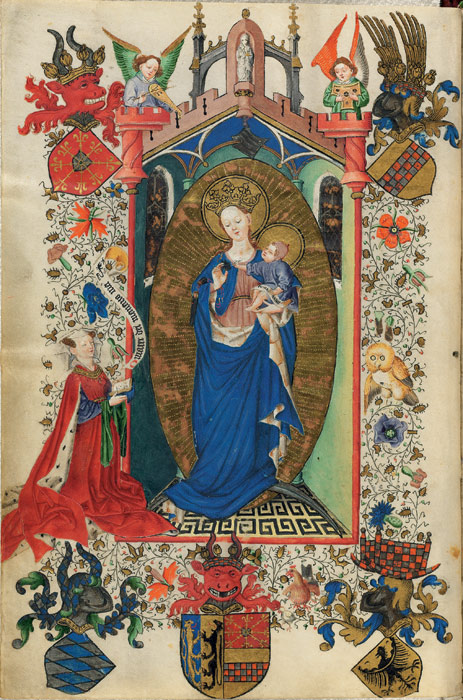
“Catherine of Cleves Praying to the Virgin and Child,” Hours of Catherine of Cleves, in Latin, Netherlands, Utrecht, Illuminated by the Master of Catherine of Cleves, ca. 1440

“Catherine of Cleves Praying to the Virgin and Child,” Hours of Catherine of Cleves, in Latin, Netherlands, Utrecht, Illuminated by the Master of Catherine of Cleves, ca. 1440


THE HOURS OF CATHERINE OF CLEVES

Morgan Library &  Museum
225 Madison Ave. at 36th St.
Tuesday – Saturday through May 2, $12 (free Fridays 7:00 – 9:00)
212-685-0008
www.themorgan.org

Betrothed at six, married at thirteen, and the mother of a half dozen children by the time she was twenty-three, Catherine of Cleves dealt with her life by delving into prayer. In 1440 she moved away from her husband, Arnold of Egmond (duke of Guelders and count of Zutphen), later getting involved in a struggle for power that tore the family apart. But she sought solace (and probably magnified her status) around 1440 by commissioning what would become one of the world’s most majestic illuminated manuscripts, “The Hours of Catherine of Cleves.” Gorgeously designed by the Master of Catherine of Cleves, who incorporated Dutch painting techniques into his ornate style, nearly one hundred pages from the Hours are on view, in sequence, at the Morgan Library, including the Hours of the Virgin, Penitential Psalms, the Hours of the Passion, Suffrages, the Office of the Dead, and assorted biblical scenes.

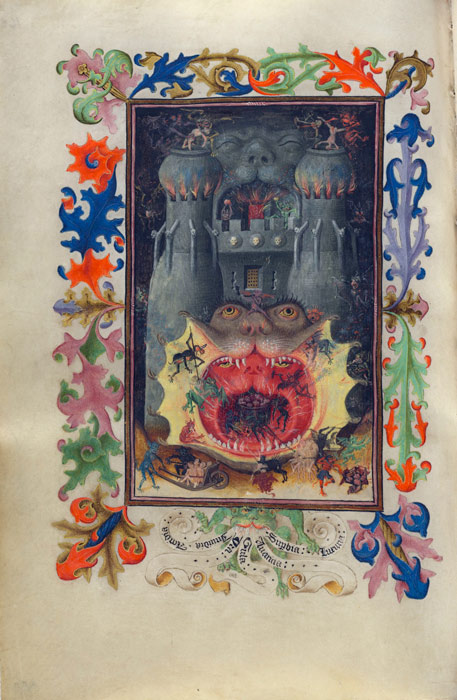
“Mouth of Hell,” Hours of Catherine of Cleves, in Latin, Netherlands, Utrecht, Illuminated by the Master of Catherine of Cleves, ca. 1440

“Mouth of Hell,” Hours of Catherine of Cleves, in Latin, Netherlands, Utrecht, Illuminated by the Master of Catherine of Cleves, ca. 1440

The Master’s creative iconography spreads into the margins of each page, and Catherine herself appears in several works, as well as her reviled husband, shown praying to Jesus. (Perhaps she thought he had better be praying, considering the family division.) Among the most impressive sections is the Hours and Masses for the Seven Days of the Week, particularly Monday, which is devoted to the Dead and features “Deathbed,” “Burial,” and “Souls Released from Purgatory,” three spectacular examples of the Master’s skill. The “Holy Family at Work” shows a unusual and touching domestic scene: the baby Jesus stands in a walker perhaps made by his dad, the carpenter Joseph, hard at work at right, while Mary is busy at a loom, all three cozy in a room whose style would be instantly familiar to a reader. Each page deserves to be pored over carefully as narratives flow and symbolism runs rampant. It’s a thrilling, one-of-a-kind exhibit, as the pages will soon be bound together back into book form, so this is a rare opportunity to see each beautiful pieces spread out. The show is supplemented with illustrations from the Master’s contemporaries, placing it in context; also on display at the Morgan is “Rome After Raphael,” “Palladio and His Legacy: A Transatlantic Journey,” and “Flemish Illumination in the Era of Catherine of Cleves.”

SECOND SUNDAYS: GUIDED TOUR OF THE GARDEN

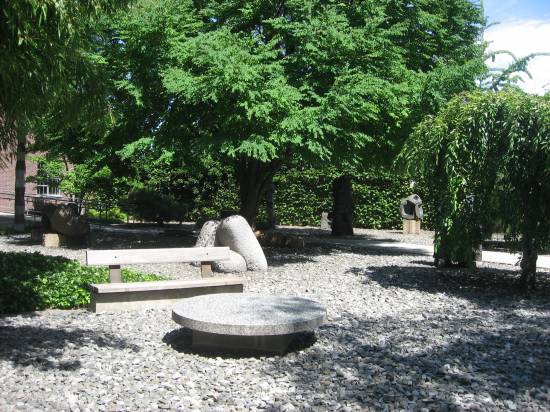
Horticulturalist George Pisegna will lead a tour of the breathtaking Noguchi Museum garden on April 11 (photo by twi-ny/mdr)

Horticulturalist George Pisegna will lead a tour of the breathtaking Noguchi Museum garden on April 11 (photo by twi-ny/mdr)

The Noguchi Museum
9-01 33rd Road (Vernon Blvd.), Long Island City
Sunday, April 11, free with museum admission of $10, 3:00
718-204-7088
www.noguchi.org

George Pisegna, director of horticulture at the Horticultural Society of New York, will lead a guided tour of the magical Noguchi Museum Sculpture Garden as part of the Long Island City institution’s monthly Second Sundays program on April 11, offering fresh new insight into this peaceful wonder. Take a deep breath as you enter the gorgeous garden, which will revive your body and soul. Look all around “The Well (Variation on a Tsukubai),” following the water as it comes out of the top and glides down the rough and glistening sides (including passing through Noguchi’s initials). Notice how the holes on both sides of “Core” invite in the light. “Indian Dancer” stands amid “Practical Rocks in Placement.” “Behind Inner Seeking Shiva Dancing” is perhaps the best-named sculpture in the garden. In the far corner is a burial marker, signifying where some of Noguchi’s ashes were laid to rest. Other mesmerizing pieces carefully arranged around Japanese and U.S. foliage are “The Big Bang,” “Unmei,” and the naturally formed “Spin-off #1 from the Chase Manhattan Garden.” You’ll find it hard to leave this urban oasis. (Also be sure not to miss the inside exhibit “Noguchi ReINstalled.”)