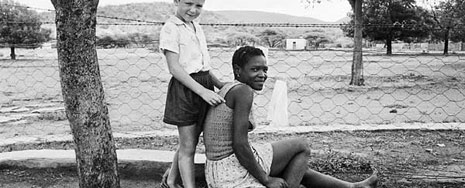
David Goldblatt, detail, “The farmer’s son with his nursemaid, on the farm in Heimweeberg, near Nietverdiend in the Marico Bushveld. Transvaal (North-West Province),” silver gelatin print, 1964
IN CONVERSATION: DAVID GOLDBLATT AND JOSEPH LELYVELD
GIDEON SHIMONI: THE JEWISH EXPERIENCE IN APARTHEID SOUTH AFRICA
Jewish Museum
1109 Fifth Ave. at 92nd St.
May 4 & 13, $15 each, 6:30
212-423-3337
www.thejewishmuseum.org
For decades, South African native David Goldblatt has been documenting the people of his home county; more than 150 of his black-and-white images are currently on view at the Jewish Museum in the exhibition “South African Photographs: David Goldblatt,” which runs through September 19. In conjunction with the show, Goldblatt will be participating in a special program on May 4, in conversation with New York Times executive editor and South Africa correspondent Joseph Lelyveld. The South African theme continues on May 13 when author Gideon Shimoni presents the lecture “The Jewish Experience in Apartheid South Africa.” And on May 17, Richard Turnbull’s Daytime Lecture Series will look at “David Goldblatt and the South African Condition,” part of the series “Conscience and the Camera: The Rise of Social Documentary Photography.” (Also through September 19, the museum is screening four films by William Kentridge in “South Africa Projections.”)
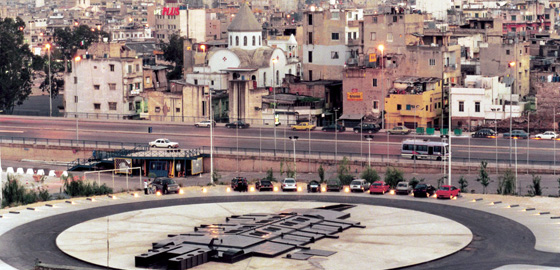
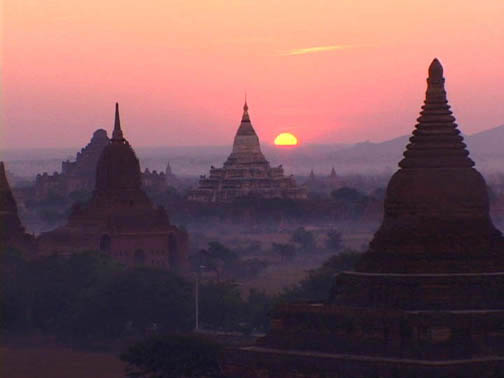
 In conjunction with the exhibition “Pilgrimage and Buddhist Art,” the Asia Society is presenting John Bush’s Yatra Trilogy, three films that journey to sacred Buddhist locations, revealing little-known, seldom-seen sites to Western audiences. The free series begins April 23 with DHARMA RIVER, in which Bush, who will introduce the screening, travels to remarkable temples and shrines in Laos, Thailand, and Burma. He uncovers treasures in Wat Po in Bangkok, Wat Phra Singh in Chiang Mai, Swedagon Pagoda in Rangoon, and Pak Ou Cave and Wat Xieng Thong in Luang Prabang, among other stops. Bush’s narration places the fascinating iconography in proper Buddhist context, avoiding oversimplification while not getting too deep into the intricacies of the different philosophies in each country. His trip along the Mekong River is particularly memorable. From 1970 to 1972, Bush studied Buddhism in India, first spending several months learning vipassana meditation in a Burmese monastery, so DHARMA RIVER is, for him, “a flowing revelation linking a personal past with an intimate present.” The film is accompanied by a beautiful soundtrack by David Hykes with the Harmonic Chant Choir. The trilogy continues April 30 with PRAJNA EARTH (2005) and concludes May 7 with VAJRA SKY OVER TIBET (2006); the Asia Society is free on Friday nights from 6:00 to 9:00, so there should also be time to pay quick visits to the exhibitions “Pilgrimage and Buddhist Art” as well as “Arts of Ancient Viet Nam: From River Plain to Open Sea.”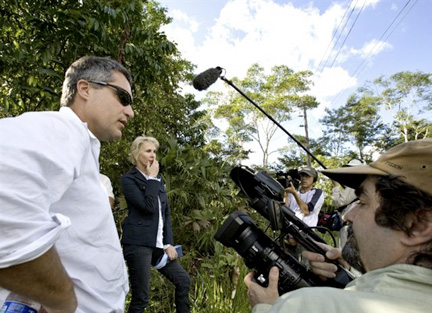
 Documentarian Joe Berlinger has a way of making a strong impact with his films — which include BROTHER’S KEEPER, PARADISE LOST, and METALLICA: SOME KIND OF MONSTER — and his latest is no exception. In CRUDE: THE REAL PRICE OF OIL, Berlinger heads to Ecuador to detail the “Amazon Chernobyl” case, centering on a 1993 class-action lawsuit brought by thirty thousand indigenous people who live in the rainforest and claim that their land and water are contaminated by years of illegal dumping by Texaco-Chevron, leading to severe illness and death for many in their community. Ecuadorian attorney Pablo Fajardo and American consulting attorney Steven Donziger go face-to-face with Chevron attorneys Diego Larrea and Adolfo Callejas, who argue that any wrongdoing was done by PetroEcuador’s takeover of the oil fields in 1992. As such high-profile people as Ecuadorian president Rafael Correa and Rainforest Foundation cofounder Trudie Styler get involved, the fight heats up, but there’s still no end in sight for the sixteen-year-old lawsuit. Berlinger does an excellent job of presenting both sides of the story, even though the bulk of the evidence continues to build for one side.