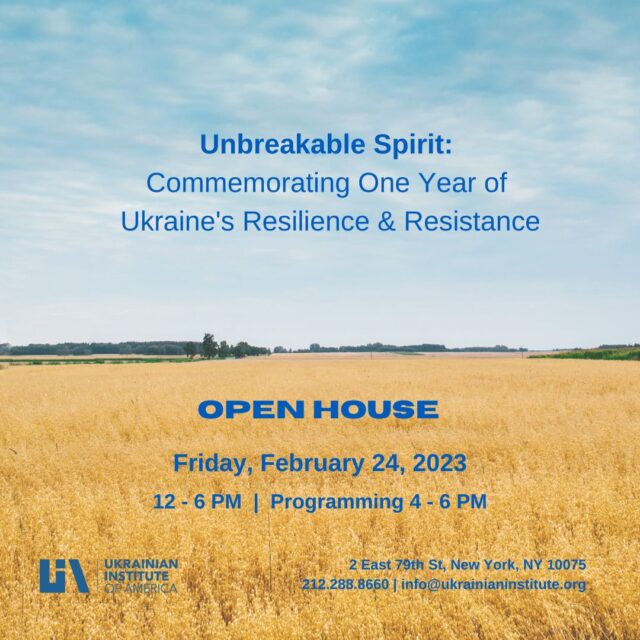
Ukrainian Institute commemoration event on February 24 features art, film, dance, lectures, panel discussions, and more
Who: Sofika Zielyk, Olia Rondiak, Kathy Nalywajko, Ivanna Klympush-Tsintsadze, Evelyn Farkas, Marcy Kaptur, Adrian Karatnycky, Urmas Reinsalu, Taisa Markus, Denys Drozdyuk, Antonina Skobina, more What:Ukrainian Institute commemoration event Where:The Ukrainian Institute, 2 East Seventy-Ninth St. at Fifth Ave. When: Friday, February 24, free, 12:00 – 6:00 pm Why: On February 24, 2022, Russia invaded Ukraine, starting a war that has resulted in the deaths of more than forty thousand people in addition to more than fifty-five thousand wounded, at least fifteen thousand missing, and some fourteen million displaced. Russian president Vladimir Putin’s plan was to “demilitarize and denazify” Ukraine, but he never expected to be in a real battle twelve months later. The Ukrainian Institute will commemorate a year that has proved the strength, valor, and courage of Ukraine, under the leadership of President Volodymyr Zelenskyy, with “Unbreakable Spirit: Commemorating One Year of Ukraine’s Resilience & Resistance,” an afternoon of free programming on February 24 that includes art exhibitions, film screenings, panel discussions, dance, and special remarks. On the first floor will be “Window on Ukraine,” “The Pysanka: A Symbol of Hope” with curator and ethnographer Sofika Zielyk and more than five hundred eggs, and a Ukrainian bookstore.
The second floor features a concert hall and Chandelier Room where contemporary Ukrainian paintings will be on display as part of the Kozytskiy Charity Foundation’s “We and the World” initiative, short films and documentaries will be shown from noon to 4:00, and conversations with experts will be held. On the third floor will be a healing space with handmade motanky sculptures with artist Olia Rondiak and a “Lives Cut Short” print and video tribute to fallen artists, curated by Ukrainian dancers Denys Drozdyuk and Antonina Skobina, with live presentations from 4:00 to 6:00. There will also be remarks and conversations with Ukrainian Institute president Kathy Nalywajko, Ukrainian MP Ivanna Klympush-Tsintsadze, American national security advisor Evelyn Farkas, Congresswoman Marcy Kaptur, Eurasia Center senior fellow Adrian Karatnycky, Estonian minster of foreign affairs Urmas Reinsalu, White & Case partner Taisa Markus, Ukrainian female former POWs, and others. Slava Ukraini!
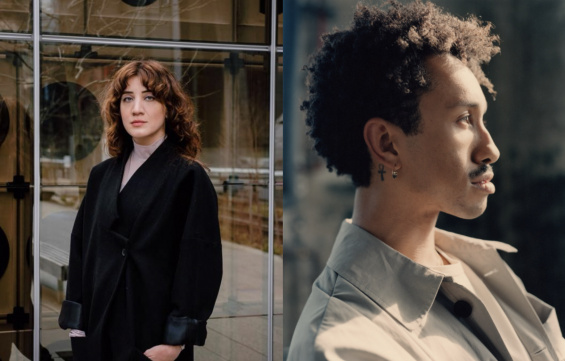
Commissioned exclusively for the space, the show features two urethane fountains by Greenberg, each containing a kind of totem of broken human figures, in between two maplike embroidered wall hangings by Caccuri depicting faceless naked people engaged in various types of contact. The frames and base are speaker systems thumping out music that merges with the sounds of water dripping in the fountains, sending ritualistic vibrations throughout the room. Caccuri’s Vessel Flame and Vessel Body were inspired by Dante’s Inferno and raves held at her studio; the sounds were adapted from recordings of Greenberg’s body following workouts. Greenberg’s Mars and Janus statues were developed from one of his durational performances and used 3D scans to create the fragmented body parts. This is the first time Caccuri and Greenberg have collaborated together, presenting an encased environment that explores the relationship between sound and body, ritual and community, and nature and humanity.
On January 26 at 6:30, Caccuri, born and based in São Paulo, and Greenberg, who was born in Montreal and lives and works in New York and Reykjavik, Iceland, will be at the New Museum Theater for the artist talk “Body as Vessel,” in which they will discuss “The Shadow of Spring” in addition to their individual practices and processes; Brazilian exhibition curator Bernardo Mosqueira will moderate the conversation.
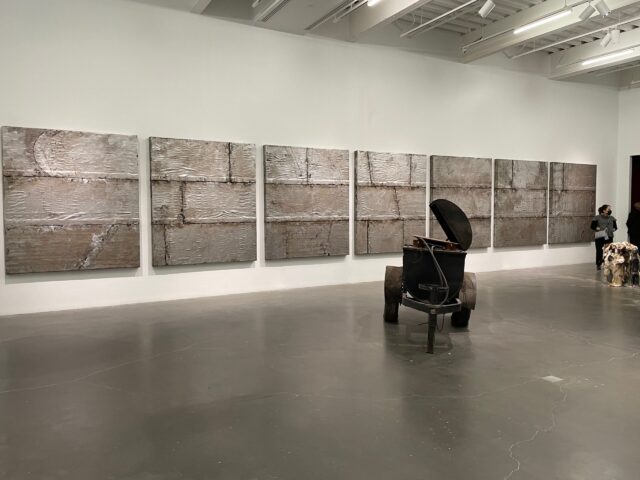
Theaster Gates pays homage to his father and his own childhood in Sweet Chariot and Seven Songs for Black Chapel #1–7 at the New Museum (photo by twi-ny/mdr)
THEASTER GATES: YOUNG LORDS AND THEIR TRACES
New Museum
235 Bowery at Prince St.
Tuesday – Sunday through February 5, $12-$18 www.newmuseum.org online slideshow
“I make designations between a thing that I made that’s art, a thing I had fabricated that’s art, and a thing that was a preexisting thing that I put alongside other things that were made or fabricated. I don’t necessarily say, ‘Oh, this is all art,’ even though it’s all art, but I think that there are moments when I’m just trying to put things alongside each other like you would in your house or like you would in a shrine,” Chicago-born multidisciplinary artist Theaster Gates says in a video for his elegiac, beautiful, deeply moving “Theaster Gates: Young Lords and Their Traces,” continuing at the New Museum through February 5. “This show is about people who I’ve lost and the things that they left for me, or people who I love and the monument of love that I want to show for them.”
In the three-floor exhibition, curated by Massimiliano Gioni and Gary Carrion-Murayari, Gates pays homage to curator Okwui Enwezor, writer bell hooks, fashion designer Virgil Abloh, scholar Robert Bird, and enslaved potter David Drake (Dave the Potter) as well as his mother (Bathroom Believer), a devout Christian, and his father, a roofer (Roof Strategies for Museum Corridor,Sweet Chariot). Gates repurposes found objects gathered from demolished buildings and construction, including from St. Laurence Church on the South Side of Chicago and Park Avenue Armory in Manhattan, where he hosted “Black Artists Retreat 2019: Sonic Imagination.” Among the highlights of the show are Black Madonna, encased in a vitrine; the short film A Clay Sermon; a music video of Gates and the Black Monks of Mississippi performing an extended improvisational “Amazing Grace”; the fifty-foot-long Roof Strategies for Museum Corridor; and the silver monochrome Seven Songs for Black Chapel, which harkens back to Gates’s childhood.
There are still several special events being held at the New Museum in conjunction with this first-ever museum retrospective of the work of Gates, who turns fifty this year. On January 19 at 6:30 ($10), the panel discussion “Resurrections: Theaster Gates” features curators Jessica Bell Brown and Dieter Roelstraete and LAXART director Hamza Walker, moderated by Carrion-Murayari. On January 21 at noon (free with museum admission), independent archivist and memory worker Zakiya Collier will facilitate an “Out of Bounds” gallery talk about Gates’s archiving practices. On January 21-22 and from January 31 to February 3 (except January 30; free with museum admission), keyboardist and composer Shedrick Mitchell will activate the Hammond B3 organ in A Heavenly Chord, performing his unique mix of Gospel, reggae, R&B, jazz, and new age music. From February 3 to 5, Gates and the Black Monks will play impromptu performances in the fourth-floor gallery. And on February 4 at 4:00 ($8), Gates will be in conversation with writer and scholar Saidiya Hartman. But you needn’t rely on a special event to get you to the New Museum to see this well-designed, uncluttered, intimate exhibit, which also deals with social injustice, racism, and faith.
Maxwell Alexandre’s “Pardo é Papel: The Glorious Victory and New Power” reimagines the museum/gallery experience (photo by twi-ny/mdr)
PARDO È PAPEL: THE GLORIOUS VICTORY AND NEW POWER
The Shed, the Bloomberg Building at Hudson Yards
545 West 30th St. at Eleventh Ave.
Wednesday – Sunday through January 8, $10 theshed.org online slideshow
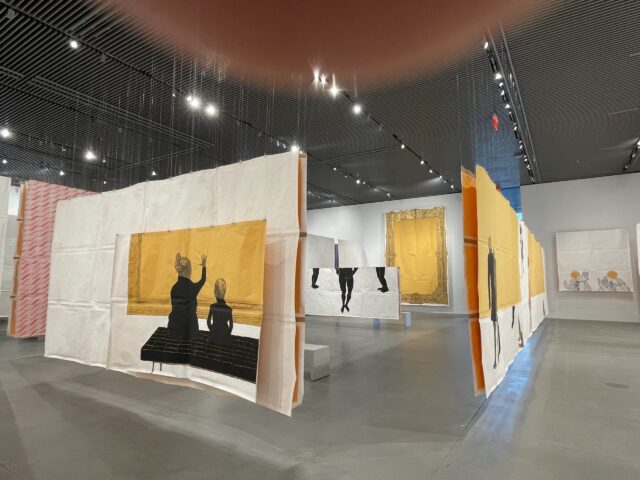
As you enter Brazilian artist Maxwell Alexandre’s debut North American solo exhibition at the Shed, “Pardo é Papel: The Glorious Victory and New Power,” the key work is to your immediate right, a large, vertical empty gold frame on wrinkled brown kraft paper hanging from the ceiling on plastic wires, its borders populated by cartoonish characters. What’s critical is what’s not in the frame: a person, particularly a Black one. It is also infused with an engaging yet disturbing fragility, as if it could fall apart at any minute.
The Shed’s level four gallery is divided into two sections, “The Glorious Victory” and “New Power,” two series that make up Alexandre’s “Pardo é Papel,” which translates as “brown is paper”; the term refers not only to the pardo paper Alexandre uses but the Brazilian census category that forces citizens to choose between Black, brown (mixed race), or white, identifying themselves by skin color and not culture and ancestry and contributing to the whitening of the country since fewer people will call themselves Black. The exhibition, organized by curator at large Alessandra Gómez, is arranged as mazes filled with images that celebrate Black empowerment and foster the idea of community amid rampant consumerism and discrimination.
“When I started painting on brown paper, it was not only a conceptual issue but a political and social issue as well,” Alexandre explains in a promotional video. “And some years later, I had an idea of painting a self-portrait, much for the sake of wanting to represent a character that was Black and blond, with dyed hair. . . . ‘Pardo é Papel’ is a series that talks specifically about empowerment, self-esteem, and the speculation of the future of glory and prosperity for Black people. So it starts pointing to these various directions, and these paintings for me are very representative because they speak of this moment of ascension, of my ascension as an artist. That I have my integrity as a Black Brazilian favelado, and as an individual, as an artist.”
The works feature pop-culture references scattered throughout, from such recording artists as Baco Exu do Blues, Djonga, BK, and Nina Simone to such consumer goods as the chocolate drink Toddynho (with its smiling mascot), Danone yogurt, and Capri pools; the latter is the focus of one of the most powerful pieces in the show, Até Deus inveja o homem preto(Even God envies the Black man), which depicts a Black swimmer with blond hair at the upper left, sucking on a long red-and-white straw that goes into the butt of Toddynho at the lower right, an actual small pool of water on the floor at the corner of the painting.
Alexandre, who was born in Rio de Janeiro in 1990 and was a professional street inline skater for twelve years, also incorporates shoe polish on many canvases, the same polish he used while serving in the army. The majority of the people in his works do not have full faces, adding to the confusion surrounding their identity. In the back room, a painting of velvet ropes is next to a long, vertical work in which four couples — and Brazilian soccer star Neymar — are looking around, as if at an art gallery, but above them is a gold landscape with no figures; at the far end, an older, perhaps wiser gentleman is walking away, ready for a different future. Meanwhile, access is blocked to a second door from the hallway, but we can see the back of a painting, in which a small, solitary Black person is floating in the upper right rectangle, facing the hall, not the gallery, as if being kept out, not allowed inside.
“Pardo é Papel” calls into question how we experience galleries and museums, from the figures depicted in the works to the creators, bringing to the forefront the history of the exclusion of artists of color; even the wall text is written on pardo paper. Discussing “New Power” in the accompanying pamphlet, Alexandre notes, “From a biographical perspective, the series talks about how I, upon arriving at a position of success, looked around and found myself in a world dominated almost exclusively by white people. The series is a study and mapping of the contradictions, pitfalls, and opportunities in this field so that more Black people can infiltrate it not only as spectators or subjects but also as agents in positions of power: curators, artists, collectors, directors, funders, gallerists, and so on.”
“Pardo é Papel” goes a long way to that necessary goal.
Barbara Kruger’s immersive atrium installation continues at MoMA through January 2 (photo by twi-ny/mdr)
BARBARA KRUGER: THINKING OF YOU. I MEAN ME. I MEAN YOU.
The Museum of Modern Art
Donald and Catherine Marron Family Atrium
11 West 53rd St. between Fifth & Sixth Aves.
Through January 2, $14-$25 www.moma.org online slideshow
There’s one word that sticks out in Barbara Kruger’s text-based architectural installation Thinking of You. I Mean Me. I Mean You. in MoMA’s atrium, and it’s in the title twice: No, not Mean but You. Standing in the middle of the imposing space, you are surrounded by words, phrases, and sentences in black-and-white, arranged in horizontal grids and ovals on the floor, walls, and stanchions, that deal with personal and group identity, racial and class injustice, greed, war, consumer culture, and capitalism. These are themes the seventy-seven-year-old Newark native has been exploring throughout her five-decade career, in such pervious works as I Shop Therefore I Am,You Are Not Yourself, The Globe Shrinks,Untitled (Questions), and Whose Hopes? Whose Fears?
A block on the floor pronounces: “IF YOU WANT A / PICTURE OF THE / FUTURE, IMAGINE / A BOOT STAMPING / ON A HUMAN FACE, / FOREVER. / GEORGE ORWELL.”
On the upper south wall, Kruger explains: “THIS IS ABOUT THE YOU NOT I. / THIS IS ABOUT A WORLD OF HURT. / THIS IS ABOUT LOOKING FOR / THE MOMENT WHEN PRIDE / BECOMES CONTEMPT. ABOUT / WANTING ONE ANOTHER. / ABOUT FEARING ONE ANOTHER. / ABOUT TOUCHING ONE ANOTHER. / ABOUT THE WAR FOR ME TO BECOME YOU. I MEAN ME. I MEAN YOU.”
Among the other statements that emerge in this dizzying display are “MONEY TALKS,” “THIS IS ABOUT LOVING AND LONGING. ABOUT SHAMING AND HATING. . . . ABOUT WHO GETS WHAT AND WHO OWNS WHAT,” “YOU ARE HERE, LOOKING THROUGH THE LOOKING GLASS, DARKLY. / SEEING THE UNSEEN, THE INVISIBLE, THE BARELY THERE,” and “IN THE END, YOU DISAPPEAR / IN THE END, LIES PREVAIL / IN THE END, ANGER FADES / IN THE END, HOPE IS LOST.” In addition, a few playful emojis contribute their thoughts on it all.
“Barbara Kruger said architecture is one of the predominant orderings of social space,” curatorial assistant Margarita Lizcano Hernandez says in a MoMA ArtSpeaks video, continuing, “There’s this level of activation of the space that, just by entering it, you’ve become part of it.”
But even as the words, in Kruger’s trademark bold, sans serif font, predict loneliness and doom, hope is not lost; there is an innate joy in just seeing these words, in sharing them with the strangers around you undergoing the same experience. There’s a reason why “YOU” and “ME” are crossed out in the title, followed by a “YOU” that is not crossed out: It’s really about us; Kruger is pointing a finger at everyone.
Giancarlo Esposito plays a philosophical cabbie in Julian Rosefeldt’s Euphoria (photo by Nicholas Knight / courtesy of Park Avenue Armory)
EUPHORIA
Park Ave. Armory, Wade Thompson Drill Hall
643 Park Ave. at Sixty-Seventh St.
Daily through January 8, $18 www.armoryonpark.org
“The point is, ladies and gentleman, that greed — for lack of a better word — is good,” Gordon Gekko (Michael Douglas) famously pronounced in Oliver Stone’s Oscar-nominated 1987 film, Wall Street. “Greed is right. Greed works. Greed clarifies, cuts through, and captures the essence of the evolutionary spirit. Greed, in all of its forms — greed for life, for money, for love, knowledge — has marked the upward surge of mankind. And greed — you mark my words — will not only save Teldar Paper but that other malfunctioning corporation called the USA.”
Well, as it turns out, greed has not exactly saved America or the world, but is there still hope? German filmmaker Julian Rosefeldt explores that possibility in his beautifully rendered twenty-four-channel immersive installation, Euphoria, continuing at Park Avenue Armory through January 8. It arrives at an opportune moment, not only in the midst of a post-global-pandemic economic crisis but during the holiday season, when rampant consumerism dominates our everyday life.
In 2016, Rosefeldt presented Manifesto at the armory, a thirteen-channel film projected on screens placed throughout Wade Thompson Drill Hall, featuring Cate Blanchett as twelve different characters spouting cultural missives by artists and philosophers going back more than 150 years. One of the themes came from Jim Jarmusch: “Nothing is original.” While nearly all the dialogue in Euphoria is taken from another source, how it is incorporated into a 115-minute visual and aural feast is anything but derivative or uninventive. And it’s about a lot more than just the Benjamins.
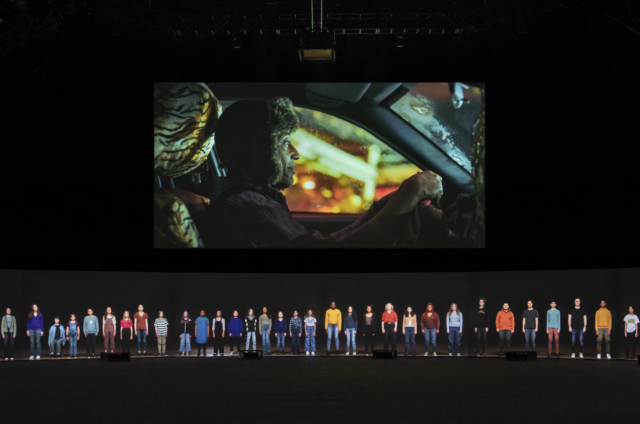
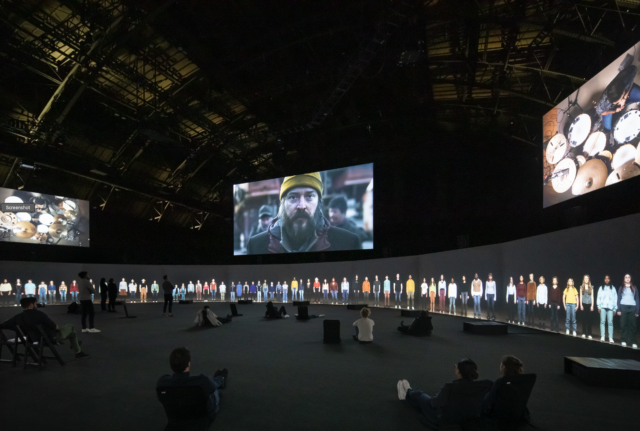
Euphoria comprises six distinct scenes, each of which exists on its own in a loop; you can enter at any time, as the order doesn’t matter. The linking factor is the discussion of socioeconomics in the modern world. There are black fold floor chairs scattered around the space, but you can also walk around the installation. The main screen hangs at the center, where the six stories are told. Five smaller screens are at the same level in a circle, where drummers Terri Lyne Carrington, Peter Erskine, Yissy García, Eric Harland, and Antonio Sanchez occasionally pick up their sticks and play. Eighteen more screens surround the space, except for the entrance, on which 140 members of the Brooklyn Youth Chorus are projected, life-size; in the dark hall, it often looks like they are actually there, in person, singing or, when silent, standing more or less still, their slight swaying adding a dash of reality to the primary narrative, which delves into the fantastical. (The score is by Samy Moussa, with an additional composition by Cassie Kinoshi.)
Julian Rosefeldt’s twenty-four-channel installation surrounds viewers (photo by Nicholas Knight / courtesy of Park Avenue Armory)
On a cold winter night in New York City, a taxi driver played by Giancarlo Esposito, partially channeling his character from Jarmusch’s Night on Earth, including his “fresh” winter hat with earflaps, picks up a well-dressed man with shopping bags who is going to the Brooklyn Navy Yard; it’s not long before we realize Esposito is playing both roles. The cabbie does most of the talking, his dialogue made up of quotes from John Steinbeck, Noam Chomsky, Fareed Zakaria, G. K. Chesterton, JR, Milton Friedman, Ayn Rand, and others, seamlessly woven together. “My momma always said: Too many people buy things they don’t need with money they don’t have to impress people who don’t care,” the cabbie says (Will Rogers). Passing by strange things happening on the street, the cabbie delivers lines that essentially sum up much of what Euphoria is about: “And then they see their idealism turn into realism, their realism into cynicism, their cynicism turn into apathy, their apathy into selfishness, their selfishness into greed and then they have babies, and they have hopes but they also have fears, so they create nests that become bunkers, they make their houses baby-safe and they buy baby car seats and organic apple juice and hire multilingual nannies and pay tuition to private schools out of love but also out of fear. What happened? You start by trying to create a new world and then you find yourself just wanting to add a bottle to your cellar, you see yourself aging and wonder if you’ve put enough away for that and suddenly you realize that you’re frightened of the years ahead of you. You never think you’ll become corrupt but time corrupts you, wears you down, wears you out. You get tired, you get old, you give up on your dreams. . . . You mind who you think you wanted to be” (Don Winslow).
The action moves next to a postapocalyptic ship graveyard where five white homeless men, Poet, Smartass, Randy, Keynes, and Sidekick, gather around a trash fire, discussing the “three great forces [that] rule the world: stupidity, fear, and greed” (Albert Einstein). Randy declares, “It seems to me that not doing what we love in the name of greed is just very poor management of our lives. I will tell you the secret to getting rich: Be fearful when others are greedy and greedy when others are fearful!” (Warren Buffett). Quotes from Machiavelli, Snoop Dog, Erich Fromm, Socrates, Adam Smith, Stephen King, Elizabeth Warren, and more are interwoven as the men pass around a bottle of rum, eat marshmallows, and burn a smartphone and, unbeknownst to them, a parade of animals in the background boards a large wooden ship, as if a new world is starting that the men will not be part of.
In a parcel delivery factory, three women (Virginia Newcomb, Ayesha Jordan, Kate Strong) work an assembly line, scanning and organizing packages while discussing how “things can only get worse” (Invisible Committee). They detail their struggles with overwhelming debt, long hours and low pay, racial injustice, motherhood, and misogyny and sexualization, sharing the words of Audre Lorde, Sojourner Truth, Ursula K. Le Guin, Angela Davis, bell hooks, Cardi B, and Frantz Fanon. “You sound like an archaeologist!” one of the women says to her conveyor-belt mate, who responds, “That’s right! I am an archaeologist. You wanna know why? ’Cause my life lies in fucking ruins.”
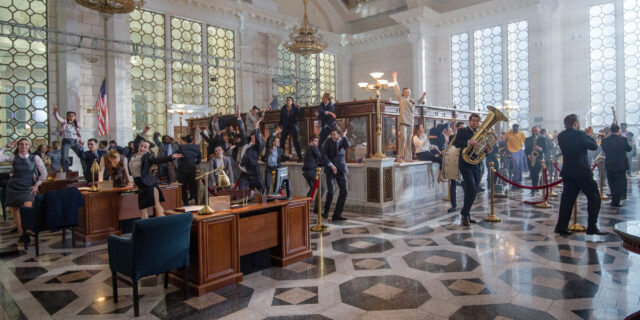
An elegant Kyiv bank turns into a surreal carnival in a scene that kicks off with a doorman (Yuriy Shepak) looking into the camera and saying, “It is a kind of spiritual snobbery that makes people think they can be happy without money” (Albert Camus). A moment later he adds, “Money is like blood. It gives life if it flows. Money enlightens those who use it to open the flower of the world” (Alejandro Jodorowsky). Excerpts from Yuval Noah Harari, Michael Lewis, Matt Taibbi, Bertolt Brecht, George Carlin, Don DeLillo, and Karl Marx merge as a security guard (Nina Songa), a mother (Evgenia Muts), a homeless woman (Elena Aleksandrovich), and a cleaner (Corey Scott-Gilbert) go about their business, the bankers transforming into magicians, acrobats, and dancers. It’s a Busby Berkeley celebration in which money isn’t real, just another trick or performance. As the cleaner notes, “Money isn’t a material reality — it is a psychological construct. It works by converting matter into mind. So why does it succeed? Because people trust the figments of their collective imagination. Trust is the raw material from which all types of money are minted. Religion asks us to believe in something. Money only asks us to believe that other people believe in something” (Yuval Noah Harari).
In another vignette, six skate teens (Rocio Rodriguez-Inniss, Esther Odumade, Tia Murrell, Dora Zygouri, Asa Ali, and Luis Rosefeldt) come together in an abandoned bus terminal talk to about the future, debating quantitative vs. qualitative value, spouting lines from Arthur C. Clarke, Victor Hugo, William Shakespeare, Aldous Huxley, and John Maynard Keynes. “It’s considered sexy to accumulate property, money, stocks, cars. What a waste of dopamine and adrenaline if it’s all just about quantity, right?” (JR) one of the girls asks. “Right,” replies a second girl. “I mean, if a monkey hoarded more bananas than it could eat, while most of the other monkeys starved, scientists would study that monkey to figure out what the heck was wrong with it. When humans do it, we put them on the cover of Forbes” (Nathalie Robin Justice). One of the boys points out, “A brutal state of affairs, profoundly inegalitarian, is presented to us as ideal” (Alain Badiou), adding, “We humans want to compete with each other, to grow, to invent, to expand. Fair enough. But why not within an ethically defined framework, based on common shared values” (JR). As almost always, the younger generation believes they can change the world for the better, through education and the reestablishment of goals based on equality and what’s best for all, not competition that serves the few. “We need to think big. Our natural habitat has always been the future, and this terrain must be reclaimed” (Nick Srnicek/Alex Williams) a third girl says. But as a fourth girl points out, “No wonder the galaxies recede from us in every direction, at the speed of light. They are frightened. We humans are the terror of the universe” (Edward Abbey). Perhaps unsurprisingly, this section contains the most original dialogue, as the teenagers seek to discover what comes next for themselves and not just relying on existing theories.
My cycle concluded in a large supermarket, where a bold, beautiful, ever-threatening tiger (voiced by Blanchett) makes its way up and down the aisles of canned, boxed, and bottled food and drink. It warns us, “Of the world as it exists, it is not possible to be enough afraid (Theodor W. Adorno). History repeats itself, first as tragedy, second as farce (Karl Marx). Those who do not know history are condemned to repeat it. But even knowing can’t save them. ’Cause what is constant in history is greed and foolishness and a love of blood (Cormac McCarthy).” With quotes from Thomas Hobbes, Terry Pratchett, A. S. Byatt, Marquis de Sade, and Theodor W. Adorno, the hungry, swaggering animal accuses humans of being short-sighted power-mongers, filled with hatred and violence, whose extinction would bring no harm to the planet; in fact it would be welcomed. But the tiger adds, “And the best at war, finally, are those who preach peace. Beware the preachers. Beware the knowers. Beware their love” (Charles Bukowski).
In his 2000 breakthrough hit, “Ride wit Me,” Nelly proclaimed, “Hey, must be the money!” In Euphoria, Rosefeldt zeroes in specifically on greed and its devastating cost on humanity. At the beginning of the bank scene, the doorman says, “For thousands of years, philosophers, thinkers, and prophets have besmirched money and called it the root of all evil,” quoting Hurari. But the full biblical quote from the apostle Paul in Timothy 6:10 actually puts it in a different perspective: “For the love of money is the root of all evil: which while some coveted after, they have erred from the faith, and pierced themselves through with many sorrows.” Today, more than ever, with more of the planet’s wealth in very few hands, financial institutions are like houses of worship, evoked further by the celestial sounds of the Brooklyn Youth Chorus in the armory. Perhaps the security guard says it best when, quoting one of the wisest sages of the last fifty years, George Carlin, he says, “Give a man a gun and he can rob a bank. Give a man a bank and he can rob the world.”
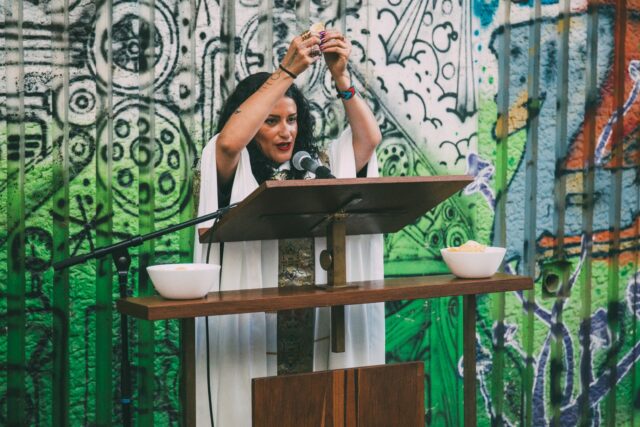
Luiza Prado de O. Martins will perform The Sermon of the Weeds at the 8th Floor on December 8 (photo by MeetFactory)
Who:Luiza Prado de O. Martins What: Live performance installation activation Where:The 8th Floor, Shelley & Donald Rubin Foundation, 17 West 17th St. When: Thursday, December 8, free with RSVP, 6:00 Why: Continuing at the 8th Floor at the Shelley & Donald Rubin Foundation through January 21, the powerful exhibition “El Corazón Aúlla (Heart Howls): Latin American Feminist Performance in Revolt” features photography, painting, video, sculpture, and installation focusing on gender-based violence, with works by more than a dozen female and nonbinary artists from Peru, Costa Rica, Guatemala, Mexico, El Salvador, Chile, Brazil, and Argentina. Jazmín Ra’s Falo X Falo — El Estado de Chile nos viola y nos mata (“The State of Chile rapes and kills us”), Flavia Marcus Bien’s From Night to Earth, and Elina Chauvet’s My Hair for Your Name explore misogyny, racism, and LGBTQ hate through documentation and performance, revealing serious issues and attempting to take the power back. Curators Alexis Heller and Tatiana Muñoz-Brenes explain, “These performances, their aesthetic decisions, and their particular social contexts answer questions that other artistic media cannot answer, or that could not establish an alliance with the viewer in the search for social justice. . . . Gender violence, reaching its highest peaks in feminicide and state violence, is a topic that should be howled when shouting is not enough, and that should go through political corporality and affections when common sense fails to bring about change.”
On December 8 at 6:00, Brazil-born, Berlin-based artist and activist Luiza Prado de O. Martins will activate The Sermon of the Weeds, a ritualistic circle of dirt on a white plinth, with a Jesus infinity sign on top of the small mound; the materials consist of paper, soil, Caesalpinia pulcherrima (peacock flower), Ruta graveolens (rue), Artemisia vulgaris (mugwort), Mentha pulegium (pennyroyal), and Cimifuga racemose (Black cohosh). The performance is a response to the current attacks on women’s reproductive rights in America and Brazil; Prado de O. Martins will dress as a priest, deliver a liturgical mass, and offer communion to the audience, specially made wafers (with natural ingredients used in traditional forms of birth control) and libations that equate humans and plants. (The menu includes parsley pesto; crisps; carrot, mint, and pistachio salad; seeded crackers; aged sheep’s cheese with grapes and pomegranate; fresh soft sheep’s cheese with balsamic and juniper; guava and cinnamon compote squares; pennyroyal liqueur; and artemisia iced tea.) The performance will be followed by a discussion with Prado de O. Martins and Heller. On December 10, Heller will give a curatorial tour of the exhibition, which also features works by Nayla Altamirano, Denise E. Reyes Amaya, Elina Chauvet, Cristina Flores, Regina José Galindo, Fernanda Laguna and Cecilia Palmeiro, Rossella Matamoros-Jiménez, Bárbara Milano, Wynnie Mynerva, and Berna Reale.