this week in art

AYALA GAZIT: WAS IT A DREAM

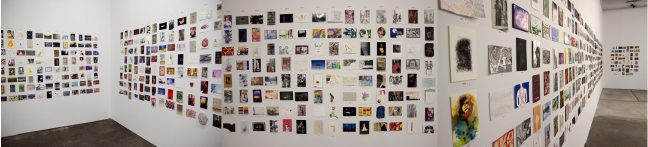
In “Was It a Dream,” photographer Ayala Gazit goes to Australia to find out about her half-brother, who committed suicide in 1996 (photo by twi-ny/mdr)

SVA Gallery
209 East 23rd St. between Second & Third Aves.
Through December 18
Admission: free
212-592-2010
www.schoolofvisualarts.edu
www.ayalagazit.com

Born in Haifa in 1984, Ayala Gazit was twelve years old when her father told her that she had a half-brother named James in Australia from a brief relationship he had with an Englishwoman named Linda in London. Gazit wrote James a letter introducing herself, but they never met, as he committed suicide later that year. After being awarded the Tierney Grant in Photography as a senior at SVA, Gazit used the prize, which gives promising graduating photography students one year to create an exhibition, to go to Australia and find out about the half-brother she never knew. She met with James’s mother and siblings, went through the family album, and scouted out the neighborhood where James lived. What she discovered, in words and pictures, is on view through the weekend in the somber yet powerful “Was It a Dream,” at the SVA Gallery on East 23rd St. Gazit, who was an intelligence photographer in the Israeli military for two years, groups together portraits of members of both families along with haunting individual shots of landscapes where James lived and played. To further the idea of home, one corner includes two chairs and a table on which sits an ashtray with a partially smoked cigarette in it, as if something has been left unfinished. There are few smiles in Gazit’s photographs, mostly serious looks contemplating a life cut short and what might have been. The pictures are supplemented with Linda’s letter to Ayala’s father telling him about the suicide, Ayala’s letter to James, and a slideshow of older family photographs.

JEAN-MICHEL BASQUIAT: THE RADIANT CHILD

Tamra Davis examines the life of her friend Jean-Michel Basquiat in revealing documentary (photo courtesy of Lee Jaffe)

JEAN-MICHEL BASQUIAT: THE RADIANT CHILD (Tamra Davis, 2010)
Film Forum
209 West Houston St.
December 15-21, 1:15, 3:15, 6:00, 8:00, 10:00
212-727-8110
www.filmforum.org
www.jean-michelbasquiattheradiantchild.com

Director Tamra Davis (GUNCRAZY) transports viewers back to the 1980s New York art scene in the intimate documentary JEAN-MICHEL BASQUIAT: THE RADIANT CHILD, which is having a special return engagement at Film Forum by popular demand. In 1986, just as the career of street artist Jean-Michel Basquiat was exploding, Davis filmed him being interviewed by designer Becky Johnson, a revealing portrait that she put away in a drawer for more than twenty years. Davis finally brings out that footage, making it the centerpiece of this new examination of the ambitious, influential artist and musician who experienced massive success before falling hard and fast and dying of a drug overdose at the age of twenty-seven in 1988. Davis, a friend of Basquiat’s, conducts new interviews with many of the people from his inner circle, including art dealers Jeffrey Deitch, Larry Gagosian, Annina Nosei, Tony Shafrazi, and Bruno Bischofberger; Basquiat’s girlfriends Suzanne Mallouk and Kelle Inman; close Basquiat friends Diego Cortez and Fab 5 Freddy; NEW YORK BEAT cable TV host Glenn O’Brien; and fellow artist Julian Schnabel, who directed Basquiat in DOWNTOWN 81. Davis has also dug up amazing footage from the 1980s of Basquiat that shows him to be a unique, driven figure who used whatever he could — from broken windowframes and doors he’d find on the street to immense canvases — to spread his art and world view, which began with drawings in which he identified himself as Samo, criticizing contemporary art as “the same old shit.” Ultimately, though, it was his relationship with Andy Warhol that was the beginning of the end. JEAN-MICHEL BASQUIAT: THE RADIANT CHILD is a dazzling document of a fascinating time and a cautionary tale of success that comes too fast, too soon.

THE FRICK COLLECTION: 75th ANNIVERSARY — FREE!

Francisco de Goya y Lucientes, “Regozijo (Mirth), (Album D. 4),” brush and ink and wash and chalk, ca. 1816-20 (courtesy of the Hispanic Society of America, New York)

The Frick Collection
1 East 70th St. at Fifth Ave.
Thursday, December 16, free, 10:00 am – 6:00 pm
Also: Tuesday – Sunday, $18 (free Sundays 11:00 am – 1:00 pm)
212-288-0700
www.frick.org

In 1913, wealthy industrialist Henry Clay Frick hired Carrère and Hastings to build him a five-million-dollar mansion on Fifth Ave. as a place to live as well as a public repository for his magnificent art collection after his death. Frick died in 1919, and his wife passed away in 1931, sending in motion plans to open the mansion and its art holdings to the public. In December 1935, the trustees opened the Frick Collection, where it quickly became recognized as one of the great collections and art spaces in the world. The Frick is celebrating its seventy-fifth anniversary this week with a free day on Thursday, December 16, inviting everyone to marvel in its humble glory without having to pay an admission charge. Currently on view in the downstairs galleries is “The Spanish Manner: From Ribera to Goya” (through January 9), a splendid exhibition of thirty-two seventeenth- and eighteenth-century drawings and twenty-three drawings by Goya that display the imaginative skill of Spanish draftsmen. The first room contains such impressive sheets as Jusepe de Ribera’s red chalk “Studies of a Head in Profile,” which has a fantastical quality, as well as his less detailed, somewhat more abstract “Crucifixion of Saint Peter”; Antonio del Castillo y Saavedra’s emotional pen and ink “Four Heads of Man”; and Bartolomé Esteban Murillo’s delicate “Saint Felix of Cantalice Holding the Christ Child.” The second room is dedicated solely to Spanish master Francisco de Goya y Lucientes, who displays a wicked sense of humor and an exquisite use of brush, ink, wash, and chalk in such powerful works as “Tuti li mundi (Peepshow),” “Repentance,” and “Three Men Digging,” thought to be a sketch for the Frick’s painting “The Forge,” on view upstairs. In several drawings, Goya places his central figure right in the middle, either appearing to be suspended in midair, literally suspended, or without a background for context, including “Torture of a Man,” “A Man Drinking from a Wineskin,” “Beggar Holding a Stick in His Left Hand,” “Peasant Carrying a Woman,” and the delightful “Regozijo (Mirth).”

Diego Rodriguez de Silva y Velázquez, “King Philip IV of Spain,” oil on canvas, 1644 (the Frick Collection, New York)

In conjunction with the Spanish Manner exhibit, the Frick has a dossier presentation, “The King at War: Velázquez’s Portrait of Philip IV” (through January 23), which investigates Diego Rodriguez de Silva y Velázquez’s famous 1644 portrait of King Philip IV, detailing the history that brought the two together as well as a close look at the painting’s recent restoration, which uncovered some revealing facts about Velázquez’s process. (Don’t miss the short film in the nearby screening room.) As always, make sure to leave plenty of time to take in the Frick’s stunning permanent collection, a treasure trove of some of the greatest works of art of the last seven hundred years and more, from Gainsborough’s “The Mall in St. James’s Park” and Constable’s “Salisbury Cathedral from the Bishop’s Garden” to Turner’s “The Harbor of Dieppe” and Romney’s “Lady Hamilton as ‘Nature,’” from the Fragonard and refurbished Boucher rooms to Degas’s “The Rehearsal” and Manet’s “The Bullfight,” from El Greco’s “St. Jerome” and Vermeer’s “Girl Interrupted at Her Music” to Frans Hals’s “Portrait of an Elderly Man,” Hans Memling’s “Portrait of a Man,” and Hans Holbein the Younger’s “Sir Thomas More.” And then grab a seat at the garden fountain and start all over again.

FLUX FACTORY AUCTION AND GALA

Flux Factory auction, which takes place online and at December 15 gala, includes Kathryne Hall’s digital C-print “Tubisms: Cars: Times Square” (© 2007 by Kathryne Hall)

Center 548
548 West 22nd St. between Tenth & Eleventh Aves.
Wednesday, December 15, $15-$1,000, 7:00
718-707-3362
www.fluxfactory.org

Long Island City’s Flux Factory, “a not for profit arts organization supporting innovation in things,” will be holding its annual auction Wednesday night in Chelsea, with live performances, light food and drink, and an impressive list of artists selling works to benefit the art collective. Among the participating artists are Andrea Dezsö, Dan Colen, Kathryne Hall, Marie Losier, Molly Surno, Peter Doig, Ryan McNamara, Stefany Anne Golberg, Swoon, and Ward Shelley, with Angela Washko, Daupo, Douglas Paulson, Elizabeth Larison, Gabriela Vainsencher, Sarah Glidden, and Will Harris serving as “knock-off” live artists, creating customized copies on demand. Guests of honor Elizabeth Dee and city councilmember Jimmy Van Bramer will also be feted by a performance by Alison Ward, video art by Jaime Iglehart, Matthew-Robin Nye’s creative seating, silkscreening by Bread and Butter Collective, and DJ Sondies leading a dance party. You don’t have to attend the festivities in order to bid on the works, which are all detailed online.

CAROLEE SCHNEEMAN — BOOK RELEASE EVENT!

Carolee Schneeman will introduce MEAT JOY and other short works at Anthology Film Archives on December 16 in celebration of the publication of her letters

Anthology Film Archives
32 Second Ave. at Second St.
Thursday, December 16, 7:30
212-505-5181
www.anthologyfilmarchives.org
www.dukeupress.edu

American performance artist Carolee Schneeman has been shaking up the art world since the late 1950s, staging happenings and making short films in which she bares it all in shocking, controversial ways, holding nothing back. Among her many works are FUSES, MEAT JOY, MORTAL COILS, and VULVA’S MORPHIA, which investigate such themes as erotics, kinetics, dreams, war, and cats. Born in Pennsylvania in 1939, Schneeman has opened up a fascinating aspect of her life in the new book CORRESPONDENCE COURSE: AN EPISTOLARY HISTORY OF CAROLEE SCHNEEMAN AND HER CIRCLE (Duke University Press, November 2010, $99.95 hardcover, $29.95 paperback), allowing Duke University professor Kristine Stiles to publish letters that Schneeman has kept throughout her career. “The letters were edited and selected for how they document charged personal and artistic struggles, arguments, and displays of ego; how they illuminate internecine aesthetic politics, conflicting ethics, and values; and how countless mundane activities constitute the exasperating vicissitudes of making art, building an artistic reputation, and negotiating an industry as unpredictable and demanding as the art world in the mid-to-late twentieth century,” Stiles writes in the preface. “For her part, Schneeman discusses financial dilemmas; grapples with her career; shares her success, joy, and love; and contends with loneliness, aging, and disappointment.” Schneeman will celebrate the publication of the book on Thursday, December 16, at Anthology Film Archives, where she will introduce and screen FUSES, MEAT JOY, KITCH’S LAST MEAL, ASK THE GODDESS, and MYSTERIES OF THE PUSSIES and discuss her work and career in what should be quite an unusual evening.

DRAW BOOK RELEASE PARTY

Karen O’s “So Trashed” is among the many works collected in DRAW

Fuse Gallery
93 2nd Ave between Fifth & Sixth Sts.
Wednesday, December 15, free, 7:00 – 10:00
212-777-7988
www.fusegallerynyc.com

In October 2006, Erik Foss and Curse Mackey curated “Draw,” an exhibition at Fuse Gallery of drawings by illustrators, skateboarders, animators, graphic novelists, musicians, tattoo artists, and others. The show traveled to Austin, London, San Francisco, and, most recently, Mexico City, where El Museo de la Ciudad de México has put together the catalog with curator Miguel Calderon. On December 15, Fuse will host a party for the launch of the book, making one hundred advance copies available for a mere $25, with posters going for $10. The 256-page book features drawings by such artists and musicians as Raymond Pettibon, Tom Sachs, Chris Johanson, Terence Koh, Dan Colen, Swoon, Ozzy Osbourne, DAZE, Karen O, R. Crumb, HR Giger, Clive Barker, Barry McGee, Rick Griffin, Ron English, Neck Face, David Byrne, Hank Williams III, WK Interact, Doze Green, Tara McPherson, Les Claypool, and Shawn Barber. Also on view in the gallery is Benjamin Bertocci’s “Stutter.”

THE SOUND OF ONE HAND: PAINTINGS AND CALLIGRAPHY BY ZEN MASTER HAKUIN

Hakuin Ekaku, “Two Blind Men on a Bridge,” ink on paper (Man’yo-an Collection)

Japan Society Gallery
333 East 47th St. at First Ave.
Through January 9, $10-$12, free Friday from 6:00 to 9:00
212-832-1155
www.japansociety.org

One of the current New York City exhibitions most deserving of applause is also one of the most contemplative ones, sparking a quiet awe and fascinaton from those who experience its subtle wonder. “The Sound of One Hand: Paintings and Calligraphy by Zen Master Hakuin,” at Japan Society thorugh January 9, features sixty-nine scroll paintings by artist and teacher Hakuin Ekaku (1685-1768), made primarily for his students, lay followers, and other monks as teaching tools, never for sale. Able to create marvelous scenes with an intuitive economy of line, Hakuin displays a sly sense of humor and a deep understanding of human behavior in his works. The centerpiece is “Hotei’s Sound of One Hand,” a depiction of Hakuin’s favorite subject, the wandering monk Hotei, sitting in a meditative position, one hand raised, asking what has since become one of the great existential questions, the famous koan, “What is the sound of one hand [clapping]?” Hotei, one of the Seven Gods of Good Fortune, is surrounded by such sayings as “Young shop-clerks, no matter what you say / if you don’t hear the sound of one hand, it’s all rubbish!” Hakuin also shows Hotei playing kickball, juggling while spinning a plate from his chin, watching sumo mice, and transformed into a kite. “Hakuin’s Hotei paintings demonstrate that Zen is not an unfathomable discipline restricted to a few determined monastics, but a lively force available to everyone in every daily activity,” writes cocurator Stephen Addiss in his essay “Hotei as Everyman” in the gorgeous exhibition catalog (Shambhala, $65), which also features such chapters as “Life in Art, Art in Life,” “Buddhist, Shinto, and Folk Deities,” and “Confucian Themes and Painting-Calligraphy Interactions.” Hakuin’s immense skill and humble nature are also evident in such works as “Monkey and Cuckoo,” “Sixth Patriarch’s Rice Mill,” “Ant on a Grindstone,” “Two Blind Men on a Bridge,” and “Daruma’s Shoe,” ink-on-paper scroll paintings imbued with both mystery and meaning but never overladen with heavy messages. As you make your way through “The Sound of One Hand,” you’ll continually want to stop and applaud — and break out into laughter — but instead, slowly breathe in its quiet splendor and unending charm in silence, evoking the sound of one hand. (On December 12 and January 8 at 11:00 am, Roshi Pat Enkyo O’Hara of Village Zendo will lead a discussion about Hakuin, followed by a meditation; tickets are $25 and include admission to the gallery. While at Japan Society, also be sure to go downstairs to see the free exhibition “oxherding,” an extraordinary collaboration between painter Max Gimblett and writer and translator Lewis Hyde.)