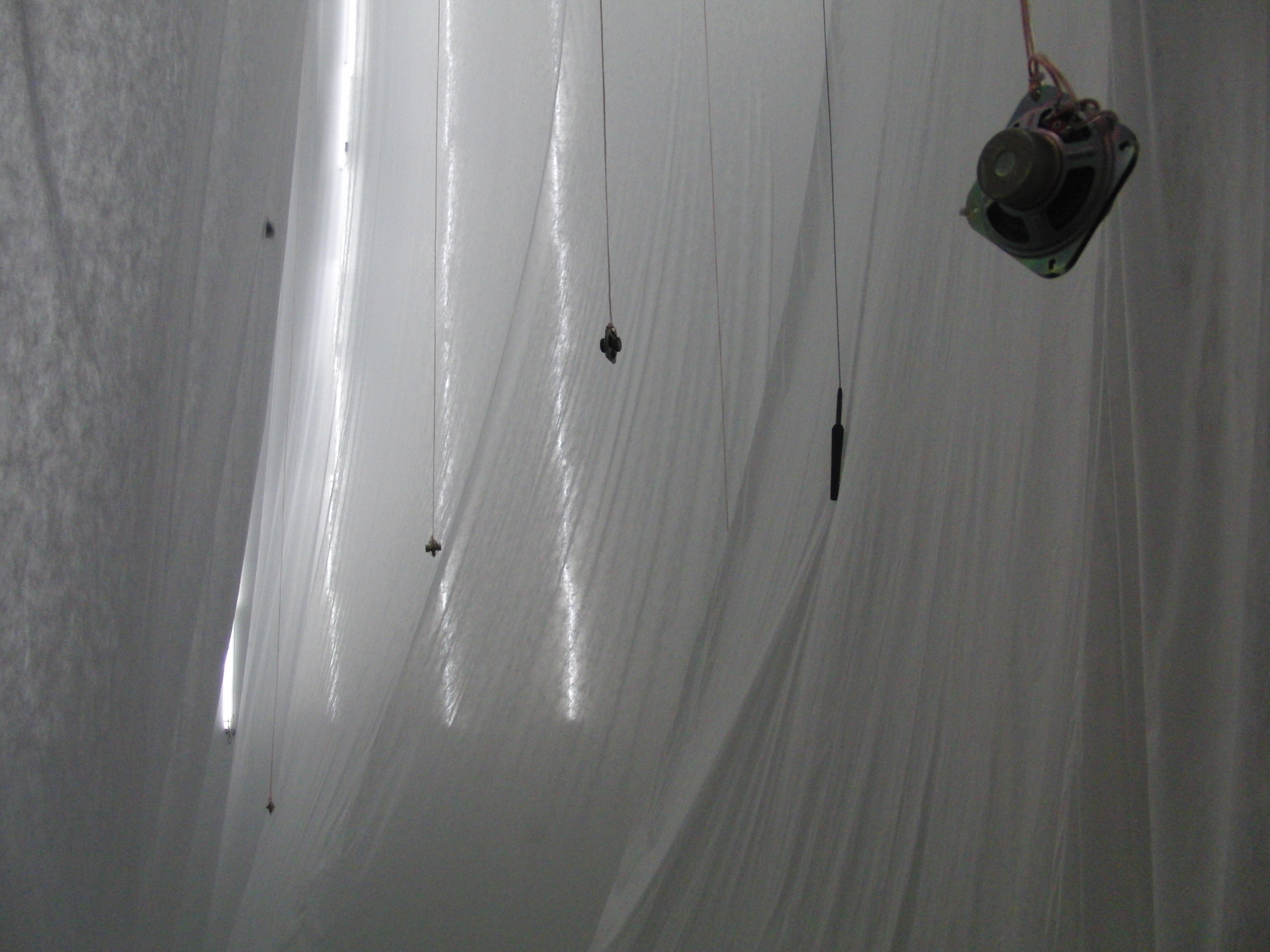
Carlito Carvalhosa’s “Sum of Days” is a palimpsestual participatory treat for the eyes and ears (photo by twi-ny/mdr)
Museum of Modern Art
The Donald B. and Catherine C. Marron Atrium, second floor
11 West 53rd St. between Fifth & Sixth Aves.
Wednesday – Monday, $22.50 ($12 can be applied to the purchase of a film ticket within thirty days)
212-708-9400
www.moma.org
sum of days slideshow
For his “Sum of Days,” Brazilian artist Carlito Carvalhosa has created a palimpsestual participatory passageway in MoMA’s Marron Atrium that is more than initially meets the eyes — and ears. Sheets of white translucent fabric hang down from the high ceiling, forming a mazelike twisting walkway lined with a series of dangling speakers and microphones at different heights, recording current ambient sound while playing back the sounds of the installation’s previous days, melding everything together into a symphonic cacophony of the piece’s past and present, with the older sounds fading away in the background. Just as it’s hard to differentiate among the various noises and make out actual words, people’s vision is also impacted by the long sheets, which turn other visitors into shadowy figures walking by like ghosts. Many people go through the installation very quickly, but you should take your time, letting the sights and sounds envelop you for an energizing, ethereal experience. Once a week through November 10, a special sixty-to-ninety-minute musical performance will take place within the exhibition, but while MoMA has announced the lineup — Lisa Bielawa, David Crowell, Jon Gibson, Philip Glass, Carla Kihlstedt, Michael Riesman, Mick Rossi, and Andrew Sterman — the concerts will be announced on the actual day of the event via MoMA’s Twitter feed (@MuseumModernArt), although we can tell you that the first one is scheduled for September 15.



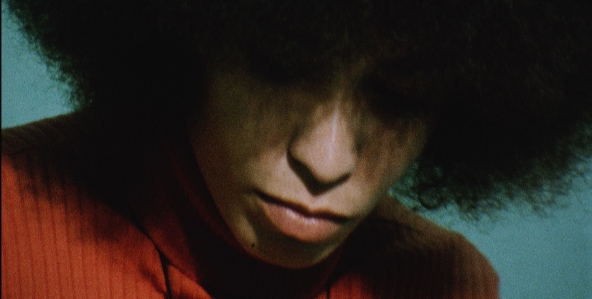
 From 1967 to 1975, a group of more than two dozen Swedish journalists came to America to document the civil rights movement. More than thirty years later, director and cinematographer Göran Hugo Olsson discovered hours and hours of unused 16mm footage — the material was turned into a program shown only once in Sweden and seen nowhere else — and developed it into The Black Power Mixtape 1967-1975, a remarkable visual and aural collage that focuses on the Black Panthers and the Black Power movement, a critical part of American history that has been swept under the rug. Olsson and Hanna Lejonqvist have seamlessly edited together startlingly intimate footage of such seminal figures as Eldridge Cleaver, Bobby Seale, Huey P. Newton, Dr. Martin Luther King, Jr., and Stokely Carmichael, including a wonderfully personal scene in which Carmichael interviews his mother on her couch. But the star of the film is the controversial political activist Angela Davis, who allowed the journalists remarkable access, particularly in a jailhouse interview shot in color. (Most of the footage is in black and white.) Davis also adds contemporary audio commentary, sharing poignant insight about that tumultuous period, along with Abiodun Oyewole of the Last Poets, singer Erykah Badu, professor, poet, and playwright Sonia Sanchez, Roots drummer Ahmir Questlove Thompson (who also composed the film’s score with Om’Mas Keith), and rapper Talib Kweli, who discusses specific scenes in the film with a thoughtful grace and intelligence. The Black Power Mixtape 1967-1975 is an extraordinary look back at a crucial moment in time that has long been misunderstood, if not completely forgotten. The filmmakers will be at the IFC Center for the 8:15 and 10:20 shows on Friday and Saturday night to talk about the work. In conjunction with the film’s opening,