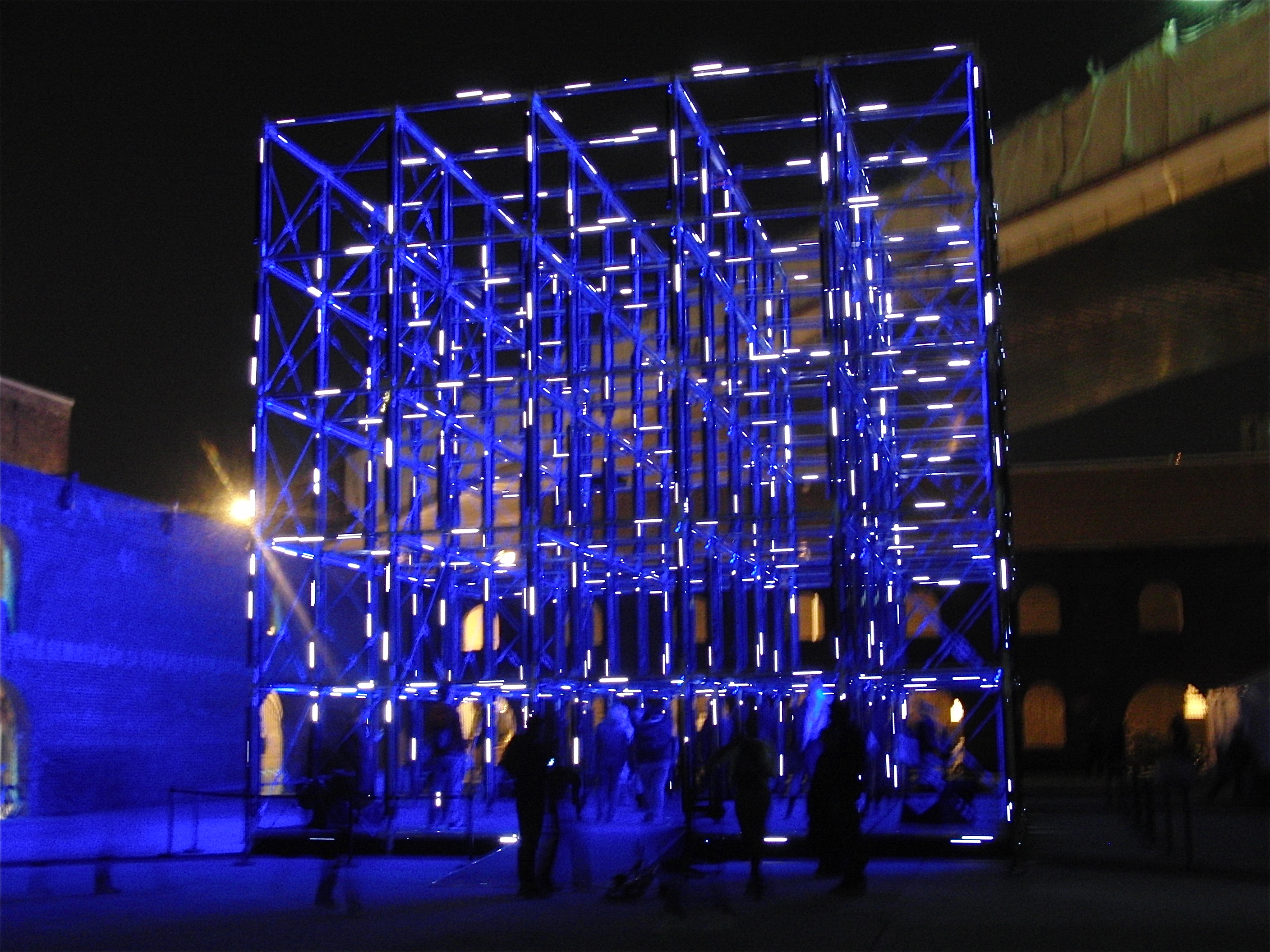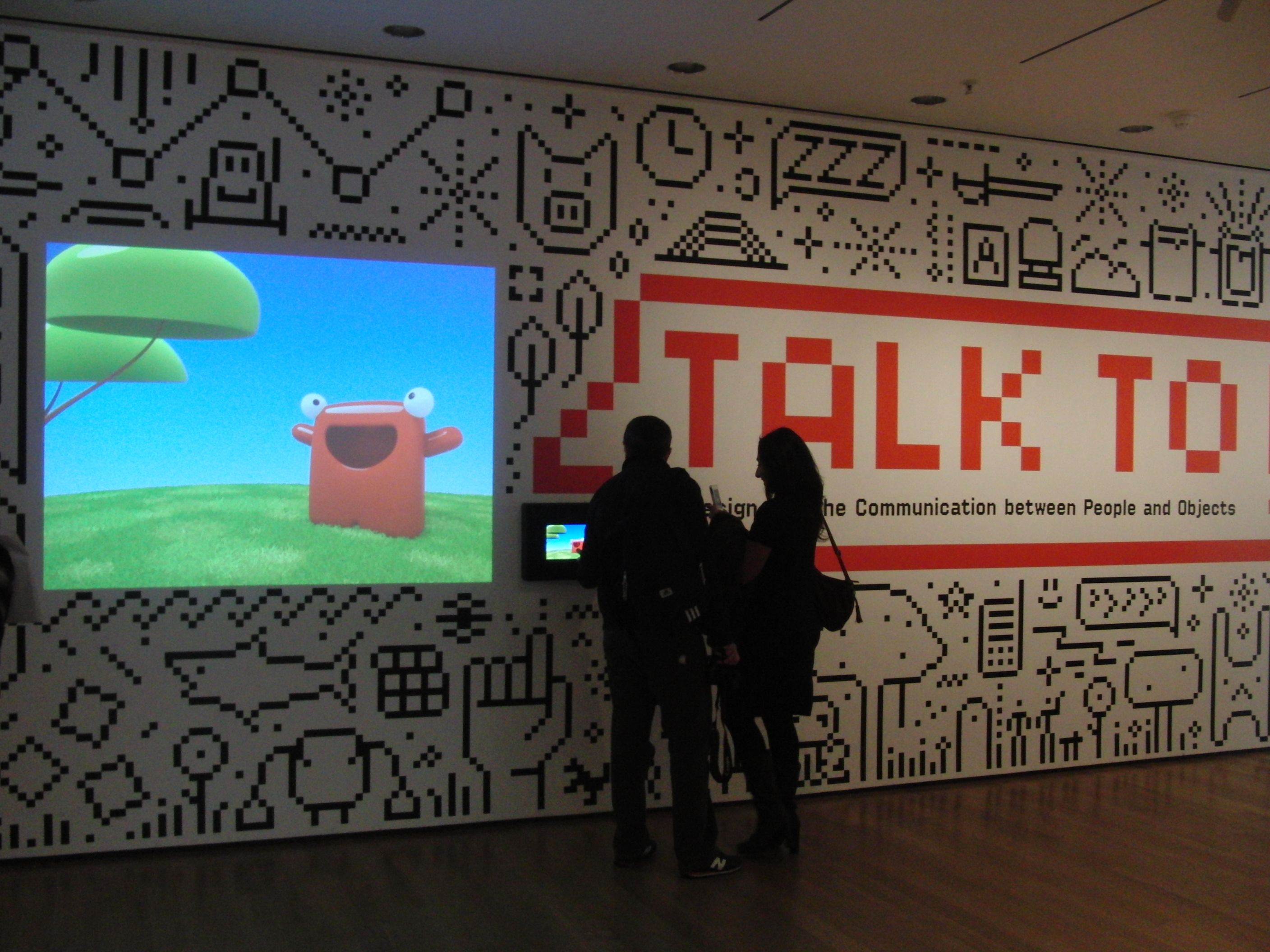
Yann Le Coroller, “Talking Carl,” 3DSmax, Vray, and Xcode software, 2010 (photo by twi-ny/mdr)
Museum of Modern Art
11 West 53rd St. between Fifth & Sixth Aves.
Wednesday – Monday through November 7, $25
212-708-9400
www.moma.org
On October 14, Apple released the iPhone 4S, the latest iteration of the handheld device that reached a whole new synthesis of design, technology, and communication with Siri, which responds to voice commands with a voice of its own. Although not part of MoMA’s interactive “Talk to Me: Design and the Communication between People and Objects,” the iPhone is a prime example of how the relationship between man and machine has changed over the decades. “The bond between people and things has always been filled with powerful and unspoken sentiments going well beyond functional expectations and including attachment, love possessiveness, jealousy, pride, curiosity, anger, even friendship and partnership,” writes senior curator Paola Antonelli in the exhibition catalog, which also contains essays by Jamer Hunt, Alexandra Midal, Khol Vinh, and Kevin Slavin. Indeed, there is surprising warmth to the exhibit, which invites visitors to explore not only the many items’ visual splendor but their interactivity as well. People are greeted at the entrance by Yann Le Coroller’s “Talking Carl,” a cute and silly Etch-a-Sketch-like animated being that responds to sound and touch, a fun opening to a wide-ranging wonderland of high- and low-tech displays that examine both form and function.
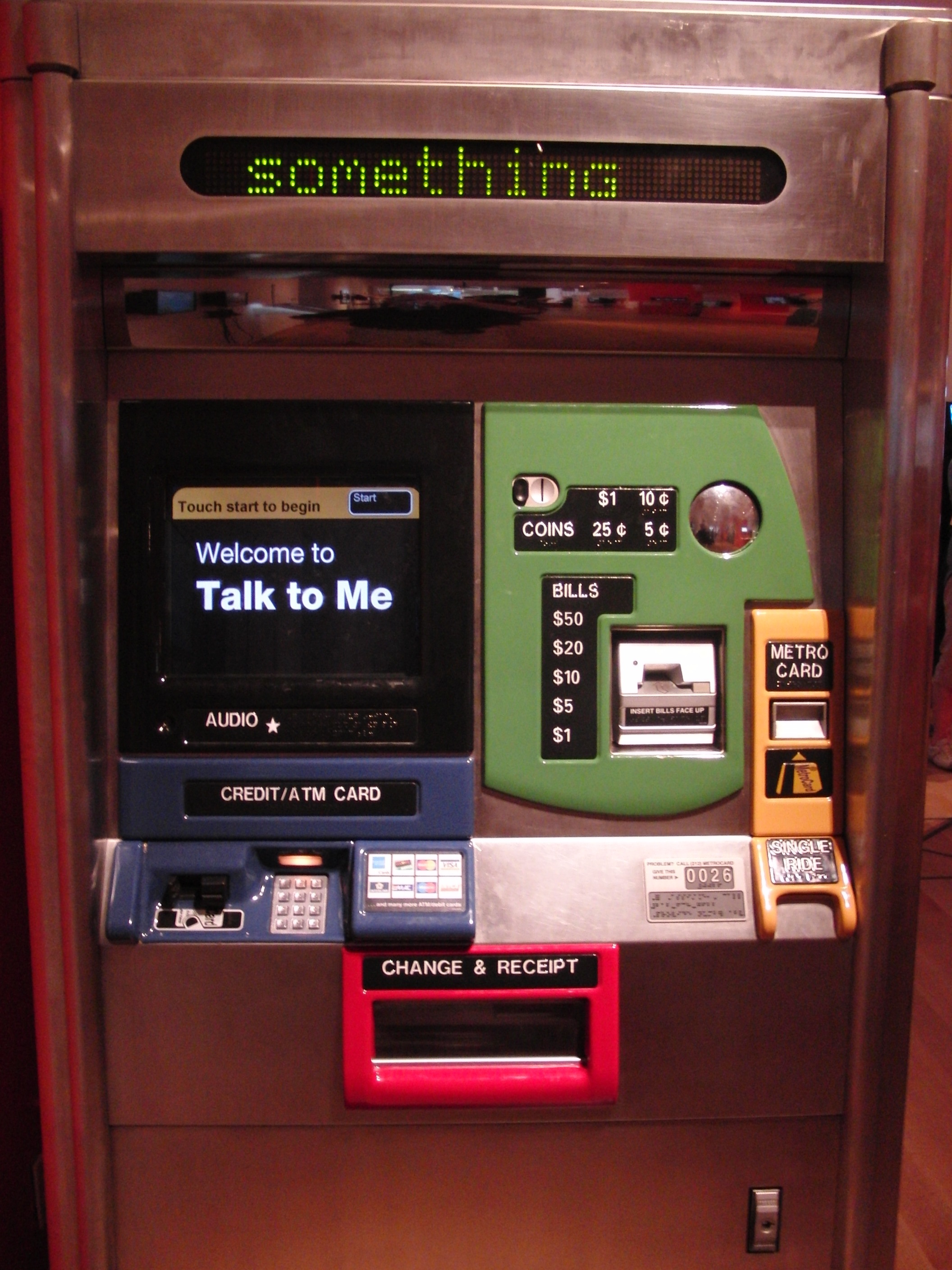
“MetroCard Vending Machine,” vending machine: steel and other materials; interface: Director, Photoshop, Illustrator, and Visual Basic software, 1999 (photo by twi-ny/mdr)
Divided into six sections — “Objects,” “I’m Talking to You,” “Life,” “City,” “Worlds,” and “Double Entendre” — “Talk to Me” features sociological projects that help the blind, the homeless, and the maimed, geographic grids that impact business and transportation, and three-dimensional charts and graphs that detail private and public information. There are also plenty of innovative works that are just plain fun. In “The Wilderness Downtown,” people plug in the name of their street or hometown, which soon becomes a visual part of Arcade Fire’s music video for the song “We Used to Wait.” Straphangers can buy a real MetroCard from a vending machine that has been slightly reconfigured for the show. Dishes and silverware morph with a heated argument excerpted from the Oscar-winning film American Beauty in Geoffey Mann’s “Cross-fire.” Chris Woebken and Natalie Jeremijenko use voice-recognition software for “Bat Billboard,” which broadcasts messages from bats who live behind it. A close look at Maarten Bass’s “Analog Digital Clock” reveals that it is not quite what it seems, combining people and time in a unique way. Marcos Weskamp’s “Newsmap” arranges news stories by how much coverage they receive in the media. Sissel Tolaas’s “Berlin, City Smell Research” uses the olfactory sense to create a different kind of map of Germany’s capital. Andy and Carolyn London give life to manhole covers, pay phones, and other objects to relay interviews with tourists in “The Lost Tribes of New York City.” And “N Building facade” turns the outside of a Tokyo building into an immense QR code that offers all types of information about the structure. In fact, every item in “Talk to Me” has its own QR code, so adventurous museumgoers can delve deeper into the works and interact with them further. “Talk to Me” is an engaging exhibition that takes an entertaining look at the shape of things to come. The show is now in its final week, with several special events still scheduled: Rob Walker will moderate the discussion “The Language of Objects,” with Kenneth Goldsmith, Ben Greenman Leanne Sharpton, and Cintra Wilson, on November 2 at 6:00 ($10), and gallery conversations will take place with Jennifer Gray on November 3 at 6:00, Marianne Egler on November 5 at 11:30 am, and Diana Bush on November 6 at 1:30, all free with museum admission.

 Screening at 92YTribeca as part of the third annual Doomsday Film Festival — which promises “Deserted streets! Blood-red skies! Total social breakdown!” — Stanley Kubrick’s Dr. Strangelove is one of the grandest satires ever made, the blackest of black comedies. With the threat of nuclear annihilation looming over the United States and the Soviet Union, General Jack D. Ripper (Sterling Hayden) has a meltdown, becoming obsessed with protecting the country’s “precious bodily fluids” and threatening to launch the bombs. While President Merkin Muffley (Peter Sellers) tries to make nice with the Soviets, General Buck Turgidson (George C. Scott) gets caught up in all the military excitement, Colonel Bat Guano (Keenan Wynn) defends the Coca-Cola company, Group Captain Lionel Mandrake (Sellers) can’t get anyone to listen to him, and Major T. J. “King” Kong (Slim Pickens) prepares for the ride of his life. Based on Peter George’s novel Red Alert and written by George, Kubrick, and Terry Southern, Dr. Strangelove or: How I Learned to Stop Worrying and Love the Bomb is hysterically funny and wickedly prescient, an absolute hoot from start to finish, featuring razor-sharp dialogue, inspired slapstick, and just enough truth to scare the hell out of you. (Be sure to watch for Peter Bull not being able to stop laughing as Sellers goes crazy in a wheelchair at the end.) The screening will be followed by a “Doomsday on the Brain” panel discussion with Joseph Le Doux, Dr. Mark Siegel, Lee Quinby, Keith Uhlich, and Mark Asch, moderated by Paul W. Morris from, of course, BOMB magazine. The Doomsday Film Festival also includes Steve De Jarnatt’s 1988 WWIII flick Miracle Mile, followed by a Q&A with star Anthony Edwards and the director; Don McKellar’s 1999 Y2K nightmare Last Night; Joseph Sargent’s classic Colossus: The Forbin Project, followed by “The Singularity Is Nigh,” a panel discussion with Maggie Jackson, Joshua Rothkopf, Jason Zinoman, Chris Bregler, and Roger Schank, moderated by Michael Byrne; Tobe Hooper’s 1985 exploitation fave Lifeforce, preceded by complimentary sexy alien zombie makeup; a collection of short films; and schlockmeister Larry Cohen’s 1976 cop drama God Told Me To, followed by a Skype Q&A with Cohen. If the end of the world is coming, this is a fine way to say goodbye.