this week in art

RESIDUE: AN INSTALLATION BY EIKO & KOMA

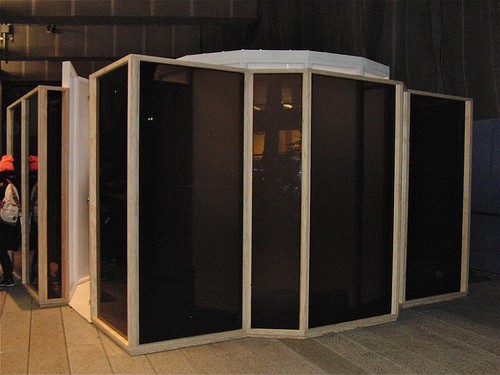
Eiko & Koma take a look back at their life and career in “Residue” (photo by twi-ny/mdr)

The New York Public Library for the Performing Arts
Dorothy and Lewis B. Cullman Center, Vincent Astor Gallery
40 Lincoln Center Plaza, 111 Amsterdam Ave. between 64th & 65th Sts.
Through Saturday, October 29, free, 12 noon – 6:00 or 8:00
www.eikoandkoma.org/residue
www.nypl.org

It’s been quite a year for Japanese dance couple Eiko & Koma here in their home base of New York City. Celebrating their fortieth anniversary together, Eiko Otake and Takashi Koma Otake performed the postapocalyptic dance installation Naked at the Baryshnikov Arts Center in the spring, went for a dip in the Paul Milstein Pool on Lincoln Center’s Hearst Plaza for the mesmerizing Water this summer, and held numerous local talks and workshops. And, as part of their three-year Retrospective Project, they’re taking a look back at their career in the unique gallery installation “Residue,” on view at the New York Public Library for the Performing Arts through October 29. Designer Eric Bissell has transformed the Vincent Astor Gallery into a dark, hypnotic space featuring paraphernalia from throughout Eiko & Koma’s career, including costumes, sets, a series of white rectangular wells screening videos at the bottom, and a central structure similar to the Naked wall where visitors can walk in, sit down, and watch Naked on a monitor on the floor. “Residue” highlights such works as Hunger, River, White Dance, Thirst, Grain, Wind, Tree, and Offering, organic pieces in which Eiko and Koma are often naked, performing in the outdoors or on stark sets. “It is very clear nothing lasts,” Koma says in the exhibition brochure. “So this installation too is not an attempt to last or save what we have done,” Eiko responds. “We just look at the ‘dust’ and enjoy that we can look at it for now.” Visitors will be able to look at and enjoy the dust of Eiko and Koma’s continuing adventurous career through the end of the week, and as an added treat the duo will be at the gallery on Saturday from 4:00 to 6:00 to meet and greet everyone who stops by.

LYLE ASHTON HARRIS: SELF/PORTRAIT

Lyle Ashton Harris, “Untitled (Face/Back #155 Lyle),” Polaroid photograph, 2000 (courtesy the artist and CRG Gallery)

The Studio Museum in Harlem
144 West 125th St. between Lenox Ave. (Malcolm X Blvd.) & Adam Clayton Powell, Jr. Blvd. (Seventh Ave.)
Final day: October 23, free, 12 noon – 6:00 pm
212-864-4500
www.studiomuseum.org

From 1998 to 2008, Bronx-born photographer Lyle Ashton Harris took “Chocolate Polaroids” of his friends, families, and neighbors, taking one picture of their face and another of the back of their head. Nearly two dozen of these fascinating pairings have been collected for the revealing show “Lyle Ashton Harris: Self/Portrait,” which ends today at the Studio Museum in Harlem. The large-format, sepia-toned 20×24-inch works, shot in a SoHo studio, include such familiar figures as Al Sharpton, Tony Kushner, Anna Deavere Smith, and Cindy Sherman along with such less-familiar faces as artist and writer Senam Okudzeto, museum curators Thelma Golden and Robert Storr, visual artist Shirin Neshat, and an exotic dancer named Dorian who has a frightening scar down the back of his head, in addition to Harris himself, with each pair accompanied by brief text. Staring straight into the camera, the subjects feel like they’re communicating something silent but serious to the viewer, saying as much from the front as from the back. Also closing today, when the museum is free from 12 noon to 6:00, are “Spiral: Perspectives on an African-American Art Collective,” with wonderful works from the 1960s group by Norman Lewis, Romare Bearden, Hale Woodruff, Charles Alston, Emma Amos, and others; “Harlem Postcards Summer 2011,” with postcards by Senetchut Floyd, Phillip Pisciotta, Tribble & Mancenido, and Genesis Valencia; and “Evidence of Accumulation,” a multimedia exhibition of pieces by artists in residence Simone Leigh, Kamau Amu Patton, and Paul Mpagi Sepuya, highlighted by Leigh’s six-minute video Breakdown, made with Liz Magic Laser and Alicia Mall Horan.

AÏDA RUILOVA: GONER

A woman is terrorized by an unseen presence in Aïda Ruilova’s psychological horror short

Salon 94 Bowery
243 Bowery between Stanton & Rivington Sts.
Goner through Saturday
Prop House through Sunday
212-979-0001
www.salon94.com
www.aidaruilova.com/goner.htm

Today is the last day to see West Virginia-born Aïda Ruilova’s claustrophobic horror short Goner, which follows a young woman in a white night shirt (Sonja Kinski) as she is terrified by an unseen predator. Quick cuts, a handheld camera, and blood splatters propel this tense psychological thriller, which is projected onto the far wall in the downstairs space at Salon 94 Bowery. We’re not sure why the gallery chose to end this exhibition, which also includes miniature stills from Goner and several of Ruilova’s other films, just a week before Halloween, but it’s still a good way to get your scare on as you prepare for the annual pagan celebration. However, Ruilova’s Prop House, which comments on the props used in horror films, can be seen tomorrow, projected onto the gallery’s outside wall.

DOOMSDAY FILM FESTIVAL: DR. STRANGELOVE

Peter Sellers has some grand plans for the end of the world as Dr. Strangelove in classic Kubrick cold war comedy

92YTribeca
200 Hudson St.
Sunday, October 23, $12, 2:00
Festival runs October 21-23
212-601-1000
www.doomsdayfilmfest.com

Screening at 92YTribeca as part of the third annual Doomsday Film Festival — which promises “Deserted streets! Blood-red skies! Total social breakdown!” — Stanley Kubrick’s Dr. Strangelove is one of the grandest satires ever made, the blackest of black comedies. With the threat of nuclear annihilation looming over the United States and the Soviet Union, General Jack D. Ripper (Sterling Hayden) has a meltdown, becoming obsessed with protecting the country’s “precious bodily fluids” and threatening to launch the bombs. While President Merkin Muffley (Peter Sellers) tries to make nice with the Soviets, General Buck Turgidson (George C. Scott) gets caught up in all the military excitement, Colonel Bat Guano (Keenan Wynn) defends the Coca-Cola company, Group Captain Lionel Mandrake (Sellers) can’t get anyone to listen to him, and Major T. J. “King” Kong (Slim Pickens) prepares for the ride of his life. Based on Peter George’s novel Red Alert and written by George, Kubrick, and Terry Southern, Dr. Strangelove or: How I Learned to Stop Worrying and Love the Bomb is hysterically funny and wickedly prescient, an absolute hoot from start to finish, featuring razor-sharp dialogue, inspired slapstick, and just enough truth to scare the hell out of you. (Be sure to watch for Peter Bull not being able to stop laughing as Sellers goes crazy in a wheelchair at the end.) The screening will be followed by a “Doomsday on the Brain” panel discussion with Joseph Le Doux, Dr. Mark Siegel, Lee Quinby, Keith Uhlich, and Mark Asch, moderated by Paul W. Morris from, of course, BOMB magazine. The Doomsday Film Festival also includes Steve De Jarnatt’s 1988 WWIII flick Miracle Mile, followed by a Q&A with star Anthony Edwards and the director; Don McKellar’s 1999 Y2K nightmare Last Night; Joseph Sargent’s classic Colossus: The Forbin Project, followed by “The Singularity Is Nigh,” a panel discussion with Maggie Jackson, Joshua Rothkopf, Jason Zinoman, Chris Bregler, and Roger Schank, moderated by Michael Byrne; Tobe Hooper’s 1985 exploitation fave Lifeforce, preceded by complimentary sexy alien zombie makeup; a collection of short films; and schlockmeister Larry Cohen’s 1976 cop drama God Told Me To, followed by a Skype Q&A with Cohen. If the end of the world is coming, this is a fine way to say goodbye.

THE CREATORS PROJECT: ORIGIN

Ultracool responsive LED cube is on view nightly through Sunday in DUMBO (photo by twi-ny/mdr)

Tobacco Warehouse
38 Water St., DUMBO
Through October 23, free, 5:00 – 9:00 pm
www.thecreatorsproject.com
origin slideshow

At last year’s inaugural Creators Project event at Milk Studios, the UK collective United Visual Artists presented two works, “Hereafter” and “Triptych,” that were among the coolest of the show. For this year’s two-day Creators Project festival in DUMBO, they came up with something even better, one of the coolest things ever. Situated in Tobacco Warehouse on Water St. — and extended through Sunday night — “Origin” is an intoxicating collaboration between UVA and innovative British sound artist Scanner (Robin Rimbaud), a giant cube, ten meters by ten meters, with twenty-five two-meter squares on each side and in between, forming a mesmerizing lattice grid that comes alive with LED lights that form dazzling patterns in red, white, and blue. Accompanied by a soundtrack of experimental noise and human dialogue, “Origin” brightens up the night sky with chasing lights that zoom around the structure at changing rates of speed, reacting to visitors via infrared cameras as men, women, and children walk through the piece or lie down on their backs for a rather dizzying, delightful experience. “‘Origin’ is alive, and it’s moody,” UVA explains. “It will stay in a state of calm, soothing bliss for fifteen minutes at a time, lulling its occupants into a sense of false security. Then, seemingly on a whim, it will take exception to their behaviour; its metaphorical tail will start to lash back and forth like a cat’s, until it explodes into an angry tantrum that rises to a terrifying crescendo. Then it will again seemingly calm down.” Evoking such well-known objects as the spaceship from Close Encounters of the Third Kind , the Borg cube from Star Trek: The Next Generation, and the monolith from 2001: A Space Odyssey — with some psychedelic laser Floyd thrown in — “Origin” will take you on an inner and outer journey that will go as far as you’re willing to allow it.

TWI-NY TALK: RED GROOMS

Red Grooms, “Spy Cab,” acrylic on paper, 2011 (courtesy of Marlborough Gallery)

“RED GROOMS, NEW YORK: 1976-2011”
Marlborough Gallery
40 West 57th St.
Through October 22, free, 10:00 am – 6:00 pm
212-541-4900
www.marlboroughgallery.com

In the playful noir short story that opens the catalog of his latest exhibition at the Marlborough Gallery, Red Grooms’s alter ego, Gunslinger, says, “Ya see, I wanted to show the public how low it gets sometimes, down under the belly of the beast.” For more than fifty years, Grooms has been revealing the belly of the beast that is New York, but it turns out that Grooms’s world is filled with colorful caricatures living it up in the maelstrom he refers to as “the city that never snores.” In “Red Grooms, New York: 1976-2011,” Grooms, who was born and raised in Nashville and has lived in New York City since 1957, collects some of his finest work of the last thirty-five years, including paintings, mixed-media constructions, sculpto-pictoramas, and such walk-in installations as “The Bus” and “42nd Street — Porno Bookstore.” Grooms has an innate sense of life in the Big Apple, capturing the essence that lies at the heart of the city in such pieces as “The Funny Place,” “Give My Regards to Broadway,” “Small Hot Dog Vendor,” and “Tattoo Parlor.” We recently spoke with Grooms, a tall, engaging, and quite forthcoming fellow, at the exhibit’s opening, where he was surrounded by admiring fans who could not wipe the huge smiles off their faces, and later by phone.

twi-ny: There’s a timeless quality to your work, in which you display a unique view of New York. The city has gone through some major changes during the period covered in this exhibition. How do you see the New York of 1976, or even the 1950s, as different from today?

Red Grooms: I think it’s great right now. It just seems very vibrant to me. It seems like there are twice as many people as there used to be. I’m down here below Canal St., almost in Chinatown and near the courts. We’re getting a tremendous amount of tourists —Chinatown, Little Italy, and then going on downtown, down Broadway. That vibrancy and energy, I enjoy it; it’s fun. So I would hope I get some of that now with what I’m doing.

I have a few late works in the show — “Count Tribecula” is one of them — to get the funny quality of the TriBeCa area. I’ve always done a lot on Chinatown. I’ve been in the same studio on Walker St. for forty-two years, so I have seen a bunch of different things. It used to be the hardware center; that actually influenced my work a lot. It took me two minutes to go out and get whatever I needed. There’s still some plastic stores. In the ’70s, plastic was kind of a fashionable medium for a while, and I indulged in it myself. Those different media influenced the work. Right here there’s always been a fabric center as well.

twi-ny: Speaking of different media, in several works from 2010, you have incorporated digital imagery. What made you start doing that?

Red Grooms: I consider myself absolutely not a photographer, and so I used the throwaway cameras, and I’ve literally taken hundreds, if not even thousands, of pictures. About two years ago, I looked through the pictures of ten or so years ago, and they had sort of settled in, so some of them looked kind of special just because it was a particular moment. I started to make collages with them.

This one scene called “Lunchtime on Broadway,” which is panoramic, I took a whole bunch of pictures and glued them together — you know, cut and paste — and made a fairly large composite, and I used that to make that dimensional work, and in doing that, I discovered that if you cut out a figure, it leaves a hole in putting it on a white piece of paper; it got a very strong jump to it between the silhouette and the photographic background. So in that process, I made a whole bunch of four-by-six cards, cut out elements that I wanted to, and then I water-colored in the same thing that was in there. In doing that was when I enlarged them more and did the works you see in the show now.

Red Grooms enjoys the opening of his latest exhibit at the Marlborough Gallery on 57th St. (photo by twi-ny/mdr)

twi-ny: With regard to technology, you don’t have a cell phone or e-mail, and you don’t use a computer, is that right?

Red Grooms: I’m pathetically old school in that way. My wife is capable. You know, it’s really hard to work with people without it. It’s very difficult. I think it will be impossible soon.

twi-ny: Another of the places that you have always captured is Times Square and Broadway. What do you think of the new Times Square?

Red Grooms: When I did the early works from ’76, ’77, I did do research up there, and it was funny because after “Ruckus Manhattan” opened, it was very popular and got a lot of press, so they called me in, some of the people who were trying to clean up Times Square at the time, to see if I had any ideas. I had this weird duality about it. I actually wanted to do something, but in the end, I couldn’t really think of anything. Nothing panned out.

twi-ny: It’s probably best that way.

Red Grooms: So I was there when they were starting to do it. They had a lot of trouble, actually, a lot of starting and stopping on that project before it really got going and became what it is now. We don’t have those places like “Porno Bookstore” anymore. They were so prevalent at that time.

twi-ny: Well, it’s great to now have it on 57th St. at the Marlborough.

Red Grooms: That was a little daring. It hadn’t been up for thirty-four years. It ran well when “Ruckus” showed at the Marlborough in ’77; we didn’t really get any complaints. But in ’82 I had a show with the “Ruckus” stuff on 54th St. and Sixth Ave., and when we were unpacking the stuff, the superintendent of the building took a look at the porno store and said he was going to close the whole show down if we tried to put that up.

twi-ny: In the catalog, you open with a short noir story in which you work many of the pieces’ names into it. Is this writing something you’re exploring more?

Red Grooms: I wrote it together with my wife, Lysiane Luong, and it was a lot of fun. In fact, it was so much fun that we were going to jump right in to an actual full-length detective story, but we didn’t get very far. You’re one of the first persons right now talking about it. I very much liked doing it.

twi-ny: You’ve used the word “fun” several times, and that’s a good way to describe what people experience when they see your work. At the opening, everyone was laughing and smiling. What kind of satisfaction does that bring you?

Red Grooms: It’s great, it’s exciting. You know, I’m quite isolated when I do it. . . . But my dreams of monetary success never panned out.

MATTHEW BARNEY: DJED

Matthew Barney, “Secret Name,” cast lead, polycaprolactone, copper, and zinc, 2008/2011 (photo by twi-ny/mdr)

Gladstone Gallery
530 West 21st St. between Tenth & Eleventh Aves.
Tuesday – Sunday through October 22, free, 10:00 am – 6:00 pm
212-206-9300
www.gladstonegallery.com

Since 2007, multimedia installation artist, filmmaker, and former college football hero Matthew Barney has been developing Ancient Evenings, an ambitious collaboration with Jonathan Bepler inspired by Norman Mailer’s 1983 novel. Incorporating American automobiles, mythical figures, and such settings as a Chrysler dealership, a Detroit sewage treatment plant, and a glue factory, the rather unusual opera includes the pouring of hot metal onto the stage. The resulting sculptures, along with lovely, mysterious ink-on-paper “River Rouge” drawings and other related works, are on view in “DJED” at the Gladstone Gallery in Chelsea through October 22. The San Francisco-born Cremaster maestro has given the pieces such curious titles as “Canoptic Chest,” “Secret Name,” and “Sacrificial Anode,” inviting visitors to venture into his surreal, engaging landscape, some of which Cremaster fans will get an extra kick out of as they recognize the references. The display is on two floors, so be sure to go upstairs to experience the complete exhibition.