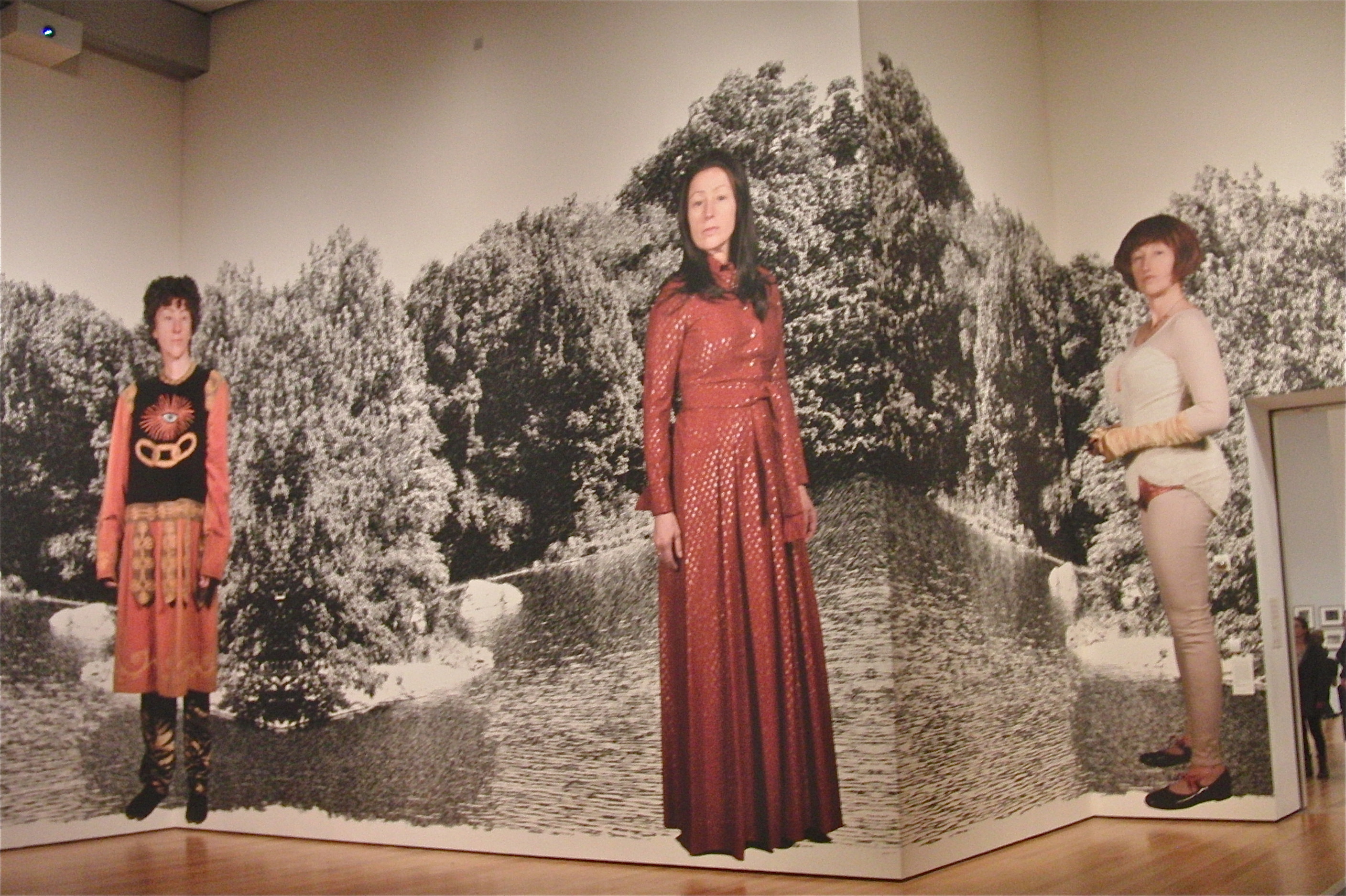
Giant Cindy Shermans watch over entrance to stunning MoMA retrospective (photo by twi-ny/mdr)
Museum of Modern Art
11 West 53rd St. between Fifth & Sixth Aves.
“Cindy Sherman” through June 11, Joan and Preston Robert Tisch Exhibition Gallery, sixth floor
“Sanja Iveković: Sweet Violence” through March 26, Donald B. and Catherine C. Marron Atrium and Special Exhibition Galleries, third floor
Wednesday – Monday, $25 (includes same-day film screenings)
212-708-9400
www.moma.org
MoMA is currently home to two solo shows by women who take very different approaches to explorations of gender, identity, sexual freedom, empowerment, and representation. “Cindy Sherman” is an appropriate title for the revelatory career survey of American artist Cindy Sherman, who has been photographing herself in ever-evolving series for thirty-five years. Sherman’s oeuvre is not a celebration of herself but an examination of how women are depicted and treated in society. Working alone, Sherman, who is most often associated with the Pictures Generation, dresses up in an endless array of costumes and makeup, becoming a sexy chanteuse, an elderly aristocrat, a centerfold model, a fashion icon, a clown, a Renaissance virgin, a tattooed punk rebel, and a murder victim. Each photograph, most of which were taken in her studio, is untitled, allowing viewers to experience it for themselves, bringing their own biases to it without being prodded. Her “Untitled Film Stills” are not based on actual movies, allowing the viewer to create their own story around the carefully choreographed pictures. In such series as “Centerfolds,” “Fashion,” “Fairy Tales and Disasters,” and “History Portraits,” she re-creates herself in ways that make the story about who she portrays, not who she is. “Time and time again, writers have asked, Who is the real Cindy Sherman?” exhibition organizer Eva Respini writes in the show’s catalog. “It is Sherman’s very anonymity that distinguishes her work. Rather than explorations of inner psychology, her pictures are about the projection of personas and stereotypes that are deepseated in our shared cultural imagination.” In representing the fascinating work of one of contemporary art’s most important figures, “Cindy Sherman” is a spectacular success. (On March 26, such artists as George Condo, Kalup Linzy, Elizabeth Peyton, and Collier Schorr will participate in the panel discussion “Cindy Sherman: Circle of Influence,” moderated by Respini. In addition, Sherman has curated the film series “Carte Blanche,” which runs April 2-10 and includes such films as Barbara Kopple’s Harlan County USA, Tobe Hooper’s The Texas Chain Saw Massacre, Bong Joon-ho’s The Host, David Lynch’s Inland Empire, John Cassavetes’s Shadows, John Waters’s Desperate Living, and Sherman’s own Doll Clothes and Office Killer.)

Sanja Iveković’s “Lady Rosa of Luxembourg” rises high in MoMA’s Marron Atrium (photo by twi-ny/mdr)
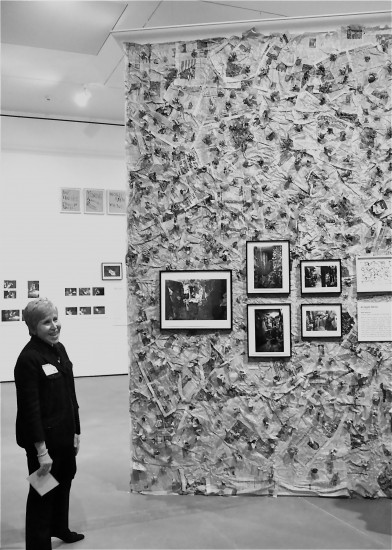
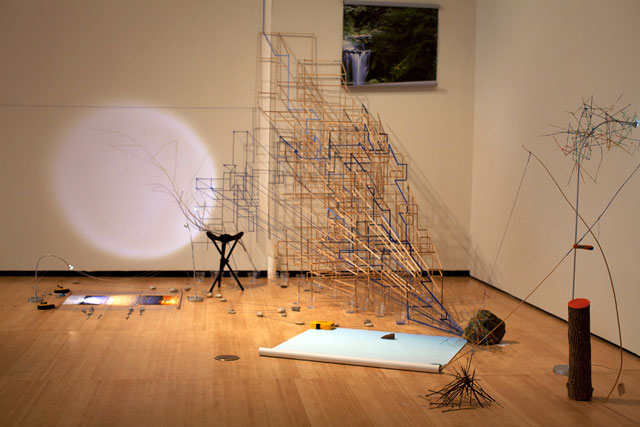
As “Cindy Sherman” settles in to MoMA, continuing through June 11, “Sanja Iveković: Sweet Violence” prepares to move out, ending March 26. The first museum retrospective of the Croatian multimedia artist and activist born five years before Sherman, the show consists of photography, sculpture, drawing, video, and collage that tackle such issues as politics, female identity, and gender roles in war-torn East Central Europe. Like Sherman, Iveković, who is part of the Nova Umjetnička Praksa (New Art Practice) generation, often puts herself in her work, but she is much more direct and far less subtle. In “Tragedy of a Venus,” Iveković pairs older, existing pictures of herself with shots of Marilyn Monroe, while in “Double Life” she is seen alongside magazine advertisements for beauty products. In the short video “Personal Cuts,” Iveković films herself using scissors to slice off parts of a dark stocking that covers her face, intercut with historical footage of the post-Tito history of the former Yugoslavia. And in “Practice Makes a Master,” Iveković wears a white sheet over her head as the continually falls to the ground as if having been executed, while Monroe sings a song from Bus Stop. Other series include “Paper Women,” in which Iveković rips, scratches, and tears actual magazine ads with female models; “Sweet Violence,” in which she places bars on a television monitor showing a Zagreb economic propaganda program; and “Women’s House (Sunglasses),” large-scale prints of fashion models on which details of beaten and abused women are superimposed. The show’s centerpiece is “Lady Rosa of Luxembourg,” Iveković’s public art project that involved the re-creation of a war monument in which she made the statue of Nike into a pregnant woman and replaced the names of the fallen soldiers with such words as “Kitsch,” “Madonna,” “Virgin,” “Resistance,” “Justice,” and “Whore.” Seen together, “Cindy Sherman” and “Sanja Iveković: Sweet Violence” offer two very different perspectives on very similar themes, from two women artists from two very different cultures.


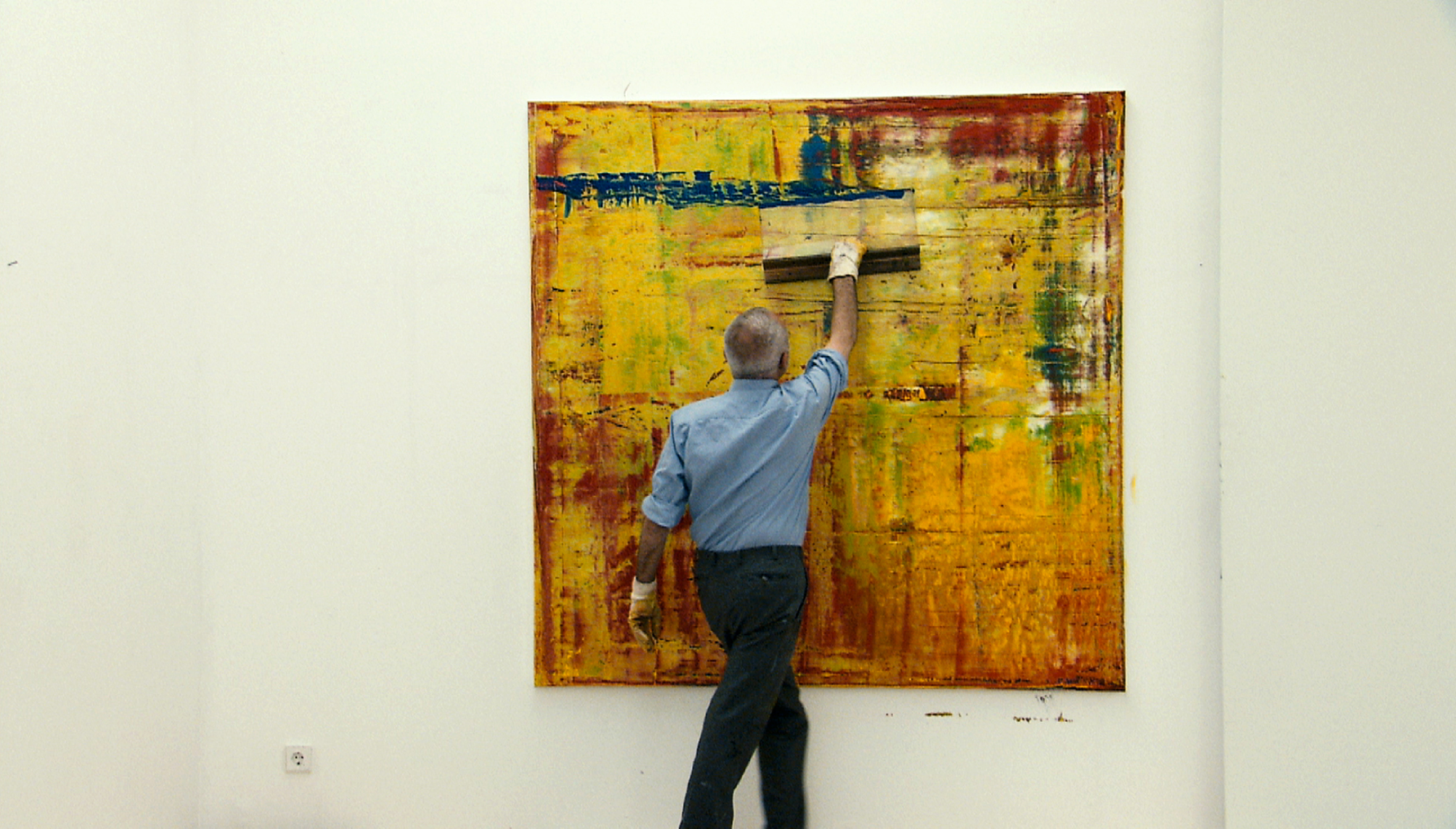
 There’s nothing abstract about the title of Corinna Belz’s documentary on German artist Gerhard Richter, no missing words or punctuation marks. Gerhard Richter Painting is primarily just that: Ninety-seven minutes of Gerhard Richter painting as he prepares for several exhibitions, including a 2009 show at the Marian Goodman Gallery in New York City. In 2007, Belz got a rare chance to capture Richter on camera, making a short film focusing on the stained-glass window he designed for the Cologne Cathedral. Two years later, the shy, reserved German artist, who prefers to have his art speak for itself, invited Belz into his studio, giving her remarkable access inside his creative process, which revealingly relies so much on chance and accident. Belz films Richter as he works on two large-scale canvases on which he first slathers yellow paint, adds other colors, then takes a large squeegee and drags it across the surface, changing everything. It’s fascinating to watch Richter study the pieces, never quite knowing when they are done, unsure of whether they are any good. It’s also painful to see him take what looks like an extraordinary painting and then run the squeegee over it yet again, destroying what he had in order to see if he can make it still better. “They do what they want,” he says of the paintings. “I planned something totally different.” About halfway through the film, a deeply concerned Richter starts regretting his decision to allow the camera into his studio. “It won’t work,” he says. “At the moment it seems hopeless. I don’t think I can do this, painting under observation. That’s the worst thing there is.” But continue he does, for Belz’s and our benefit. Belz (Life After Microsoft) even gets Richter to talk a little about his family while looking at some old photos, offering intriguing tidbits about his early life and his escape to Düsseldorf just before the Berlin Wall went up. Belz also includes clips from 1966 and 1976 interviews with Richter, and she attends a meeting he has with Goodman about his upcoming show, lending yet more insight into the rather eclectic artist. “To talk about painting is not only difficult but perhaps pointless, too,” Richter, who turned eighty last month, says in the 1966 clip. However, watching Gerhard Richter Painting is far from pointless; Belz has made a compelling documentary about one of the great, most elusive artists of our time. “Man, this is fun,” Richter says at one point, and indeed it is; watching the masterful artist at work is, well, a whole lot more fun than watching paint dry. Gerhard Richter Painting opens on March 14 at Film Forum, with Yale School of Art dean Robert Storr introducing the 8:00 screening.