this week in art

LAST CHANCE: VAN GOGH’S CYPRESSES

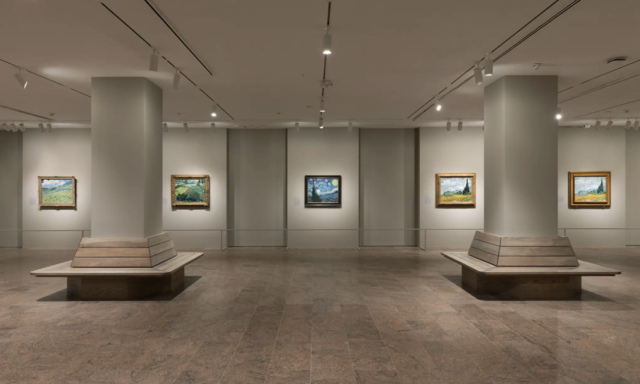
Installation view, “The Making of a Signature Motif: Saint–Rémy, May–September 1889” (photo © 2023 The Metropolitan Museum of Art)

VAN GOGH’S CYPRESSES
Metropolitan Museum of Art, Met Fifth Ave.
Gallery 199
1000 Fifth Ave. at 82nd St.
Through August 27, $30 (NY, NJ, CT residents pay-what-you-wish)
212-535-7710
www.metmuseum.org

In his “Illustrated Letter to Willemien van Gogh (Reminiscence of the Garden at Etten),” Vincent van Gogh writes to his sister, about a painting of the Garden at Etten, “Now here are the colors. The younger of the two women walking is wearing a Scottish shawl with green and orange checks and carrying a red parasol. The old one has a blue-violet shawl, almost black. But a bunch of dahlias, some lemon yellow, others variegated pink and white, explode against this sombre figure. Behind them a few emerald-green cedar or cypress bushes. Behind these cypresses one catches a glimpse of a bed of pale green and red cabbages, surrounded by a border of little white flowers. The sandy path is a raw orange, the foliage of two beds of scarlet geraniums is very green. Finally, in the middle ground is a maidservant dressed in blue who’s arranging plants with a profusion of white, pink, yellow, and vermilion-red flowers. There you are, I know it isn’t perhaps much of a resemblance, but for me it conveys the poetic character and the style of the garden as I feel them.”

The 1888 letter is one of several such dispatches in the revelatory show “Van Gogh’s Cypresses,” a collection of nearly fifty paintings, drawings, and illustrated letters in which van Gogh focused on what Met director Max Hollein calls “the artist’s most enduring, expressive motif. . . . This exhibition offers an unprecedented opportunity to revisit the most famous trees in the history of art.” The centerpiece is MoMA’s The Starry Night; you’ll have to wait in a long line to be able to see it. Most people chat away on the queue until they have their own moment with the painting, snap a few pictures, then walk away. And that’s a shame, because the gallery is filled with small and big gems, familiar masterpieces and sweet surprises, including the glorious Wheat Field with Cypresses right next to The Starry Night, a stunning canvas that so many don’t see as they wander away, checking the photos they just took on their phone.

The show is divided into three chronological sections: “The Roots of His Invention: Arles, February 1888 – May 1889,” “The Making of a Signature Motif: Saint–Rémy, May–September 1889,” and “Branching Out in Style: Saint–Rémy, October 1889 – May 1890.” Drawbridge and The Langlois Bridge offer two renderings of the same bridge; oddly, the pen-and-ink drawing was done after the painting. Still Life of Oranges and Lemons with Blue Gloves, made shortly after his release from the hospital, features cypress needles behind the title objects. There’s a loneliness to Stairs in the Garden of the Asylum, which has no human figures in it, while The Public Garden explores solitude by having three people sharing a bench off to the left and a long path leading to a single person by themselves to the right. Window in the Studio was painted in van Gogh’s hospital studio; the artist used chalk, brush and oil paint, and watercolor on paper to depict a barred window with empty bottles on the sill, loosely drawn paintings on the wall, and a garden outside, all bathed in a yellow-gold tint.

At the asylum, van Gogh told a soldier, “It’s difficult to leave a land before having something to prove that one has felt and loved it.” The master, who died in July 1890 at the age of thirty-seven, proved more than he would ever know with these paintings.

The final two works, A Walk at Twilight and Country Road in Provence by Night, each features a pair of people in the foreground; looking intently at the works, the man next to me wondered which one he would most like to enter.

In order to enter the exhibit, which concludes August 27, you need to first go to the gallery and scan a QR code that will give you the time you can go inside and experience this amazing garden of riches.

[Mark Rifkin is a Brooklyn-born, Manhattan-based writer and editor; you can follow him on Substack here.]
ALEXA MEADE: WONDERLAND DREAMS

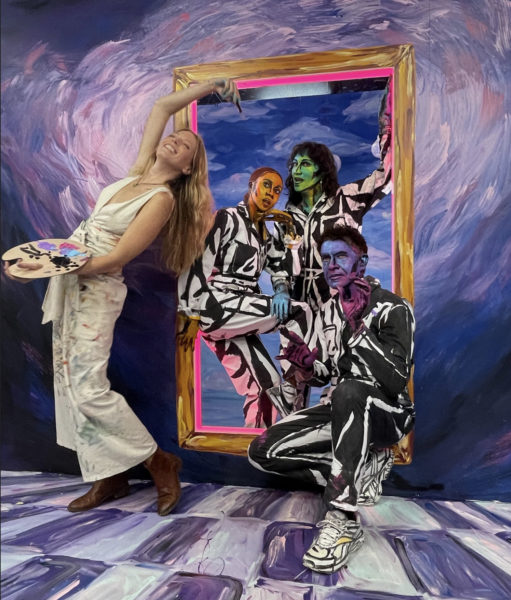
Alexa Meade paints Hailee Kaleem Wright, Eden Espinosa, and Brian Stokes Mitchell at Wonderland Dreams (photo by twi-ny/mdr)

WONDERLAND DREAMS
529 Fifth Ave. between Forty-Third & Forty-Fourth Sts.
Wednesday – Monday through September 10, $33.50-$44.50
www.wonderlanddreams.com
online slideshow

If you’re looking for that elusive rabbit hole to bring respite to your harried life — and we’re not talking about the proverbial rabbit hole but something more akin to the real deal — then you can’t go wrong with Wonderland Dreams.

Washington, DC–born installation artist Alexa Meade has transformed a 26,000-square-foot midtown space into an immersive version of Lewis Carroll’s classic nineteenth-century novels, Alice’s Adventures in Wonderland and Through the Looking-Glass. Thankfully, it’s nothing like the overhyped shows in which works by such artists as Vincent van Gogh, Claude Monet, and Gustav Klimt “come to life,” morphing in projections on the floor, walls, ceilings, and mirrored sculptures.

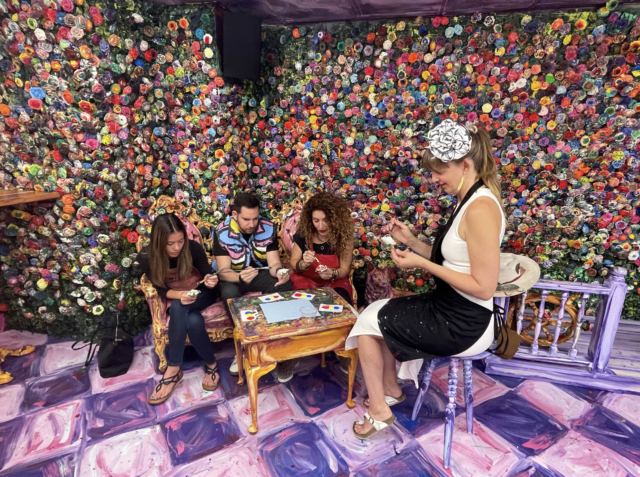
Everyone is invited to paint their own acrylic flowers at Wonderland Dreams (photo by twi-ny/mdr)

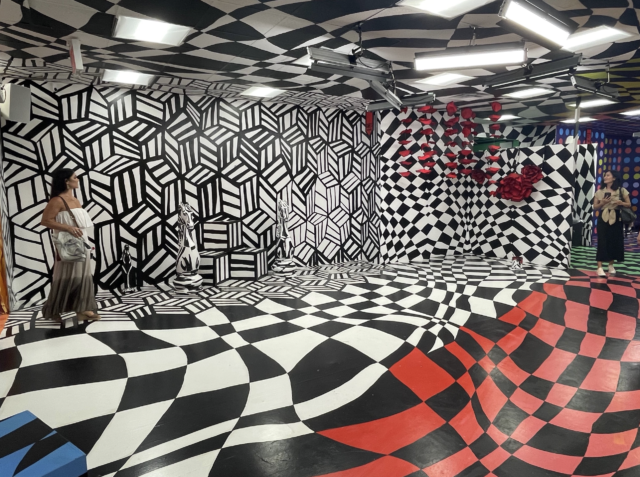
For Wonderland Dreams, Meade and her team hand-painted every inch of the space; as you walk, crawl, or glide through the many rooms, you’ll encounter fanciful chairs and couches, giant mushrooms and flowers, tiny houses, an inviting keyhole, a large chess set and playing cards, a hedge maze, a carousel horse, a swirling tea party, out-of-sync clocks, empty picture frames, and photographs and portraits of celebrities whose bodies Meade has painted on. Everything can be touched, handled, and ridden on; essentially, it’s a gigantic playhouse for kids and adults. Be sure to pick up 3D glasses to enhance your experience in several cool rooms, and stop by the café and the gift shop for bonus surprises, even if you’re not seeking to eat, drink, or buy anything.

In July, I attended Broadway Night, during which stars Eden Espinosa (Wicked, Rent), two-time Tony winner Brian Stokes Mitchell (Man of La Mancha, Kiss Me, Kate), and Hailee Kaleem Wright (Six, Paradise Square) donned black-and-white jumpsuits and then, standing in a full-length empty frame, were painted all over by Meade, who is currently the artist-in-residence at the Perimeter Institute for Theoretical Physics in Waterloo, Ontario; the actors held the palette as Meade covered every bit of their skin, including their faces, necks, hands, and wrists. They then posed in the frame, individually and together, as if the paintings were, well, coming to life. The next Broadway Night is August 21, with guests to be announced; the Grand Finale closing party is set for September 9.

Every room holds a different surprise in Wonderland Dreams (photo by twi-ny/mdr)

There are various places where visitors are encouraged to put on masks, hats, coats, and other props for further immersion into the world of Alice, the Mad Hatter, the Cheshire Cat, the Red Queen, the White Rabbit, the Caterpillar, and Tweedledum and Tweedledee. In the back is a studio where you can paint an acrylic flower and add it to the wall. There’s also the family-friendly Mad Hatter’s Adventure on Saturday and Sunday mornings at ten.

“If I had a world of my own, everything would be nonsense,” Alice says in the first book.

As Meade reveals in Wonderland Dreams, there’s nothing wrong with that.

[Mark Rifkin is a Brooklyn-born, Manhattan-based writer and editor; you can follow him on Substack here.]
CONEY ISLAND SAND SCULPTING CONTEST 2023

Twenty-fifth annual Sand Sculpting Contest takes place in Coney Island on Saturday (photo by twi-ny/mdr)

Thirty-first annual Coney Island Sand Sculpting Contest should feature some wild creations on Saturday (photo by twi-ny/mdr)

CONEY ISLAND SAND SCULPTING CONTEST
Coney Island
Boardwalk between West Tenth & Twelfth Sts.
Saturday, August 12, free, noon – 4:00 pm
www.coneyisland.com
www.allianceforconeyisland.org

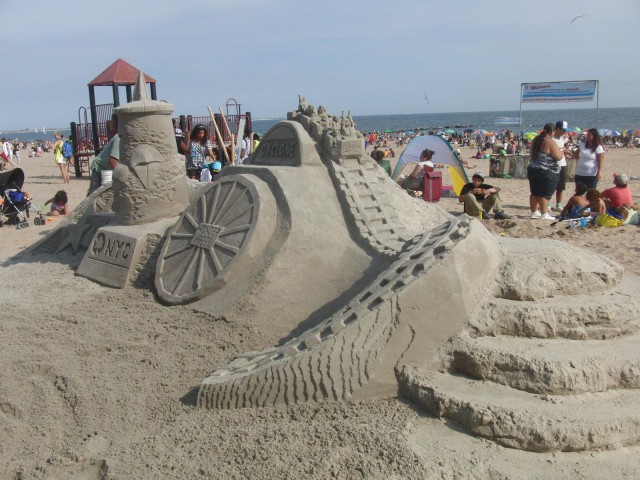
The thirty-first annual Coney Island Sand Sculpting Contest will take place at the People’s Playground on August 12, as amateurs, semiprofessionals, and professionals will create masterpieces in the Brooklyn sand, many with a nautical theme. It’s a blast watching the constructions rise from nothing into some extremely elaborate works of temporary art. The event, which features cash prizes, is hosted by the Alliance for Coney Island and features four categories: Adult Group, Family, Individual, and People’s Choice. There are always a few architectural ringers who design sophisticated castles, along with a handful of gentlemen building, well, sexy mermaids. You can register as late as eleven o’clock Saturday to participate. While visiting Coney Island on August 12, you should also check out the Coney Island Museum, the Coney Island Circus Sideshow, the Music of Curiosities Viva concert with Mystical Children and host PNK VLVT WTCH, and the New York Aquarium in addition to riding the Cyclone and the Wonder Wheel.

[Mark Rifkin is a Brooklyn-born, Manhattan-based writer and editor; you can follow him on Substack here.]
GEORGIA O’KEEFFE: TO SEE TAKES TIME

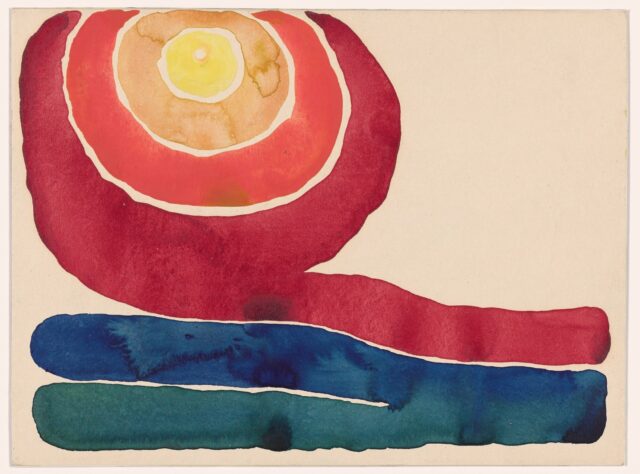
Georgia O’Keeffe, Evening Star No.III, watercolor on paper mounted on board, 1917 (Museum of Modern Art, New York. Mr. and Mrs. Donald B. Straus Fund, 1958. © 2022 Georgia O’Keeffe Museum / Artists Rights Society, New York)

GEORGIA O’KEEFFE: TO SEE TAKES TIME
MoMA, Museum of Modern Art
11 West 53rd St. between Fifth & Sixth Aves.
Through August 12, $14-$25 (sixteen and under free)
212-708-9400
www.moma.org

In the catalog for the 1950 exhibition “An American Place,” Georgia O’Keeffe wrote, “A flower is relatively small. Everyone has many associations with a flower — the idea of flowers. You put out your hand to touch the flower — lean forward to smell it — maybe touch it with your lips almost without thinking — or give it to someone to please them. Still — in a way — nobody sees a flower — really — it is so small — we haven’t time — and to see takes time, like to have a friend takes time. If I could paint the flower exactly as I see it no one would see what I see because I would paint it small like the flower is small.”

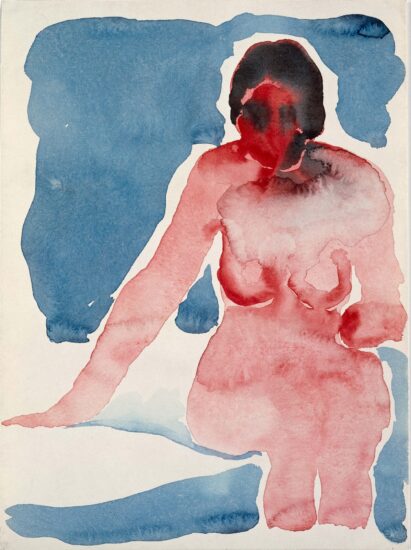
Appropriately born in a town called Sun Prairie in Wisconsin in 1887, O’Keeffe is beloved for her colorful paintings of flowers, animal skulls, and the desert. In the exhibition “To See Takes Time,” MoMA offers a rare look at her series of works in charcoal, pencil, watercolor, and pastel, with 90 of the more than 120 drawings and paintings dating from 1915 to 1926, before she moved to Santa Fe, where she died in 1986 at the age of 98. Organized by Samantha Friedman with Laura Neufeld and Emily Olek, the show introduces viewers to other, unexpected sides of O’Keeffe, steeped in abstraction.

The works range from the swirling, colorful 1915 pastel Special No. 33 and a trio of 1916 line drawings done in charcoal, watercolor, and watercolor and pencil, respectively, to fourteen 1959-60 pieces depicting similar shapes in nature, culminating in the 1964 oil painting On the River, the latest work in the show.

Georgia O’Keeffe, Seated Nude XI, watercolor on paper, 1917 (Metropolitan Museum of Art, New York. Purchase, Mr. and Mrs. Milton Petrie Gift, 1981. © 2023 Georgia O’Keeffe Museum / Artists Rights Society, New York)

The show features such other highlights as four 1916 works on paper of the inside of a tent, made when O’Keeffe was studying at the University of Virginia; 1916-17 pencil drawings of Palo Duro Canyon; all eight 1917 Evening Star watercolors; eight early nudes; charcoal drawings of New York City from 1926 and 1932; a quartet of portraits of artist Beauford Delaney from 1943; and a pair of exquisite pencil on paper drawings of a patio door that recalls the work of Danish painter Vilhelm Hammershøi.

And no need to worry; purists will also find a handful of banana flowers and canna lilies as well as an orchid and a few vaginal works.

In the 1950 catalog, O’Keeffe continued, “So I said to myself — I’ll paint what I see — what the flower is to me but I’ll paint it big and they will be surprised into taking time to look at it — I will make even busy New-Yorkers take time to see what I see of flowers.”

So, tourists and busy New-Yorkers, take your time once you get to MoMA, but get there soon, because the exhibition closes August 12.

[Mark Rifkin is a Brooklyn-born, Manhattan-based writer and editor; you can follow him on Substack here.]
A CELEBRATION — THE ROOF GARDEN COMMISSION: LAUREN HALSEY

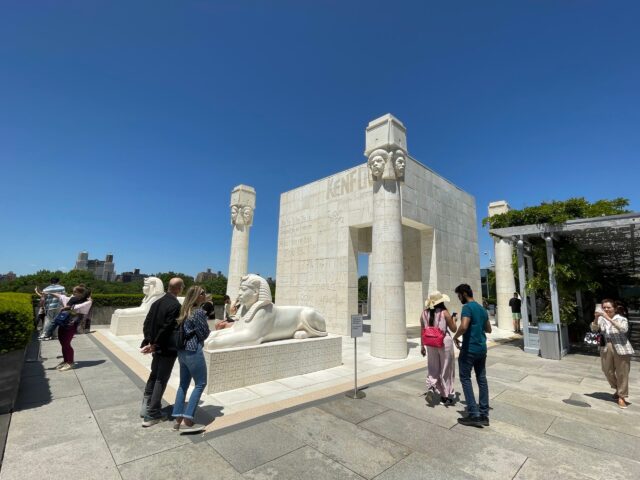
Lauren Halsey’s Met Roof Garden Commission will be activated by live performances and more this weekend (photo by twi-ny/mdr)

the eastside of south central los angeles hieroglyph prototype architecture (I)
Metropolitan Museum of Art, Met Fifth Avenue
The Iris and B. Gerald Cantor Roof Garden
1000 Fifth Ave. at 82nd St.
July 21-23, free with museum admission
Exhibit continues through October 22 (weather permitting)
Admission: $30 adults, children under twelve free (New York State residents pay-what-you-wish)
212-535-7710
www.metmuseum.org
the eastside of south central slideshow

“I get to build the worlds I wish I lived in,” artist Lauren Halsey says in a promotional video about her Met Roof Garden Commission, the eastside of south central los angeles hieroglyph prototype architecture (I). “I collapse all of these worlds: street, pyramid, gorgeous nature, domestic worlds, into one composition to create new opportunities that are about uplift, that are about togetherness.” Wanting to build an Egyptian-style modern-day temple, Halsey studied works at the Met, including the Temple of Dendur, listened to PFunk, and constructed the eastside, which will be part of her community center Summereverything in South Central after the roof show is over.

This weekend Metlivearts will activate the sculpture, which features likenesses of Halsey’s loved ones and influences and carvings of local images and text she’s collected over the last fifteen years, with a series of special events, all free with museum admission and first come, first served. On Friday at 6:30 and 7:30 on the roof, California-born disabled choreographer, dancer, and sound artist Jerron Herman will perform the solo piece LAX, with an ornate costume by unsighted textile artist Sugandha Gupta, as part of Disability Pride Month. On July 22 at 6:00 and 7:15 on the roof, Moten/López/Cleaver will present a new work inspired by the eastside, with Fred Moten on vocals, Brandon López on double bass, and Gerald Cleaver on drums. And on Sunday from 11:00 to 2:00, “A Celebration — The Roof Garden Commission: Lauren Halsey” consists of interactive drop-in stations, a creative writing workshop in the Charles Engelhard Court, a Scent Lab and Architectural Art Making at the Temple of Dendur, and gallery chats on the roof and at the famed temple.

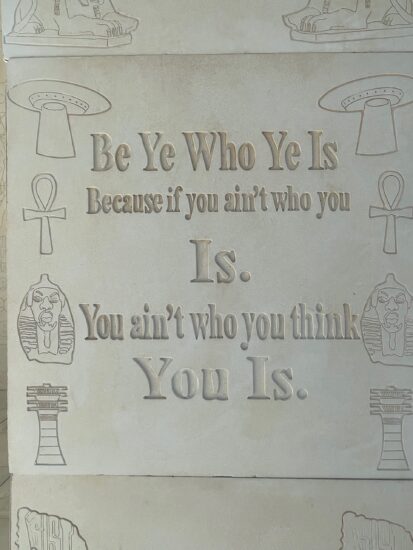
Lauren Halsey Met roof installation features carved text and imagery (photo by twi-ny/mdr)

“This work is aspirational,” Halsey continues in the video. “They’re images around community, transcendence, self-determination, and autonomy. . . . I hope when folks come to the Met and experience my piece, they walk away with a more holistic view about South Central that aren’t about the violence, they aren’t about dread, they’re very much about survival, vibrancy, love. And they also are just into me reinvisioning the hieroglyph as a form to tell stories.”

YAYOI KUSAMA: I SPEND EACH DAY EMBRACING FLOWERS

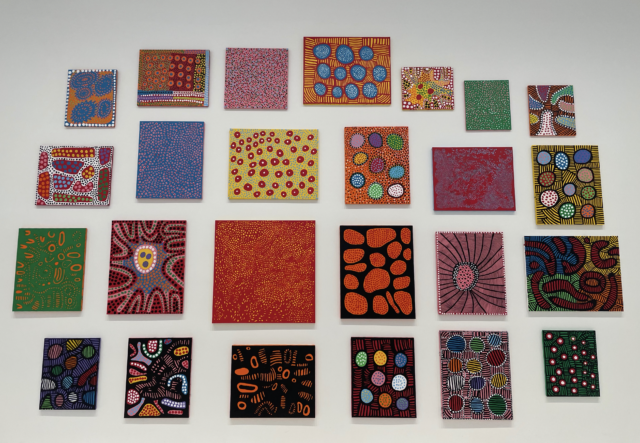
Twenty-five of Yayoi Kusama’s “Every Day I Pray for Love” paintings are part of new show at David Zwirner in Chelsea (photo by twi-ny/mdr)

YAYOI KUSAMA: I SPEND EACH DAY EMBRACING FLOWERS
David Zwirner
519, 525, 533 West Nineteenth St. between Tenth & Eleventh Aves.
Through July 21, free, 10:00 am – 6:00 pm
www.davidzwirner.com
online slide show

There are only two days left to see Yayoi Kusama’s latest exhibition of new works at David Zwirner, a three-part show entitled “I Spend Each Day Embracing Flowers.” Kusama is ninety-four and has been living voluntarily in the Seiwa Hospital for the Mentally Ill in Tokyo since 1977; every day she gets up and walks over to her studio across the street and works. There are long lines to get into the show on West Nineteenth St., but that is primarily for Dreaming of Earth’s Sphericity, I Would Offer My Love, a Mirror Infinity Room where groups of no more than five people can spend sixty seconds in a seemingly endless space of red, yellow, blue, and green disks; while it’s very cool, it’s not necessarily a must-see if you have to wait online for an hour or more to get inside.

There is less of a line, if any at all, to see the rest of the exhibit, a kind of organic follow-up to her wonderful “Cosmic Nature” display throughout the New York Botanical Garden in 2021. The title piece at Zwirner consists of thee large-scale, colorful, and hugely adorable stainless-steel flower sculptures, a celebration of the beauty of the natural world while also touching on the impermanence of life. In a back room, there are three dozen new acrylic and ink paintings, mostly from her “Every Day I Pray for Love” series, canvases that feature many of her favorite elements, from dots and circles to squiggly lines and abstract geometric shapes; twenty-five of the pieces hang together in a lovely display on one wall.

The highlight is Aspiring to Pumpkin’s Love, the Love in My Heart, a trio of long, undulating, somewhat flattened black and yellow bronze pumpkin sculptures winding their way through their own room. They evoke Richard Serra’s freestanding sets of weatherproof steel plates, only here bright with color and charm; I dare you to try not to smile as you follow the paths in and around the works, which reflect the light and passersby. See if you can find the two areas where Kusama used a camera obscura, resulting in upside-down images

Kusama has also delivered a special message for the show, summing up her world view: “I’ve Sung the Mind of Kusama / Day by Day, / a Song from the Heart. / O Youth of Today, / Let Us Sing Together a Song from / the Heart of the Universe!”

(To receive a digital booklet of select poems from Kusama’s 2023 collection Every Day I Pray for Love, go here.)

ADAA CHELSEA GALLERY WALK: NXTHVN WALKTHROUGH AND LIVE PERFORMANCE

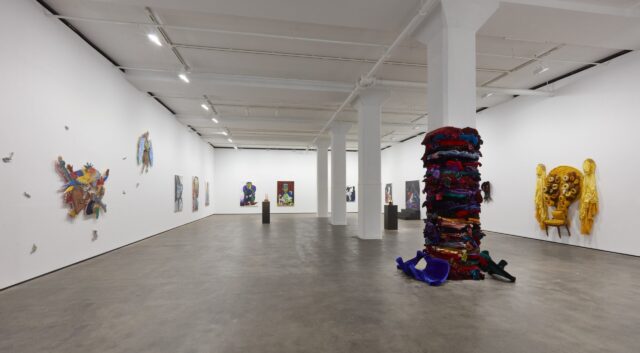
“NXTHVN: Reclamation” at Sean Kelly features curator tour, artist discussions, and live performance on July 19 (photo by Jason Wyche / courtesy Sean Kelly)

Who: Cornelia Stokes, Kiara Cristina Ventura, Athena Quispe, Ashanté Kindle, Donald Guevara, Edgar Serrano, Anindita Dutta
What: Curator-led walkthrough, artist discussions, live performance
Where: Sean Kelly Gallery, 475 Tenth Ave. at Thirty-Sixth St.
When: Wednesday, July 19, free, 6:00
Why: In 2016, arts incubator NXTHVN was founded by American artist Titus Kaphar, private equity entrepreneur Jason Price, and Canadian artist Jonathan Brand. Based in two former manufacturing plants in New Haven, Connecticut, the nonprofit’s mission is “to build an alternative model of art mentorship and career advising through a specially designed curriculum, and to simultaneously set into motion significant opportunities for emerging local entrepreneurs.” Sean Kelly Gallery is currently hosting the two-floor exhibition “NXTHVN: Reclamation,” continuing through August 11, featuring painting, drawing, collage, video, sculpture, installation, and performance by six artists from NXTHVN’s Cohort 04 Fellowship Program: Anindita Dutta, Donald Guevara, Ashanté Kindle, Athena Quispe, Edgar Serrano, and Capt. James Stovall V.

On July 19, as part of ADAA Chelsea Gallery Walk, the gallery will present a walkthrough of the show at 6:00, led by NXTHVN curatorial fellows Cornelia Stokes and Kiara Cristina Ventura, joined by Quispe, Kindle, Guevara, and Serrano, who will discuss their contributions. “It is in this dance that the display of contradictory bodies and settings superimposed and cut together become a new whole; the cyborg of cultural mixture in a new virtualized arena where the procession of time can be known but not yet felt,” Guevara says of his work.

At 6:30, there will a live performance by Dutta, who uses such found materials as clothing, shoes, fabric, rawhide, chairs, and horns to take on gender conflict, sexual violence, and impermanence. “When victims and perpetrators remain silent about heinous crimes, the truth remains obscured and inaccessible,” she notes in her artist statement. “I wonder who holds the truth? Who is the witness to the events that transpired? Who is the knower of all thoughts and feelings, pain and suffering, stigma, and depression?”