this week in art

PEPÓN OSORIO IN CONVERSATION

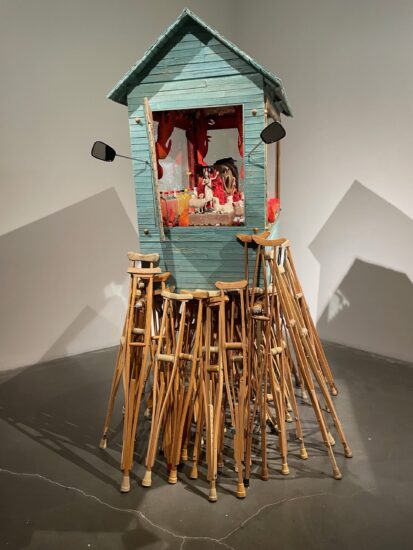
Pepón Osorio, Lonely Soul, 2009 (photo by twi-ny/mdr)

Who: Pepón Osorio, Bernardo Mosqueira, Margot Norton
What: Artist conversation
Where: New Museum of Contemporary Art, 235 Bowery at Prince St.
When: Thursday, September 14, $10, 6:30 (exhibition continues through September 17)
Why: “I’ve always been interested in people’s stories, always interested in somehow transforming my life through the lens of people’s experiences,” Puerto Rican artist Pepón Osorio says in a New Museum video about his stunning exhibition, “Pepón Osorio: My Beating Heart/ Mi corazón latiente,” which continues through September 17.

When he moved from San Juan to what he refers to as the Republic of the South Bronx in 1975 at the age of twenty, Osorio learned English and about American culture. He worked for the Department of Social Services, visiting some four thousand homes, finding trouble, safety, and spirituality.

“What I was doing was collecting stories, collecting experiences, collecting the memory of what it was to be with all those families, and then translating them into an installation,” he says. “And I also saw myself not bearing the responsibility of a caseworker but that of an artist, trying to figure out a way to allow myself and the people that I work with to step back and look at the situation.”

The exhibition features large-scale environments that Osorio calls “the social architecture of communities.” No Crying Allowed in the Barbershop (En la barbería no se llora) is a barbershop filled with videos, hubcaps, a pool table, photos of Latino men, and a tableaux with a saint; the piece questions masculinity and faith within a dazzling space. (The piece was originally presented in a storefront, with people getting actual haircuts.) Badge of Honor pairs a boy’s bedroom, stuffed to the gills with baseball cards, sports posters, sneakers, and other items, next to a jail cell with only a toilet, a mattress, and one pair of sneakers; the boy and his imprisoned father, Nelson Gonzalez, communicate in poignant video projections.

Osorio worked with a real detective when putting together Scene of the Crime (Whose Crime?), the inside of an elaborately detailed home where a murder has taken place, evoking how Latinos are portrayed in Hollywood films, particularly Fort Apache, the Bronx. Osorio re-creates the shuttered Fairhill Elementary in Philadelphia in ReForm, complete with videos of students’ reactions to the closure.

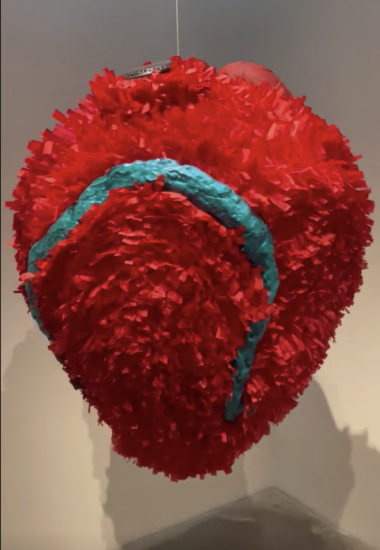
Inspired by Osorio’s own cancer treatment, Convalescence indicts the American health-care system; next to it, in the corner, is My Beating Heart (Mi corazón latiente), an oversized piñata-like heart that emits the sound of the artist’s own pumping organ. Osorio honors Amina Lawal, a Nigerian woman who was sentenced to death by stoning for adultery in 2002, in Lonely Soul, a shaved-ice cart held up by crutches, with religious elements and other key objects inside.

Pepón Osorio, My Beating Heart (Mi corazón latiente), 2000 (photo by twi-ny/mdr)

On September 14 at 6:30, Osorio will be at the New Museum for a conversation with exhibition curators Margot Norton of the Berkeley Art Museum and Pacific Film Archive and Bernardo Mosqueira of the Institute for Studies on Latin American Art; judging from their discussion in the catalog, it should be an enlightening event.

[Mark Rifkin is a Brooklyn-born, Manhattan-based writer and editor; you can follow him on Substack here.]

LAST CHANCE — SARAH SZE: TIMELAPSE / GEGO: MEASURING INFINITY

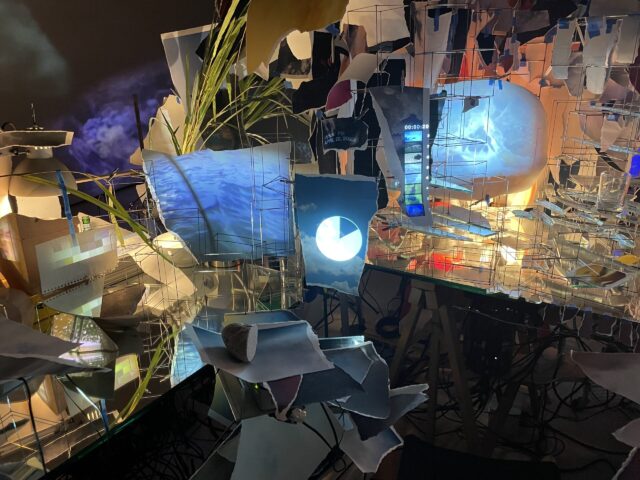
Sarah Sze, Timekeeper, detail, mixed media, 2016 (photo by twi-ny/mdr)

SARAH SZE: TIMELAPSE / GEGO: MEASURING INFINITY
Solomon R. Guggenheim Museum
1071 Fifth Ave. at 89th St.
Through September 10, $19-$30
212-423-3587
www.guggenheim.org
sarah sze: timelapse online slideshow

A pair of wonderful exhibits that contemplate time and space through striking, fragile visuals come to a close this weekend; be sure to make time to see them.

“Gego: Measuring Infinity” is a career retrospective of Hamburg-born Venezuelan artist Gertrud Goldschmidt, known as Gego. Nearly two hundred works are on view, arranged chronologically and thematically, dating from the early 1950s to the early 1990s; Gego died in 1994 at the age of eighty-two, leaving behind a plethora of sculptures, textiles, drawings, prints, sketches, watercolors, letters, artist’s books, and more. “To visualize a solution is what matters: to make visible that which still does not exist outside of me,” she said.

An architect and engineer who fled the Nazis, Gego used such materials as bronze, steel, aluminum, iron, nylon, copper, plastic, and lead to create three-dimensional structures that are like line drawings in space — she even calls some Drawing without Paper — appearing so delicate that you might think you can blow them apart (but please don’t try). On the floor, on tables, and hanging from the ceiling, the works evoke scientific helixes and nets, with titles that often explain what they are: Cube in Sphere, 12 Concentric Circles, Four Red Planes, Eight Squares. Gego’s ink-on-paper pieces play with grids and offer optical illusions that delight the eye.

“Gego: Measuring Infinity” is brilliantly paired with “Sarah Sze: Timelapse,” in which the Boston-born, New York City–based Sze incorporates elements of the Guggenheim’s spiraling Frank Lloyd Wright building — both outside and inside — into complex, spirited installations that explore time and space while revealing much of her creative process. Combining cutting-edge digital technology with tireless handwork and large-scale paintings, Sze invites visitors to marvel at the nearly impossibly detailed works, which feature plants, a pendulum hovering over water, tools, clothespins, thread, ladders, writing implements, coffee cups, tape, lamps, salt, string, wood, cords, mirrors, fans, remote controls, books, dice, and live video feeds and projections. “I often use found objects because they are scaled to me, like a compass for my own body,” Sze says. Be careful where you step; it appears that the constructions can fall apart with one tiny misstep.

Sze’s imagination extends to the titles; works have such names as The Moon’s Gravity Causes the Oceans’ Tides, Travelers Among Streams and Cascades, Images that Images Beget, The Night Sky Is Dark Despite the Vast Number of Stars in the Universe, and Things Caused to Happen (Oculus). As Sze explains, her installations consider “how we mark and measure time — constructing our own personal timelines of memory through images and fragments of experiences that are constantly evolving.” Evoking Gego, Sze also notes, “There is fragility in drawing a line through space; with this one simple powerful gesture, you can occupy an entire space.”

The show concludes at the top tower with 2016’s Timekeeper, a multimedia marvel that gets its own room. Myriad objects and projections are on and surround a desk, offering a look inside the mind of this wildly talented artist, who calls the exhibition “a contemplation on how we mark time and how time marks us.” She adds, “Every exhibition is a timekeeper. Art is a way to have a conversation over time. The show becomes almost like a forensic site for an installation or an archaeology site for a series of works, so you see the process of making, the evidence of that process left over, live in the space.” Happy digging!

[Mark Rifkin is a Brooklyn-born, Manhattan-based writer and editor; you can follow him on Substack here.]

MOLLY GOCHMAN: GATHERING

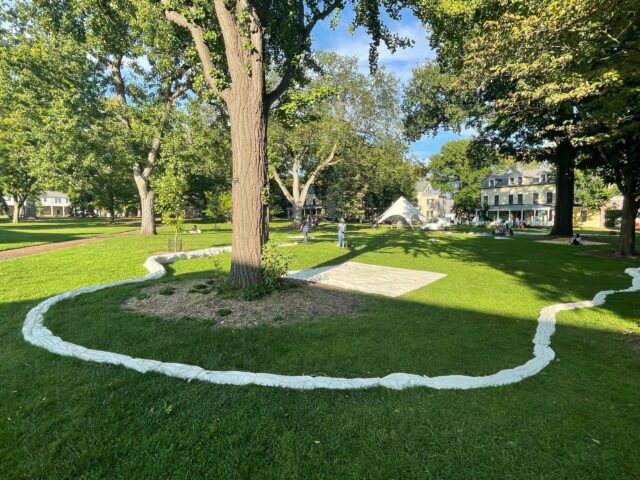
Molly Gochman’s participatory Gathering will have special activations Sundays through October 1 on Governors Island (photo by twi-ny/mdr)

GATHERING
Nolan Park, Governors Island
Sunday, September 10, 17, 24, and October 1, free, 1:00 – 3:00
Installation open Friday-Sunday through October 1, 11:00 am – 5:00 pm
mollygochman.com
online slide show

As part of House Fest 2023 on Labor Day weekend on Governors Island, San Antonio–born, New York City–based artist Molly Gochman began installing the site-specific Gathering, a twisting, snakelike series of two hundred white and gray rolled-up waxed canvas tarps. “Stitched” together with rope, they create a thirteen-thousand-square-foot outline of the original shape of the island. Winding around trees on the grass at the center of Nolan Park, the work invites visitors to sit on it; to grab a tarp, spread it out, and have a picnic; to contemplate how the island has changed over the last hundred years through excavation and dredging; or to relax on a tarp and take it home, with Gochman’s blessing, her work spreading like gentle tentacles from the peaceful nature of Nolan Park to the endless hustle and bustle of New York City. Gochman, a friendly and enthusiastic woman, loves to engage with passersby, talking about the piece and helping them choose a tarp to use and perhaps keep. Eventually, Gathering will erode like the land itself, leaving no trace of what once was but living on through those who have engaged with it.

“I believe we live in a world where thoughtful participation — with our environment, with our objects, with our community, with ourselves, and with our fellow human beings — is the greatest good we can do. This involvement, on every level, creates a world where empathy and freedom are our primary values,” Gochman explains in her artist statement. “I hope that the person who experiences my work feels welcomed to go from the work into his or her own contemplation of what the work inspires in them or just offers them an opportunity to pause and be in that moment. In a sense, the works are only half-done when I complete my work on them. They are invitations to experience, and it’s up to each person who comes into contact with them to decide how — or if — to accept that invitation.”

Every Sunday at 1:00 through October 1, Gathering will be activated, and visitors are invited to bring a picnic and be part of the experience; all events are free. On September 10, community leaders and organizers from Black Women’s Blueprint and Black Joy Farm will come together to make unique use of the space; on September 17, Ani Weinstein will lead a guided meditation; on September 24, artist, dancer, and amulet maker Annmaria Mazzini will host a moving meditation around the work, joined by vocalist and musician Paula Jeanine Bennett and others; and on October 1, dancer and actress Christine Elmo will perform a new work created in response to Gathering to wish it a fond farewell.

[Mark Rifkin is a Brooklyn-born, Manhattan-based writer and editor; you can follow him on Substack here.]

MAUM MARKET / HANGAWI KOREAN FESTIVAL

MAUM MARKET / HANGAWI KOREAN FESTIVAL
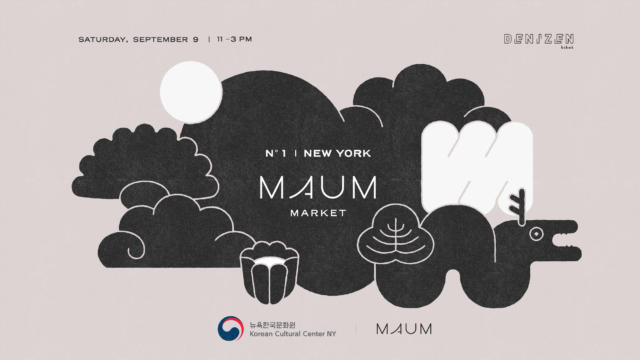
Market: Saturday, September 9, Denizen Bushwick, 123 Melrose St., free with advance RSVP, 11:00 am – 3:00 pm
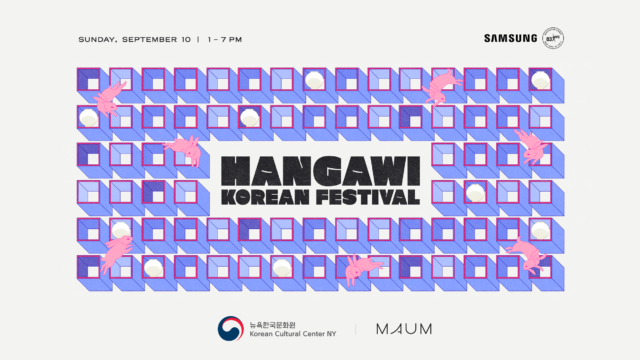
Festival: Sunday, September 10, Samsung 837, 837 Washington St., free with advance RSVP, 1:00 – 7:00
www.koreanculture.org

In celebration of Chuseok, the Korean Thanksgiving and harvest festival that honors the ancestors, and the seventieth anniversary of the ROK-US Alliance, the Korean Cultural Center New York (KCCNY) is presenting the Hangawi Korean Festival on September 10 at Samsung 837 in the Meatpacking District. From 1:00 to 7:00, there will be talks, panel discussions, arts and crafts, food tastings, fashion, workshops, and more. The day before, on Friday, September 9, the MAUM Market will make its New York debut as a one-day-only pop-up in Denizen Bushwick at 123 Melrose St. Maum, which means “heart and mind,” will feature fifty AAPI artists, creatives, and entrepreneurs participating in maker and business spotlights, including Grace Nyugen, Hwa Joong Kim, Hannah Lee, Alice Jun, Hana Jun, Ryan Kim, and Sungmee Cho. Below is the full schedule for the Hangawi main stage; be sure to wish everyone 추석 잘 보내세요 (chuseok jal bonaeseyo).

Kickoff Panel, with Kevin D. Kim, NYC Department of Small Business Services, and Michael Cheonsoo Kim, executive director of KCCNY, 1:00

Cookbook Authors, with Hooni Kim (My Korea: Traditional Flavors, Modern Recipes). Sohui Kim (Korean Home Cooking), James Park (Chili Crisp: 50+ Recipes to Satisfy Your Spicy, Crunchy, Garlicky Cravings), and Jennifer Ban (Rice Blossoms: Modernized Korean Desserts), moderated by Irene Yoo, 2:00

Beauty & Fashion, with Wonny Lee, Erica Choi, and Grace Chi Nguyen, moderated by Terrence Kim, 3:00

Food & Drink, with Ryan Kim, Hannah Bae, and John Limb, moderated by Madeline Park, 4:00

Gallery Artists, with Ho Jae Kim, Jane Yang-D’Haene, and Yoona Hur, moderated by Diana Lee, 5:00

Restaurants, with Wesley Sohm, Jae Lee, Ahris Kim, and Esther Choi, moderated by Matt Rodbard, 6:00

[Mark Rifkin is a Brooklyn-born, Manhattan-based writer and editor; you can follow him on Substack here.]

WORKS & PROCESS: PHOTOGRAPHING NEW YORK CITY BALLET WITH PAUL KOLNIK AND WENDY WHELAN

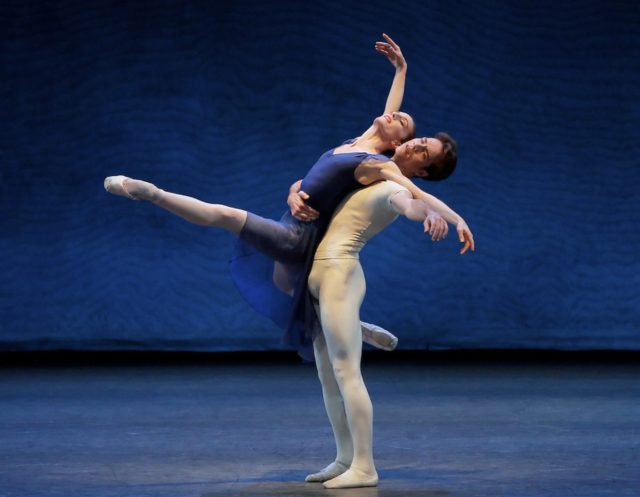
Wendy Whelan and Gonzalo Garcia in Opus 19/The Dreamer, New York City Ballet, 5/7/10 (photo © 2010 Paul Kolnik)

Who: Paul Kolnik, Wendy Whelan, Linda Murray
What: Works & Process illustrated conversation
Where: Bruno Walter Auditorium, the New York Public Library for the Performing Arts, 40 Lincoln Center Plaza
When: Thursday, September 7, free with advance RSVP, 6:00
Why: Chicago native Paul Kolnik saw his first ballet in 1971, at the age of twenty-three, and soon moved to New York City, where he worked as an assistant to New York City Ballet staff photographer Martha Swope before taking his own pictures of the company, under the leadership of cofounding artistic director George Balanchine. In celebration of the seventy-fifth anniversary of NYCB, Kolnik will sit down for a special Works & Process discussion on September 7 at 6:00 in the Bruno Walter Auditorium with NYCB associate artistic director Wendy Whelan and moderator Linda Murray, NYPL curator of the Jerome Robbins Dance Division. Kolnik, who has also extensively photographed Broadway shows and Alvin Ailey American Dance Theater, has had his work published in such books as New York City Ballet Workout, Dancing to America, The Producers, and Beacon and Call: A Cisterian Monastic Pilgrimage. Admission is free with advance RSVP.

[Mark Rifkin is a Brooklyn-born, Manhattan-based writer and editor; you can follow him on Substack here.]

DOUGLAS DUNN + DANCERS: GARDEN PARTY

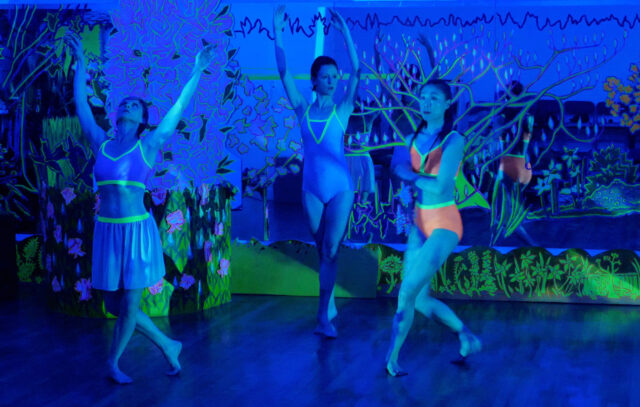
Douglas Dunn’s Garden Party is back for a return engagement (photo by Jacob Burckhardt)

GARDEN PARTY
Douglas Dunn Studio
541 Broadway between Spring & Prince Sts., third floor
September 6-10, $20 floor cushions, $25 chairs
www.douglasdunndance.com

This past April, Douglas Dunn + Dancers presented the world premiere of Garden Party at the company’s third-floor Soho loft studio. The sixty-minute piece is now returning for an encore run September 6-10; tickets are $20 for floor cushions or $25 for a chair.

Longtime Dunn collaborator Mimi Gross designed the colorful costumes and scenery, bathing the space in lushly painted trompe l’oeil walls and ceiling and a long horizontal mirror covered with pink, yellow, and green flowers, plants, trees, clouds, raindrops, and other natural elements. The work is performed by Dunn, Alexandra Berger, Janet Charleston, Grazia Della-Terza, Vanessa Knouse, Emily Pope, Paul Singh, Jin Ju Song-Begin, Timothy Ward, and Christopher Williams, with lighting and projections by Lauren Parrish, sound by Jacob Burckhardt, and preshow live music by guitarist and composer Tosh Sheridan.

The soundtrack consists of pop and classical tunes (Robert de Visée, John Lennon & Yoko Ono, Bach, Mark Knopfler & Emmylou Harris, more), birdsong, and poetry (by John Keats, Anne Waldman, Molière, Rainer Maria Rilke, John Milton, Stephanie Jacco, and others, read by Dunn, Waldman, Jacco, and Della-Terza). In an April twi-ny talk, Dunn noted, “The feel of this evening was clear to me the day the title hit me (about three years ago, the pandemic postponing the project). The lavish beauty of Mimi’s set completely fulfills my initial intuition . . . as if she’d read my dancing mind.”

Tickets are limited; the show sold out its April premiere, so don’t hesitate if you want to be part of this intimate experience.

BARBARA G. MENSCH: A FALLING-OFF PLACE

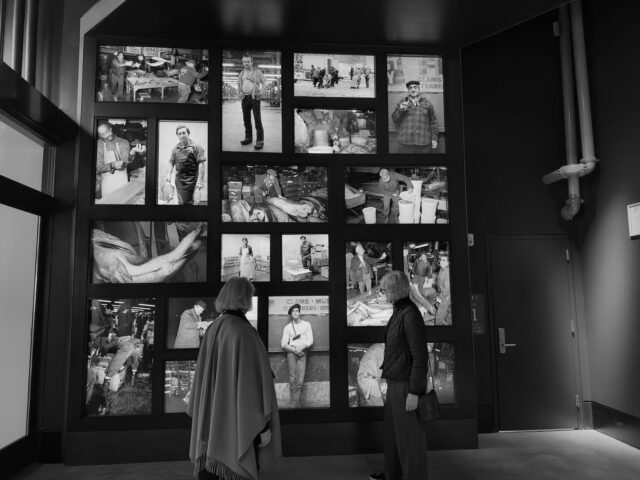
Barbara Mensch’s “The Nobility of Work” is a site-specific installation in the Tin Building (photo © Barbara Mensch)

A FALLING-OFF PLACE: THE TRANSFORMATION OF LOWER MANHATTAN
The powerHouse Arena, POWERHOUSE @ the Archway
28 Adams St. at Water St. @ the Archway
Wednesday, September 6, $7.18 includes $5 gift certificate, $47.73 includes copy of book, 7:00
Untapped Cities tour: Saturday, October 7, free with insider membership, 1:00
powerhousearena.com
menschphoto.com

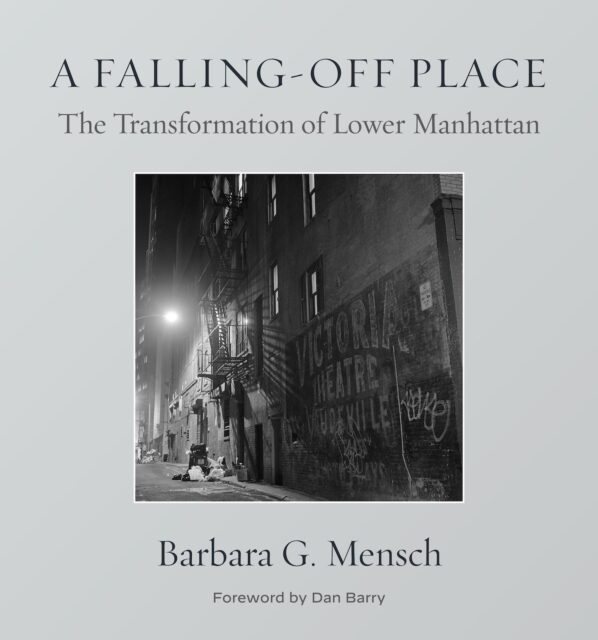
“There is no longer any scent of what was. Thankfully, though, there is Barbara G. Mensch, whose images are like the conjuring rain,” journalist and author Dan Barry writes in the foreword to Barbara Mensch’s latest photography book, A Falling-Off Place (Fordham University Press, September 5, $39.95). “She is the Brooklyn Bridge of the New York imagination, linking the now and the then. She sees the incremental turns in the city’s inexorable evolution, the obliteration of the past by gentrification, the irreversible dominion of profit over preservation.”

The Brooklyn-born Mensch initially took up drawing and worked as an illustrator at Ms. magazine after graduating from Hunter College. She soon found that photography was her calling, documenting a changing New York City. She has spent nearly fifty years using a Polaroid SX70, a Rolleiflex, and now an iPhone, focusing primarily on Lower Manhattan. During the pandemic, she looked through her archive of unlabeled boxes of photos and gathered together black-and-white shots of the Fulton Fish Market, Chinatown, Peck Slip, and the Bowery, of demolition and decay, of a different era. She added shots of 9/11 and Hurricane Sandy to construct a powerful narrative.

“They became my personal visual timeline,” she writes in the introduction to the book, a follow-up to 2007’s South Street and 2018’s In the Shadow of Genius: The Brooklyn Bridge and Its Creators. “What did the passages of decades reveal to me? What dynamics were at play in my images of the same streets that I walked repeatedly for years? What fell off as the old was swept away by the new?”
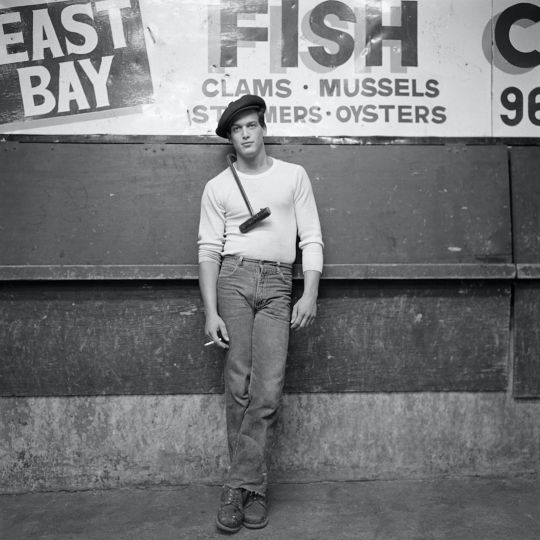
“Vinny, an unloader, Fulton Fish Market, 1982” (photo © Barbara Mensch)

A Falling-Off Place is divided into three chronological sections: “the 1980s: making a living on the waterfront,” “the 1990s: setting the stage for a real estate boom / fires, floods, and neglect,” and “the new millennium: managing change / anxiety, optimism, and the uncertainty of historic preservation.” There are photos of the old Paris Bar, a dilapidated section of the FDR Drive, the Beekman Dock icehouse, and Pier 17 being torn down, along with portraits of such characters as Mikey the Watchman, Mombo, Vinny, and Bobby G., supplemented with quotes from Jane Jacobs, fishmongers, a retired boxer, and Robert Moses.

Many of the photos can also be seen in Mensch’s site-specific permanent installation, “The Nobility of Work,” in the restored and rehabilitated Tin Building on South St., which was originally built in 1907 on the space where the Fulton Fish Market began in 1835. The market moved to Hunts Point in the Bronx in 2005; the new Tin Building, which is celebrating its one-year anniversary in September, was commissioned by the Howard Hughes Corporation and features a 53,000-square-foot high-end food court and marketplace run by chef Jean-Georges Vongerichten.

On September 6, Mensch will be at the powerHouse Arena, in conversation with culinary documentarian Daniel Milder (Chef’s Table, Street Food Asia); she will also be leading an Untapped Cities tour on October 7. Below she discusses living downtown, being a woman in what was a man’s world, upcoming projects, and more.

twi-ny: When you first began photographing at the Fulton Fish Market, the men there were suspicious that you might be a government plant. What was that like?

barbara mensch: Well, what can I say? When I first began taking photos in the early 1980s, it was horrible. I would be taking photos and lo and behold, sharp (and I mean very sharp) pieces of ice would repeatedly be hurled at me. The fishmongers would use ice to preserve the seafood as it was stored in crates, and later in the early hours of the morning in coolers. I remember that the sharp pieces of ice could really hurt if thrown with tremendous velocity. Also, in the beginning there were many threats to my life, which were at the time palpable. Although the origins of this project were challenging, where I photographed the Fulton Market and the East River waterfront below the Brooklyn Bridge, I was intrigued and kept going forward.

As a side note, I was always very competitive with men and wanted to prove my worth. As a result, in the male-dominated world of the waterfront, the challenge was provoking. In order to create this project, a sense of gradual time had to be taken into consideration. Convincing men, who were hardened and determined to make a living within a certain number of hours in the harshest of conditions and had no room for me or my pictures. Working in this environment was a daunting task that was only achieved with a gradual, mutual feeling of trust. That came with years of interaction.

twi-ny: You have a permanent, site-specific exhibition at the Tin Building; how did that come about?

bm: After the Howard Hughes Corporation, which operates the new Tin Building, considered several different major artists for the space, they determined that I had the best understanding of the area and the strongest commitment in my pictures to the historical record.
twi-ny: The photos there and in your new book are both quintessentially New York and at the same time universal. Which photographers inspired you? Do you seek that dichotomy when you peer through the lens?

bm: My influences as an artist are vast and consequential. Although I am a photographer and have worked hard to perfect the art of printing and creating images, there are truly so many “heroes” that I have come to know over the years and try to follow their practices. One of my mentors was my friend Bruce Davidson, a legendary photographer who influenced me with his extraordinary wisdom into the creative process.

And I have also been influenced by countless other artists, primarily filmmakers, including Ingmar Bergman, Luchino Visconti, Roberto Rossellini, and more. Each artist, in his or her masterful way, chose to depict humanity in a raw and gritty reality. Rudy Burkhardt also comes to mind as a painter, photographer, and filmmaker whose images evoke a sense of New York as it passed into a new era. Many of these artists continue to resonate with me.

twi-ny: It’s hard to believe some of those pictures go back only forty years; things now seem so different from then. I can’t get the 1999 photograph of a security guard on Schermerhorn Row out of my head; it looks like it’s from a 1940s British noir. What kind of image instantly catches your eye?

bm: To answer your question, I always shoot “reflexively.” When I saw the security guard walking back and forth, blanketed in smoke and fog, I believe my unconscious was at work. Cinematic art has deeply influenced my work, so Frank Capra’s film Lost Horizon and Michael Powell’s captivating films where mystery is created in light and shadow impacted me greatly and often influence my work.

twi-ny: At the end of the book, instead of you being interviewed, you interview someone who tracked you down because of your photographs. What made you want to reverse the tables?

bm: Well, just to be clear, she found me. I thought that interviewing an individual who had some inside perspective on mob activities during the Giuliani investigations against organized crime during the 1980s would be provocative.

twi-ny: It certainly is that. In that interview, the two of you discuss gentrification and land grabs as well as Rudy. At one point, your subject says, “Men’s egos and thirst for power drove us off a cliff. That is the real ‘falling-off place.’” Do you see us ever climbing back from that? You spend much more time photographing deconstruction than reconstruction. Are you worried about the future character of the city itself?

bm: Photographing “deconstruction” for me was unconscious. I was merely trying to capture the beauty inherent in many of the images that I made of the places that we lost.
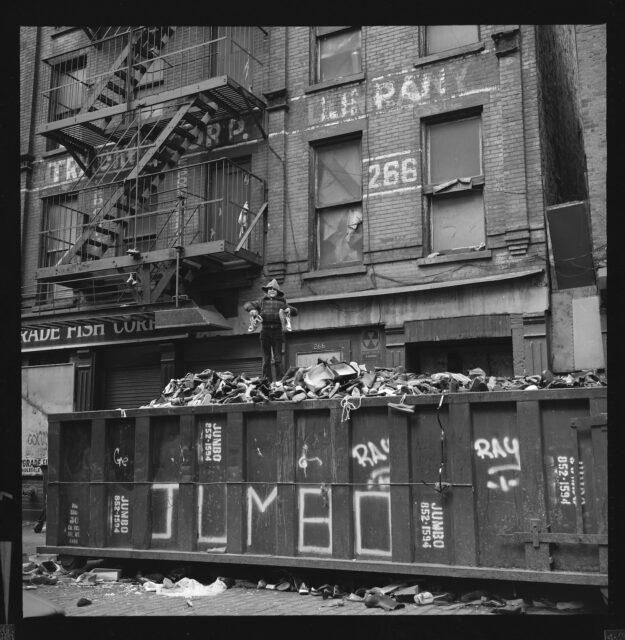
“Proud Lower East Side boy on a dumpster of shoes, 1982” (photo © Barbara Mensch)

twi-ny: You’ve lived downtown for forty years. How have the myriad changes affected your daily life in the neighborhood, outside of your work?

bm: Well, New York is . . . New York! It is the quintessential experience of life in a great metropolis. As one walks down the street, we have a blending of cultures, of aspirations, and of course the “zeal” in which new commerce replaces the old.

twi-ny: Can we ever have another Fulton Fish Market in New York the way it was, with the same kind of fishmongers and overall feeling, or has the time for that passed?

bm: Unfortunately, I think that time has passed. Sorry if I sound cynical.

twi-ny: You’re a lifelong New Yorker. Your previous book was about the Brooklyn Bridge. So many people leave New York; what are some of the things that keep you here, besides your photography?

bm: Honestly, I love my loft, which is situated in the shadow of the Brooklyn Bridge. I have gained so much inspiration by exploring the bridge’s origins. But as it has been said, “All things must pass.” That means I, too, think about the future and wonder what’s next. Looking out at the Brooklyn Bridge, however, keeps me forever engaged.

twi-ny: You are so inextricably tied to New York City. When you travel, what kinds of places do you like to go to? Do you take color photos like a tourist, or is it always a busman’s holiday?

bm: If you are a serious artist, every place you go on the globe warrants an intense “staring contest” between you and your vast subject matter. I find stories everywhere I go. The problem is finding the time to put them all together. Art and photography are a serious business, and each project one does merits intense thought and consideration, and of course the consequences of making it available to the public.

Recently I have been making trips to South America, to Colombia. It is a country struggling to emerge from years of violence and corruption. I traveled to Chocó province on the Pacific, where rainforests and jungles remain uninhabited and many of the locals are among the poorest in the country.

I have embraced the iPhone, and once I am away from New York, shooting in color seems natural!

[Mark Rifkin is a Brooklyn-born, Manhattan-based writer and editor who used to live near the Fulton Fish Market and shares a birthday with the Brooklyn Bridge; you can follow him on Substack here.]