this week in art

PERFORMING REPRESENTATIONS

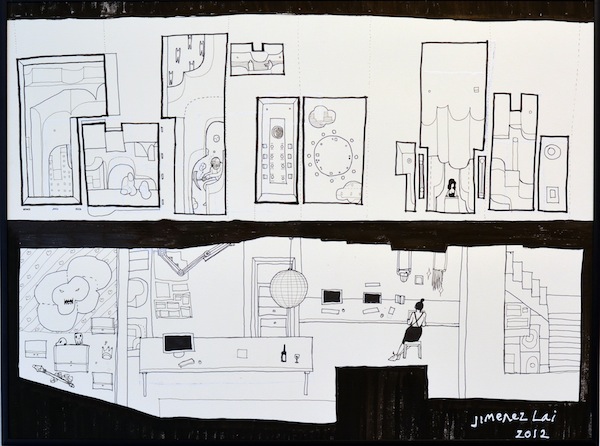
Jimenez Lai, “storefront back of house,” ink on paper, 2012

Storefront for Art and Architecture
97 Kenmare St.
Tuesday, July 24, free, 7:00
212-431-5795
www.storefrontnews.org

As part of the book launch for Jimenez Lai’s Citizens of No Place: An Architectural Graphic Novel (Princeton Architectural Press, May 2012, $19.95), the Storefront for Art and Architecture is hosting a special one-day-only exquisite-corpse drawing conversation with Lai, Drawing Center executive director Brett Littman, and architects Johanna Meyer-Grohbrügge and Michael Young. “Citizens of No Place imagines alternate worlds and engages with the design of architecture through the act of storytelling,” the book’s preface explains. “It offers narratives about character development, through which the reader can explore relationships, curiosities, and attitudes, as well as absurd stories about fake realities that invite new futures to become possibilities.” While discussing representation, the participants will create a continuous drawing, in conjunction with the Storefront’s current exhibition, “Aesthetics/Anesthetics,” which explores the nature of architectural drawings, with works by Lai, Vito Acconci, Sam Jacob, Philippe Rahm, Juergen Mayer H., Jorge Otero-Pailos, Noura Al Sayeh, Sho Shigematsu, Ling Fan, and others.

BILL BOLLINGER: THE RETROSPECTIVE

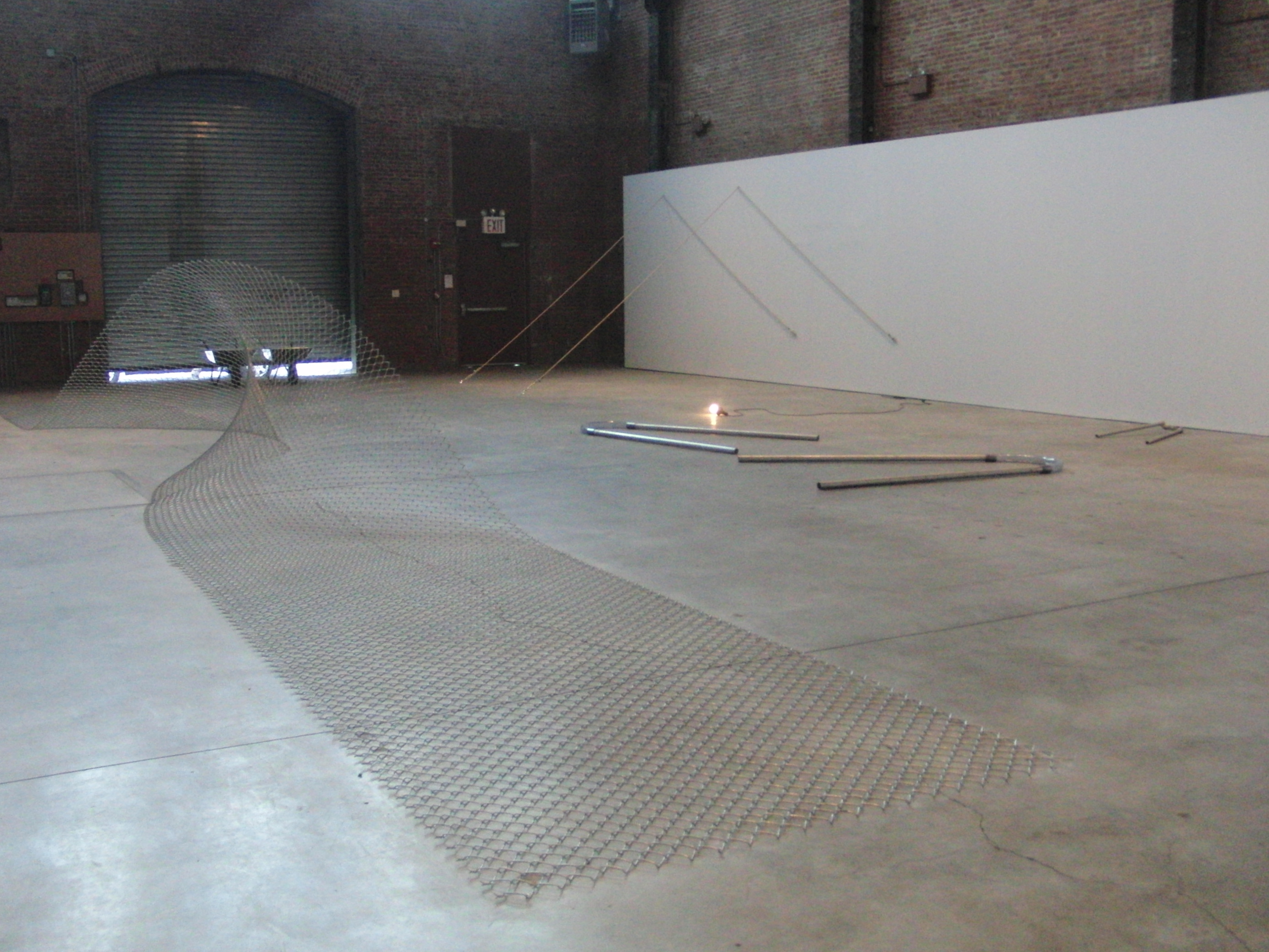
Extremely satisfying and necessary Bill Bollinger retrospective runs through July 30 at SculptureCenter (photo by twi-ny/mdr)

SculptureCenter
44-19 Purves St., Long Island City
Thursday – Monday through July 30, $5, 11:00 am – 6:00 pm
718-361-1750
sculpture-center.org
bill bollinger slideshow

“I only do what it is necessary to do,” Brooklyn-born sculptor Bill Bollinger said in 1968. “There is no reason to use color, to polish, to bend, to weld, if it is not necessary to do so.” Bollinger, who died of alcoholism in 1988 at the age of forty-eight, is the subject of a small but fascinating retrospective at SculptureCenter in Long Island City. Concentrating on his most productive years of the late 1960s, the two-floor show consists of many works that repurpose standard industrial supplies, emphasizing space, form, and materiality. Using wheelbarrows, lightbulbs, Manila rope, plastic hoses, electric cables, aluminum pipes, and sections of Cyclone fencing, Bollinger created a conceptual oeuvre that brought together art and commodity in unique ways; indeed, sometimes you have to look twice before realizing what is part of the show and what is merely part of SculptureCenter’s former-factory home. But that is not meant to detract one iota from Bollinger’s extremely satisfying work, particularly “Cyclone Fence,” a gently, beautifully twisted chain-link fence that rises from the floor as if it’s alive, and “Graphite Piece,” in which black graphite powder has been thrown against a wall in its own room. A contemporary of such more well known artists as Richard Serra, Eva Hesse, Bruce Nauman, Dan Flavin, Carl Andre, Donald Judd, and Robert Smithson, Bollinger participated in several important and influential group shows in the late 1960s, as well as having his own solo exhibition at the Starrett-Lehigh Building in 1970, before personal problems, including a custody battle for his son that he ultimately won, sent him upstate into relative obscurity. The show is supplemented with a series of drawings upstairs as well as preparatory sketches, notes, and letters downstairs that reveal Bollinger’s detailed creative process. The retrospective also includes Bollinger’s only known film, in which he tries to balance what appears to be a telephone pole on the ground, only to knock it over once he does so, toying with the viewer’s expectations. “It is all very easy to execute, does not exist until it has been executed, ceases to exist when it has been taken down,” he once explained. “Bill Bollinger: The Retrospective” offers a much-needed, well-curated look at an important twentieth-century artist whose history had been threatening to cease to exist.

NEW MUSEUM BLOCK PARTY

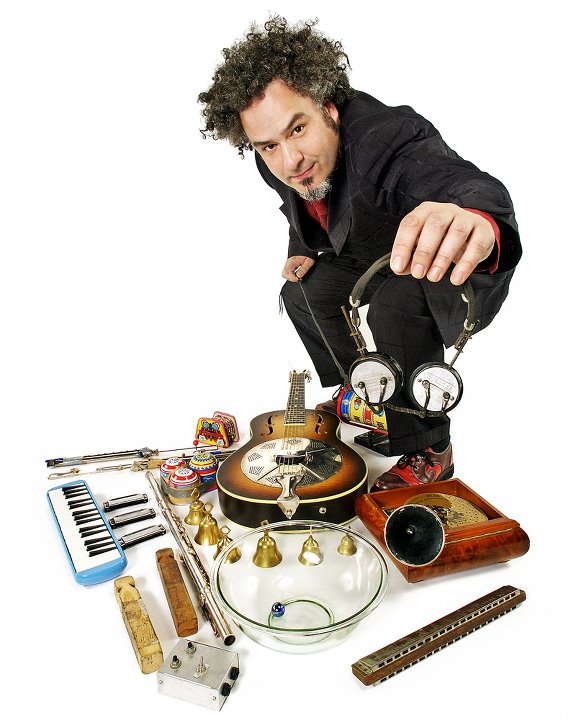
Experimental composer Sxip Shirey will be performing at 2:45 at the New Museum Block Party in Sara D. Roosevelt Park on July 21

New Museum of Contemporary Art, 235 Bowery at Prince St.
Sara D. Roosevelt Park, Chrystie St. between Delancey & Broome Sts.
Saturday, July 21, 12 noon – 5:00
212-219-1222
www.newmuseum.org

The sixth annual New Museum Block Party takes place on the Lower East Side on Saturday in nearby Sara D. Roosevelt Park as well as the museum itself. There will be live outdoor performances by experimental artists Chris Giarmo/Boys Don’t Fight, Yvonne Meier, Sxip Shirey, and High Priest of Antipop Consortium, a Bowery Artist Tribute in which visitors can remix and recontextualize poems that have ties to the neighborhood, a digital archive of New Museum catalogs (in which you can create your own mix-and-match mini-catalog), an Op art workshop, a Lower East Side photo show, an interactive paper workshop led by Nicolás Paris, an alternate-color demonstration, and free admission to the museum (with tours every hour at a quarter past), where you can check out the exhibitions “Ghosts in the Machine,” “Pictures from the Moon: Artists’ Holograms 1969 – 2008,” “The Parade: Nathalie Djurberg with Music by Hans Berg,” and “Carlos Motta: We Who Feel Differently.”

SUPER SÁBADO! EL MUSEO’S BLOCK PARTY

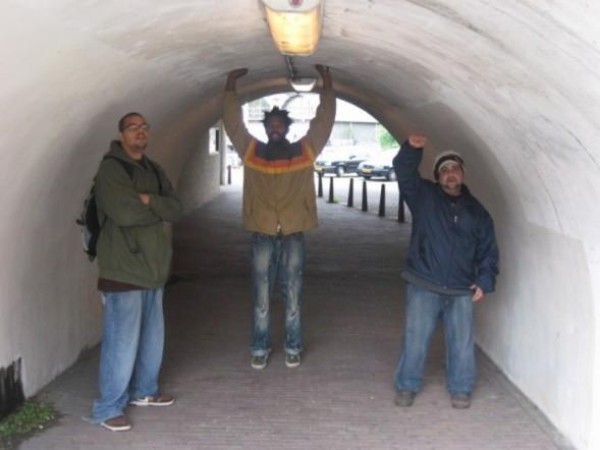
The Welfare Poets will perform at annual El Museo Block Party on Saturday

FREE THIRD SATURDAYS
El Museo del Barrio
1230 Fifth Ave. at 104th St.
Saturday, July 21, free, 11:00 am – 8:00 pm
212-831-7272
www.elmuseo.org

El Museo del Barrio’s monthly free celebration of art, music, dance, and food heads outdoors on July 21 for a family-friendly summer block party on 104th St. Most of the special events take place in the late afternoon, with the Welfare Poets, domino tables, a pop-up photo booth, art workshops, A Lo Afro-Colombiano and KR3Ts dance classes, DJ EX spinning soulful tunes, and El Barrio’s Freshest 2012 breakdancing competition. The museum’s galleries are open as well, so you can beat the heat by going inside and checking out the exhibitions “Caribbean: Crossroads of the World” and “Voces y Visiones: Gran Caribe.”

CREST HARDWARE ART SHOW

Tools are not always what they seem at Crest Hardware (photo by twi-ny/mdr)

Crest Hardware & Urban Garden Center
558 Metropolitan Ave. between Lorimer & Union
Daily thorugh August 31, free, Monday – Saturday 8:00 – 7:00, Sunday 10:00 – 5:00
718-388-9521
www.cresthardwareartshow.com
crest hardware art show slideshow

The annual Crest Hardware Art Show is an exhibit like none other, a fun, lighthearted display spread throughout the Brooklyn store, which is celebrating its fiftieth anniversary this year. More than one hundred artists have works on the shelves, down the aisles, hanging from the ceiling, and out in the garden, most of which are made of and/or comment on objects available at the popular hardware store. Priced from $10 to $8,888, with most works between $100 and $500, the show is like a treasure hunt, with a majority of the pieces artfully “hidden” as if they are regular hardware items. Chelsea Bahr uses toilet seats in “All the Things I’ve Read on the Pot.” Bernadette Scelta paints a paintbrush painting in “Paint a Wall and Clear Your Mind,” which evokes Magritte as it hangs among the paintbrushes. A pair of rats with a broom are not happy in Peter Pracilio’s “Damn Housing.” Aya Rosen and Ruti Dan create offbeat faces using unusual materials in “Where the Midnight Summer’s Dreams.” Jilly Ballistic places gas masks on Marilyn Monroe and a would-be subway rider that resemble nearby safety goggles and paint odor respirators in “Seven Year Itch à la Jilly Ballistic” and “E Train to World Trade Center.” Joseph Silva’s “50 Shades of Gray” features fifty squares of different shades of the color gray as if they were paint swatches. Jude Ferencz uses wires to create such Tim Burton-inspired works as “Crucified Copper” and “Copper Skate Punk.” Damien Olsen’s “Bill Murray” tells the bizarre tale of a hungry alligator and an unfortunate person. And visitors are encouraged to put on the headphones and groove to Kayrock’s self-DJ’d “Emergency Synthesizer Tool Box.” Other pieces incorporate power drills, hammers, watering cans, ladders, wrenches, chain saws, flashlights, nuts, bolts, locks, spray paint, pliers, lamps, screws, rat traps, duct tape, and other hardware elements in inventive ways. The Crest Hardware Art Show is a great way to spend a few hours when one of you wants to see art while the other is getting ready to do some home improvement. Sales from the works benefit the City Reliquary, the museum and civic organization down the street on Metropolitan Ave.

RICHARD AVEDON: MURALS & PORTRAITS

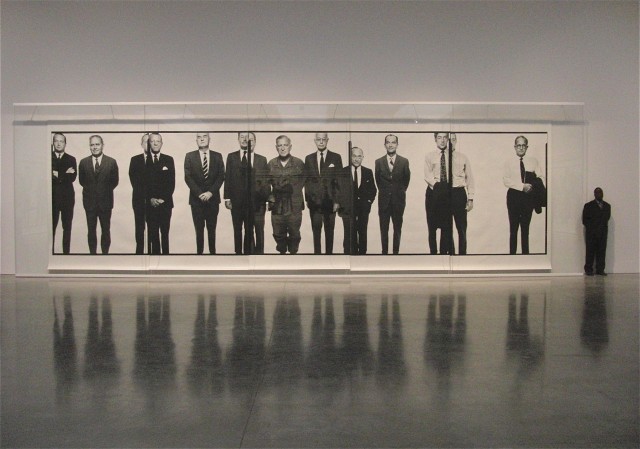
Richard Avedon, “The Mission Council,” silver gelatin prints, five panels mounted on linen, printed 1975, © The Richard Avedon Foundation (photo by twi-ny/mdr)

Gagosian Gallery
522 West 21st St. between Tenth & Eleventh Aves.
Monday – Friday through July 27, free, 10:00 am – 6:00 pm
212-741-1717
www.gagosian.com
www.richardavedon.com

Born and raised in New York City, photographer Richard Avedon began taking pictures at the YMHA when he was twelve, eventually honing his craft while serving in the Merchant Marine during WWII and studying at the New School. Renowned for his fashion photography, Avedon, who died in 2004 at the age of eighty-one, also specialized in silver gelatin portraits that explored the sociopolitical climate of America, particularly between 1969 and 1971. “My photographs don’t go below the surface,” he once said. “I have great faith in surfaces. A good one is full of clues.” Extended through July 27 at Gagosian’s Twenty-first St. gallery, “Richard Avedon: Murals & Portraits” features spectacular murals and intimate portraits that have beautiful surfaces indeed while providing plenty of clues about the state of the nation. Spread out in an awe-inspiring space designed by David Adjaye that holds surprises around every corner, the smaller portraits and massive murals — which run as high as ten feet and as long as thirty-five — feature such seminal counterculture figures as the Chicago Seven, Allen Ginsberg and his family, and Andy Warhol and such Factory denizens as Paul Morrissey, Candy Darling, Joe Dallesandro, Viva, Taylor Mead, and Gerard Malanga in addition to members of the Mission Council, a group of war administrators who influenced U.S. involvement in Vietnam. There are also smaller portraits of writers Brendan Behan, Julius Lester, and Jean Genet, activist Julian Bond, the sons of Julius and Ethel Rosenberg, Ginsberg and Peter Orlovsky naked, civil rights lawyers Leonard Weinglass, William Kunstler, and Florynce Kennedy, Nixon secretary Rose Mary Woods, and Vietnamese survivors of napalm attacks that put the pro- and antiwar movements and the sexual revolution in perspective, supplemented by vitrines containing paraphernalia relating to the nearby photographs and specific subject matter. Made before the era of digital manipulation and Photoshop, the large-scale murals, which include some subjects twice in the same series of panels, hang loosely behind sheets of plexiglass in an almost nonchalant way that adds to their mystique. The lighting also affects the murals, casting shadows of the men and women across the floor and even reflecting the mural opposite; although it was most likely accidental, it is quite intriguing to look at the eleven men of the Mission Council with a small, subtle reflection of nude factory members ghosted over them.

OUR HAUS

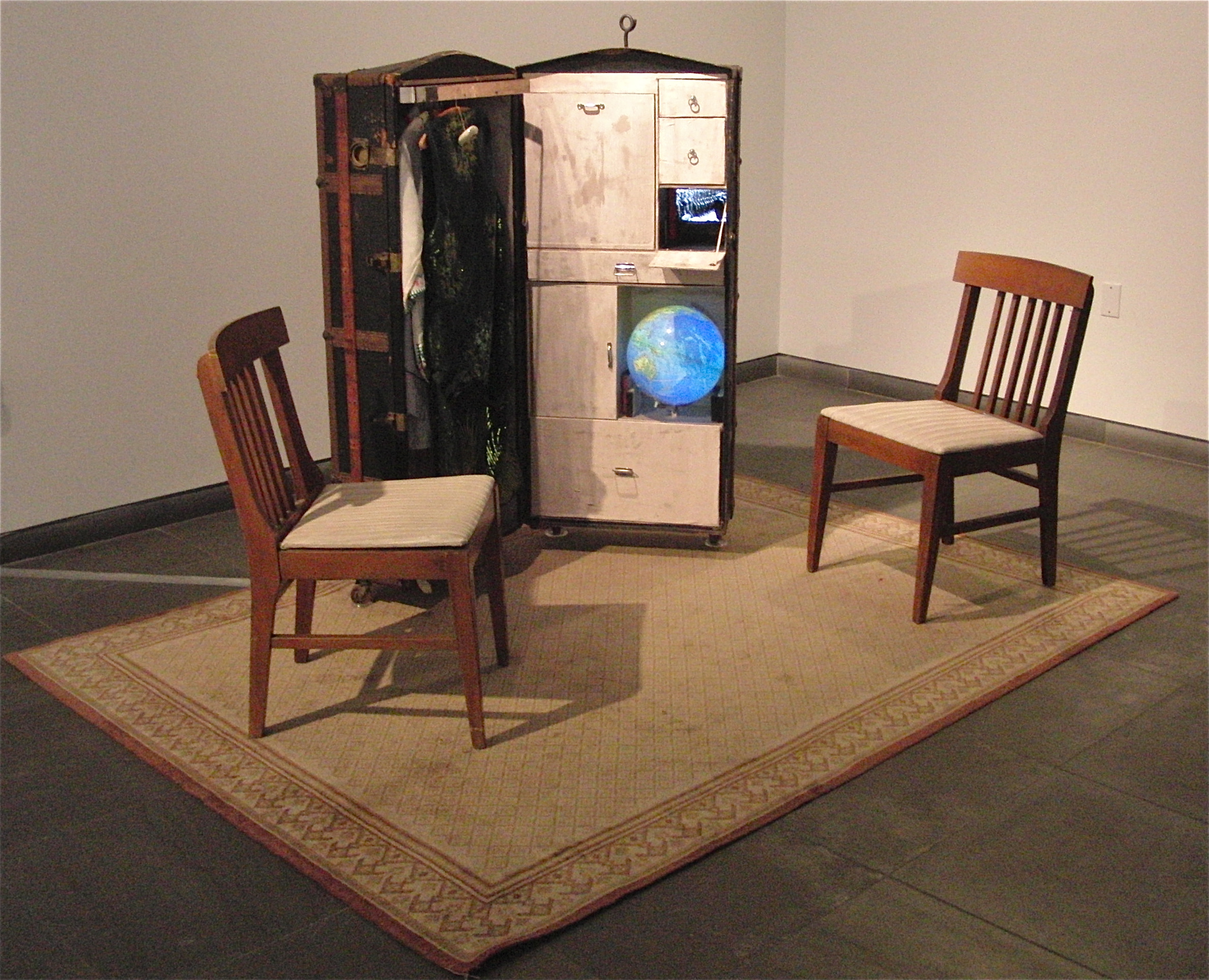
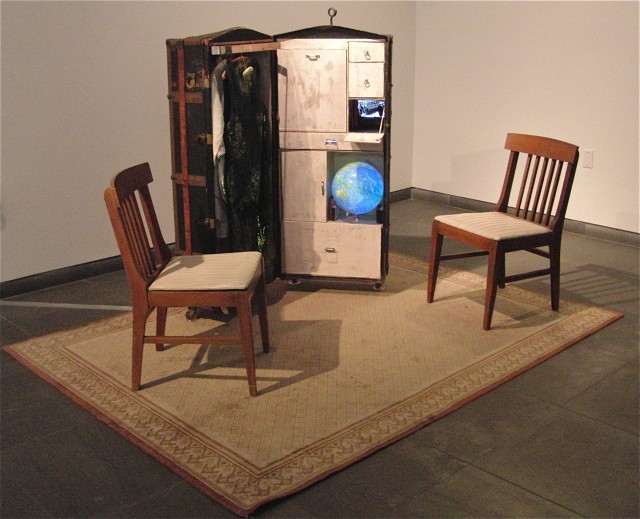
“Unattended Luggage” by Time’s Up gives visitors a chance to explore personal aspects of immigration and home (photo by twi-ny/mdr)

Austrian Cultural Forum
11 East 52nd St. between Madison & Fifth Aves.
Daily through August 26, free, 10:00 am – 5:00 pm
212-319-5300
www.acfny.org
our haus slideshow

In 1970, Crosby, Stills, Nash & Young sang, “Our house is a very, very, very fine house.” The same can be said of architect Raimund Abraham’s stunning Austrian Cultural Forum tower, which turns ten this year. In honor of the anniversary, the ACFNY has put together the multimedia exhibit “Our Haus,” consisting of specially commissioned works that explore the nature of home, the physicality and psychology of place, and the cross-cultural link between New York and Austria. Spread across four floors of the twenty-five-foot-wide, eighty-one-foot-deep, twenty-four-story building that ACFNY director Andreas Stadler calls “an artistic lighthouse in this metropolis of creativity and communication,” the show includes photography, painting, video, sculpture, and site-specific installations that curator Amanda McDonald Crowley says “recognize the ACFNY as a space for conversation, contradiction, intimacy, and conviviality.” In Brünnerstraße 165, Helmut and Johanna Kandl go back to Johanna’s childhood home, combining vintage Super-8 footage of her as a little girl playing in the backyard with contemporary video of her rising out of a pond on the now-abandoned property. Austrian-born artist Rainer Ganahl examines two sides of New York in “Haunted Houses — Vacant Buildings on Third Avenue between 99th and 120th Street,” a two-channel video that he made while riding his bicycle through his adopted home of Spanish Harlem; while the bottom images depict stores and signs of life, the top shows broken windows, empty apartments, and shattered dreams. Judith Fegerl’s “Untitled (cauter)” intrudes on Abraham’s tower itself, as electrical wires burn lines onto the wall. Time’s Up investigates travel and immigration in “Unattended Luggage,” which invites visitors to look through drawers in a large open suitcase filled with items that remind one of home. Matthias Herrmann conjures up Felix Gonzalez-Torres and Bruce Naumann in a series of still-life postcards, free for the taking, that he made during a New York City residency.
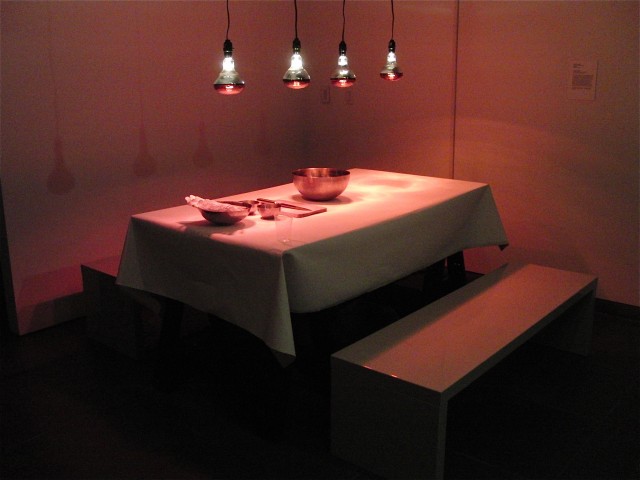
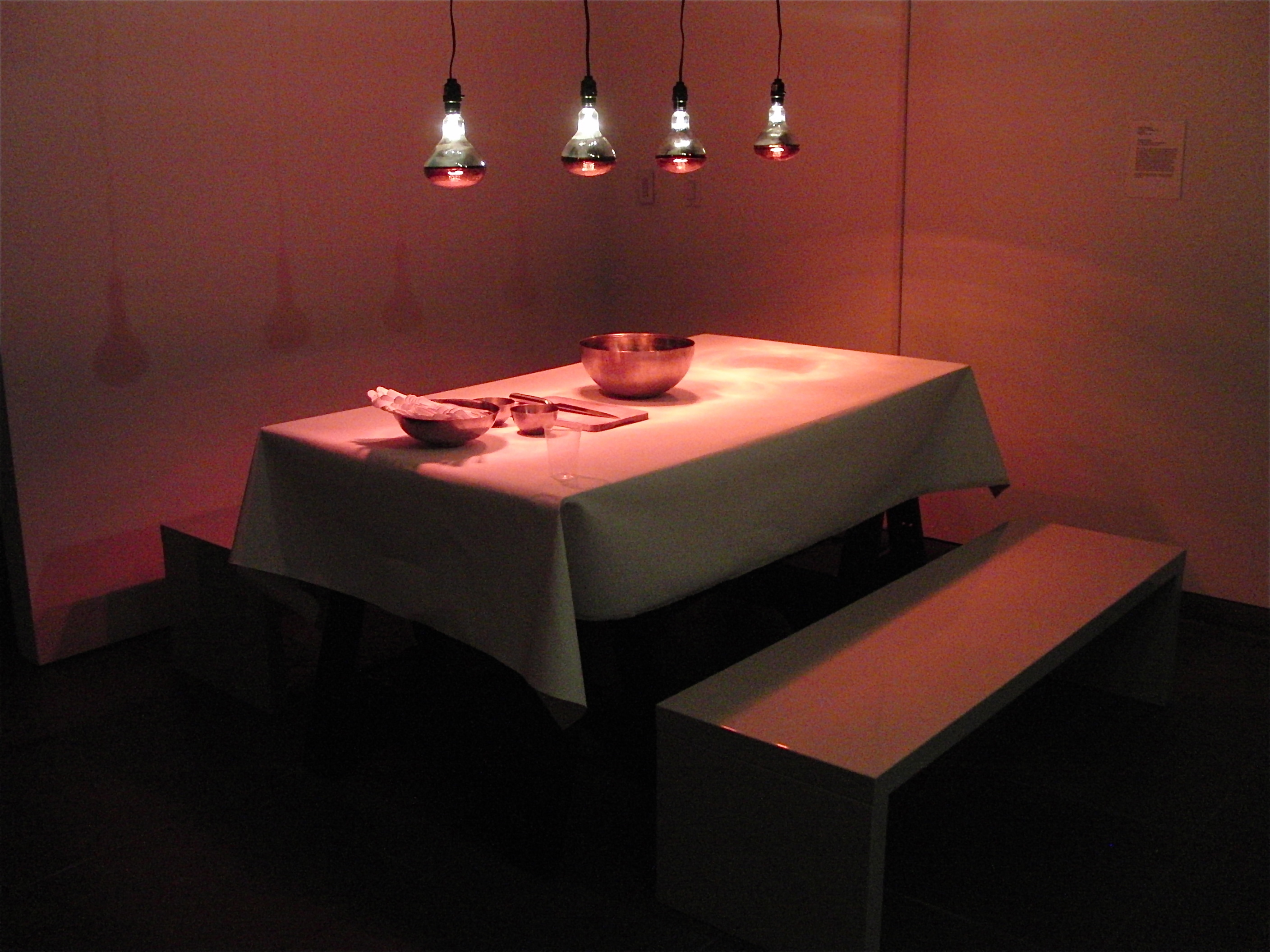
Rainer Prohaska’s “Floor Cuisine, ACF New York” offers a place to gather at the Austrian Cultural Forum (photo by twi-ny/mdr)

In 1982, the British ska band Madness sang, “Our house it has a crowd / There’s always something happening,” and the same can be said for “Our Haus.” Rainer Prohaska’s “Floor Cuisine, ACF New York” features kitchen stations throughout the exhibit, culminating in a table downstairs where people can come together and enjoy a drink from Mathias Kessler’s “Das Eismeer, Die gescheiterte Hoffnung (The Arctic Sea, the Failed Hope),” a refrigerator stocked with beer and containing a sculptural tribute to Caspar David Friedrich in the freezer. Meanwhile, the collective WochenKlausur has set up a meeting room that will host various gatherings over the course of the exhibition; through July 22, “It Came from chashama” will highlight works from the nonprofit organization that displays art in public spaces. (The Center for Urban Pedagogy takes over July 23-29, with a panel discussion that first night at 7:00, followed by Green Guerillas, CAAAV, and Not an Alternative.) And in conjunction with the anniversary, Anthology Film Archives is hosting “The Austrian Cultural Forum New York: The First Decade,” a series of screenings through July 22 of Austrian films made over the last ten years, including Nikolaus Geyrhalter’s Our Daily Bread, Götz Spielmann’s Revanche, Michael Haneke’s The White Ribbon, and Ruth Beckermann’s Zorro’s Bar Mitzva.